
Last reviewed: November 2026. Acid status for Coca-Cola, Diet Coke, Coke Zero Sugar, Pepsi, Pepsi Zero Sugar, Dr Pepper, Sprite, 7 Up, Fanta, Sunkist, Mountain Dew, and Poppi is from the U.S. labels we photographed in October and November 2026. Root beers, ginger ales, Zevia, and the Olipop and Poppi colas are from the manufacturers’ current published ingredient lists. Formulas change, so check the can.
People go looking for a soda without phosphoric acid for three reasons: a dentist mentioned enamel, a doctor mentioned bones or kidneys, or a renal diet put a number on phosphorus. The good news is that the list is long and easy to remember, because phosphoric acid is the cola acid. It’s in Coke, Pepsi, and Dr Pepper, in every diet and zero-sugar version of them, and in almost nothing else on the shelf. The less convenient news is that the sodas without it are still acidic and, in most cases, still carry 38 to 46 grams of sugar. Here’s the full list of Sodas Without Phosphoric Acid from the labels, what each one uses instead, and what the switch does and doesn’t buy you.
Quick answer: which sodas have no phosphoric acid?
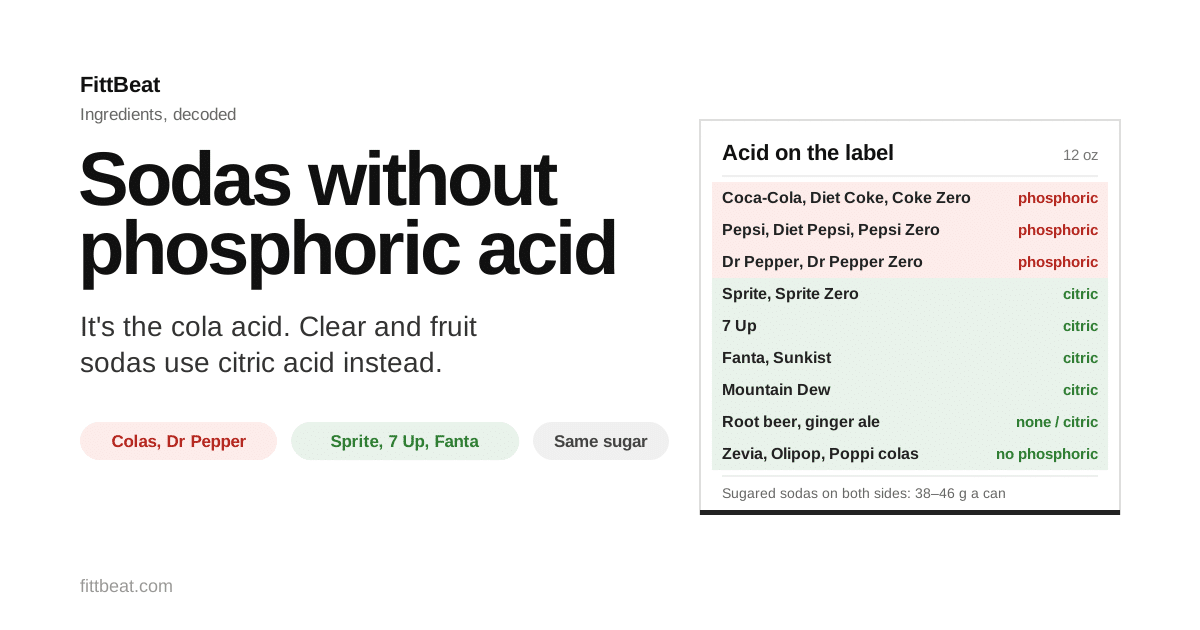
No phosphoric acid: Sprite and Sprite Zero Sugar, 7 Up, Starry, Fanta, Sunkist, Crush, Mountain Dew, ginger ales (Canada Dry, Schweppes), the big root beers (A&W, Mug, Barq’s), cream sodas, and the prebiotic sodas Poppi and Olipop. Three colas skip it too: Zevia Cola, Olipop Vintage Cola, and Poppi Classic Cola. Contains phosphoric acid: Coca-Cola, Diet Coke, Coke Zero Sugar, Cherry Coke, Pepsi, Diet Pepsi, Pepsi Zero Sugar, Dr Pepper, Diet Dr Pepper, Dr Pepper Zero Sugar, Pibb Xtra, and RC Cola. The catch: nearly every soda on the first list uses citric acid instead, which is about as hard on tooth enamel, and the sugared ones have the same sugar as a cola. The switch matters most for people limiting phosphorus for their kidneys. For everyone else it’s a small improvement on a drink whose main problem is somewhere else on the label.
Jump to: The list · Label table · Which sodas have it · Why avoid it? · What replaces it · Renal diets · Verdict · FAQ
Sodas Without Phosphoric Acid
Sprite and Sprite Zero Sugar Citric acid
The label we photographed lists citric acid and sodium citrate, and nothing from the phosphate family. A 12 oz Sprite has 38 g of sugar and no caffeine or color. Sprite Zero Sugar keeps the citric acid and swaps the corn syrup for aspartame and Ace-K, which makes it the easiest answer for someone who wants a zero-sugar soda with no phosphoric acid and no caffeine.
7 Up Citric acid
Six ingredients: filtered carbonated water, high fructose corn syrup, citric acid, natural flavors, potassium citrate, and calcium disodium EDTA. No phosphoric acid and no benzoate preservative either. The sugar matches Sprite at 38 g. Our 7 Up breakdown goes through all six.
Fanta and Sunkist Citric acid, dyed
Both orange sodas use citric acid. What they add instead is color: Yellow 6 and Red 40 in each. Fanta Orange has 44 g of sugar in 12 oz, more than a Coke, and no caffeine. Sunkist has a little less sugar and 19 mg of caffeine. If you’re leaving cola to get away from an additive, check that you haven’t traded it for two synthetic dyes.
Mountain Dew Citric acid, 46 g sugar
No phosphoric acid, and the least persuasive entry on the list. Mountain Dew uses citric acid, and it also has the most sugar (46 g) and the most caffeine (54 mg) of any mainstream soda, plus Yellow 5. Dental studies that rank sodas by how much enamel they dissolve put citrus sodas like this one at or above the colas.
Root beer: A&W, Mug, Barq’s None or citric
Root beer is brown because of caramel color, which leads people to assume it’s built like a cola. It isn’t. By their published lists, A&W has no added acid at all, and Mug and Barq’s use a small amount of citric acid. That makes root beer the least acidic of the mainstream sodas. The sugar is in the mid-40s per 12 oz, a little above a cola, and Barq’s is the one with caffeine.
Ginger ale and cream soda Citric acid
Canada Dry and Schweppes ginger ales use citric acid. So do most cream sodas. Sugar is in the mid-30s per can, slightly under a cola.
Poppi and Olipop Vinegar, juice, tartaric acid
The prebiotic sodas get their tartness from food acids. The Poppi can we photographed lists apple cider vinegar and fruit juice, with 5 g of sugar. Olipop uses juice concentrates and lemon or lime juice, with 2 to 5 g of sugar. Both are the rare entries here where the sugar problem is solved as well.
The three colas without it: Zevia, Olipop, Poppi Cola, no phosphoric acid
If what you want is cola flavor, these are the only widely sold options. Zevia Cola is sweetened with stevia and acidified with citric and tartaric acid, with no caramel color and 45 mg of caffeine. Olipop Vintage Cola uses lime juice and has 50 mg of caffeine from green tea. Poppi Classic Cola uses apple cider vinegar and tartaric acid, with 40 mg of caffeine. None of them tastes exactly like a Coke, and the missing phosphoric acid is part of why: it gives cola a dry, sharp bite that fruit acids don’t reproduce.
Acid on the label: the table
| Per 12 oz | Phosphoric acid | Acid used | Sugar | Caffeine | Also on the label |
|---|---|---|---|---|---|
| Sprite | No | Citric | 38 g | 0 mg | Sodium benzoate |
| Sprite Zero Sugar | No | Citric | 0 g | 0 mg | Aspartame, Ace-K |
| 7 Up | No | Citric | 38 g | 0 mg | No benzoate |
| Fanta Orange | No | Citric | 44 g | 0 mg | Yellow 6, Red 40 |
| Sunkist | No | Citric | 41 g | 19 mg | Yellow 6, Red 40 |
| Mountain Dew | No | Citric | 46 g | 54 mg | Yellow 5 |
| Poppi | No | Vinegar, juice | 5 g | 0 to 40 mg | 3 g fiber |
| Olipop | No | Juice | 2 to 5 g | 0 to 50 mg | 6 or 9 g fiber |
| Coca-Cola | Yes | Phosphoric | 39 g | 34 mg | Caramel color |
| Pepsi | Yes | Phosphoric + citric | 41 g | 38 mg | Caramel color |
| Dr Pepper | Yes | Phosphoric | 39 g | 41 mg | Caramel color, sodium benzoate |
| Diet Coke | Yes | Phosphoric + citric | 0 g | 46 mg | Aspartame |
Three things to notice. The phosphoric acid column splits exactly along the cola line, and diet or zero versions never change which side a soda is on. The sugar column barely moves between the two halves, so a switch from Coke to Sprite removes one acid and one gram of sugar. And the only rows that are green in both columns are Sprite Zero Sugar, Poppi, and Olipop.
Which sodas have phosphoric acid?
The colas, and the two “pepper” sodas that are built on a cola base. From the labels: Coca-Cola, Diet Coke, and Coke Zero Sugar; Pepsi, Diet Pepsi, and Pepsi Zero Sugar; Dr Pepper and Dr Pepper Zero Sugar; plus Cherry Coke, Pibb Xtra, RC Cola, and store-brand colas. Pepsi and Diet Coke list citric acid as well, on top of the phosphoric. The quick test on any can: if it’s brown and it isn’t root beer, expect phosphoric acid until the ingredient list says otherwise.
Why avoid phosphoric acid? (And should you?)
Here are the reasons people give, with what the evidence says about each.
“It’s bad for my teeth.” True, and so is its replacement. Enamel starts to dissolve below about pH 5.5. Colas sit around 2.5, Dr Pepper around 2.9, and Sprite and 7 Up around 3.3. That’s a real gap on paper, but citric acid also binds calcium, and lab studies that soak teeth in soda find citrus sodas erode enamel as much as colas do, sometimes more. Switching acids doesn’t protect your teeth. Drinking it with a meal, through a straw, and not sipping one can for an hour does.
“It’s bad for my bones.” This is the finding that’s specific to cola. In the Framingham Osteoporosis Study, women who drank cola daily had lower hip bone density, and other carbonated drinks showed no such link. It’s an association, not proof: the effect could come from phosphoric acid, from caffeine, or from cola taking milk’s place in the diet. If bone density is your concern, switching from cola to a non-cola soda is consistent with the evidence, and switching to milk or water is better supported.
“It’s bad for my kidneys.” A 2007 case-control study found that two or more colas a day went with roughly double the risk of chronic kidney disease, for regular and diet cola alike, and found no link for non-cola sodas. That points at the phosphoric acid and not the sugar. For kidney stones the picture is different: a large cohort study found sugar-sweetened non-cola sodas raised stone risk at least as much as sugared colas, so leaving cola for Sprite doesn’t help there.
“My renal diet limits phosphorus.” This is the strongest reason, and it gets its own section below.
Our phosphoric acid explainer goes through the studies one by one.
Read next: Phosphoric acid — the cola acid: what it does to enamel, and the bone and kidney research at heavy intake.
What the sodas without it use instead
Citric acid. The acid in nearly every non-cola soda. It gives a brighter, fruitier tartness, and it’s a normal part of human metabolism. Its one cost is dental, as above.
Citrate salts. Sodium citrate in Sprite and potassium citrate in 7 Up buffer the acid so the tartness stays even. They’re harmless at these amounts.
The same sugar. This is the part the acid question hides. Sprite and 7 Up have 38 g, Coke has 39, Fanta has 44, and Mountain Dew has 46. The research on daily sugared soda (weight gain, type 2 diabetes, fatty liver) applies to all of them equally, and it’s far stronger than anything known about phosphoric acid. Our corn syrup breakdown covers it.
Dyes, in the fruit sodas. Cola’s color is caramel. Leave cola for orange or citrus soda and you pick up Yellow 5, Yellow 6, or Red 40.
Fruit acids and vinegar. Tartaric acid, lime juice, and apple cider vinegar in the Zevia, Olipop, and Poppi colas. These are the only swaps on this page that don’t bring a new question with them.
If you’re on a low-phosphorus diet
For people with chronic kidney disease, phosphoric acid matters for a specific reason. The phosphorus in additives is absorbed almost completely, while the body takes up roughly half of the phosphorus that occurs naturally in food. A 12 oz cola carries about 50 mg of it. That’s why renal dietitians single out dark colas and usually allow clear sodas.
Two cautions from the labels. First, “no phosphoric acid” is not the same as “no phosphate.” Sports drinks use phosphate salts as electrolytes: the Gatorade bottle we photographed lists monopotassium phosphate, and Prime Hydration lists dipotassium phosphate. Scan any ingredient list for the letters “phos.” Second, the clear sodas that pass the phosphorus test can fail a potassium or fluid limit. Your own lab numbers decide this, so run the list past your nephrologist or renal dietitian.
Sodas without phosphoric acid: the verdict
FittBeat verdict
An easy ingredient to avoid, and a small win unless your kidneys are the reason. Phosphoric acid is confined to colas and Dr Pepper, so any clear soda, fruit soda, root beer, or ginger ale gets you out of it. If you’re limiting phosphorus on medical advice, that switch is worth making today. For teeth, it changes little, because citric acid erodes enamel too. For general health, a Sprite is a Coke with a different acid and the same sugar. The picks that improve more than one line of the label are Sprite Zero Sugar, Zevia, Poppi, and Olipop, and plain sparkling water beats all of them.
The concerns in a soda without phosphoric acid, ranked by evidence:
- Sugar. 38 to 46 g a can in the sugared ones. This is the clearest long-term harm in any soda, and it’s unchanged by the switch.
- Enamel erosion. Citric acid plus sugar, sipped slowly. It’s comparable to cola.
- Synthetic dyes. Yellow 5, Yellow 6, and Red 40 in Mountain Dew, Fanta, and Sunkist.
- Sweeteners in the zero versions. Aspartame and Ace-K in Sprite Zero Sugar. Evidence of harm at normal intake is weak.
- Everything else. Citrate salts, EDTA, and benzoate are minor at these amounts.
Phosphoric acid-free sodas for kids, pregnancy, and kidney disease
Kids: the bone research is one more reason not to make cola a child’s daily drink, since those are the bone-building years. A clear soda removes the cola acid and the caffeine and keeps all the sugar. Milk and water are still the answer.
Pregnancy: phosphoric acid isn’t a pregnancy concern at soda amounts. Caffeine and sugar are, and the caffeine-free sodas on this list (Sprite, 7 Up, Fanta, most root beer and ginger ale) take care of the first. Our guide to which sodas have caffeine has the numbers.
Kidney disease: clear sodas over dark colas is standard renal-diet advice. Check potassium, fluid limits, and hidden phosphate additives with your care team.
Cleaner alternatives
For cola flavor without the acid: Zevia Cola, or an Olipop or Poppi cola. For a zero-sugar soda with no phosphoric acid and no caffeine: Sprite Zero Sugar or Zevia Lemon Lime. For the fizz with no acid added at all: plain sparkling water or club soda. Flavored seltzers add a little citric acid and nothing else.
Frequently asked questions
Which sodas don’t have phosphoric acid?
Sprite, Sprite Zero Sugar, 7 Up, Starry, Fanta, Sunkist, Crush, Mountain Dew, ginger ales, the major root beers (A&W, Mug, Barq’s), cream sodas, Poppi, and Olipop. Zevia Cola, Olipop Vintage Cola, and Poppi Classic Cola are colas without it.
Does Sprite have phosphoric acid?
No. Sprite and Sprite Zero Sugar use citric acid and sodium citrate. Neither lists phosphoric acid.
Does Dr Pepper have phosphoric acid?
Yes. Dr Pepper, Diet Dr Pepper, and Dr Pepper Zero Sugar all list phosphoric acid, the same as Coke and Pepsi.
Does root beer have phosphoric acid?
The major brands don’t. By their published ingredient lists, A&W has no added acid, and Mug and Barq’s use citric acid. Root beer is brown from caramel color, not from a cola base.
Does Mountain Dew have phosphoric acid?
No. Mountain Dew uses citric acid. It does have 46 g of sugar and 54 mg of caffeine per 12 oz, the most of any mainstream soda.
Do diet sodas have phosphoric acid?
The diet colas do: Diet Coke, Coke Zero Sugar, Diet Pepsi, Pepsi Zero Sugar, and Dr Pepper Zero Sugar. Diet versions of clear and fruit sodas, such as Sprite Zero Sugar, don’t.
Is there a cola without phosphoric acid?
Yes. Zevia Cola uses citric and tartaric acid, Olipop Vintage Cola uses lime juice, and Poppi Classic Cola uses apple cider vinegar and tartaric acid. Every mainstream cola from Coca-Cola, PepsiCo, and Keurig Dr Pepper contains phosphoric acid.
Is citric acid better for you than phosphoric acid?
For bones and kidneys, the research that raises concerns is about cola and doesn’t extend to citric-acid sodas. For teeth, no: citric acid erodes enamel about as much. And the sugar is the same either way.
Sources
- Labels photographed October and November 2026: Coca-Cola, Diet Coke, Coke Zero Sugar, Pepsi, Pepsi Zero Sugar, Dr Pepper, Sprite, 7 Up, Fanta Orange, Sunkist, Mountain Dew, Poppi. Root beer, ginger ale, Zevia Cola, Olipop Vintage Cola, and Poppi Classic Cola ingredient lists from the manufacturers’ and retailers’ current published labels, checked November 2026.
- Tucker KL, et al. Colas, but not other carbonated beverages, are associated with low bone mineral density in older women: the Framingham Osteoporosis Study. American Journal of Clinical Nutrition, 2006. doi:10.1093/ajcn/84.4.936
- Saldana TM, et al. Carbonated beverages and chronic kidney disease. Epidemiology, 2007. doi:10.1097/EDE.0b013e3180646338
- Ferraro PM, et al. Soda and other beverages and the risk of kidney stones. Clinical Journal of the American Society of Nephrology, 2013. doi:10.2215/CJN.11661112
- Reddy A, et al. The pH of beverages in the United States. Journal of the American Dental Association, 2016. doi:10.1016/j.adaj.2015.10.019
- Malik VS, et al. Sugar-sweetened beverages and risk of metabolic syndrome and type 2 diabetes. Diabetes Care, 2010. doi:10.2337/dc10-1079
- Kalantar-Zadeh K, et al. Understanding sources of dietary phosphorus in the treatment of patients with chronic kidney disease. Clinical Journal of the American Society of Nephrology, 2010. doi:10.2215/CJN.06080809
Acid status for drinks we haven’t photographed is from published ingredient lists and may change. A product on this page without a FittBeat link hasn’t been through our full label review yet.
This article is for informational purposes and is not medical advice. If you’re on a phosphorus-restricted diet, follow your nephrologist’s or renal dietitian’s guidance.
