
Last reviewed: October 2026. Regulatory status is changing quickly; the timeline below reflects announcements through this date.
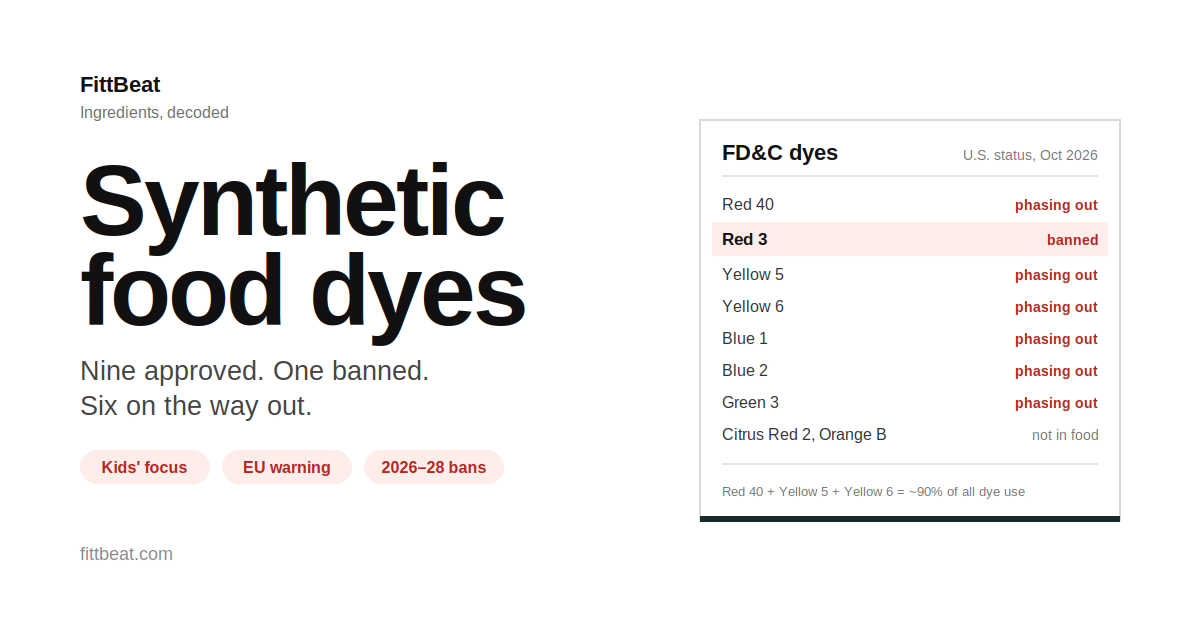
There are nine synthetic food dyes approved for food in the United States, and seven of them do almost all the work: two reds, two yellows, two blues, and a green, made from petroleum, mixed in combinations to produce every color on the candy aisle. One of them was banned in January 2025. The other six are the subject of an FDA phase-out, two state bans, and a warning label across the EU. Here’s each one — what it is, what the evidence says, where it’s restricted, and what’s replacing it — in one place.
Quick answer: are synthetic food dyes bad for you?
The nine FD&C dyes are petroleum-derived colorings approved by the FDA, with no nutritional purpose. One, Red 3, is banned (revoked January 2025, off shelves by 2027) because it caused thyroid tumors in rats. The others are legal but under pressure: a 2007 randomized trial found that mixtures of these dyes modestly increased hyperactivity in children, which led the EU to require a warning label in 2010 and the FDA to request a voluntary phase-out in 2025. There’s no credible evidence the remaining dyes cause cancer at food levels. The reasonable summary is: low risk for adults, worth limiting for children, and increasingly unnecessary because the food industry is replacing them anyway.
Jump to a dye: Red 40 · Red 3 · Yellow 5 · Yellow 6 · Blue 1 · Blue 2 · Green 3 · Phase-out timeline
The nine U.S. synthetic food dyes at a glance
| Dye | Also called | Color | U.S. status (Oct 2026) | EU status | Main concern |
|---|---|---|---|---|---|
| Red 40 | Allura Red, E129 | Orange-red | Legal; voluntary phase-out; WV ban 2028 | Warning label | Child behavior |
| Red 3 | Erythrosine, E127 | Pink-red | Banned — food deadline Jan 2027 | Mostly banned | Thyroid tumors (rats) |
| Yellow 5 | Tartrazine, E102 | Lemon yellow | Legal; voluntary phase-out; WV ban 2028 | Warning label | Child behavior, sensitivity |
| Yellow 6 | Sunset Yellow, E110 | Orange | Legal; voluntary phase-out; WV ban 2028 | Warning label | Child behavior |
| Blue 1 | Brilliant Blue, E133 | Bright blue | Legal; voluntary phase-out; WV ban 2028 | Permitted, no warning | Low |
| Blue 2 | Indigo Carmine, E132 | Royal blue | Legal; voluntary phase-out; WV ban 2028 | Permitted, no warning | Low; one old rat study |
| Green 3 | Fast Green, E143 | Sea green | Legal; voluntary phase-out; WV ban 2028 | Banned | Low; rarely used |
| Citrus Red 2 | — | Orange | Legal, orange peels only; FDA revoking | Banned | Animal carcinogen; not eaten |
| Orange B | — | Orange | Legal, sausage casings only; unused; FDA revoking | Banned | Not in use |
Red 40, Yellow 5, and Yellow 6 together account for roughly 90% of all dye used in U.S. food. If you avoid those three, you’ve avoided almost all of it.
What synthetic dyes are and why they’re in everything
“FD&C” means approved for food, drugs, and cosmetics. These dyes are made from petroleum-derived aromatic hydrocarbons, which is where “petroleum-based” comes from — there is no oil in the finished product, but the starting materials come from it. Six of the seven common ones are azo dyes (they share a nitrogen double bond); the two blues and the green are triarylmethane dyes. They won out over plant colors a century ago for the same reasons they persist: they’re cheap, intensely colored, stable in heat, light, and acid, and identical from batch to batch. A beet-juice red fades in a clear bottle on a hot shelf; Red 40 doesn’t.
Their job is purely cosmetic. They make fruit-flavored products look like fruit, make processed cheese orange, make pickles greener, and make children’s medicine pink. Nothing tastes different without them, which is the central fact in every argument about them: whatever the risk is, there’s no benefit to weigh against it except appearance.
What the research actually says
Hyperactivity in children The finding that holds up
The 2007 University of Southampton study gave about 300 children from the general population drinks containing one of two dye mixtures (Yellow 5, Yellow 6, Red 40, and three dyes not used in the U.S., plus the preservative sodium benzoate) or a placebo, in a randomized, double-blind crossover design. Both mixtures increased hyperactivity as rated by parents, teachers, and a computerized attention test. The effect was small on average and varied widely between kids. The EU acted on it in 2010. The FDA’s 2011 advisory committee agreed a link existed in “certain susceptible children” but voted 8–6 against a warning label. California’s 2021 OEHHA assessment reviewed 27 trials and concluded that synthetic dyes can affect behavior in some children, and that the FDA’s intake limits, set decades ago, never considered behavioral effects at all. That’s the evidence base behind the 2025 federal phase-out.
Cancer One dye, old studies, high doses
Red 3 is the exception: it caused thyroid tumors in male rats at high doses, which triggered the 1990 cosmetic ban and, 35 years later, the food ban under the Delaney Clause. For the others, the evidence is thin. Some older animal studies showed tumors at very high doses (Blue 2 and brain gliomas, Green 3 and bladder tumors, Yellow 6 and adrenal tumors), none consistently replicated. The more concrete concern is contaminants: azo dyes can carry trace benzidine and 4-aminobiphenyl, both known carcinogens, which the FDA limits to very low levels in certified batches. A 2022 mouse study linking Red 40 to gut inflammation and DNA damage at high doses is under review by EFSA.
Allergy and sensitivity Rare, real
Yellow 5 is the one with a documented sensitivity: hives, asthma flare-ups, and other reactions in a small number of people, particularly those sensitive to aspirin. That’s why the FDA has required Yellow 5 to be named specifically on labels since 1980. Red 40 and Yellow 6 have occasional reports; the blues almost none.
Each dye explained
Red 40 (Allura Red) Flagged
The most-used dye in the U.S. by volume. Behavioral evidence from Southampton; no credible cancer link; carries the EU warning; banned statewide in West Virginia from 2028 and from California school food from 2028. It’s in red and purple drinks, candy, cereal, snacks, and kids’ medicine. It has its own full page.
Red 3 (Erythrosine) Banned
A pink-red iodine-based dye, chemically unrelated to Red 40. Rats fed high doses developed thyroid tumors in studies from the 1980s; the FDA banned it in cosmetics in 1990 but left it in food for 35 years until a 2022 petition forced the issue. The ban was finalized January 15, 2025, with food makers given until January 15, 2027 and drug makers until January 18, 2028 to reformulate. It was used in maraschino cherries, candy corn, Peeps, strawberry-flavored products, and some medications. Its replacement is usually Red 40 — so the ban may increase Red 40 use in the short run — or beet and carmine in reformulated products.
Yellow 5 (Tartrazine) Flagged
Lemon yellow, the second most-used dye. It was in both Southampton dye mixtures and carries the EU warning. It’s the only dye with a well-documented sensitivity reaction — hives and asthma in a small number of people, more often those with aspirin sensitivity — which is why it’s been required to be named on U.S. labels since 1980 rather than hidden as “artificial color.” Found in lemon-lime Gatorade and Gatorade Zero, Mountain Dew, pickles, boxed mac and cheese (until Kraft removed it in 2016), yellow candy, and mixed with Blue 1 to make green. Phase-out: voluntary by end of 2026–2027; West Virginia ban 2028; California school ban 2028.
Yellow 6 (Sunset Yellow) Flagged
Orange, and the dye that makes orange soda orange. In the Southampton mixtures; carries the EU warning, which is why European Fanta is colored with carrot and pumpkin and U.S. Fanta isn’t. Older rat studies showed adrenal and testicular tumors at high doses, not replicated at relevant levels; the FDA considers it safe within limits. Found in Fanta, Sunkist, orange Gatorade, Cheetos, Doritos, cheese crackers, and orange candy — nearly always paired with Red 40. Phase-out: same as Yellow 5.
Blue 1 (Brilliant Blue) Low concern
The bright blue in Powerade Mountain Berry Blast, Glacier Freeze Gatorade, blue raspberry anything, and most green foods (blended with Yellow 5). It wasn’t in the Southampton study and the EU permits it without a warning. The one specific episode: in 2003 the FDA warned against adding Blue 1 to tube-feeding formula after several critically ill patients absorbed it through compromised guts, and some died — a hospital practice, not a food exposure. Otherwise the evidence of harm is weak. It’s on the FDA’s phase-out list by association rather than by evidence; the FDA simultaneously approved two natural blues (galdieria algae extract and butterfly pea flower) in 2025 to replace it.
Blue 2 (Indigo Carmine) Low concern
A darker, royal blue, less common than Blue 1 — used in some candy (blue M&M’s), cereal, and pet food. A 1980s rat study found brain gliomas in male rats at high doses, which has not been replicated and which the FDA judged not to be dye-related. EU permits it without warning. On the phase-out list.
Green 3 (Fast Green) Low concern, rare
The least-used of the seven — most green foods use Yellow 5 plus Blue 1 instead. One old study linked it to bladder tumors in rats; it’s banned in the EU but not for that reason (it was never approved there). You’ll find it in some mint-flavored products, canned peas, and sauces. On the phase-out list.
Citrus Red 2 and Orange B Not in your food
Two restricted dyes rounding out the nine. Citrus Red 2 is permitted only on the skins of Florida oranges that aren’t for processing, and it’s a known animal carcinogen — which is fine as long as you don’t eat the peel. Orange B is approved only for hot dog and sausage casings and hasn’t been manufactured in years. The FDA began the process of formally revoking both in April 2025.
The phase-out timeline
| Date | Action | Applies to |
|---|---|---|
| 2010 | EU child-behavior warning label required | Red 40, Yellow 5, Yellow 6, and three non-U.S. dyes |
| Sept 2024 | California School Food Safety Act signed (effective Dec 31, 2027) | Red 40, Yellow 5, Yellow 6, Blue 1, Blue 2, Green 3 in public school food |
| Jan 15, 2025 | FDA revokes Red 3 (food deadline Jan 15, 2027; drugs Jan 18, 2028) | Red 3 |
| Mar 2025 | West Virginia HB 2354 signed — school food Aug 2025, statewide Jan 1, 2028 | All seven common dyes |
| Apr 22, 2025 | FDA/HHS announce voluntary phase-out by end of 2026; begin revoking Citrus Red 2 and Orange B; fast-track natural color approvals | Red 40, Yellow 5, Yellow 6, Blue 1, Blue 2, Green 3 |
| 2025 | FDA approves galdieria extract blue, butterfly pea flower, calcium phosphate white, gardenia blue as natural alternatives | Replacements |
| 2025–2026 | Kraft Heinz, General Mills, Nestlé, PepsiCo, Tyson, Hershey, Smucker, Conagra and others commit to removal, mostly by end of 2027 | Corporate |
| Apr 2026 | PepsiCo announces Gatorade and Gatorade Zero core flavors go dye-free by fall 2026 | Corporate |
| Dec 31, 2026 | FDA’s original voluntary target | Likely to slip to 2027 |
| Dec 31, 2027 | California school ban effective; most corporate deadlines | — |
| Jan 1, 2028 | West Virginia statewide ban effective | — |
The pattern: the FDA’s phase-out has no enforcement behind it, so the real deadlines are the state laws and the companies’ own commitments. Expect dyes to linger longest in candy and beverages, where natural colors are hardest to match, and to disappear first from cereal, yogurt, and snacks.
Why Europe and the U.S. differ
The same chemicals, different rules. The EU’s 2010 warning requirement — “may have an adverse effect on activity and attention in children” — didn’t ban anything, but it made the dyes commercially toxic: no company wanted the label, so most reformulated. That’s why a European Skittles bag, Fanta can, or Froot Loops box uses paprika, turmeric, spirulina, and vegetable juices. The U.S. version of each product still used the synthetic dyes through 2025, and the gap is closing only now, as state laws and the federal phase-out replicate the EU’s pressure fifteen years later.
What’s replacing them
Natural colors are extracted from plants, algae, insects, and minerals: beet juice and carmine (cochineal insects) for red, paprika and annatto for orange, turmeric and safflower for yellow, spirulina and the newly approved galdieria and butterfly pea extracts for blue, and chlorophyllin for green. They’re more expensive, less stable, and often paler — which is why reformulated products look duller, and why candy and soda are the slowest to switch. “No artificial colors” on a label now means plant-derived colorants are used; it doesn’t mean no color was added. Carmine, worth noting, isn’t vegan and can trigger rare allergic reactions of its own.
One more distinction: caramel color, the brown in cola, is not an FD&C dye and isn’t part of the phase-out. It has its own, separate question (4-MEI), covered on its own page.
Are synthetic dyes bad for you?
FittBeat verdict
Low risk for adults, worth limiting for children, and about to become much easier to avoid. The cancer fears belong almost entirely to Red 3, which is banned. The remaining dyes’ documented effect is a modest increase in hyperactivity in some kids — enough that the EU, California, West Virginia, and now the FDA have all acted. For an adult, dyes are far down the list of label concerns, well below sugar. For a child who eats dyed foods daily, cutting them is a reasonable experiment with no downside. And since the products are reformulating anyway, the easiest strategy is to read the color line and prefer the version without a numbered dye.
How to avoid synthetic dyes
- Read the end of the ingredient list. Colors are listed last. Any name with a number (Red 40, Yellow 5, Blue 1) or “Lake” after it is synthetic. “Color added” or “artificial color” without a name means a dye is present but unnamed.
- Be suspicious of bright, fruit-flavored, juice-free products. If it’s red, orange, blue, or green and lists no fruit, it’s dyed.
- Check green. Most green foods are Yellow 5 plus Blue 1, so “green” means two dyes.
- Check kids’ medicine and vitamins. Many liquid and chewable formulations are dyed; dye-free versions exist for most.
- Watch reformulated packaging. Through 2027 the same brand may be dyed in one package and dye-free in the next. “No artificial colors” on the front is the signal.
Frequently asked questions
Are food dyes banned in the U.S.?
Only Red 3, revoked in January 2025 with a January 2027 deadline for food. The other six common dyes are legal but subject to a voluntary FDA phase-out and to state bans in West Virginia (2028) and California schools (2028).
Which food dyes are banned in Europe?
Green 3, Citrus Red 2, and Orange B were never approved there; Red 3 is restricted to a few uses. Red 40, Yellow 5, Yellow 6, Blue 1, and Blue 2 are legal in the EU, but the first three require a warning label about effects on children’s activity and attention, which led most manufacturers to reformulate.
Do food dyes cause ADHD?
No. Randomized trials show dye mixtures can modestly increase hyperactivity and reduce attention in some children for a few hours after consumption, including children without any diagnosis. They don’t cause the disorder.
Do food dyes cause cancer?
Red 3 caused thyroid tumors in rats, which is why it’s banned. For the other dyes there’s no consistent evidence of cancer at food-level exposure; regulators limit carcinogenic contaminants (benzidine) in certified batches.
What is Yellow 5 and why is it named on labels?
Yellow 5 (tartrazine) is a lemon-yellow azo dye. Because a small number of people have allergic-type reactions to it — hives, asthma — the FDA has required it to be named specifically on labels since 1980.
Which dyes are in green food?
Usually Yellow 5 plus Blue 1. Green 3 exists but is rarely used.
What does “no artificial colors” mean?
That the colors are derived from plants, minerals, algae, or insects (carmine) rather than petroleum. It doesn’t mean no color was added.
Is caramel color a synthetic dye?
No. Caramel color is made by heating sugar and isn’t an FD&C dye or part of the phase-out. It has a separate concern, 4-MEI, covered on our caramel color page.
This article is for informational purposes and is not medical advice. Talk to a doctor or registered dietitian about your individual nutrition needs.
Leave a Reply