

Last reviewed: October 2026. Reflects the U.S. Lucky Charms box photographed in store (Limited Edition Jumbo Unicorns), which carries the post-August 2026 “colors from natural sources” recipe. Earlier boxes listed Red 40, Yellow 5, Yellow 6, and Blue 1; if your box still does, it’s older stock.
Lucky Charms is the cereal that’s half cereal and half candy, and for most of its 60 years the candy half got its colors from petroleum. That changed in August 2026, when General Mills announced it had removed artificial dyes from every U.S. cereal it makes. The box now says “colors from natural sources,” and the new color line is worth reading closely: vegetable and fruit juice, spirulina, turmeric, paprika — and carmine, a red made from crushed insects. The rest of the label didn’t change. It’s still whole grain oats up front, still sugar and corn syrup in the top four, still gelatin holding the marshmallows together. Here’s all the Lucky Charms ingredients on the current box, what replaced the dyes, why it isn’t vegetarian, and what a bowl actually delivers.
Quick answer: what’s in Lucky Charms?
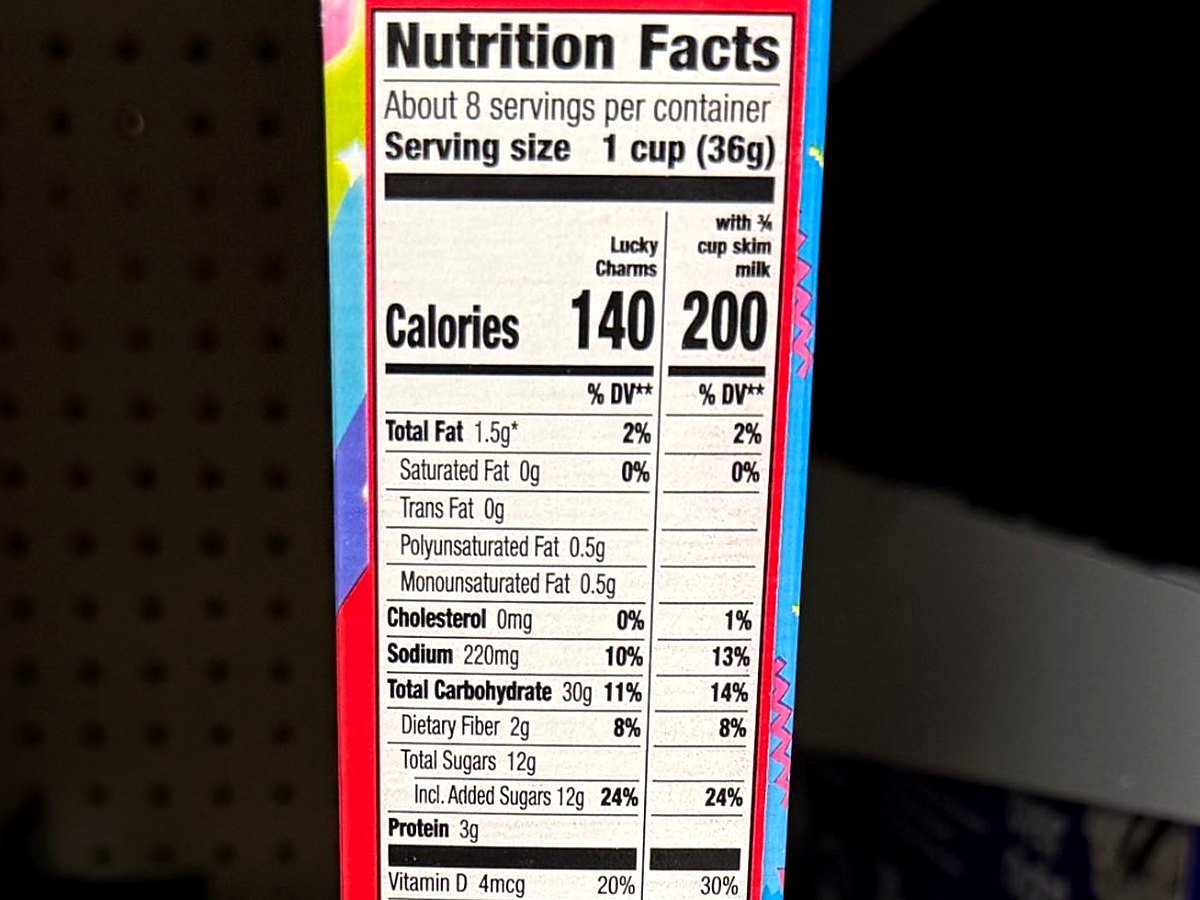
Lucky Charms is whole grain oats, sugar, whole grain corn, corn syrup, and corn starch, plus 2% or less of salt, gelatin, trisodium phosphate, color (vegetable and fruit juice, carmine, spirulina extract, turmeric oleoresin, paprika oleoresin), natural and artificial flavor, and vitamin E for freshness, with added calcium, iron, zinc, and B vitamins. A 1-cup (36 g) serving has 140 calories, 1.5 g of fat, 220 mg of sodium, 30 g of carbohydrate, 2 g of fiber, 12 g of added sugar (24% of the daily value), and 3 g of protein. The synthetic dyes are gone — a real change. What’s left to weigh is a third of the cereal’s weight in added sugar, a refined-corn-and-sugar marshmallow, and two animal ingredients (gelatin and carmine) that make it unsuitable for vegetarians.
Jump to: The label · Each ingredient · What replaced the dyes · Is it vegetarian? · Nutrition · Verdict · FAQ
The full Lucky Charms ingredients list
Whole Grain Oats, Sugar, Whole Grain Corn, Corn Syrup, Corn Starch. Contains 2% or less of: Salt, Gelatin, Trisodium Phosphate, Color (Vegetable and Fruit Juice, Carmine, Spirulina Extract, Turmeric Oleoresin, Paprika Oleoresin and Other Color Added), Natural and Artificial Flavor. Vitamin E (Mixed Tocopherols) Added to Preserve Freshness. Vitamins and Minerals: Calcium Carbonate, Vitamin C (Sodium Ascorbate), Iron and Zinc (Mineral Nutrients), A B Vitamin (Niacinamide), Vitamin B6 (Pyridoxine Hydrochloride), Vitamin B1 (Thiamin Mononitrate), Vitamin A (Palmitate), Vitamin B2 (Riboflavin), A B Vitamin (Folic Acid), Vitamin B12, Vitamin D3. Gluten free. Contains bioengineered food ingredients.
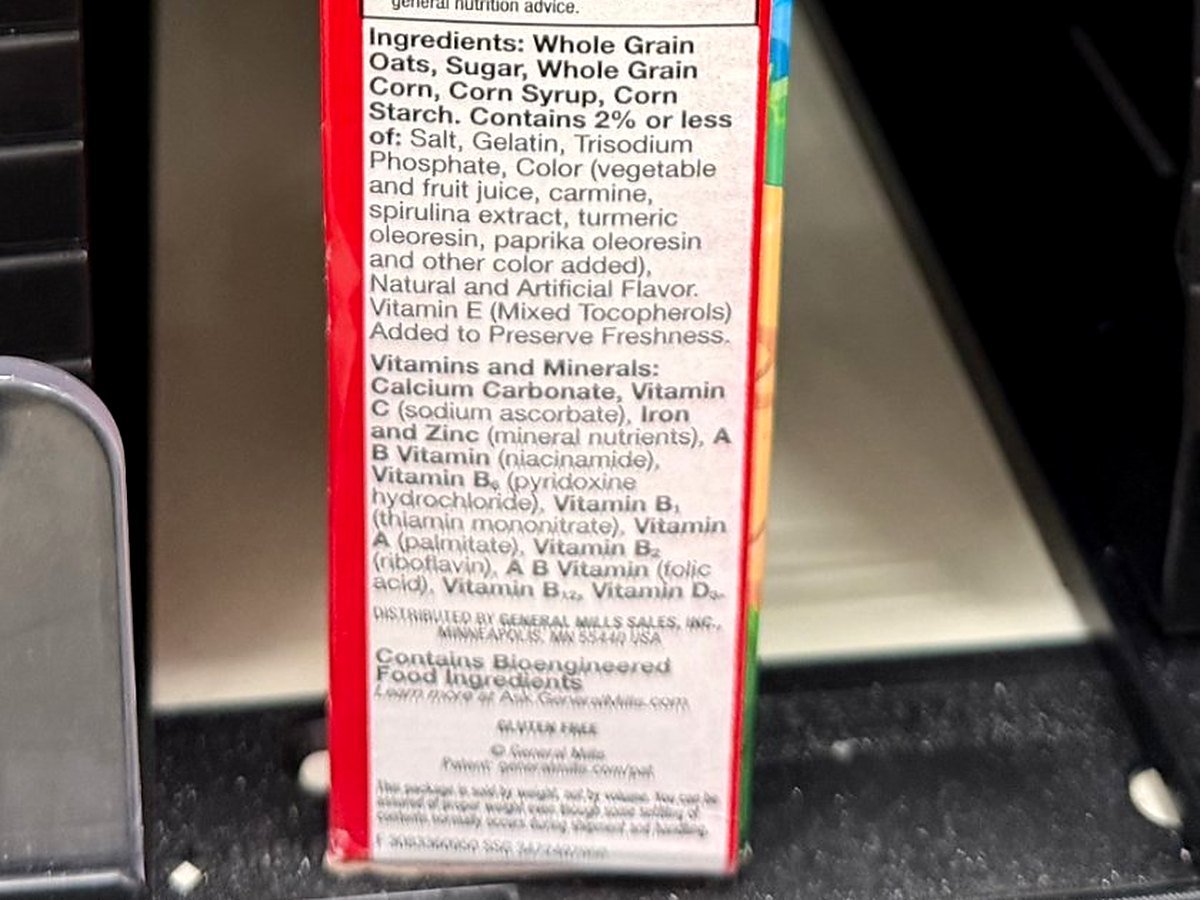
Three things to notice. Whole grain oats are the first ingredient, which is the basis for the “whole grain” claims and the 2 g of fiber — the oat pieces are the cereal half. But sugar is second and corn syrup fourth, and together with the corn starch they make up most of the marshmallows, which is why 12 g of every 36-gram cup is added sugar. And the color line is new: where the old box had four FD&C numbers, this one has plant extracts and carmine. “Natural and artificial flavor” is still there — only the colors went natural.
Lucky Charms ingredients explained
Whole grain oats The good part
Toasted oat pieces, the same base as Cheerios, and the first ingredient by weight. They supply most of the 2 g of fiber and 3 g of protein, and they let General Mills put the whole-grain stamp on the box. Oats are naturally gluten-free but usually contaminated with wheat in processing; General Mills mechanically sorts its oats, which is how the box can say “gluten free.”
Sugar and corn syrup Flagged, 12 g
Two sweeteners, second and fourth on the list: sugar coats the oat pieces (“frosted toasted cereal”) and, with corn syrup, forms the bulk of the marshmallows. Together they’re 12 g of added sugar per cup, 24% of the daily value — and since a cup is only 36 g, that’s a third of the cereal by weight. Corn syrup isn’t high fructose corn syrup; it’s mostly glucose, used in the marshmallows because it keeps them soft and stops sugar crystallizing. Either way, it’s the number that matters on this box: one cup is about half the American Heart Association’s daily added-sugar limit for a child, and most bowls are bigger than a cup.
Whole grain corn and corn starch Fine
Whole grain corn goes into the oat pieces for texture; corn starch is a main ingredient of the marshmallows (and dusts them so they don’t stick together). Neither adds much nutrition; neither is a concern.
Salt 220 mg
220 mg of sodium per cup, 10% of the daily value — more than people expect from a sweet cereal, and the reason it doesn’t taste one-note. Trisodium phosphate adds a little too.
Gelatin Animal-derived
The protein that gives the marshmallows their chewy, foamy structure. Gelatin is made from animal collagen — skin and bones, typically pork or beef — and the box doesn’t say which. It’s safe and has been used in confections for centuries; it’s flagged because it means Lucky Charms is not vegetarian, vegan, halal, or kosher, which surprises a lot of parents. The section below covers that.
Trisodium phosphate Safe (despite the internet)
The ingredient that gets screenshotted because the same compound is sold as a heavy-duty cleaner. In food it’s used at tiny amounts to adjust acidity, help the cereal flow through the extruder, and keep the color even. The FDA classifies it as generally recognized as safe, and the EU allows it (E339). Phosphate additives add up across a heavily processed diet — a real consideration for people with kidney disease — but the amount in a bowl of cereal is small. Our phosphoric acid breakdown covers the phosphate research.
Color: vegetable and fruit juice, carmine, spirulina, turmeric, paprika The 2026 change
The new color system for the marshmallows, replacing Red 40, Yellow 5, Yellow 6, and Blue 1. Spirulina (blue-green algae) gives the blues and, mixed with yellows, the greens; turmeric and paprika give yellows and oranges; vegetable and fruit juices (typically beet, carrot, purple sweet potato) give pinks and purples; carmine gives the reds. “Other color added” covers anything else in the blend. The full breakdown, including carmine, is below.
Natural and artificial flavor Undisclosed
The vanilla-marshmallow taste. “Artificial” stayed when the colors went natural — the box says “colors from natural sources,” not “all natural.” The specific compounds aren’t disclosed; vanillin is the usual suspect.
Vitamin E (mixed tocopherols) Good preservative
A natural antioxidant that keeps the oat oils from going rancid — the clean alternative to BHT, which some cereals still use. A small credit.
Added vitamins and minerals Fortification
Calcium carbonate, iron, zinc, vitamin C, vitamins A and D3, and six B vitamins, at 10–20% of the daily value per cup. Cereal fortification is a real public-health contribution — breakfast cereal is a major source of iron and folic acid for American kids — and it’s the reason the panel looks nutritious. It doesn’t offset the sugar; it sits alongside it.
What replaced the dyes — and what carmine is
On August 26, 2026, General Mills said it had removed artificial colors from all of its U.S. cereals, including Lucky Charms and Trix, and shifted to fruit-, vegetable-, and spice-based colors. The move followed years of pressure that peaked in 2025–2026: the FDA’s plan to phase out petroleum dyes, General Mills’ 2025 agreement with the Texas attorney general to remove synthetic dyes by the end of 2027, and Target’s announcement that it would stop selling cereals with artificial colors by the end of May 2026. General Mills had tried this once before — it took dyes out of Trix in 2015 and put them back in 2017 after customers complained the colors looked dull — so the box’s “colors from natural sources” badge is the second attempt, and this time the whole cereal line moved at once.
Most of the replacements are uncontroversial: spirulina, turmeric, paprika, and fruit and vegetable juices are foods, used here in small amounts. The one worth knowing is carmine. Carmine is a deep red pigment made from cochineal, a scale insect that lives on prickly pear cactus; the dried, crushed insects are processed into carminic acid. It’s been used to color food, cosmetics, and textiles for centuries, it’s FDA-approved, and it’s more stable than most plant reds, which is why food makers reach for it. Two caveats come with it. It’s an animal product, so it takes Lucky Charms further from vegetarian. And it can cause allergic reactions — rare, but severe enough that since 2011 the FDA has required it to be listed by name rather than hidden under “color added.” If your child has had a reaction to red-colored foods or cosmetics before, check for carmine.
Whether the switch matters for health is a separate question. The research linking synthetic dyes to hyperactivity in some children — the 2007 Southampton trial, California’s 2021 OEHHA review — is about the petroleum dyes, and those are gone. The natural colors carry no comparable behavioral evidence. So for parents who were avoiding Lucky Charms specifically because of Red 40 and Yellow 5, the reason is resolved. The sugar wasn’t part of the change. Our synthetic dyes breakdown has the full research and the phase-out timeline.
Are Lucky Charms vegetarian or vegan?
No, on two counts. The marshmallows contain gelatin, made from animal collagen, and the reds now come from carmine, made from insects. Either one rules out vegan; gelatin rules out vegetarian for most people, and carmine rules it out for strict vegetarians. Gelatin of unspecified animal origin also means Lucky Charms isn’t halal or kosher certified. The oat pieces alone are plant-based, but they aren’t sold separately. If you’re looking for a vegetarian version, store-brand “marshmallow” cereals sometimes use plant-based marshmallows — check the label for gelatin — and there are vegan marshmallow cereals from smaller brands.
Lucky Charms nutrition facts
| Per serving | Lucky Charms (1 cup, 36 g) | With ¾ cup skim milk | Cheerios (1½ cups, ~39 g) | Froot Loops (1⅓ cups, ~39 g) | Cinnamon Toast Crunch (1 cup, ~41 g) |
|---|---|---|---|---|---|
| Calories | 140 | 200 | ~140 | ~150 | ~170 |
| Added sugar | 12 g | 12 g | ~2 g | ~12 g | ~12 g |
| Sugar as % of weight | 33% | — | ~5% | ~31% | ~29% |
| Fiber | 2 g | 2 g | ~4 g | ~3 g | ~2 g |
| Protein | 3 g | 9 g | ~5 g | ~2 g | ~2 g |
| Sodium | 220 mg | 300 mg | ~190 mg | ~200 mg | ~250 mg |
| Synthetic dyes | None (since 2026) | None | None | Being removed by end of 2026 | None |
| Animal ingredients | Gelatin, carmine | + milk | None | None | None |
Lucky Charms figures (including the skim-milk column) are from the photographed box; the other cereals are approximate from current manufacturer labels, which vary slightly by box size. WK Kellogg has said it will remove artificial colors from Froot Loops and its other U.S. cereals by the end of 2026.
The 2022 sick-complaint reports
In spring 2022, thousands of people posted reports of nausea, vomiting, and diarrhea after eating Lucky Charms to a food-safety complaint website, and the FDA received more than a hundred complaints and opened an inquiry. General Mills said its own investigation found no evidence that the cereal caused illness, and the FDA did not identify a pathogen, contaminant, or cause or announce a recall. The episode is a common search, and the honest summary is that the reports were real, a cause was never found, and no product action followed. It isn’t connected to any of the ingredients above.
Are Lucky Charms healthy?
FittBeat verdict
The dyes are gone; the dessert isn’t. The 2026 switch to natural colors genuinely removes the ingredient most parents worried about, and the box has real credits: whole grain oats first, a clean vitamin E preservative, gluten-free sorting, and meaningful fortification. But a third of the cereal by weight is added sugar, the marshmallows are essentially sugar, corn syrup, and gelatin, and the new red comes from insects — fine for most people, a dealbreaker for vegetarians and a rare allergen for others. It’s a treat cereal with a better color line than it had last year. Serve a measured cup, with milk for protein, and not every morning.
The concerns, ranked by evidence:
- Added sugar. 12 g per 36-gram cup, a third of the cereal’s weight; about half a child’s daily limit before the bowl is refilled.
- Low protein and fiber for a breakfast. 3 g and 2 g per cup; the milk does most of the protein work.
- Animal ingredients. Gelatin and carmine — not a health issue for most, but not vegetarian, vegan, halal, or kosher.
- Carmine allergy. Rare; real enough that the FDA requires it named.
- Everything else. Trisodium phosphate, corn starch, salt, natural colors, vitamin E, fortification: no meaningful concern at these amounts.
Lucky Charms for kids, allergies, and diets
Kids: the dye change removes the most common parental objection. The sugar remains: one cup is 12 g of added sugar against the AHA’s 25 g daily limit for children, and kids typically pour 1½–2 cups. A cup with milk and fruit on the side is the reasonable version.
Gluten-free: yes — labeled gluten-free, with sorted oats.
Vegetarian / vegan: no — gelatin and carmine.
Allergies: no major allergens are declared. Carmine can cause allergic reactions in sensitive people.
Diabetes: 30 g of carbohydrate with only 2 g of fiber, a third of it added sugar — a fast-digesting breakfast. Pair with protein or choose a lower-sugar cereal.
Cleaner alternatives
For the same oat base without the marshmallows: Cheerios, which are essentially Lucky Charms’ oat pieces with about 2 g of added sugar. For the marshmallow fun with less sugar: mix a quarter cup of Lucky Charms into a bowl of plain Cheerios — kids get the marshmallows, the bowl gets a fraction of the sugar. For a vegetarian marshmallow cereal: look for store brands or specialty brands that use plant-based marshmallows. And for a breakfast that does the job of breakfast: oatmeal with fruit, or eggs and toast, both of which beat any frosted cereal on protein and fiber.

Frequently asked questions
What are the ingredients in Lucky Charms?
Whole grain oats, sugar, whole grain corn, corn syrup, corn starch, and 2% or less of salt, gelatin, trisodium phosphate, color (vegetable and fruit juice, carmine, spirulina extract, turmeric oleoresin, paprika oleoresin), natural and artificial flavor, vitamin E for freshness, and added vitamins and minerals.
Do Lucky Charms still have artificial dyes?
No. General Mills removed artificial colors from all its U.S. cereals, including Lucky Charms, in August 2026. The marshmallows are now colored with fruit and vegetable juice, spirulina, turmeric, paprika, and carmine. Older boxes listed Red 40, Yellow 5, Yellow 6, and Blue 1.
What is carmine in Lucky Charms?
A red color made from cochineal insects. It’s FDA-approved and used widely in food and cosmetics, but it’s an animal product and can cause allergic reactions in a small number of people, which is why it must be listed by name.
Are Lucky Charms vegan or vegetarian?
No. The marshmallows contain gelatin, made from animal collagen, and the red color comes from carmine, made from insects.
How much sugar is in Lucky Charms?
12 g of added sugar per 1-cup (36 g) serving, 24% of the daily value — about a third of the cereal by weight.
Are Lucky Charms gluten-free?
Yes. The box is labeled gluten-free; General Mills sorts its oats to remove wheat and barley.
What is trisodium phosphate in cereal?
A food-grade phosphate salt used in small amounts to adjust acidity and help the cereal process evenly. It’s FDA-recognized as safe. The same compound is used in some cleaners, which is why it alarms people online, but the food-grade amount in cereal is tiny.
Are Lucky Charms healthy?
Not as an everyday breakfast. The whole grain oats and fortification are real credits and the dyes are gone, but a third of the cereal is added sugar and it’s low in protein and fiber. A measured cup with milk is a reasonable treat.
Sources
- General Mills Sales, Inc. Nutrition facts and ingredients, Lucky Charms (Limited Edition Jumbo Unicorns box). Product label, photographed October 2026.
- Durbin D-A. Lucky Charms and Trix go au naturel as General Mills ditches artificial colors. Associated Press, August 26, 2026.
- HHS and FDA. HHS, FDA to phase out petroleum-based synthetic dyes in nation’s food supply. April 22, 2025. fda.gov
- U.S. FDA. Listing of color additives exempt from certification; food, drug, and cosmetic labeling: cochineal extract and carmine declaration (final rule, 2009; effective 2011). ecfr.gov
- McCann D, et al. Food additives and hyperactive behaviour in 3-year-old and 8/9-year-old children in the community. The Lancet, 2007. doi:10.1016/S0140-6736(07)61306-3
- California OEHHA. Health effects assessment: potential neurobehavioral effects of synthetic food dyes in children. 2021. oehha.ca.gov
- U.S. FDA. 21 CFR 182.1778, sodium phosphate (GRAS). ecfr.gov
- Vos MB, et al. Added sugars and cardiovascular disease risk in children: a scientific statement from the American Heart Association. Circulation, 2017. doi:10.1161/CIR.0000000000000439
Cheerios, Froot Loops, and Cinnamon Toast Crunch figures are approximate from current manufacturer labels. The 2022 complaint reports are summarized from FDA and General Mills statements reported at the time.
This article is for informational purposes and is not medical advice. Talk to a doctor or registered dietitian about your individual nutrition needs.
