
Last reviewed: October 2026. Reflects the U.S. Oreo Original Chocolate Sandwich Cookies, 13.29 oz (376 g) pack, photographed in store. Double Stuf, Thins, Golden, and Gluten Free Oreos use variations of the same list and are noted below.
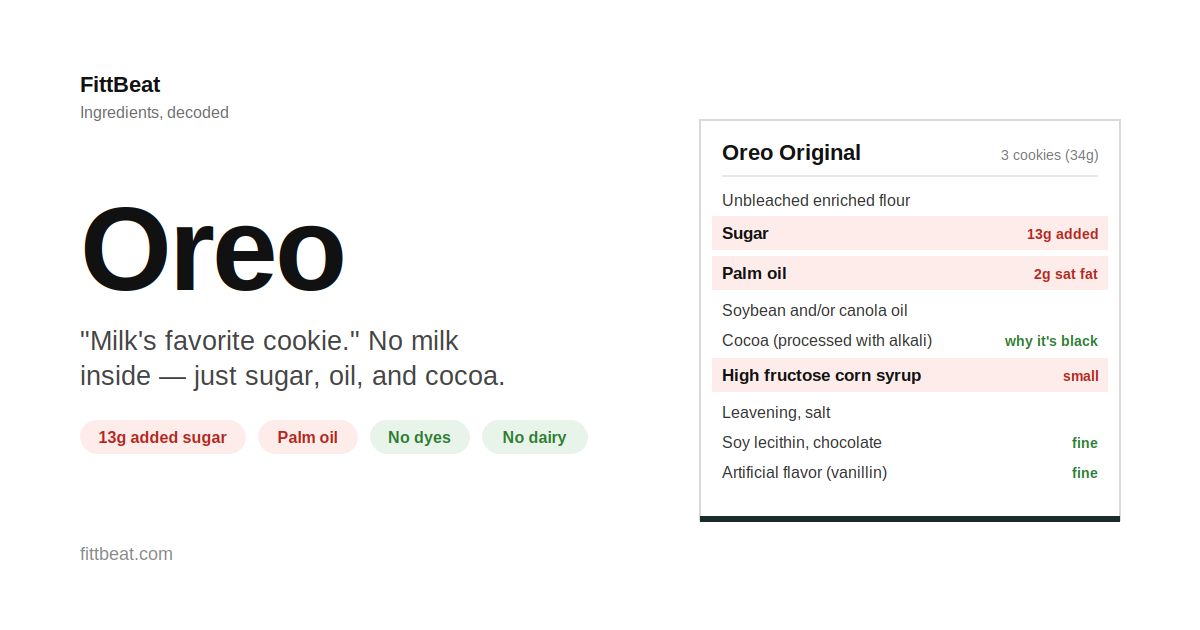
Oreo is the best-selling cookie in the world — more than 40 billion a year — and the ingredient list is shorter than most people expect: flour, sugar, two kinds of vegetable oil, cocoa, a little corn syrup, leavening, salt, lecithin, chocolate, and vanillin. There’s no milk, no butter, no cream in the “creme,” no dye, and no preservative. That makes Oreos accidentally dairy-free, which is why “are Oreos vegan” is one of the most-searched food questions there is. It also makes them what they look like on the label: sugar and fat, held together by refined flour. Here’s every Oreo ingredients, what the filling is actually made of, why the cookie is black, the vegan answer that isn’t quite yes, and what three cookies cost you.
Quick answer: what’s in an Oreo?
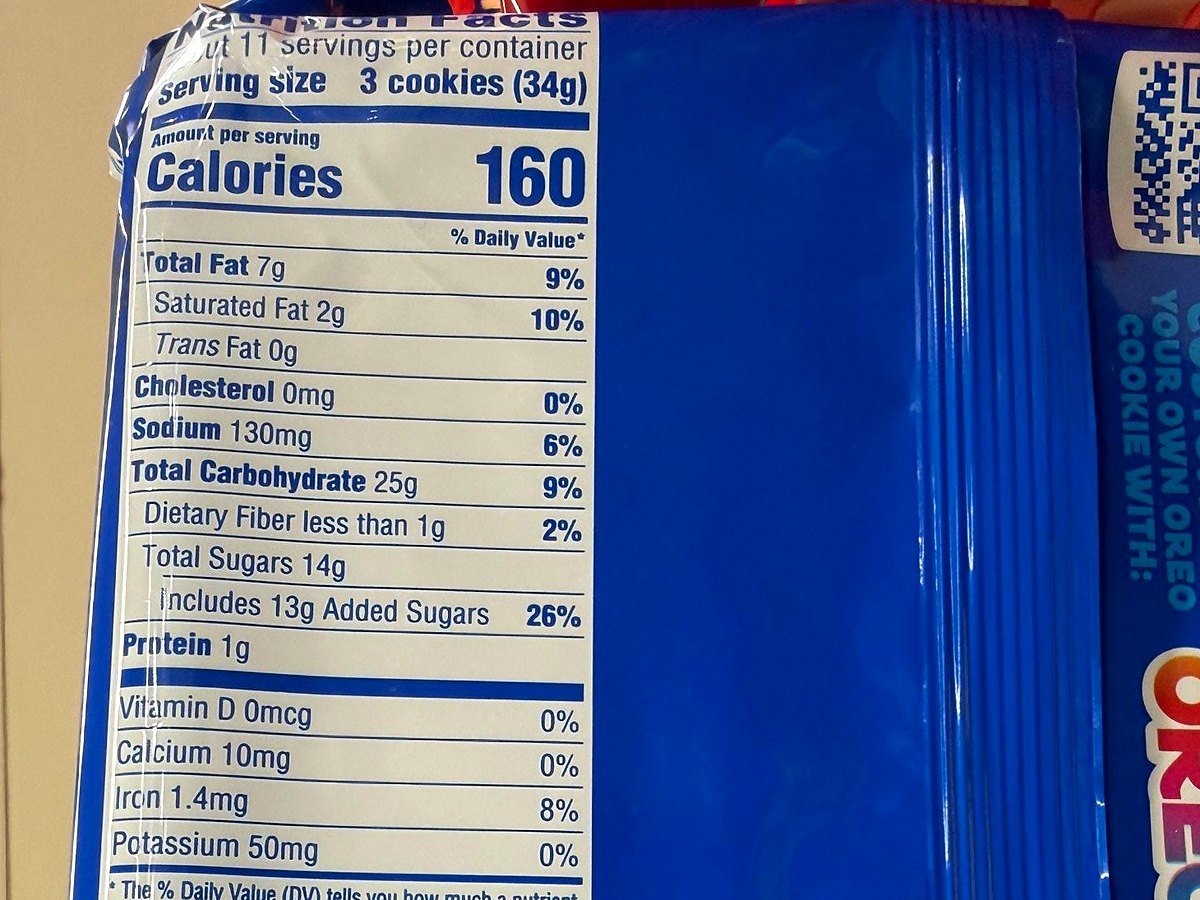
Oreos are unbleached enriched flour, sugar, palm oil, soybean and/or canola oil, cocoa processed with alkali, high fructose corn syrup, leavening (baking soda and/or calcium phosphate), salt, soy lecithin, chocolate, and artificial flavor. A serving of 3 cookies (34 g) has 160 calories, 7 g of fat, 2 g of saturated fat, 130 mg of sodium, 14 g of sugar (13 g added, 26% of the daily value), less than 1 g of fiber, and 1 g of protein. The cream filling is essentially sugar whipped with palm and soybean oil — no dairy. Nothing on the list is a hazard at a serving; the problem is the serving itself, because a quarter of a day’s added sugar in three cookies is a number few people stop at.
Jump to: The label · Each ingredient · What the cream is made of · Are Oreos vegan? · Nutrition · Verdict · FAQ
The full Oreo ingredients list
Unbleached Enriched Flour (Wheat Flour, Niacin, Reduced Iron, Thiamine Mononitrate [Vitamin B1], Riboflavin [Vitamin B2], Folic Acid), Sugar, Palm Oil, Soybean and/or Canola Oil, Cocoa (Processed with Alkali), High Fructose Corn Syrup, Leavening (Baking Soda and/or Calcium Phosphate), Salt, Soy Lecithin, Chocolate, Artificial Flavor. Contains: wheat, soy. Contains a bioengineered food ingredient. Made in Mexico.

Three things to notice. Sugar is second and the two oils are third and fourth, which means that by weight an Oreo is mostly flour, sugar, and fat in roughly that order — the cocoa that gives it its identity comes fifth. High fructose corn syrup sits sixth, after the cocoa, so it’s a small amount used for moisture and browning rather than a main sweetener. And there’s no dairy ingredient anywhere: no milk, butter, whey, or cream. The front of the pack says “Milk’s Favorite Cookie”; the back has none.
Oreo ingredients explained
Unbleached enriched flour Refined
White wheat flour with the bran and germ removed, then “enriched” with iron and four B vitamins to replace some of what milling took out — a legal requirement for enriched flour in the U.S. That’s where the 8% iron on the panel comes from. Unbleached means it wasn’t chemically whitened, a small credit. It’s still a refined carbohydrate with almost no fiber (under 1 g per serving), which is why three cookies don’t fill anyone up.
Sugar Flagged, 13 g added
Granulated sugar, the second ingredient, in both the wafers and the filling. Together with the HFCS it adds up to 13 g of added sugar per three cookies — about three teaspoons and 26% of the daily value. Per cookie that’s roughly 4.3 g, or a teaspoon each. That’s the number that matters on this label, and it scales fast: a sleeve of eight cookies is about 35 g of added sugar, more than the American Heart Association’s daily limit for most adults.
Palm oil Flagged, saturated fat
The main fat, and the reason the cream holds its shape at room temperature without being hydrogenated. Oreos used partially hydrogenated oil (trans fat) until 2006; palm oil was the replacement, and the label now reads 0 g trans fat. The trade is 2 g of saturated fat per serving, 10% of the daily value — modest, but palm oil is about half saturated fat, and it’s the reason the cream feels smooth rather than greasy. Palm oil also carries an environmental question about deforestation; Mondelez reports sourcing through RSPO-certified supply chains, a claim worth knowing but outside what a label can tell you.
Soybean and/or canola oil Fine
Liquid vegetable oils blended with the palm oil to soften the cream and the cookie. The “and/or” means Mondelez uses whichever is cheaper or available. These are mostly unsaturated fats. They’re also likely the source of the “bioengineered” disclosure, since most U.S. soybeans and canola are genetically engineered.
Cocoa (processed with alkali) Why it’s black
Dutch-process cocoa, treated with an alkaline salt to neutralize its acidity. Alkalizing darkens cocoa and mellows its bitterness, and Oreos use a heavily alkalized “black cocoa” — that’s why the wafer is nearly black rather than brown, and why it tastes less like chocolate than you’d expect. The trade-off: alkalizing destroys most of cocoa’s flavanols, the antioxidants behind dark chocolate’s health reputation, so the cocoa here contributes color and flavor, not nutrition. The front of the pack’s “Always made with real cocoa” is true.
High fructose corn syrup Small amount
Sixth on the list, after the cocoa, so it’s a minor part of the 13 g of added sugar — used because it keeps baked goods soft and helps them brown. Metabolically, HFCS and table sugar are close to identical at the same dose; the concern with HFCS is the dose people get across a whole diet, not its presence in a cookie. Our high fructose corn syrup breakdown covers the research.
Leavening (baking soda and/or calcium phosphate) Fine
Makes the wafer crisp and light. Baking soda also deepens the cocoa color slightly by raising pH. Harmless.
Salt 130 mg sodium
For flavor — it’s what keeps the cookie from tasting flat. 130 mg per three cookies, 6% of the daily value, comes partly from salt and partly from the baking soda. Low for a snack; nothing like a chip.
Soy lecithin Fine
An emulsifier from soybeans that helps the fat and sugar blend in the cream and keeps the dough workable. Trace amount; the reason soy appears in the allergen line.
Chocolate Fine
A small amount of unsweetened chocolate (chocolate liquor) for flavor depth in the wafer, listed near the end. It’s not dairy chocolate — no milk is involved.
Artificial flavor Vanillin
The vanilla note in the cream, almost certainly vanillin — the main flavor molecule in vanilla, made synthetically rather than extracted from vanilla beans. It’s chemically identical to the vanillin in a vanilla bean and is one of the most-used flavor compounds in food. “Artificial” here describes the source, not a safety concern.
What’s not here Worth saying
No milk, butter, or whey. No eggs. No synthetic dyes — the black is cocoa and the white is sugar and fat. No preservatives; the low moisture and high sugar keep the cookies shelf-stable. No trans fat since 2006.
What is Oreo cream filling made of?
Sugar and fat, mostly. Mondelez doesn’t publish a separate recipe for the “creme,” but the ingredient list leaves little room: of the eleven ingredients, the cream can only be made from sugar, palm oil, soybean or canola oil, soy lecithin, and vanillin, because the flour, cocoa, leavening, and chocolate belong to the wafer. In other words, it’s a vegetable-oil frosting — sugar whipped into a blend of solid palm oil and liquid oil, emulsified with lecithin and flavored with vanillin. The spelling “creme” isn’t an accident; it’s the convention for fillings that contain no cream. That’s also why Double Stuf, which roughly doubles the filling, raises the sugar and fat per cookie more than it raises anything else.
One popular myth worth retiring: the filling was never made from lard in the U.S. version you buy today. Oreos did use lard until the mid-1990s, when Nabisco reformulated to vegetable shortening, and later palm oil. The current recipe has no animal fat.
Are Oreos vegan?
By ingredients, yes; by Oreo’s own definition, no. Nothing in the recipe comes from an animal — no dairy, eggs, honey, or animal fat — which is why PETA and many vegan guides list Oreos as “accidentally vegan.” But Mondelez says Oreos are not vegan because they’re made on equipment shared with milk-containing products, and there may be cross-contact. The pack photographed here carries an OU-D kosher symbol (the “U D” on the front), which means “dairy” in kosher certification: either the product contains dairy or it’s made on dairy equipment, and here it’s the second. So for an ethical vegan who avoids animal ingredients, Oreos qualify. For anyone with a true milk allergy, they’re not a safe choice, and Mondelez doesn’t say they are.
Oreos are also not gluten-free (wheat flour is first), though Mondelez sells a separate Gluten Free Oreo made with oat and rice flour.
Oreo nutrition facts
| Serving | Calories | Fat (sat) | Sodium | Added sugar | Protein |
|---|---|---|---|---|---|
| 1 Oreo (11.3 g) | 53 | 2.3 g (0.7 g) | 43 mg | 4.3 g | <1 g |
| 3 Oreos (34 g, label serving) | 160 | 7 g (2 g) | 130 mg | 13 g | 1 g |
| 6 Oreos (68 g) | 320 | 14 g (4 g) | 260 mg | 26 g | 2 g |
| Whole 13.29 oz pack (~33 cookies) | ~1,760 | ~77 g (~22 g) | ~1,430 mg | ~143 g | ~11 g |
All rows are calculated from the photographed label (per-cookie values are one-third of the 3-cookie serving). For scale, the American Heart Association’s daily added-sugar limit is 25 g for women and 36 g for men; six Oreos reach the first and eight reach the second.
| Per serving | Oreo Original (3 cookies, 34 g) | Oreo Double Stuf (2 cookies, ~29 g) | Chips Ahoy! Original (3 cookies, ~33 g) |
|---|---|---|---|
| Calories | 160 | ~140 | ~160 |
| Added sugar | 13 g | ~13 g | ~11 g |
| Saturated fat | 2 g | ~2 g | ~2.5 g |
| Dairy ingredients | None | None | Milk (in chocolate chips) |
| Synthetic dyes | None | None | None |
Oreo Original figures are from the photographed pack; Double Stuf and Chips Ahoy! are approximate from current labels. Double Stuf delivers the same added sugar in two cookies that the original delivers in three, because the extra filling is sugar.
Do the cholesterol and “addictive” headlines mean anything?
Oreos have been the subject of two viral studies, and neither says what the headlines did. In 2013, a Connecticut College undergraduate study reported that rats preferred Oreos and that eating them activated the same brain reward areas as cocaine; it was a press release, not peer-reviewed research, and highly palatable foods activating reward pathways is ordinary neuroscience, not evidence of addiction. In 2024, a single-person case report by a Harvard medical student described his LDL cholesterol dropping more on a two-week diet that added 12 Oreos a day than on a statin; it was an experiment designed to illustrate how carbohydrates affect cholesterol in a specific kind of low-carb dieter, and the author was explicit that it’s not advice for anyone to eat Oreos. Both are interesting. Neither changes the label.
Are Oreos bad for you?
FittBeat verdict
An honest cookie: short list, no dyes, no dairy, no trans fat — and exactly as much sugar as it looks. There’s nothing hidden on this label. The cocoa is real, the cream is vegetable-oil frosting, the HFCS is a minor player, and the ingredients that scare people online (palm oil, “artificial flavor,” “bioengineered”) are either modest or misunderstood. The cost is the plain one: 13 g of added sugar and 160 calories in three cookies that leave you hungry, from refined flour with almost no fiber or protein. Oreos are a treat, and they’re a better-labeled treat than most. Count them; they’re designed to be hard to stop at three.
The concerns, ranked by evidence:
- Added sugar. 13 g per three cookies, 26% of the daily value; the main cost, and it compounds with portion.
- Refined carbohydrate with no fiber or protein. 25 g of carbs, under 1 g of fiber, 1 g of protein — calories that don’t satisfy.
- Saturated fat from palm oil. 2 g per serving; modest, adds up across a sleeve.
- Milk cross-contact. Not a concern for most people; a real one for milk allergies.
- Everything else. HFCS at this dose, soy lecithin, vanillin, leavening, salt: no meaningful concern.
Oreos for kids, allergies, and diets
Kids: no dyes and no caffeine, which is more than many kids’ snacks can say. Three cookies are about half the AHA’s daily added-sugar limit for a child (25 g), so two is a more reasonable kid serving.
Allergies: contains wheat and soy. Made on shared equipment with milk; not safe for milk allergy. No peanuts or tree nuts in the ingredients, but check the pack for current facility statements.
Vegan / dairy-free: no animal ingredients; cross-contact with milk. Acceptable for most vegans by ingredient; not certified.
Keto / low-carb: no — 25 g of carbohydrate per three cookies.
Gluten-free: regular Oreos no; Gluten Free Oreos are a separate certified product.
Cleaner alternatives
For the same cookie with a cleaner list: Newman-O’s (organic flour and sugar, no HFCS) or Trader Joe’s Joe-Joe’s (no HFCS, no artificial flavor) — similar sugar, so cleaner rather than healthier. For less sugar per bite: Oreo Thins deliver the same experience in a smaller cookie, or just eat two originals instead of three. For a chocolate fix with fiber and flavanols: a square of 70% dark chocolate, which keeps the cocoa that Oreo’s alkalizing removes. And for kids who want the ritual: two cookies and a glass of milk is a fine snack — the milk, at least, is real.

Frequently asked questions
What are the ingredients in Oreos?
Unbleached enriched flour, sugar, palm oil, soybean and/or canola oil, cocoa processed with alkali, high fructose corn syrup, leavening (baking soda and/or calcium phosphate), salt, soy lecithin, chocolate, and artificial flavor.
What is Oreo cream made of?
Mostly sugar whipped with palm oil and soybean or canola oil, emulsified with soy lecithin and flavored with vanillin. It contains no milk or cream, which is why it’s spelled “creme.”
Are Oreos vegan?
Their ingredients contain no animal products, so many vegan guides consider them accidentally vegan. Mondelez says they’re not vegan because of possible cross-contact with milk on shared equipment. They’re not safe for people with milk allergies.
How much sugar is in an Oreo?
About 4.3 g of added sugar per cookie — 13 g per three-cookie serving, 26% of the daily value.
Why are Oreos black?
They use heavily alkalized (Dutch-process) cocoa. Alkalizing darkens the cocoa to nearly black and mellows its bitterness. It also removes most of the cocoa’s flavanols.
Do Oreos have high fructose corn syrup?
Yes, a small amount — it’s the sixth ingredient, after the cocoa. Most of the sweetness comes from sugar, the second ingredient.
Do Oreos have dairy or lard?
No dairy ingredients and no lard. Oreos used lard until the 1990s; the current recipe uses palm oil and soybean or canola oil.
How many calories are in an Oreo?
About 53 calories per cookie, or 160 per three-cookie serving.
Sources
- Mondelez Global LLC. Nutrition facts and ingredients, Oreo Chocolate Sandwich Cookies, 13.29 oz (376 g). Product label, photographed October 2026.
- U.S. FDA. Added sugars on the Nutrition Facts label. fda.gov
- Johnson RK, et al. Dietary sugars intake and cardiovascular health: a scientific statement from the American Heart Association. Circulation, 2009. doi:10.1161/CIRCULATIONAHA.109.192627
- Miller KB, et al. Impact of alkalization on the antioxidant and flavanol content of commercial cocoa powders. Journal of Agricultural and Food Chemistry, 2008. doi:10.1021/jf801670p
- Mondelez International. Palm oil action plan and sourcing reports. mondelezinternational.com
- U.S. Department of Agriculture. National Bioengineered Food Disclosure Standard. ams.usda.gov
- Norwitz NG, Cromwell WC. Oreo cookie treatment lowers LDL cholesterol more than high-intensity statin therapy in a lean mass hyper-responder on a ketogenic diet: a curious crossover experiment. Metabolites, 2024. doi:10.3390/metabo14010073
Double Stuf and Chips Ahoy! figures are approximate from current manufacturer labels. Whole-pack totals are calculated from the per-serving label values.
This article is for informational purposes and is not medical advice. Talk to a doctor or registered dietitian about your individual nutrition needs.
