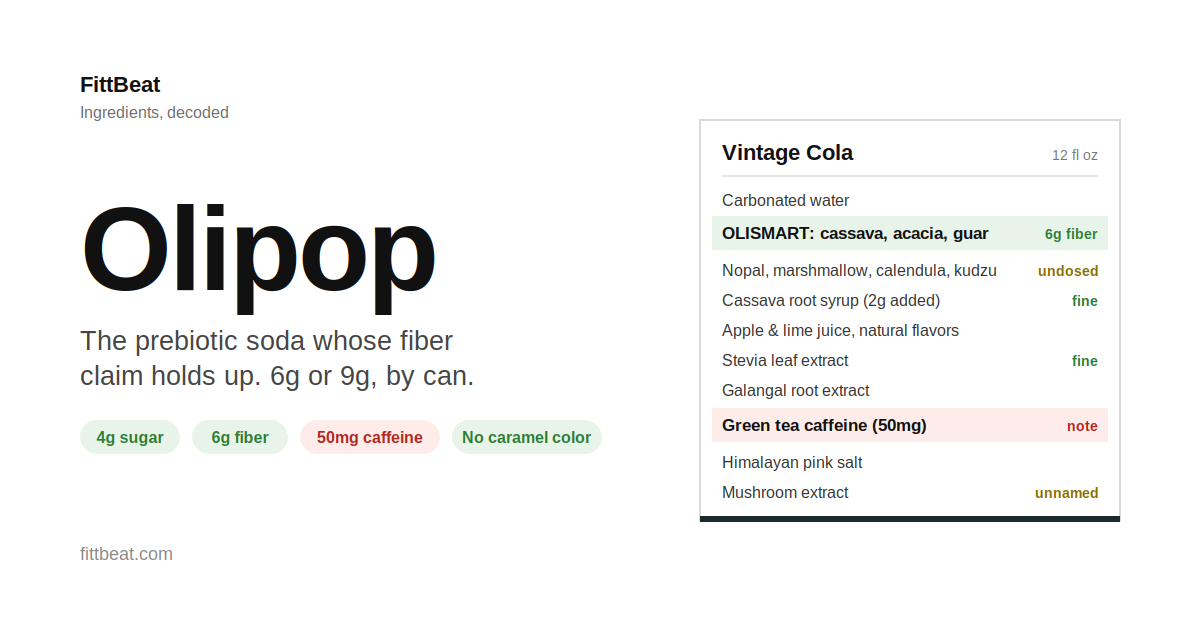

Last reviewed: October 2026. Reflects the U.S. Olipop Vintage Cola, 12 fl oz, from the shelf-stable 6 g fiber line (“store anywhere, chill to enjoy”), photographed in store; Cherry Cola from the same shelf is noted for comparison. Olipop also sells its original refrigerated line with 9 g of fiber and a different fiber blend, compared below — check which can you’re holding.
Olipop is the soda that started the prebiotic-soda aisle in 2018, two years before Poppi, and it’s built on a bigger idea: not a splash of vinegar and a little inulin, but a real dose of fiber and a blend of plant extracts it trademarks as OLISMART. The label is long for a soda — sixteen ingredients, eight of them inside one parenthesis — and almost all of it is recognizable plants. Nothing on it is a concern. The interesting questions are how much of the blend is doing anything, why there are now two versions of every flavor with different fiber, and whether the cola with no caramel color and 50 mg of caffeine is actually a better cola. Here’s every Olipop ingredients from the current can, what the research says about the fiber at 6 g versus 9 g, and how it compares to Poppi and to the soda it replaces.
Quick answer: what’s in Olipop?
Olipop Vintage Cola is carbonated water, the OLISMART blend (cassava root fiber, acacia fiber, guar fiber, and extracts of nopal cactus, marshmallow root, calendula flower, and kudzu root), cassava root syrup, apple juice concentrate, natural flavors, lime juice concentrate, stevia leaf extract, galangal root extract, green tea caffeine, Himalayan pink salt, and mushroom extract. A 12 oz can has 40 calories, 6 g of fiber, 4 g of sugar (2 g added), 30 mg of sodium, 50 mg of caffeine, and 5% juice. That’s a tenth of a Coke’s sugar and twice a Poppi’s fiber, from three gentle fibers rather than inulin — so it makes the strongest prebiotic case of the mainstream sodas and is less likely to cause bloating than older Olipop. The refrigerated 9 g line goes further. The botanicals are safe and mostly decorative. A genuinely good soda; still a soda.
Jump to: The label · Each ingredient · 6 g vs. 9 g: the two Olipops · Does the fiber do anything? · Nutrition · Olipop vs. Poppi · Verdict · FAQ
The full Olipop ingredients list
Carbonated Water, OLISMART (Cassava Root Fiber, Acacia Fiber, Guar Fiber, Nopal Cactus*, Marshmallow Root*, Calendula Flower*, Kudzu Root*), Cassava Root Syrup, Apple Juice Concentrate, Natural Flavors, Lime Juice Concentrate, Stevia Leaf*, Alpinia Galanga Root*, Green Tea Caffeine*, Himalayan Pink Salt, Mushroom*. *Extract. Caffeine: 50 mg per can.
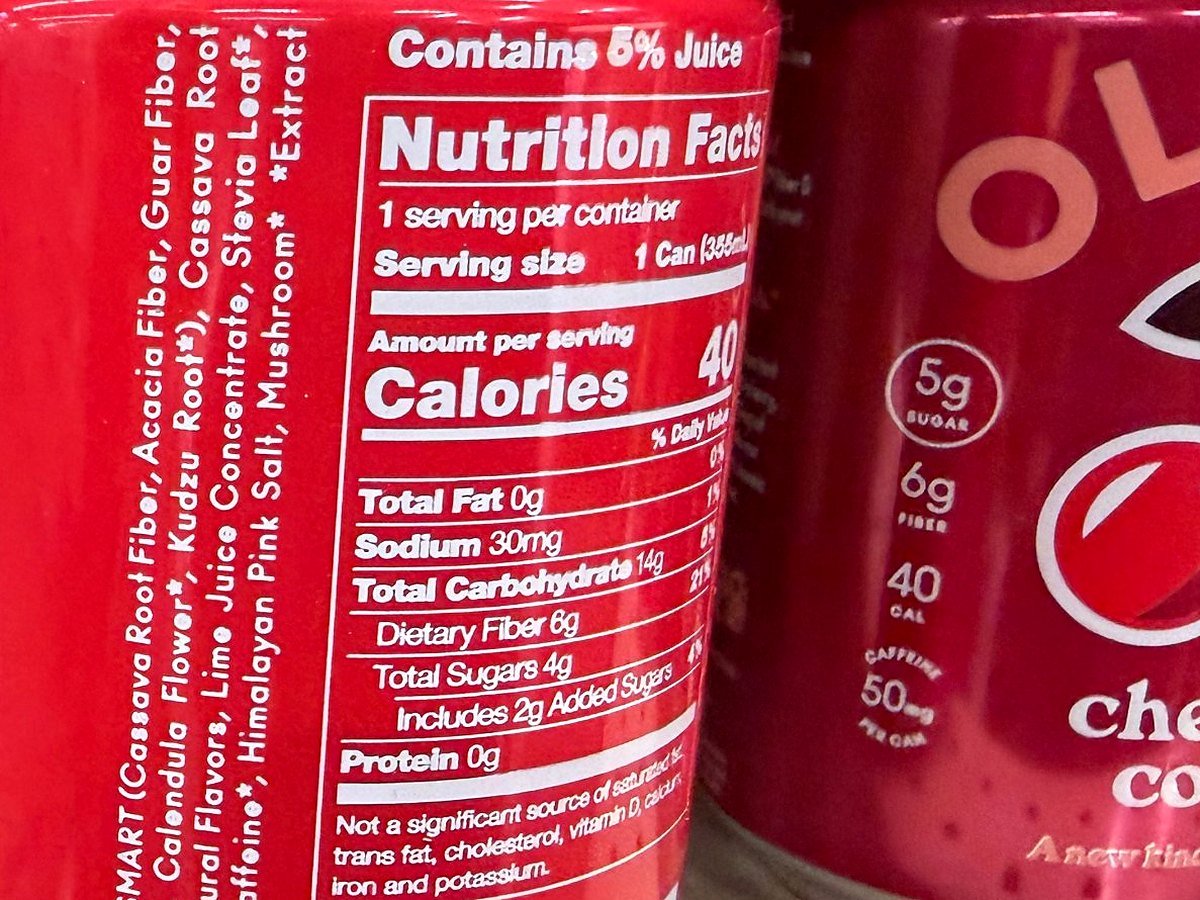
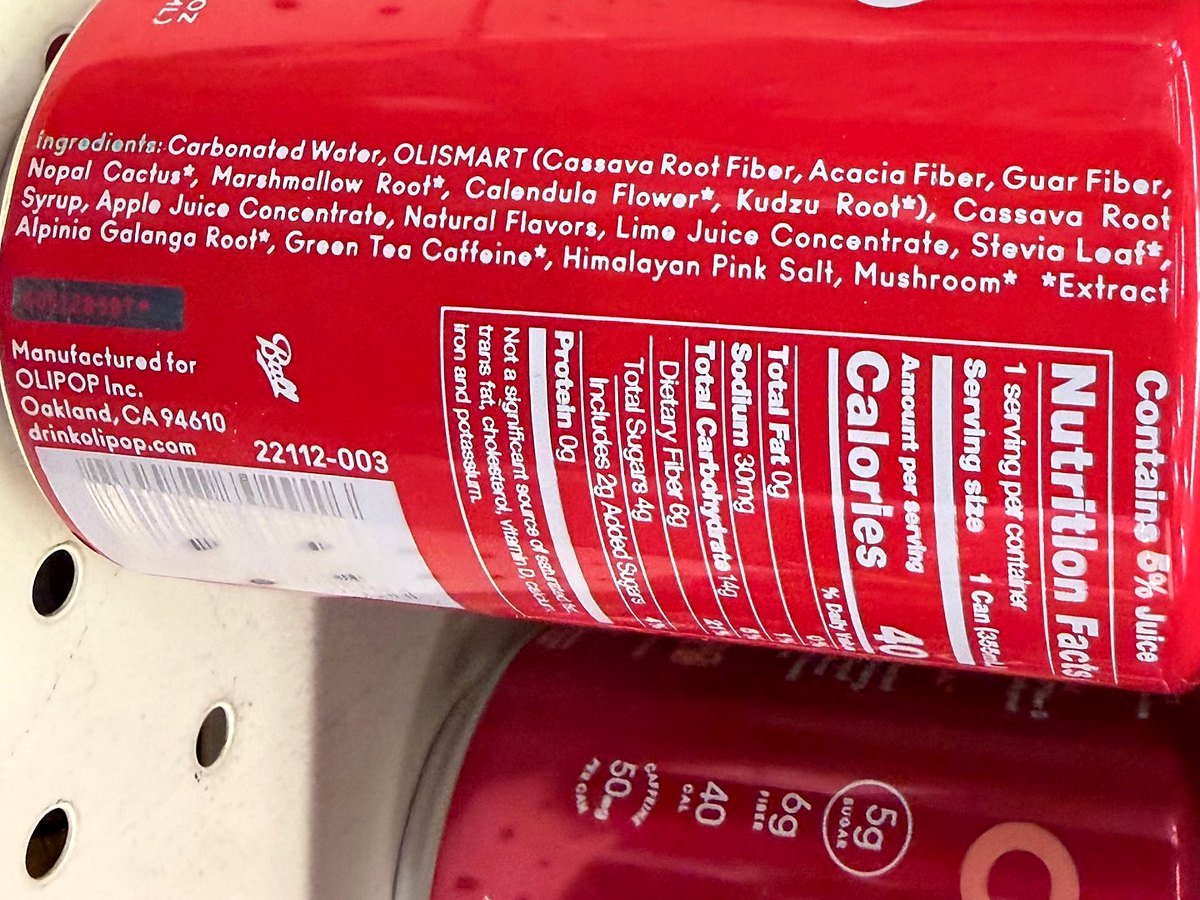
Three things to notice. OLISMART comes second, right after the water — the fiber blend outweighs every sweetener on the label, which is the opposite of most “functional” sodas, where the functional part trails the sugar. The sweetness comes from three places in small amounts: cassava root syrup (the 2 g of added sugar), apple juice (most of the other 2 g), and stevia. And for a cola, what’s missing is notable: no caramel color, no phosphoric acid, no high fructose corn syrup, no artificial sweeteners, no preservatives. It’s a cola without any of the four ingredients that define a Coke label.
Olipop ingredients explained
Carbonated water Fine
The base, and most of the can.
OLISMART: cassava root, acacia, and guar fiber The real thing, 6 g
Three soluble fibers that together supply the 6 g on the label — 21% of the daily value, more than most people get from a serving of vegetables. Cassava root fiber is a resistant dextrin from the yuca root; acacia fiber (gum arabic) comes from acacia tree sap; partially hydrolyzed guar fiber comes from the guar bean. All three pass undigested into the colon, where gut bacteria ferment them into short-chain fatty acids — the definition of a prebiotic. The choice matters: acacia and guar are among the best-tolerated fibers studied, fermenting slowly and producing less gas than inulin, which is what the older and refrigerated Olipop leans on. Partially hydrolyzed guar gum in particular has a solid trial record for regularity and IBS symptoms at 5–10 g a day. This is the strongest single argument for Olipop over its competitors.
OLISMART botanicals: nopal cactus, marshmallow root, calendula, kudzu root Present, undosed
Four plant extracts with long histories in herbal medicine: nopal (prickly pear cactus pad) for blood sugar, marshmallow root as a soothing mucilage for the throat and gut, calendula as an anti-inflammatory flower, and kudzu root, studied for alcohol cravings. Each has some laboratory or small-trial evidence at supplement doses. None of the doses are disclosed, and as extracts listed after three fibers inside a blend, they’re almost certainly far below anything studied. They’re safe, they contribute to the “botanical” flavor, and there’s no reason to think they’re doing what the herbal literature describes at these amounts. This is the “proprietary blend” problem in a gentle form.
Cassava root syrup 2 g added sugar
A syrup made by breaking down cassava starch into sugars, mostly glucose and maltose. It’s the source of the 2 g of added sugar — half a teaspoon — and it’s what gives the can some real-sugar roundness that pure stevia drinks lack. At this amount, the type of sugar doesn’t matter metabolically.
Apple and lime juice concentrates Fine
The can says 5% juice. Apple supplies most of the remaining 2 g of sugar and body; lime supplies the acidity that phosphoric acid provides in a regular cola. Not enough to count as fruit; enough to sweeten and sharpen without additives.
Natural flavors Undisclosed
The cola itself — typically vanilla, cinnamon, citrus oils, and spice. Plant-derived, composition not disclosed; standard for every cola, including Coke.
Stevia leaf extract Low concern
The zero-calorie sweetener that carries most of the sweetness. Plant-derived, GRAS in the U.S., with a clean regulatory record; the gut-bacteria research on stevia is small and mixed, and at this dose it isn’t a concern. It’s why the can is 40 calories rather than 140.
Alpinia galanga root extract Undosed
Galangal, a ginger-family root used in Thai cooking. It’s in the cola and caffeinated flavors and is marketed elsewhere as a “focus” ingredient based on a couple of small, supplement-dose trials. Safe; probably flavor here.
Green tea caffeine 50 mg
Caffeine extracted from green tea, 50 mg per can — more than a Coke (34 mg) or Diet Coke (46 mg), about half a cup of coffee. It’s chemically identical to any other caffeine; “from green tea” is sourcing, not a gentler form. Vintage Cola, Cherry Cola, and a few other flavors are caffeinated and say so on the front of the can; the fruit flavors are caffeine-free. Worth knowing for kids and for evening cans.
Himalayan pink salt 30 mg sodium
A pinch, for flavor. 30 mg of sodium; “Himalayan pink” is marketing.
Mushroom extract Unspecified
The most unusual ingredient on the can, and the least explained: “mushroom extract,” with no species named. In beverages, mushroom extracts are used as flavor modifiers that mask the bitterness of stevia and round out sweetness — a known food-tech use — rather than as the “functional mushrooms” (lion’s mane, reishi) sold as supplements. Nothing on the label claims a health benefit for it. Safe, almost certainly a taste fixer, and an ingredient the label could describe better.
6 g vs. 9 g: the two Olipops
Olipop now sells every core flavor in two versions, and they’re easy to confuse on the shelf. The original line is refrigerated, carries 9 g of fiber, and builds OLISMART from chicory root inulin, Jerusalem artichoke inulin, and cassava root fiber. The newer shelf-stable line — the one photographed here, marked “store anywhere, chill to enjoy” on the rim — carries 6 g, and swaps the two inulins for acacia and guar fiber, keeping cassava. Both use the same four botanicals and similar sugar.
The trade-off is real in both directions. The 9 g line has more fiber, squarely in the dose range where prebiotic trials show effects, but inulin is a FODMAP and is the main reason people report gas and bloating from Olipop. The 6 g line has a third less fiber, but its fibers are gentler, so it’s the better choice for anyone who found the original uncomfortable — and it can sit in a pantry. If you’re buying Olipop for the fiber, the refrigerated can is the stronger product. If you’re buying it as a soda you can drink without thinking about your stomach, the shelf-stable can is the better one. Older articles that say “Olipop has 9 g of fiber” are describing the refrigerated line, not every can.
Does Olipop’s fiber actually do anything?
More than any other mainstream soda’s. The International Scientific Association for Probiotics and Prebiotics treats about 3–5 g a day as a floor for a meaningful prebiotic dose, and trials showing measurable changes in gut bacteria or bowel habits typically use 5–10 g. One shelf-stable Olipop is 6 g, above that floor; the refrigerated line at 9 g is in the middle of the studied range. Compare Poppi at 3 g, which settled a lawsuit over exactly this gap. Fiber is also simply under-eaten: the average American gets about 15 g a day against a 25–38 g recommendation, so 6–9 g from a soda is a meaningful dent.
The honest limits. Olipop’s own clinical studies are small and company-funded, and “supports digestive health” is a structure-function claim, not a disease claim. Most of the benefit comes from the fiber, which you could get from a bowl of oatmeal or a handful of beans; the botanicals aren’t adding much. And fiber works best spread across a day, not in one can. But as sodas go, this is the first one where the number on the front matches the dose in the research.
Olipop nutrition facts
| Per 12 oz can | Olipop Vintage Cola (6 g line) | Olipop refrigerated (9 g line) | Poppi | Pepsi Prebiotic Cola | Coca-Cola | Diet Coke |
|---|---|---|---|---|---|---|
| Calories | 40 | 35–50 | 30 | 30 | 140 | 0 |
| Sugar (added) | 4 g (2 g) | 2–5 g | 5 g (4 g) | 5 g | 39 g (39 g) | 0 g |
| Fiber | 6 g | 9 g | 3 g | 3 g | 0 g | 0 g |
| Fiber sources | Cassava, acacia, guar | Chicory inulin, Jerusalem artichoke inulin, cassava | Cassava, agave inulin | Inulin | — | — |
| Sweetener | Cassava syrup + juice + stevia | Cassava syrup + juice + stevia | Cane sugar + stevia | Cane sugar + stevia | HFCS | Aspartame |
| Caffeine | 50 mg | 50 mg (colas) | 0 (32 mg in 4 flavors) | 38 mg | 34 mg | 46 mg |
| Sodium | 30 mg | ~35 mg | 0 mg | ~35 mg | 45 mg | 40 mg |
| Caramel color / phosphoric acid | No / No | No / No | No / No | Yes / Yes | Yes / Yes | Yes / Yes |
| Preservatives | None | None | None | None | None | Sodium benzoate |
Olipop shelf-stable and Poppi figures are from cans photographed side by side in October 2026; the refrigerated-line range is from Olipop’s current labels and varies by flavor; Pepsi Prebiotic Cola, Coke, and Diet Coke from current labels and our breakdowns.
Olipop vs. Poppi
They sit next to each other and get bought for the same reason, but the labels make different bets. Olipop bets on fiber: 6 g on the shelf-stable can and 9 g on the refrigerated one, from three sources, ahead of every sweetener on the list. Poppi bets on taste and lightness: 3 g of fiber, a splash of apple cider vinegar, and a bit more cane sugar, with a cleaner soda flavor many people prefer. On sugar they’re a wash (4 g vs 5 g). On the gut claim, Olipop is clearly stronger — it’s the one that clears the research floor — and the shelf-stable version has closed most of the bloating gap by dropping inulin. On ownership, Olipop is still independent while Poppi is now PepsiCo’s. If you’re choosing for fiber, Olipop. If you’re choosing for flavor, buy whichever you like; both beat a Coke by 35 grams of sugar.
Is Olipop healthy?
FittBeat verdict
The best soda in the prebiotic aisle, and the one whose fiber claim holds up. Six grams of well-tolerated fiber (nine in the refrigerated can), four grams of sugar, no caramel color, no phosphoric acid, no artificial sweeteners, no preservatives — every line of this label is an improvement on the cola it replaces, and the fiber dose is the first in the category that matches the research. The botanical half of OLISMART is mostly marketing, the mushroom extract deserves a species name, and the colas carry 50 mg of caffeine that the “healthy soda” framing tends to hide. Drink it as a better soda and you’ll get a real bonus of fiber. Just don’t mistake a can for a vegetable.
The concerns, ranked by evidence:
- Bloating and gas. Any 6–9 g dose of fiber can cause it, especially starting cold; the refrigerated line’s inulin is the bigger culprit, and the shelf-stable blend is gentler.
- Caffeine in the colas. 50 mg, more than a Coke; worth knowing for kids, pregnancy, and evening cans.
- Undisclosed blend doses. Not a safety issue — just that the botanicals’ benefits can’t be assumed at unknown amounts.
- Teeth. Juice and lime make it acidic, though without phosphoric acid it’s milder than cola.
- Everything else. Cassava syrup, stevia, juice, salt, mushroom extract: no credible concern.
Olipop for kids, keto, diabetes, and IBS
Kids: a fruit-flavor Olipop is one of the better soda swaps there is — 2–5 g of sugar, no caffeine, no dyes. Skip the colas, which have 50 mg of caffeine, and start with half a can; 6–9 g of fiber is a lot for a small gut.
Keto: 14 g of carbohydrate with 6 g of fiber puts net carbs around 8 g on the shelf-stable can; Olipop markets the refrigerated line as keto-friendly. One in moderation fits most plans.
Diabetes: one of the best soda choices — 4 g of sugar, and soluble fiber slows absorption. Olipop cites a low glycemic load per can. Far better than regular soda.
IBS: the refrigerated line’s chicory and Jerusalem artichoke inulin are high-FODMAP and a common trigger. The shelf-stable line’s acacia and guar are much better tolerated, and partially hydrolyzed guar has trial evidence for IBS symptom relief. If Olipop has bothered you before, try the “store anywhere” can.
Cleaner alternatives
If you want the fiber without the soda: a teaspoon of acacia or partially hydrolyzed guar fiber powder in water delivers the same fibers for pennies, and a bowl of oatmeal or beans does it with food. If you want zero sugar and no fiber claim: Zevia (stevia only). If you want a lighter soda with less fiber: Poppi. And if the goal is simply to drink less sugar than a Coke and get some fiber while you’re at it, Olipop is already the honest answer.

Frequently asked questions
What is OLISMART?
Olipop’s trademarked blend of prebiotic fibers and botanical extracts. On shelf-stable cans it’s cassava root fiber, acacia fiber, and guar fiber plus extracts of nopal cactus, marshmallow root, calendula flower, and kudzu root. The refrigerated line uses chicory root inulin, Jerusalem artichoke inulin, and cassava root fiber with the same botanicals.
How much fiber is in Olipop?
6 g per can on the shelf-stable line (“store anywhere, chill to enjoy”) and 9 g on the original refrigerated line. Both are more than any other mainstream soda; 6 g is 21% of the daily value.
How much sugar is in Olipop?
Vintage Cola has 4 g, of which 2 g is added (from cassava root syrup); the rest is from apple juice. Most flavors range from 2 to 5 g, sweetened with juice, cassava syrup, and stevia.
Does Olipop have caffeine?
The colas do: Vintage Cola and Cherry Cola have 50 mg per can, from green tea extract — more than a Coke. The fruit flavors are caffeine-free. Caffeinated flavors are marked on the front of the can.
Why does Olipop make me bloated?
Fiber, especially inulin. The refrigerated 9 g line uses chicory and Jerusalem artichoke inulin, which are high-FODMAP and ferment quickly. The shelf-stable 6 g line uses acacia and guar fiber, which are gentler. Starting with half a can and drinking it with food also helps.
Is Olipop better than Poppi?
For fiber, yes: 6–9 g versus Poppi’s 3 g, which puts Olipop in the range where prebiotic research shows effects. Sugar is similar (about 4 vs 5 g). Poppi tastes lighter and has no sodium; many people prefer it on flavor.
What is the mushroom extract in Olipop?
The label doesn’t name the species. In beverages, mushroom extracts are typically used as flavor modifiers to mask the bitterness of stevia and round out sweetness, not as functional supplements. Olipop makes no health claim for it.
Is Olipop keto?
Mostly. The shelf-stable Vintage Cola has 14 g of carbohydrate with 6 g of fiber, about 8 g net carbs; Olipop markets its refrigerated line as keto-friendly.
Sources
- OLIPOP Inc. Nutrition facts and ingredients, Olipop Vintage Cola, 12 fl oz, shelf-stable line; Cherry Cola front panel. Product labels, photographed October 2026.
- OLIPOP. Two fiber lines: 6 g shelf-stable and 9 g refrigerated; OLISMART fiber sources by line. drinkolipop.com, accessed October 2026.
- Gibson GR, et al. Expert consensus document: The International Scientific Association for Probiotics and Prebiotics (ISAPP) consensus statement on the definition and scope of prebiotics. Nature Reviews Gastroenterology & Hepatology, 2017. doi:10.1038/nrgastro.2017.75
- Niv E, et al. Randomized clinical study: partially hydrolyzed guar gum (PHGG) versus placebo in the treatment of patients with irritable bowel syndrome. Nutrition & Metabolism, 2016. doi:10.1186/s12986-016-0070-5
- Calame W, et al. Gum arabic establishes prebiotic functionality in healthy human volunteers in a dose-dependent manner. British Journal of Nutrition, 2008. doi:10.1017/S0007114508981447
- Quagliani D, Felt-Gunderson P. Closing America’s fiber intake gap. American Journal of Lifestyle Medicine, 2017. doi:10.1177/1559827615588079
- U.S. FDA. Spilling the beans: how much caffeine is too much? fda.gov
- U.S. FDA. High-intensity sweeteners (steviol glycosides GRAS status). fda.gov
Refrigerated-line figures are ranges from Olipop’s current labels and vary by flavor. Olipop’s company-funded digestive studies are not cited as independent evidence.
This article is for informational purposes and is not medical advice. Talk to a doctor or registered dietitian about your individual nutrition needs.
