
Last reviewed: October 2026.
Phosphoric acid is the fourth ingredient in Coke, Pepsi, Dr Pepper, and every diet version of each, and it’s the reason a cola tastes sharp rather than syrupy. It’s also the ingredient with the most direct, visible harm in the can — not the sweetener, not the color, but the acid, because it does to tooth enamel exactly what an acid does. Beyond teeth, it’s been linked in observational studies to bone and kidney effects, specifically in cola drinkers and not in drinkers of other sodas. Here’s what phosphoric acid is, why it’s in cola and nothing else, and what each of those three concerns rests on.
Quick answer: is phosphoric acid bad for you?
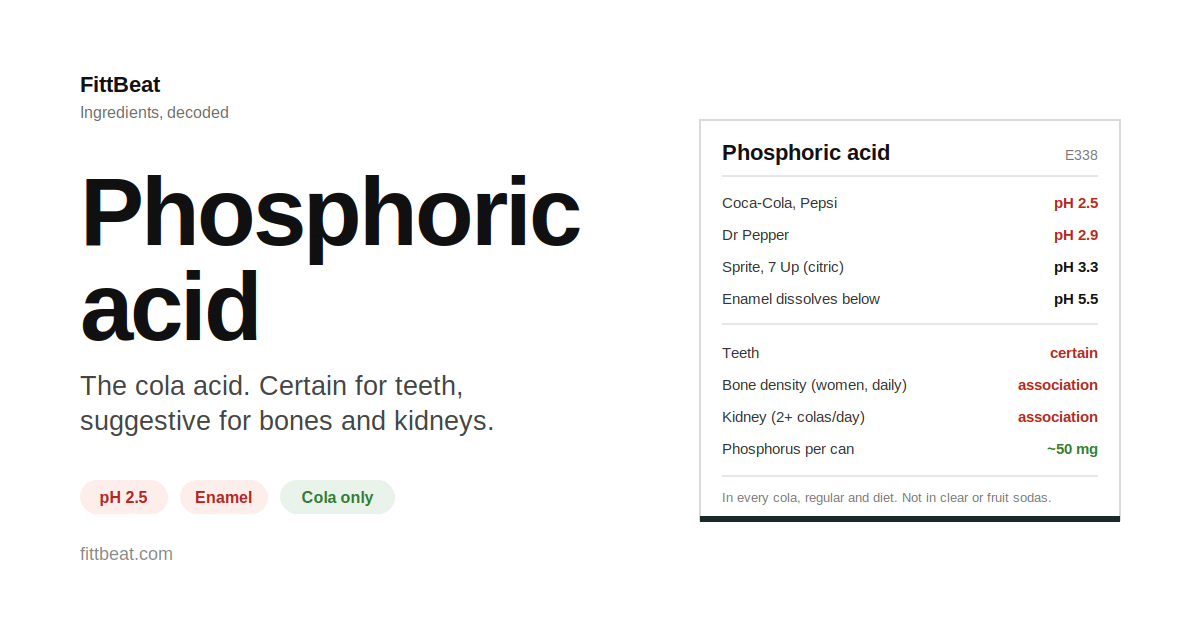
For your teeth, yes, in proportion to how long you sip: it drops cola to a pH around 2.5, comparable to lemon juice, and softens enamel on contact. For your bones and kidneys, the evidence is observational and shows up at two or more colas a day — lower bone density in women, higher chronic kidney disease risk — and it’s suggestive rather than proven. The phosphorus it adds (about 40–60 mg a can) is trivial next to the 1,000-plus mg in a normal diet, so the “it leaches calcium” explanation is probably not the mechanism; displacing milk and the acid load are more likely. Phosphoric acid is in colas and almost nothing else; clear and fruit sodas use citric acid instead.
Jump to: What it is · Teeth · Bones · Kidneys · Which drinks have it · Verdict · FAQ
What phosphoric acid is and why it’s in cola
Phosphoric acid (E338) is a mineral acid made from phosphate rock. In food it’s used as an acidulant — the thing that makes a drink tart — and cola uses it instead of the citric acid in nearly every other soda for two reasons. It’s cheaper, and it has a flat, sharp taste without citrus notes, which is what you want behind caramel and cola flavoring. It also helps keep the deep caramel color stable.
It’s the reason cola’s pH is so low. Coke tests at about 2.5, Pepsi around 2.5, Dr Pepper 2.9; Sprite and 7 Up, on citric acid, sit near 3.3. That difference sounds small, but pH is logarithmic: a cola is roughly six times more acidic than a lemon-lime soda. Diet versions are just as acidic as regular — the acid isn’t the sugar.
Teeth
This is the clearest effect, and it’s not controversial. Enamel begins to dissolve below a pH of about 5.5; cola is a hundred times more acidic than that. Dental studies that soak extracted teeth in cola measure enamel loss within hours, and the pattern in patients is specific: erosion on the front surfaces of the upper front teeth and the chewing surfaces of molars, distinct from the pattern of ordinary decay. Sugar makes it worse by feeding acid-producing bacteria, which is why regular cola is worse than diet for cavities even though both erode enamel equally.
Three things change the damage more than the quantity: how long the drink is in your mouth (sipping a can over an hour exposes teeth to more acid cycles than finishing it in five minutes), whether you drink it with food (which buffers the acid and stimulates saliva), and whether you brush immediately after (brushing softened enamel removes it; waiting 30 minutes lets saliva re-harden it). Rinsing with water afterward helps; a straw helps a little.
Bones
The study everyone cites is from the Framingham Osteoporosis Study, published in 2006: among about 2,500 adults, women who drank cola daily had lower bone mineral density at the hip than women who drank it less than once a month — and the effect held for diet cola and didn’t appear for non-cola sodas. That last part is what points at phosphoric acid, since it’s the ingredient colas have and other sodas don’t.
What the study doesn’t show is why, or that cola causes it. Three explanations compete. The old one — that phosphorus pulls calcium out of bone — is probably wrong at these amounts: a can of cola has about 40–60 mg of phosphorus against a daily intake of 1,000–1,500 mg from food, and the phosphorus-to-calcium ratio in the whole diet barely moves. The second is displacement: people who drink a lot of cola tend to drink less milk, and the Framingham data partly supported that. The third is the acid load itself, which the body buffers in part with calcium. The honest reading: a consistent association at daily intake, in women, with an unclear mechanism. Not proven causal; not nothing.
Kidneys
A 2007 case-control study found that drinking two or more colas a day — regular or diet — was associated with roughly double the odds of chronic kidney disease, while non-cola sodas showed no association. Again the cola-specific pattern implicates phosphoric acid. Proposed mechanisms include phosphate load and acid load on the kidney; the study was observational, people with kidney problems may differ from controls in other ways, and it hasn’t been followed by a trial. For people who already have kidney disease, phosphate additives in general are a real concern and are routinely restricted by nephrologists; phosphoric acid in cola is one source among many.
Which drinks have phosphoric acid
| Drink | Acid | Approx. pH |
|---|---|---|
| Coca-Cola, Diet Coke, Coke Zero | Phosphoric (+ citric in Diet Coke) | 2.5–3.2 |
| Pepsi | Phosphoric + citric | 2.5 |
| Dr Pepper | Phosphoric | 2.9 |
| Sprite, 7 Up | Citric | 3.3 |
| Mountain Dew | Citric | 3.1 |
| Fanta, Sunkist | Citric | 2.9–3.0 |
| Red Bull, Monster | Citric | 3.3–3.4 |
| Gatorade, Prime | Citric | 3.0–3.5 |
Note that citric-acid sodas are still acidic enough to erode enamel — the teeth advice applies to all of them. What’s cola-specific is the bone and kidney evidence, which tracks phosphoric acid rather than acidity in general.
Is phosphoric acid bad for you?
FittBeat verdict
The most direct harm in a cola, and the one you can manage. Enamel erosion is certain and proportional to sipping time. The bone and kidney links are real associations at daily intake with unproven mechanisms — enough to matter if you drink two colas a day, not enough to worry about an occasional one. Drink colas with food, finish them rather than nursing them, rinse with water after, and don’t brush for half an hour. If you’re a daily cola drinker with bone or kidney concerns, this is a better reason to cut back than the sweetener is.
Frequently asked questions
Why is phosphoric acid in cola?
For tartness without citrus flavor, to stabilize the caramel color, and because it’s cheap. Nearly every non-cola soda uses citric acid instead.
Does phosphoric acid damage teeth?
Yes. It brings cola to about pH 2.5, far below the 5.5 at which enamel starts to dissolve. The damage depends more on how long you sip than how much you drink.
Does cola cause osteoporosis?
Not proven. The Framingham study found lower hip bone density in women who drank cola daily, including diet cola, but not in drinkers of other sodas. The mechanism is unclear and the study is observational.
Is phosphoric acid bad for your kidneys?
A 2007 study linked two or more colas a day to higher chronic kidney disease risk; other sodas showed no link. It’s an association, not a proven cause. People with existing kidney disease are generally advised to limit phosphate additives, including cola.
Does Diet Coke have phosphoric acid?
Yes — all Coke, Pepsi, and Dr Pepper variants, regular and diet, contain it. Removing the sugar doesn’t remove the acid.
Which sodas don’t have phosphoric acid?
Sprite, 7 Up, Mountain Dew, Fanta, Sunkist, ginger ale, and most energy and sports drinks use citric acid instead. They’re still acidic enough to erode enamel.
How much phosphorus is in a can of cola?
About 40–60 mg, against a typical daily intake of 1,000–1,500 mg from food. The phosphorus itself is not the concern; the acidity is.
Is phosphoric acid the same as the acid in batteries?
No. Car batteries use sulfuric acid. Phosphoric acid is food-grade, used at low concentration, and also found in rust removers at much higher concentration — a different product, not what’s in cola.
Sources
- Tucker KL, et al. Colas, but not other carbonated beverages, are associated with low bone mineral density in older women: the Framingham Osteoporosis Study. American Journal of Clinical Nutrition, 2006. doi:10.1093/ajcn/84.4.936
- Saldana TM, et al. Carbonated beverages and chronic kidney disease. Epidemiology, 2007. doi:10.1097/EDE.0b013e3180646338
- Reddy A, et al. The pH of beverages in the United States. Journal of the American Dental Association, 2016. doi:10.1016/j.adaj.2015.10.019
- Lussi A, Jaeggi T. Erosion — diagnosis and risk factors. Clinical Oral Investigations, 2008. doi:10.1007/s00784-007-0179-z
- Heaney RP, Rafferty K. Carbonated beverages and urinary calcium excretion. American Journal of Clinical Nutrition, 2001 (the phosphorus-vs-displacement question). doi:10.1093/ajcn/74.3.343
- National Institutes of Health, Office of Dietary Supplements. Phosphorus fact sheet for health professionals. ods.od.nih.gov
- EFSA. Re-evaluation of phosphoric acid–phosphates (E 338–341, E 343, E 450–452) as food additives. EFSA Journal, 2019. doi:10.2903/j.efsa.2019.5674
This article is for informational purposes and is not medical advice. Talk to a doctor or registered dietitian about your individual nutrition needs.
