
Last reviewed: October 2026. Reflects the current U.S. 12 fl oz 7 Up formula (Keurig Dr Pepper). 7 Up Zero Sugar is compared below.
7 Up has six ingredients, no caffeine, no color, and — the detail its history is famous for — no lithium, which it contained until 1948. Today it’s the closest thing on the shelf to Sprite: same sugar, same acid, same flavor family, and one different ingredient at the end of the list. Here’s all 7-Up ingredients, what it does, how it compares to Sprite, and why “hidden dangers” is the wrong frame for a drink whose only real issue is in plain sight on the nutrition panel.
Quick answer: what’s in 7 Up?
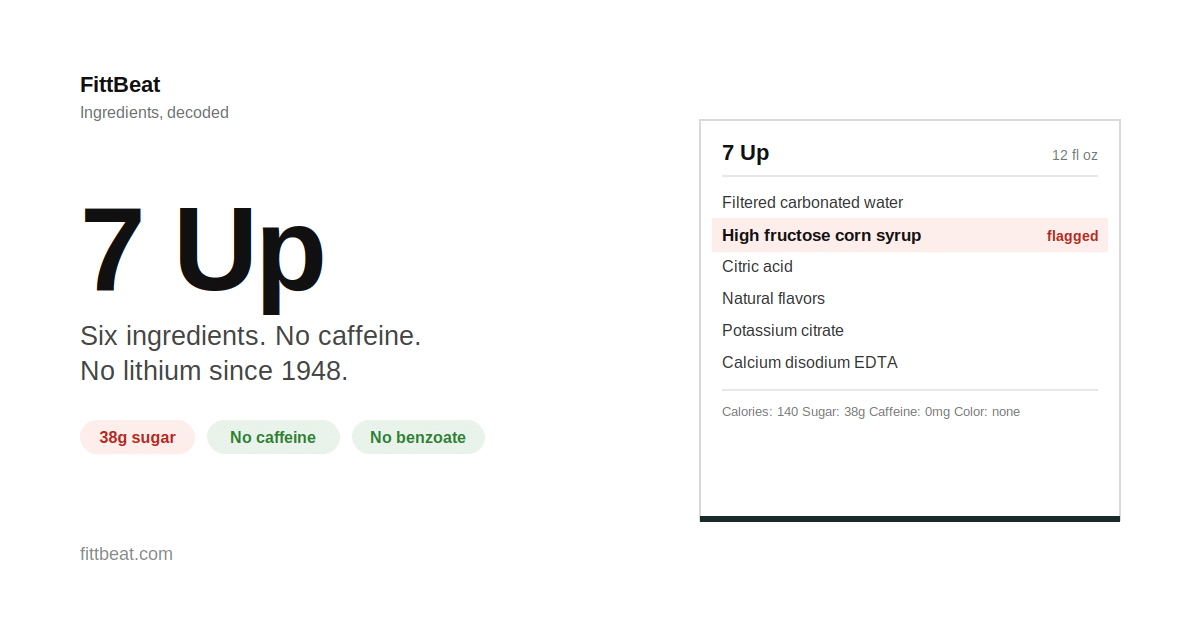
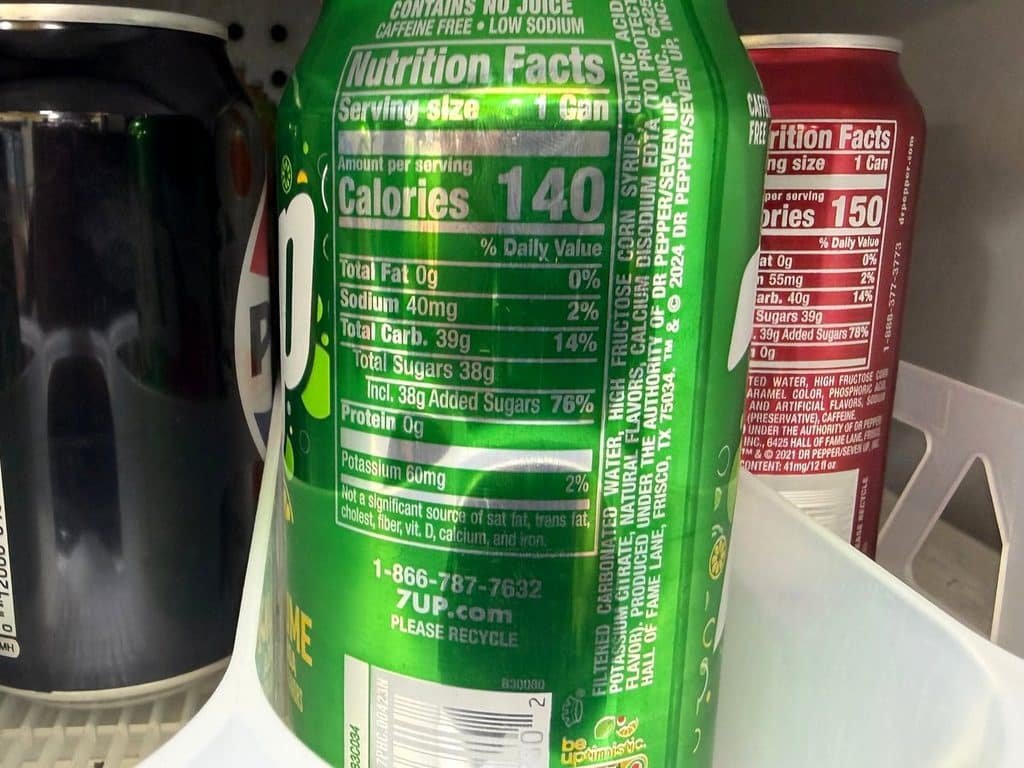
7 Up is filtered carbonated water, high fructose corn syrup, citric acid, natural flavors, potassium citrate, and calcium disodium EDTA. A 12 oz can has 140 calories, 38 g of sugar (about 9.5 teaspoons), 45 mg sodium, and no caffeine. There’s no color, no artificial sweetener, and no benzoate preservative — 7 Up uses EDTA, a metal-binding agent, to protect flavor instead. The sugar is the whole health story; everything else on the label is low concern. It is nearly identical to Sprite, and neither is a healthier choice than the other.
Jump to: The label · Each ingredient · The lithium story · Nutrition · 7 Up vs. Sprite · 7 Up Zero Sugar · Verdict · FAQ
The full 7-Up ingredients list
Filtered Carbonated Water, High Fructose Corn Syrup, Citric Acid, Natural Flavors, Potassium Citrate, Calcium Disodium EDTA (To Protect Flavor).
Six ingredients. Against Sprite’s six, the differences are the citrate (potassium instead of sodium, so 7 Up has a little less sodium) and the last ingredient: EDTA instead of sodium benzoate. 7 Up is one of the few mainstream sodas without a benzoate preservative, which is a small but real point in its favor given the benzoate-vitamin C chemistry covered in our sodium benzoate breakdown.
7-Up ingredients explained
Filtered carbonated water Fine
Water with dissolved CO₂. “Filtered” is on the label because 7 Up’s bottlers filter municipal water before carbonating; it’s standard, just stated.
High fructose corn syrup Flagged
38 g per can, identical to Sprite and one gram less than Coke. HFCS-55 is close to table sugar in composition and the body handles them nearly the same; the problem is 38 g of fast liquid sugar with nothing to slow it. Daily sugar-sweetened soda is one of the most consistent dietary predictors of weight gain, type 2 diabetes, and fatty liver in the long-term research, and clear soda counts exactly as much as brown. A 20 oz bottle is 64 g. Our high fructose corn syrup breakdown covers the science and the corn-syrup-vs-sugar question.
Citric acid Fine, with a teeth note
The tartness, in place of a cola’s phosphoric acid. Same molecule as in lemons. 7 Up’s pH is around 3.3 — less acidic than cola, still well into enamel-softening range, and lab studies rate lemon-lime sodas about as erosive as colas because citrate binds calcium. The sipping-is-worse rule applies; the cola-specific bone and kidney associations don’t.
Natural flavors Undisclosed
The lemon-lime. Plant-derived flavor compounds, proprietary blend. “Natural” means the source, not simplicity. 7 Up’s flavor is slightly more lemon-forward than Sprite’s; that’s the whole taste difference between them.
Potassium citrate Fine
A buffer that smooths the citric acid’s edge. Sprite uses sodium citrate for the same job; 7 Up’s potassium version is why its sodium is 45 mg rather than Sprite’s 65. Trace amount of potassium; no concern.
Calcium disodium EDTA (to protect flavor) Low concern
A chelating agent: it binds trace metals (copper, iron) from water and the can that would otherwise degrade the flavor. It’s how 7 Up gets by without a benzoate preservative. EDTA is widely used, approved at low limits, poorly absorbed, and excreted unchanged; at the amount in a soda it’s not a concern. It’s also an ingredient in Mountain Dew and Gatorade Zero, where it does the same job alongside other preservatives.
The lithium story
7 Up launched in 1929 as “Bib-Label Lithiated Lemon-Lime Soda,” and until 1948 it contained lithium citrate — the same lithium compound later used as a psychiatric mood stabilizer, which at the time was marketed as a hangover cure and mood lifter. The FDA banned lithium in soft drinks in 1948, and it’s been gone for nearly 80 years. It’s a fun fact, it’s the origin of a persistent rumor, and it’s the only “hidden” thing 7 Up ever had in it. The current label has nothing hidden; the sugar is on the front.
7 Up nutrition facts
| Per 12 oz can | 7 Up | 7 Up Zero Sugar | Sprite | Coca-Cola | Mountain Dew |
|---|---|---|---|---|---|
| Calories | 140 | 0 | 140 | 140 | 170 |
| Sugar | 38 g | 0 g | 38 g | 39 g | 46 g |
| Sweetener | HFCS | Aspartame + Ace-K | HFCS | HFCS | HFCS |
| Caffeine | 0 mg | 0 mg | 0 mg | 34 mg | 54 mg |
| Sodium | 45 mg | 45 mg | 65 mg | 45 mg | 60 mg |
| Color | None | None | None | Caramel | Yellow 5 |
| Preservative | None (EDTA) | Potassium benzoate | Sodium benzoate | None | Benzoate + erythorbic acid |
7 Up vs. Sprite
Nutritionally the same drink: 140 calories, 38 g of sugar, no caffeine, no color, citric acid. The two differences are 20 mg of sodium (7 Up has less) and the preservative strategy — Sprite uses sodium benzoate, 7 Up uses EDTA and no benzoate. Neither is a health difference you’d notice. Pick by taste: 7 Up is a touch more lemon, Sprite a touch more lime and sharper. If you’re specifically avoiding benzoates, 7 Up is the one. Our Sprite breakdown goes line by line.
7 Up Zero Sugar
Drops the 38 g of corn syrup for aspartame plus acesulfame potassium — and, because sugar was doing part of the preserving, adds potassium benzoate. So the zero version is the one with a benzoate; the regular version isn’t. It carries the phenylalanine warning. For a daily lemon-lime habit, it removes the only real problem on the regular label; the artificial-sweetener questions are covered in the aspartame post.
Is 7 Up bad for you?
FittBeat verdict
A clean label with one problem, and the problem is 38 g of sugar. No caffeine, no color, no benzoate — 7 Up’s ingredient list is about as short and unobjectionable as a mainstream soda gets, and the lithium left in 1948. None of that changes the fact that a can is a full day’s added sugar. Occasionally, with food, it’s a soda. Daily, it’s the intake linked to weight gain and type 2 diabetes. For a regular habit, Zero Sugar removes the sugar; for a sick day, flat 7 Up works for the same reason any sugared drink does.
The concerns, ranked by evidence:
- Sugar. 38 g, above the AHA’s daily limit for women and men in one can.
- Teeth. Citric acid at pH 3.3 plus sugar, sipped. Rinse after; wait before brushing.
- Everything else. Citrate and EDTA are stability ingredients with no meaningful evidence of harm at these amounts.
7 Up for keto, diabetes, kids, and sick days
Keto: no, 38 g of carbs. Zero Sugar is zero-carb.
Diabetes: fast liquid sugar; as bad for glucose control as any soda, which is also why a few ounces treats low blood sugar.
Kids: the better soda pick against cola (no caffeine, no color), and still 38 g against a 25 g daily limit.
Sick days: flat 7 Up helps nausea because sugar, water, and a little salt help; an oral rehydration solution does it with less sugar.
Cleaner alternatives
For lemon-lime without the sugar or artificial sweeteners: Zevia Lemon Lime (stevia) or Spindrift Lemon (sparkling water and real juice, almost no sugar). Sparkling water with a squeeze of lemon and lime is 7 Up’s recipe minus the corn syrup. If you want 7 Up, have a 7 Up — it’s a soda, and the rules for soda apply.
Frequently asked questions
Does 7 Up have caffeine?
No. 7 Up and 7 Up Zero Sugar are caffeine-free.
How much sugar is in 7 Up?
38 g per 12 oz can — about 9.5 teaspoons, the same as Sprite. A 20 oz bottle has 64 g.
Did 7 Up really contain lithium?
Yes, from its launch in 1929 until 1948, when the FDA banned lithium in soft drinks. It’s been lithium-free for nearly 80 years.
Is 7 Up healthier than Sprite?
No meaningful difference. Same sugar, calories, and acid; 7 Up has slightly less sodium and uses EDTA instead of a benzoate preservative.
Does 7 Up have preservatives?
Regular 7 Up has no benzoate preservative; it uses calcium disodium EDTA to protect flavor. 7 Up Zero Sugar adds potassium benzoate.
Is 7 Up healthier than Coke?
Slightly: no caffeine, no caramel color, no phosphoric acid. The sugar is nearly identical, and sugar is where soda’s health effects come from.
What is calcium disodium EDTA?
A chelating agent that binds trace metals so they don’t degrade flavor. Widely used, poorly absorbed, excreted unchanged; not a concern at soda levels.
Is 7 Up keto?
No, 38 g of carbs. 7 Up Zero Sugar is zero-carb.
Sources
- Keurig Dr Pepper. Nutrition facts and ingredients, 7 Up, 12 fl oz. Product label, photographed October 2026.
- Rippe JM, Angelopoulos TJ. Sucrose, high-fructose corn syrup, and fructose: their metabolism and potential health effects. Nutrients, 2016. doi:10.3390/nu8110697
- Malik VS, et al. Sugar-sweetened beverages and risk of metabolic syndrome and type 2 diabetes. Diabetes Care, 2010. doi:10.2337/dc10-1079
- Reddy A, et al. The pH of beverages in the United States. Journal of the American Dental Association, 2016. doi:10.1016/j.adaj.2015.10.019
- EFSA. Scientific opinion on the re-evaluation of calcium disodium ethylene diamine tetra-acetate (E 385) as a food additive. EFSA Journal, 2024. (Link to the EFSA Journal entry once confirmed.)
- American Heart Association. Added sugars: daily limits. heart.org
- EFSA. Scientific opinion on the re-evaluation of aspartame (E 951). EFSA Journal, 2013 (7 Up Zero sweetener). doi:10.2903/j.efsa.2013.3496
Lithium citrate history: 7 Up’s 1929 launch formulation and the FDA’s 1948 action on lithium in beverages, as documented in company history and trade press.
This article is for informational purposes and is not medical advice. Talk to a doctor or registered dietitian about your individual nutrition needs.
