
Last reviewed: October 2026. Summarizes published research and regulatory positions current as of that date, including EFSA’s April 2025 re-evaluation.
Acesulfame potassium is the artificial sweetener you’ve probably consumed the most of without ever searching for it. It’s rarely the headline sweetener on a label — that’s aspartame or sucralose — but it sits beside them in Coke Zero, Pepsi Zero, Powerade Zero, Prime Hydration, Monster Zero Ultra, Red Bull Sugarfree, and nearly every protein shake on the shelf. Food scientists call it the “blending” sweetener: it fixes the other sweetener’s aftertaste and makes the whole thing taste more like sugar. This article covers what acesulfame potassium is, why it’s always paired with something else, what the 2025 European safety review concluded, and which of the acesulfame potassium side effects people worry about have evidence behind them.
Quick answer: is acesulfame potassium bad for you?
Not according to any major regulator. The FDA has approved it since 1988, and in April 2025 the European Food Safety Authority finished its first full re-evaluation in 25 years, found no genotoxicity concern, and actually raised the acceptable daily intake from 9 to 15 mg/kg. The honest caveats: Ace-K is the least independently studied of the big sweeteners, animal studies have linked high doses to gut-bacteria changes and weight gain, it crosses the placenta and shows up in breast milk, and EFSA flagged a manufacturing impurity (5-chloro-acesulfame) that needs more data. Nothing has been shown to harm people at the amounts in a few drinks a day. “Under-studied but approved” is the fair summary.
What is acesulfame potassium?
Acesulfame potassium — also written acesulfame K, Ace-K, or E950 in Europe — is a synthetic sweetener discovered by accident in 1967 by a German chemist at Hoechst who licked his fingers while working on a different compound (the same origin story as saccharin, cyclamate, and aspartame). Chemically it’s a potassium salt of a small sulfur-and-nitrogen ring compound; it doesn’t resemble sugar at all, and the “potassium” in the name is just the salt form, not a meaningful potassium source.
Three properties explain why it’s everywhere:
- It’s about 200 times sweeter than sugar, so a can of soda needs only 40–60 mg.
- It’s heat- and acid-stable, unlike aspartame, so it survives baking, shelf life, and acidic drinks.
- Your body doesn’t metabolize it. About 99% is absorbed and excreted unchanged in urine within 24 hours. That’s the basis for “zero calories” and for the regulatory view that it’s inert.
Its one flaw is taste: on its own, Ace-K has a bitter, metallic aftertaste at higher concentrations. That’s why you almost never see it alone. Paired with aspartame or sucralose, each sweetener masks the other’s off-notes, the mix tastes closer to sugar, and manufacturers can use less of each. This is the “synergy” that keeps it in business.
Where acesulfame potassium hides
Water, Citric Acid, Electrolytes (Salt, Sodium Citrate, Magnesium and Calcium Chlorides, Mono-Potassium Phosphate), Vitamins B12 and C, Natural Flavors, Sucralose, Acesulfame Potassium, Calcium Disodium EDTA, Red 40, Blue 1.
Spot the pattern: it’s usually a few places after the main sweetener. From our breakdowns and beyond:
- Coke Zero Sugar, Sprite Zero, Pepsi Zero Sugar, Diet Pepsi, Diet Dr Pepper, Diet Mountain Dew (paired with aspartame or sucralose)
- Powerade Zero, Gatorade Zero, Propel, BodyArmor Lyte (paired with sucralose)
- Prime Hydration (paired with sucralose)
- Monster Zero Ultra, Red Bull Sugarfree, Rockstar Zero, Ghost, Alani Nu, Reign
- Premier Protein, Fairlife Core Power, Muscle Milk, and most whey protein powders
- Sugar-free gum (Trident, Extra), sugar-free syrups, “light” yogurts, sugar-free Jell-O
- Many children’s chewable vitamins and liquid medicines
- Coffee creamers, “zero sugar” ketchup and BBQ sauces, keto snacks
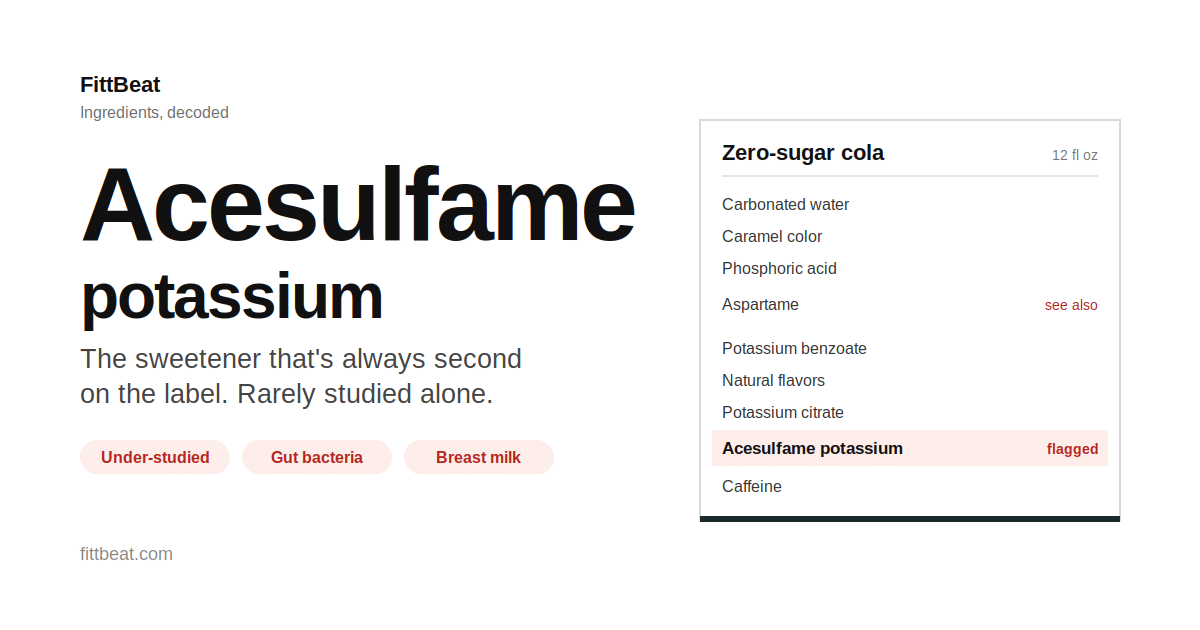
One useful tell: if a product says “zero sugar” and the sweetener list has two names, one of them is almost always acesulfame potassium. The notable holdout is Diet Coke, which still uses aspartame alone. Celsius is a rare exception that uses sucralose alone.
Acesulfame potassium side effects: what the evidence shows
Ranked from most to least substantiated.
1. It’s been studied less than the others The core concern
This isn’t a side effect so much as the reason the question stays open. Ace-K was approved in the U.S. in 1988 largely on the basis of two rat studies from the 1970s and 80s. The Center for Science in the Public Interest petitioned the FDA in 1996 arguing those studies were poorly designed and that two of them suggested tumors; the FDA disagreed and expanded approval to soft drinks in 1998 and general use in 2003. Compared to aspartame (hundreds of human studies) and sucralose (dozens), the independent human literature on Ace-K alone is thin — partly because it’s nearly always consumed in a blend, which makes it hard to isolate.
EFSA’s 2025 re-evaluation is the most thorough look so far. It reviewed everything published since the 2000 assessment, found no evidence of DNA damage from Ace-K or its breakdown products, set an ADI of 15 mg/kg based on a chronic rat study, and noted that even the highest-consuming Europeans stay below it. It also recommended tighter limits on lead and mercury in commercial Ace-K and asked for genotoxicity data on an impurity called 5-chloro-acesulfame. So: a clean bill of health on the main compound, with a note to check the manufacturing quality.
2. Gut bacteria and weight gain in animals Animal data
A 2017 study in PLOS ONE gave mice Ace-K for four weeks and found shifts in gut bacteria, with male mice gaining weight and female mice showing different bacterial changes. Other rodent studies have found similar microbiome effects. The relevance to humans is uncertain: doses were high, mouse microbiomes differ from ours, and no human trial has reproduced a weight effect. This is the finding behind most “Ace-K causes weight gain” headlines.
3. It reaches the fetus and breast milk Confirmed, significance unclear
A 2015 study in the Journal of Perinatology detected Ace-K and sucralose in breast milk from most of the mothers tested, and other work has found it in amniotic fluid and cord blood. Because the body doesn’t metabolize it, it circulates intact. Whether that matters is unknown — one mouse study found that exposure during pregnancy and nursing altered the offspring’s sweet-taste preference and metabolism. Regulators consider it safe in pregnancy at normal intake. Moderation is the sensible default when the data is this thin.
4. Cancer Weak association in one cohort
No regulator classifies Ace-K as carcinogenic, and EFSA’s 2025 review specifically found no genotoxicity. The one human signal comes from the French NutriNet-Santé cohort (2022), where higher intake of artificial sweeteners overall was associated with modestly higher cancer risk, and Ace-K was one of the two sweeteners (with aspartame) driving the association. It’s observational, heavy diet-soda drinkers differ from non-drinkers in many ways, and Ace-K and aspartame are consumed together, which makes the two hard to separate. The 1970s rat studies CSPI cited have not been replicated.
5. Cognitive effects One mouse study
A 2013 study found that mice fed Ace-K for 40 weeks showed memory impairment and metabolic changes. It’s cited often but hasn’t been replicated in a way that translates to people.
6. Blood sugar and insulin No direct effect shown
Ace-K contains no carbohydrate and doesn’t raise blood glucose. Some early research suggested it might stimulate insulin release through the sweet-taste receptors on the pancreas (the same concern now better documented for aspartame and sucralose), but human trials have generally not shown a meaningful effect from Ace-K itself.
7. Methylene chloride Not detected in product
A persistent online claim is that Ace-K contains methylene chloride, a solvent that’s a potential carcinogen. Methylene chloride was historically used in one manufacturing route, and CSPI raised it in the 1990s. The FDA’s position is that it is not detectable in the finished sweetener. Not a credible concern for the product on shelves.
8. Headaches, nausea, mood Anecdotal
Reported by some people, not reproduced in controlled trials. As with any additive, if you notice a pattern, an elimination test is reasonable.
How much acesulfame potassium is “safe”?
The FDA’s acceptable daily intake is 15 mg per kilogram of body weight; EFSA raised its ADI to the same 15 mg/kg in 2025 (from 9). For a 155 lb (70 kg) adult, that’s about 1,050 mg a day.
| Product | Approx. Ace-K | Servings to reach ADI (155 lb adult) |
|---|---|---|
| Coke Zero Sugar, 12 oz | ~45 mg | ~23 cans |
| Diet Pepsi, 12 oz | ~45 mg | ~23 cans |
| Powerade Zero, 20 oz | ~50 mg (est.) | ~21 bottles |
| Zero-sugar energy drink, 16 oz | ~40–70 mg (est.) | ~15–26 cans |
| Protein shake, 11 oz | ~30–60 mg (est.) | ~18–35 shakes |
| Stick of sugar-free gum | ~2–5 mg | hundreds |
Brands don’t have to disclose amounts, so most of these are estimates from the few published analyses. The ADI is hard to reach. The more realistic concern is cumulative exposure for someone having a protein shake, two diet sodas, a zero-sugar energy drink, and gum every day — still under the limit, but a steady daily dose of a compound with a thin human-research base. And because the ADI is weight-based, a child reaches it at a third of the adult amount.
Acesulfame potassium vs. sucralose vs. aspartame vs. stevia
| Acesulfame K | Sucralose | Aspartame | Stevia | |
|---|---|---|---|---|
| What it is | Synthetic potassium salt | Chlorinated sugar | Two amino acids | Plant extract |
| Sweetness vs sugar | 200× | 600× | 200× | 200–300× |
| Metabolized? | No — excreted intact | Mostly not | Yes — fully | Partly, by gut bacteria |
| Heat stable | Yes | To ~250°F | No | Yes |
| Cancer classification | None | None | IARC 2B | None |
| Human research base | Thin | Moderate | Extensive | Moderate |
| Main concern | Under-studied; animal gut data | Hunger, gut, heating | PKU, IARC 2B, heart data | Aftertaste |
| Usually paired with | Sucralose or aspartame | Ace-K | Ace-K | Erythritol, monk fruit |
Our sucralose and aspartame breakdowns cover its two usual partners in depth. If you’re reading a label and see any two of these three names together, you’re looking at the standard zero-sugar formula.
Should you avoid acesulfame potassium?
FittBeat verdict
Approved, re-checked in 2025, and still the sweetener we know the least about. No human harm demonstrated; animal data on gut bacteria and some open questions on manufacturing impurities. Since it’s almost never consumed alone, the practical question isn’t “is Ace-K safe” but “how many zero-sugar products am I drinking a day” — and the answer to that governs your exposure to all of them at once.
- Occasional diet drink or protein shake: no meaningful concern.
- Multiple zero-sugar products daily: you’re getting a steady dose of Ace-K plus whatever it’s paired with. Worth trimming, mainly because of the sucralose and aspartame findings on hunger and insulin rather than anything specific to Ace-K.
- Pregnancy and breastfeeding: approved, but it crosses to the baby intact and the long-term data doesn’t exist. Reasonable to keep it occasional.
- Kids: weight-based ADI means a child reaches it far faster, and it’s in chewable vitamins and medicines they may already be taking.
- Trying to avoid artificial sweeteners entirely: Ace-K is the one most likely to slip past you, because it’s never the headline. Check the full list, not just the first sweetener.
See the full ingredients index for every drink we’ve broken down and which sweeteners each one uses.
Frequently asked questions
What is acesulfame potassium?
A calorie-free synthetic sweetener about 200 times sweeter than sugar, approved by the FDA since 1988. It’s usually blended with aspartame or sucralose to improve taste. Also called acesulfame K, Ace-K, or E950.
Is acesulfame potassium safe?
The FDA, EFSA, and WHO consider it safe within the acceptable daily intake of 15 mg/kg body weight. EFSA’s April 2025 re-evaluation found no genotoxicity concern. It has been studied less in humans than aspartame or sucralose.
Does acesulfame potassium cause cancer?
No regulator classifies it as a carcinogen, and EFSA’s 2025 review found no DNA-damage concern. One French cohort study linked high artificial sweetener intake, including Ace-K, to modestly higher cancer risk, but it was observational and couldn’t separate Ace-K from aspartame.
Is acesulfame potassium the same as aspartame?
No. They’re different compounds that are often used together. Aspartame is made from amino acids and is fully metabolized; Ace-K is a synthetic salt that passes through unchanged. Ace-K doesn’t carry the PKU warning.
Why is acesulfame potassium always combined with another sweetener?
On its own it has a bitter aftertaste at higher concentrations. Blending it with sucralose or aspartame masks that, makes the drink taste closer to sugar, and lets manufacturers use less of each.
Does acesulfame potassium raise blood sugar?
No. It contains no carbohydrate and human trials have not shown a meaningful effect on blood glucose or insulin from Ace-K itself.
Is acesulfame potassium safe during pregnancy?
Regulators consider it safe at normal intake. It does cross the placenta and appear in breast milk unchanged, and long-term data is limited, so many people choose to keep it occasional.
Is acesulfame potassium a source of potassium?
No. The potassium in the name is just the salt form; a can of soda provides a negligible amount.
This article is for informational purposes and is not medical advice. Talk to a doctor or registered dietitian about your individual nutrition needs.
Leave a Reply