
Last reviewed: October 2026. This article summarizes published research and regulatory positions current as of that date; the science on non-nutritive sweeteners is active and we update it as findings change.
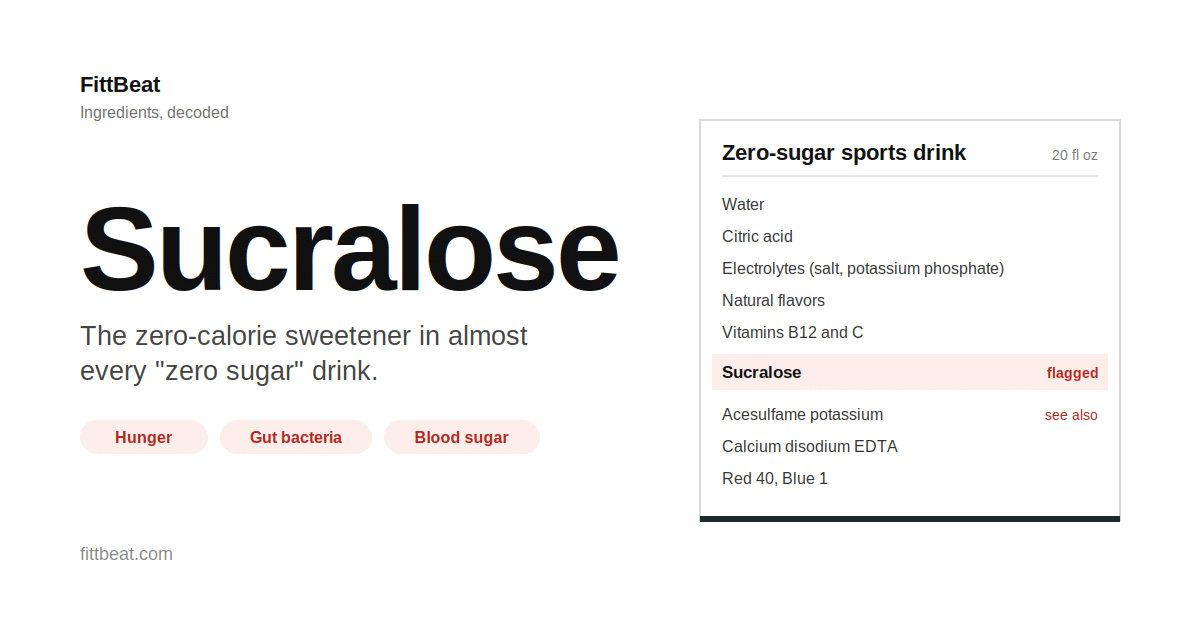
Sucralose is the sweetener in Splenda, and the reason Powerade Zero, Prime Hydration, Celsius, Gatorade Zero, and most “zero sugar” drinks taste sweet without calories. It’s 600 times sweeter than sugar, made by swapping three of sugar’s hydroxyl groups for chlorine atoms, and it’s been FDA-approved since 1998. It is also, after aspartame, the artificial sweetener people ask about most. This article goes through the sucralose side effects that have real evidence behind them, the ones that are overstated, and what regulators decided when they re-examined it in 2026.
Quick answer: is sucralose bad for you?
At the amounts in a few diet drinks a day, no major regulator considers sucralose harmful, and the European Food Safety Authority reaffirmed that in February 2026. But the research since 2022 has turned up effects worth knowing about: it can increase hunger signals in the brain, shift gut bacteria at high doses, blunt glucose tolerance in some people, and break down into a compound (sucralose-6-acetate) that damaged DNA in lab tests. Heating it to baking temperatures produces chlorinated compounds, which is why EFSA declined to approve it for baked goods. None of this amounts to “sucralose causes cancer.” It does amount to “sucralose isn’t the inert molecule it was marketed as.”
What is sucralose?
Sucralose starts as ordinary table sugar (sucrose). Manufacturers replace three hydrogen-oxygen groups on the sugar molecule with chlorine atoms. The result tastes like sugar but your digestive enzymes don’t recognize it, so it passes through mostly unabsorbed — about 85% leaves in stool and the rest is excreted in urine within a day or so. That’s where the “zero calories” and the “it just passes through” claims come from, and both are mostly accurate.
On labels it appears as sucralose or, in Europe, E955. Splenda is a brand name; the yellow packets are sucralose bulked up with dextrose and maltodextrin, which is why a packet technically has a few calories. In drinks, it’s almost always paired with acesulfame potassium (Ace-K) because the two mask each other’s aftertaste.
Where sucralose hides
You’ll find it in most products labeled “zero sugar,” “diet,” “lite,” or “no sugar added.” A few from our ingredient breakdowns:
- Powerade Zero (sucralose + Ace-K)
- Prime Hydration (sucralose + Ace-K)
- Gatorade Zero, BodyArmor Lyte, Propel
- Celsius, Monster Zero Ultra, Red Bull Sugarfree, Ghost, Alani Nu
- Sparkling Ice, Crystal Light, MiO
- Most protein powders, protein bars, and “keto” snacks
- Sugar-free syrups, gum, yogurt, and ice cream
- Diet Coke uses aspartame, not sucralose — but Coke Zero Sugar uses both aspartame and Ace-K, and some Coke “zero” variants outside the U.S. use sucralose.
Also, by the way, in many children’s medicines and chewable vitamins.
Sucralose side effects: what the evidence shows
Ranked roughly from strongest to weakest evidence in humans.
1. It may make you hungrier
This is the most solid recent finding. A 2025 randomized study in Nature Metabolism from the University of Southern California gave 75 young adults a sucralose drink, a sugar drink, and water on separate days. After sucralose, blood flow to the hypothalamus — the brain’s hunger center — increased, and participants reported feeling hungrier than after the sugar drink. The effect was stronger in people with obesity. The same lab’s earlier work found greater brain reward responses to food images after sucralose, and that women ate more at a buffet afterward.
The mechanism makes sense: sweetness without calories may decouple the “sweet taste” signal from the “energy arrived” signal, and the brain compensates. The caveat is that these studies measured a single-session brain response and appetite rating, not weight gain over months. But it fits with the World Health Organization’s 2023 guidance that non-sugar sweeteners don’t help with long-term weight control.
2. It can affect blood sugar response in some people
Sucralose itself doesn’t contain carbohydrate and won’t spike blood sugar on its own. However, a 2022 study in Cell found that two weeks of sucralose at typical consumer doses impaired glucose tolerance in some healthy adults, and that the effect tracked with changes in their gut bacteria — researchers could transfer the impaired response to mice by transplanting the participants’ stool. Other trials have found no effect. The honest summary: for most people, nothing happens; for a subset, sucralose seems to nudge glucose handling in the wrong direction. Anyone managing diabetes or insulin resistance should at least watch their own numbers rather than assume “zero sugar” means zero effect.
3. It shifts gut bacteria (at least at high doses)
Mouse studies consistently show sucralose alters the microbiome, reducing beneficial species and disrupting the chemical signaling bacteria use to coordinate. Human studies are mixed: the Cell trial above found changes; others at lower doses didn’t. Most of the dramatic results used doses equivalent to many cans a day for weeks. Whether moderate intake matters for gut health in people is unresolved. Regulators have not treated microbiome effects as a reason to restrict sucralose.
4. Sucralose-6-acetate and DNA damage
This is the finding behind most of the “sucralose causes cancer” headlines. In 2023, North Carolina State University researchers reported that sucralose-6-acetate — a compound produced when gut bacteria act on sucralose, and also found in trace amounts in some commercial sucralose — broke DNA strands in human blood cells in the lab and made gut tissue “leaky” in cell models. The authors called for a regulatory review and said they’d personally avoid it.
What happened next: EFSA’s February 2026 re-evaluation looked directly at this work. It concluded the lab results did not establish that ordinary sucralose consumption damages DNA in people, noted that the compounds in the original rat experiments may have been impurities in the sucralose sample rather than something the body makes, and kept the acceptable daily intake unchanged. An August 2026 genotoxicity study of commercial-grade sucralose in Food and Chemical Toxicology was also negative. The FDA has not opened a review. So: a real lab finding, not confirmed in humans, and judged by regulators not to change the safety picture.
5. Heating it produces chlorinated compounds
Sucralose is sold as heat-stable, and it mostly is at cooking temperatures. But at roughly 120°C / 250°F and above — oven baking, high-heat frying — it begins to break down and can generate chloropropanols and other chlorinated compounds, some of which are classed as potentially carcinogenic. This is specifically why EFSA’s 2026 review declined to extend sucralose approval to “fine bakery wares” in the EU. For drinks it’s irrelevant. If you bake with Splenda, it’s a reason to prefer a different sweetener in anything that goes in the oven.
6. Digestive symptoms, headaches, and migraines
Plenty of people report bloating, gas, loose stools, or headaches after sucralose. Controlled trials haven’t consistently reproduced these as sucralose-specific effects, and the sugar alcohols that often accompany sucralose in “sugar-free” products (sorbitol, maltitol) are a more likely cause of digestive complaints. That said, individual sensitivity is real: if you notice a pattern, you don’t need a trial to justify cutting it out.
7. Cancer
No human study has linked sucralose to cancer. The large French NutriNet-Santé cohort (2022) found a modest association between high total artificial sweetener intake and cancer risk, driven mainly by aspartame and Ace-K, with sucralose not showing a significant association on its own. A 2016 Italian mouse study (Ramazzini Institute) reported leukemia in male mice at high doses; its methods have been criticized and the finding hasn’t been replicated. In 2023 the WHO’s cancer agency classified aspartame as “possibly carcinogenic” — a widely misreported story — but that classification did not involve sucralose.
How much sucralose is “safe”?
The FDA’s acceptable daily intake is 5 mg per kilogram of body weight per day; EFSA’s is 15 mg/kg. For a 70 kg (155 lb) adult, that’s 350 mg a day by the stricter FDA number.
| Product | Approx. sucralose | Servings to hit FDA ADI (155 lb adult) |
|---|---|---|
| Splenda packet | 12 mg | ~29 packets |
| Powerade Zero, 20 oz | ~40 mg | ~9 bottles |
| Prime Hydration, 16.9 oz | ~35–45 mg (est.) | ~8 bottles |
| Zero-sugar energy drink, 16 oz | ~30–50 mg (est.) | ~7–11 cans |
| Protein powder scoop | ~20–40 mg (est.) | ~9–17 scoops |
Brands don’t have to disclose the amount, so the drink figures are estimates from the few that have been published. The takeaway is that the ADI is hard to reach with a normal diet — but it’s not hard for a kid, who weighs less, to get a meaningful fraction of it from a couple of drinks and a flavored yogurt. The ADI also only addresses toxicity; it says nothing about the hunger or glucose effects above, which showed up at ordinary doses.
Sucralose vs. aspartame vs. Ace-K vs. stevia
| Sucralose | Aspartame | Acesulfame K | Stevia / monk fruit | |
|---|---|---|---|---|
| Source | Chlorinated sugar | Two amino acids | Synthetic | Plant extract |
| Sweetness vs sugar | 600× | 200× | 200× | 200–300× |
| Heat stable | To ~250°F | No | Yes | Yes |
| Cancer classification | None | IARC 2B (possibly) | None | None |
| Main concern | Hunger, gut, S-6-A | PKU; IARC 2B | Under-studied | Aftertaste; fewer studies |
| Found in | Zero-sugar sports/energy drinks | Diet Coke, Diet Pepsi | Paired with sucralose | Zevia, Olipop, some Poppi |
Our Aspartame post covers that one in detail. If you want to avoid all of them, drinks sweetened with stevia or monk fruit are the usual alternative; they have their own aftertaste debate but fewer open research questions.
Should you avoid sucralose?
A reasonable position, based on what’s known in 2026:
- Occasional diet drink: no meaningful concern. If it replaces a 40 g sugar soda, it’s still the better trade.
- Several zero-sugar drinks every day: worth cutting back, mainly because of the hunger and glucose findings and because the microbiome research used doses in this range.
- Trying to lose weight: be skeptical that “zero sugar” is helping. The WHO’s 2023 review found no long-term benefit, and the hunger studies suggest why.
- Diabetes or insulin resistance: test your own response rather than assuming it’s inert.
- Baking: use something else.
- Kids: the ADI is weight-based, so a 60 lb child reaches it at a third of the adult amount. Several U.S. states have restricted artificial sweeteners in school meals since 2025 on precautionary grounds.
- Pregnancy: approved, but a 2025 review flagged possible epigenetic effects from consistent maternal intake as an open question. Moderation is the sensible default.
The bigger-picture point: the strongest argument against sucralose isn’t that it’s toxic. It’s that it may not deliver the thing people drink it for. If a sweetener keeps your sweet cravings alive and nudges your appetite up, the calorie savings on the label may not survive contact with the rest of your day.
See our full full ingredients index for every drink we’ve broken down.
Frequently asked questions
Is sucralose safe?
The FDA, EFSA (as of its 2026 review), and other major regulators consider it safe within the acceptable daily intake. Research since 2022 has raised questions about appetite, gut bacteria, and glucose response that regulators have not treated as grounds for restriction.
Does sucralose cause cancer?
No human study has shown that. A 2023 lab study found a sucralose breakdown product damaged DNA in cells; EFSA reviewed it in 2026 and concluded it did not demonstrate a risk at normal intake. Aspartame, not sucralose, is the sweetener IARC classified as “possibly carcinogenic.”
Does sucralose raise blood sugar?
Not directly. One 2022 trial found it impaired glucose tolerance in some people after two weeks of daily use, apparently via gut bacteria; other trials found no effect. People with diabetes should monitor their own response.
Does sucralose cause weight gain?
Studies haven’t shown direct weight gain, but a 2025 study found it increased hunger signaling in the brain compared to sugar, and the WHO advises against relying on non-sugar sweeteners for weight control.
Is sucralose bad for your gut?
High doses alter gut bacteria in animal studies and in at least one human trial. Effects at moderate intake are unclear.
Can you bake with sucralose?
Below about 250°F it’s stable. Above that it can break down into chlorinated compounds, and EU regulators declined in 2026 to approve it for baked goods. Use a different sweetener for oven recipes.
Sucralose vs. aspartame — which is worse?
They have different concerns. Aspartame carries an IARC “possibly carcinogenic” label and is dangerous for people with PKU; sucralose has the hunger, gut, and heat-breakdown questions. Neither has been shown to cause harm at normal intake.
This article is for informational purposes and is not medical advice. Talk to a doctor or registered dietitian about your individual nutrition needs.
Leave a Reply