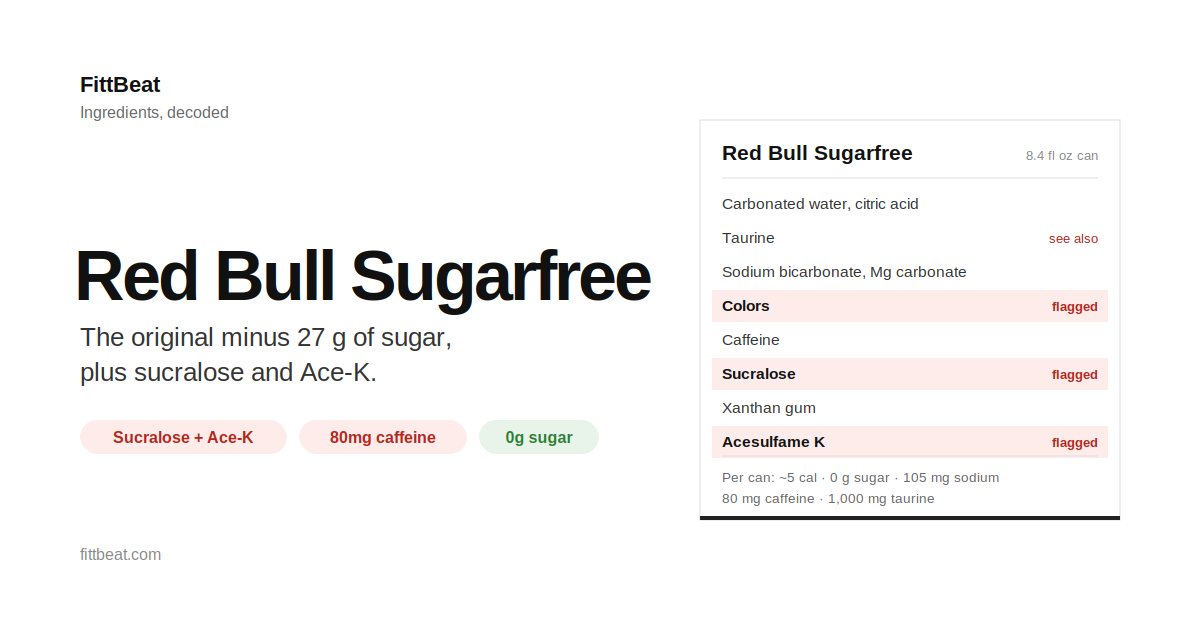

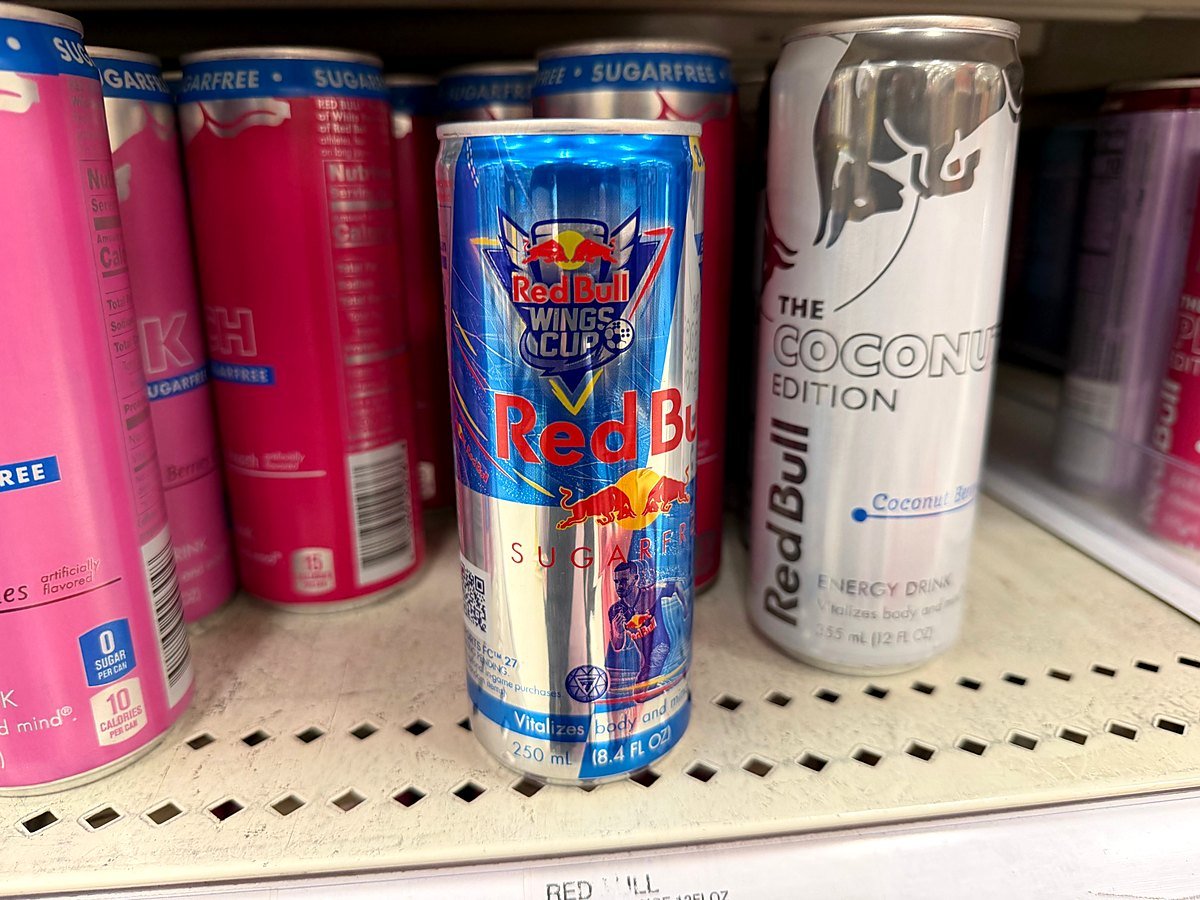
Last reviewed: November 2026. Reflects the U.S. Red Bull Sugarfree, 8.4 fl oz can, photographed in store in October 2026. The 12 oz and 16 oz cans scale the same formula; the Sugarfree “Editions” (White Peach, Summer Edition, and others) use the same sweeteners with different flavors and colors. Glare hid the calorie line on the can we photographed; Red Bull lists 5 calories per 8.4 oz.
Red Bull Sugarfree is the original Red Bull with the sugar taken out and two sweeteners put in, and that’s almost the whole story. The taurine, caffeine, B vitamins, and carbonated water are identical; the 27 g of sucrose and glucose are gone; sucralose and acesulfame potassium do the sweetening; and a gum is added to put back some of the body the sugar provided. It’s the energy drink people switch to when they want the caffeine without the calories — and since regular Red Bull is the one major energy drink with no artificial sweeteners at all, switching to Sugarfree is also the point where you take them on. Here’s all the Red Bull Sugarfree ingredients, what the two sweeteners are, the one line on the can that’s less specific than it should be, and how it stacks up against the other zero-sugar cans.
Quick answer: what’s in Red Bull Sugarfree?
Red Bull Sugarfree is carbonated water, citric acid, taurine, natural and artificial flavors, sodium bicarbonate, magnesium carbonate, colors, caffeine, sucralose, xanthan gum, acesulfame potassium, niacinamide, pyridoxine hydrochloride (B6), calcium pantothenate (B5), and vitamin B12. An 8.4 oz can has about 5 calories, 0 g of sugar, 2 g of carbohydrate, 105 mg of sodium, 80 mg of caffeine, and 100% or more of the daily value for niacin and B6. It’s the lowest-caffeine mainstream energy drink per can, with the same 1,000 mg of taurine as the original. The things to know: the sweeteners are sucralose and Ace-K, the pairing used in most “zero” drinks; the can says only “colors” without naming them; and the caffeine, at 80 mg, is less than a cup of coffee.
Jump to: The label · Each ingredient · The two sweeteners · “Colors” · Nutrition · Sugarfree vs. regular · Verdict · FAQ
The full Red Bull Sugarfree ingredients list
Carbonated Water, Citric Acid, Taurine, Natural and Artificial Flavors, Sodium Bicarbonate (Baking Soda), Magnesium Carbonate, Colors, Caffeine, Sucralose, Xanthan Gum, Acesulfame K, Niacinamide, Pyridoxine HCl (Vitamin B6), Calcium Pantothenate, Vitamin B12. Caffeine content: 80 mg per 8.4 fl oz. Not recommended for children, pregnant or nursing women, and persons sensitive to caffeine.
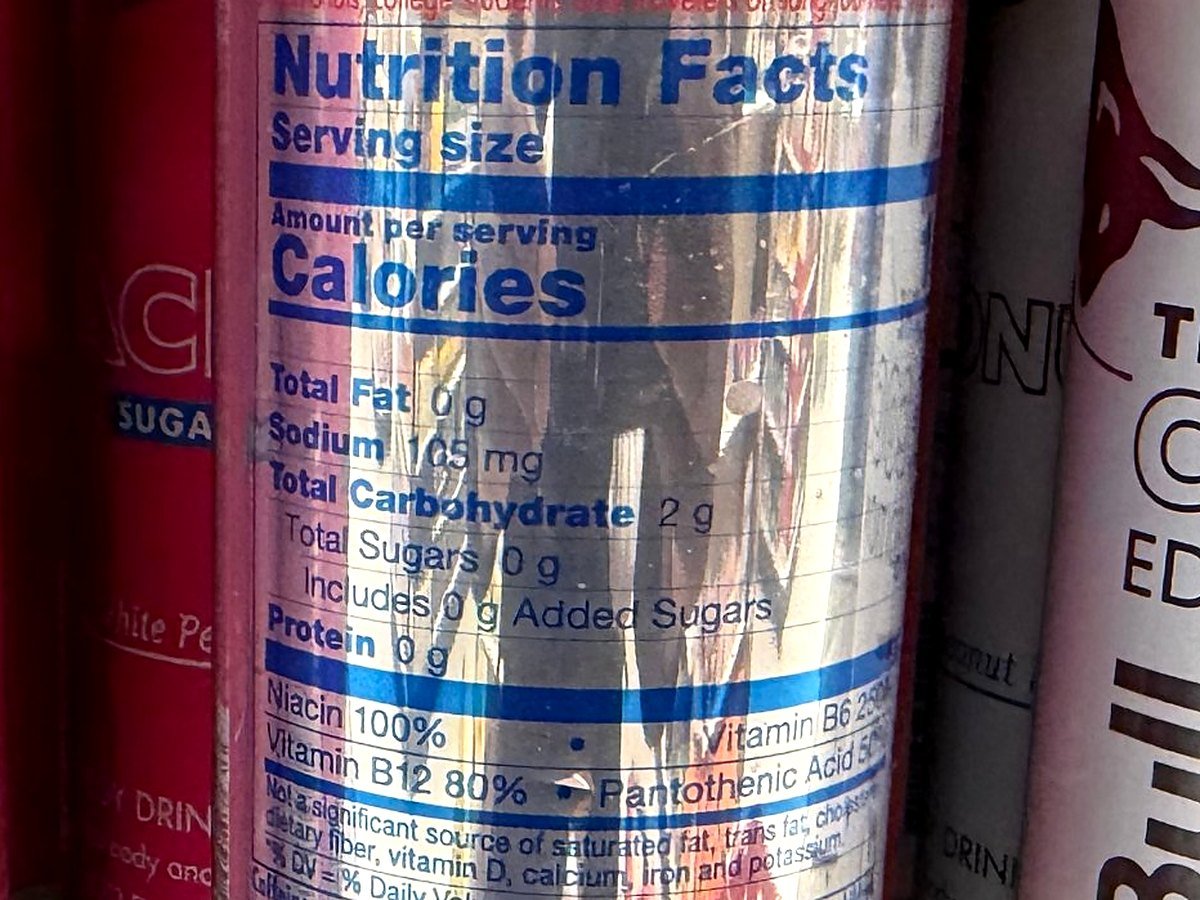
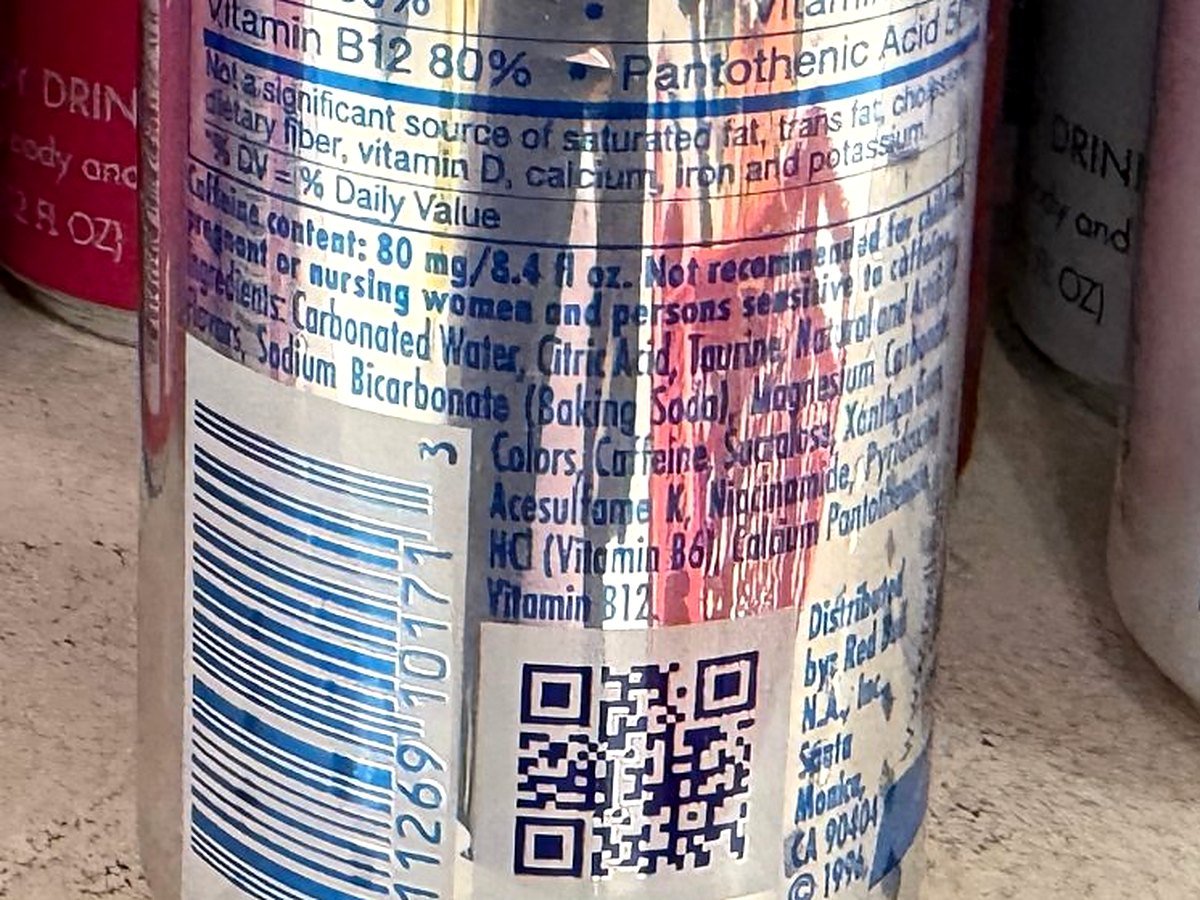
Three things to notice. Compared with regular Red Bull, two ingredients are gone (sucrose and glucose) and three are added (sucralose, acesulfame K, and xanthan gum) — the rest of the list is the same, in nearly the same order. Caffeine still sits in the middle of the list, after the color, which reflects how little of it there is by weight: 80 mg in 250 mL. And “colors” is listed generically with no FD&C number or named source, which is legal and unusual, and gets its own section below.
Red Bull Sugarfree ingredients explained
Carbonated water Fine
The base. Red Bull is lightly carbonated compared with soda.
Citric acid Fine, with a teeth note
Tartness and preservation; Red Bull sits around pH 3.3, in enamel-softening range. Without sugar, the erosion risk is lower than the original’s, but the acid is the same.
Taurine Safe, mostly inert
1,000 mg per 8.4 oz, the same as the original. An amino acid your body makes and that’s in meat and fish; not a stimulant, not from bulls, and reviewed as safe by EFSA at energy-drink levels. It doesn’t give you energy; it’s there for its long association with the brand and some evidence it blunts caffeine’s effect on blood pressure. Our taurine breakdown covers the research, including the 2023 longevity study.
Natural and artificial flavors Undisclosed
The Red Bull taste, a proprietary blend. “Artificial” means some compounds are synthesized; the exact flavor is one of the better-kept secrets in beverages.
Sodium bicarbonate and magnesium carbonate Fine
Baking soda and magnesium carbonate buffer the citric acid so the drink isn’t as sharp as its pH suggests. They’re the source of the 105 mg of sodium and a trace of magnesium.
Colors Unspecified
The faint amber tint. The U.S. can says only “colors,” which is covered in its own section below.
Caffeine 80 mg
The ingredient that works. 80 mg per 8.4 oz is the lowest dose of any major energy drink per can — about the same as a small home-brewed coffee, half a 16 oz Monster, 40% of a Celsius, and a quarter of a Bang. Per ounce it’s 9.5 mg, similar to Monster, so a 12 oz Sugarfree is 114 mg and a 16 oz is 151 mg. The can’s warning covers children, pregnancy, and caffeine sensitivity; for a healthy adult, one 8.4 oz can is a mild dose.
Sucralose Flagged
The primary sweetener, replacing the sugar. FDA-approved since 1998, about 600 times sweeter than sugar, and not metabolized for calories. Safe by regulatory standards at any realistic intake; the research since 2022 links it to gut-bacteria changes and altered glucose tolerance in some people, and to increased hunger signaling in some trials. Our sucralose breakdown covers each study. The section below has the detail on why it’s paired with Ace-K.
Xanthan gum Fine
A thickener made by fermenting sugar with a bacterium, used in tiny amounts to give the drink some of the mouthfeel that 27 g of sugar used to provide. It’s the one ingredient here that’s in Sugarfree and not the original. Harmless; it’s in salad dressings and gluten-free bread.
Acesulfame K Flagged
The second sweetener. Ace-K is 200 times sweeter than sugar, passes through the body unchanged, and is approved everywhere; the human research is thin, and a few animal studies raise questions about gut and cognitive effects at high doses. It’s paired with sucralose because the two together taste more like sugar than either alone. Our Ace-K breakdown covers it.
B vitamins (B3, B6, B5, B12) Overdosed, harmless
Niacinamide at 100% of the daily value, pyridoxine (B6) at 250%, pantothenic acid at 50%, B12 at 80%. B vitamins help turn food into energy, which is where the “energy” claim comes from, but extra B vitamins don’t add energy unless you were deficient; the excess is excreted. The 250% B6 is worth noting only if you drink several a day alongside a supplement — chronic high B6 intake (hundreds of milligrams) can cause nerve symptoms, and one can is far below that.
The two sweeteners, and why there are two
Almost every zero-sugar energy drink uses sucralose and acesulfame potassium together, and Red Bull Sugarfree is no exception. The reason is taste: sucralose alone has a lingering sweetness and Ace-K alone has a bitter edge, and blended they cancel each other’s off-notes and taste closer to sugar. Earlier Sugarfree formulations used aspartame alongside Ace-K; current U.S. cans contain no aspartame, which is worth knowing because it’s one of the most-searched questions about the drink.
Are they a problem? Both are approved by the FDA and EFSA with acceptable daily intakes far above what a can delivers. The reasons for caution are the same as in every “zero” product: a 2022 trial found sucralose and saccharin shifted gut bacteria and glucose responses in some healthy adults; sweetener use has been associated with higher, not lower, calorie intake in some observational studies; and Ace-K’s human data are sparse. That’s a case for moderation, not alarm. If you’d rather have neither, regular Red Bull’s 27 g of sugar is the trade-off, and our Red Bull breakdown covers that side.
“Colors” — the vaguest line on the can
U.S. labeling rules let manufacturers list certified FD&C dyes by name (Red 40, Yellow 5) and uncertified colors as “artificial color,” “color added,” or similar. Red Bull’s U.S. can says only “colors,” which tells you a color was added and nothing about which. Red Bull’s labels in other markets are more specific: in the EU, the ingredient list reads “colours (caramel, riboflavin)” — caramel color for the amber and riboflavin (vitamin B2) for yellow. If the U.S. formula matches, as it very likely does, the color is caramel plus a vitamin, not a petroleum dye. But that’s an inference from a different label, not something the U.S. can states, which is why this post doesn’t say Red Bull contains a synthetic dye and doesn’t say it’s free of one. Our caramel color breakdown covers the 4-MEI question that would apply if it’s caramel.
Red Bull Sugarfree nutrition facts
| Per can | Red Bull Sugarfree (8.4 oz) | Red Bull (8.4 oz) | Monster Zero Ultra (16 oz) | Celsius (12 oz) | Bang (16 oz) |
|---|---|---|---|---|---|
| Calories | ~5 | 110 | 10 | 10 | 0 |
| Sugar | 0 g | 27 g | 0 g | 0 g | 0 g |
| Sweetener | Sucralose + Ace-K | Sucrose + glucose | Sucralose + Ace-K | Sucralose | Sucralose + Ace-K |
| Caffeine | 80 mg | 80 mg | 140 mg | 200 mg | 300 mg |
| Caffeine per oz | 9.5 mg | 9.5 mg | 8.8 mg | 16.7 mg | 18.8 mg |
| Taurine | 1,000 mg | 1,000 mg | ~2,000 mg | 0 mg | 0 mg |
| Sodium | 105 mg | 105 mg | 180 mg | 0 mg | 40 mg |
| Preservatives | None | None | Sorbic + benzoic acid | None | Benzoate + sorbate |
| Color | “Colors” (unspecified) | “Colors” (unspecified) | None | None | None |
Red Bull Sugarfree and Bang figures are from cans photographed for FittBeat (the Sugarfree calorie line was unreadable, so it’s Red Bull’s published figure); the others are from current labels and our breakdowns. Sugarfree is the smallest caffeine dose on the table and one of only two cans with no preservative.
Red Bull Sugarfree vs. regular Red Bull
The only differences are the sweetener system and about 105 calories. Both have 80 mg of caffeine, 1,000 mg of taurine, the same B vitamins, the same acid and buffers, the same unspecified “colors,” and no preservatives. Regular Red Bull delivers 27 g of sugar — a can of Coke’s worth, in two-thirds the volume — and nothing artificial in the sweetener line. Sugarfree removes the sugar and adds sucralose, Ace-K, and a gum. Which is better depends on what you’re avoiding. For calories, blood sugar, teeth, and daily use, Sugarfree wins clearly: 27 g of added sugar a day is a real long-term cost, and the sweeteners’ downsides are smaller and less certain. For someone who wants nothing artificial and drinks one occasionally, the original is the cleaner can — the sugar is the price. Either way, the caffeine is identical and modest.
Is Red Bull Sugarfree bad for you?
FittBeat verdict
The mildest mainstream energy drink, minus the sugar, plus two sweeteners. At 80 mg of caffeine, 5 calories, no sugar, and no preservatives, Red Bull Sugarfree is one of the least concerning cans in the category: the taurine and B vitamins are harmless, the caffeine is less than a coffee, and the acid is the only thing your teeth will notice. What you take on is sucralose and Ace-K — safe by regulatory standards, with enough open questions in the gut-health research that one a day is a better habit than three — and a color line that doesn’t say what the color is. For a daily caffeine source, it’s a better choice than the sugared original and a gentler one than Monster, Celsius, or Bang. Coffee is still the simpler answer.
The concerns, ranked by evidence:
- Sucralose and Ace-K. Safe at regulatory limits; the 2022 gut-microbiome research and appetite findings are the reason for moderation.
- Caffeine stacking. 80 mg is mild alone; the 12 oz and 16 oz cans, or a can plus coffee, add up quickly.
- Teeth. Acidic, sipped; less erosive than the sugared version, still acidic.
- Unspecified color. Not a safety finding — a transparency one.
- Everything else. Taurine, B vitamins, buffers, xanthan gum: no meaningful concern.
Red Bull Sugarfree for keto, diabetes, pregnancy, and teens
Keto: yes — 2 g of carbohydrate, 0 g of sugar. One of the few energy drinks with no sugar alcohols either.
Diabetes: no sugar and no meaningful glycemic impact from the sweeteners; a reasonable choice for the caffeine, with the usual sweetener caveats.
Pregnancy: 80 mg is under the 200 mg daily guidance, but the can says not recommended during pregnancy, and most obstetric advice is to skip energy drinks for the taurine-and-sweetener blend rather than the caffeine.
Teens: the AAP’s position is that adolescents shouldn’t drink energy drinks; Red Bull is the lowest dose, and the can still says not for children.
Cleaner alternatives
For caffeine with no sweeteners at all: black coffee or unsweetened cold brew (about 95–200 mg per cup, nothing else). For a zero-sugar can without sucralose or Ace-K: Zevia Energy (120 mg, stevia) or a sparkling green tea. For an energy drink with sugar but no artificial sweeteners: regular Red Bull, 27 g and all. And for less of everything: the 8.4 oz Sugarfree can is already the smallest dose in the aisle — don’t trade up to the 16 oz for the same price.
Frequently asked questions
What sweetener is in Red Bull Sugarfree?
Sucralose and acesulfame potassium (Ace-K), the same pairing used in most zero-sugar energy drinks. Current U.S. cans do not contain aspartame.
How much caffeine is in Red Bull Sugarfree?
80 mg per 8.4 oz can, the same as regular Red Bull — about a small cup of coffee. The 12 oz can has about 114 mg and the 16 oz about 151 mg.
How many calories are in Red Bull Sugarfree?
About 5 per 8.4 oz can, from 2 g of carbohydrate. Regular Red Bull has 110.
Is Red Bull Sugarfree healthier than regular Red Bull?
It removes 27 g of sugar, which is the original’s biggest issue, and keeps everything else the same. The trade is sucralose and Ace-K, which are safe by regulatory standards with some open research questions. For daily use, Sugarfree is the better choice; for an occasional can with nothing artificial, the original.
Does Red Bull Sugarfree have aspartame?
No. Earlier formulations did; current U.S. cans use sucralose and acesulfame potassium.
Is Red Bull Sugarfree keto?
Yes — 0 g of sugar and 2 g of carbohydrate per can.
What are the “colors” in Red Bull?
The U.S. can doesn’t say. Red Bull’s European labels list caramel and riboflavin (vitamin B2), which is likely what the U.S. formula uses, but the U.S. label only says “colors.”
Does Red Bull Sugarfree have taurine?
Yes, 1,000 mg per 8.4 oz, the same as the original. Taurine is an amino acid your body produces; it’s safe at this amount and isn’t a stimulant.
Sources
- Red Bull North America, Inc. Nutrition facts, ingredients, and caffeine statement, Red Bull Sugarfree, 8.4 fl oz. Product label, photographed October 2026; calorie figure from Red Bull’s published product information.
- Red Bull. Red Bull Sugarfree product page and ingredient information (including EU ingredient listing). redbull.com
- U.S. FDA. Additional information about high-intensity sweeteners permitted for use in food in the United States (sucralose, acesulfame potassium). fda.gov
- Suez J, et al. Personalized microbiome-driven effects of non-nutritive sweeteners on human glucose tolerance. Cell, 2022. doi:10.1016/j.cell.2022.07.016
- EFSA. The use of taurine and D-glucurono-γ-lactone as constituents of the so-called “energy” drinks. EFSA Journal, 2009. doi:10.2903/j.efsa.2009.935
- U.S. FDA. Spilling the beans: how much caffeine is too much? fda.gov
- Schneider MB, Benjamin HJ, AAP Committee on Nutrition. Sports drinks and energy drinks for children and adolescents. Pediatrics, 2011. doi:10.1542/peds.2011-0965
- U.S. FDA. 21 CFR 101.22, foods; labeling of spices, flavorings, colorings and chemical preservatives. ecfr.gov
This article is for informational purposes and is not medical advice. Talk to a doctor or registered dietitian about your individual nutrition needs.
