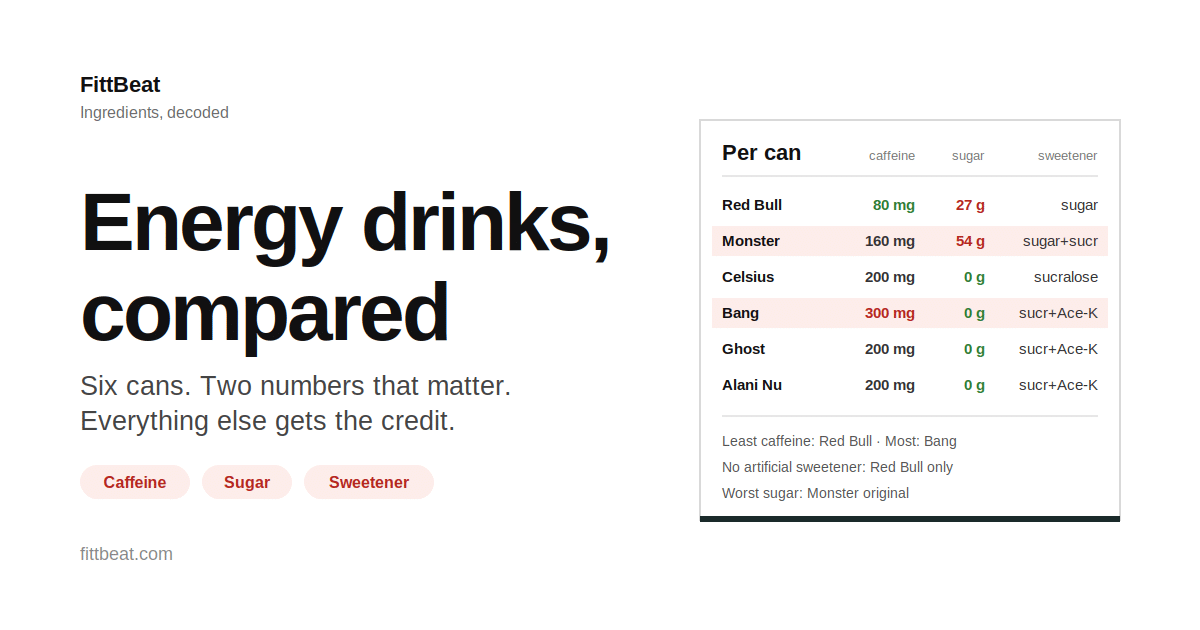

Last reviewed: October 2026. Figures are from current U.S. labels for the standard can of each: Red Bull 8.4 oz, Monster 16 oz, Celsius 12 oz, Bang 16 oz, Ghost 16 oz, Alani Nu 12 oz.
Every energy drink is caffeine plus a sweetener plus a list of things that get the credit. The six that dominate the cooler — Red Bull, Monster, Celsius, Bang, Ghost, and Alani Nu — differ on exactly three things that matter: how much caffeine, whether the sweetener is sugar or artificial, and what size the can is. Everything else (taurine, B vitamins, ginseng, carnitine, nootropics) is at doses that range from inert to unmeasured. This page puts all six energy drinks compared on one table, ranks them by each thing you might be avoiding, and gives a straight answer on which is “healthiest” — which is a different question from which is best.
Quick answer: which energy drink is healthiest?
None of them is healthy; the question is which is least costly. By sugar, the four zero-sugar drinks (Celsius, Bang, Ghost, Alani Nu) beat the two sugared ones (Red Bull, Monster) by a wide margin — Monster’s 54 g is the worst number on any label here. By caffeine dose, Red Bull is gentlest (80 mg) and Bang is most extreme (300 mg). By label length, Celsius is shortest. The practical ranking for an adult who’s going to drink one: Celsius or Alani Nu for a moderate 200 mg without sugar, Red Bull if you’d rather have 27 g of sugar than artificial sweeteners, and Bang only if you’ve decided 300 mg is what you want. Monster’s original is the worst of the six on the ingredient that matters most.
Jump to: The table · By caffeine · By sugar and sweetener · The extras · Pick by what you’re avoiding · Verdict · FAQ
Six energy drinks compared, one table
| Per can | Red Bull 8.4 oz | Monster 16 oz | Celsius 12 oz | Bang 16 oz | Ghost 16 oz | Alani Nu 12 oz |
|---|---|---|---|---|---|---|
| Caffeine | 80 mg | 160 mg | 200 mg | 300 mg | 200 mg | 200 mg |
| Caffeine per oz | 9.5 | 10 | 16.7 | 18.8 | 12.5 | 16.7 |
| Calories | 110 | 230 | 10 | 0 | 5 | 10 |
| Sugar | 27 g | 54 g | 0 | 0 | 0 | 0 |
| Sweetener | Sucrose + glucose | Sugar + glucose + sucralose | Sucralose | Sucralose + Ace-K | Sucralose + Ace-K | Sucralose + Ace-K |
| Taurine | 1,000 mg | ~2,000 mg | Yes, undisclosed | 0 | 1,000 mg | Yes, undisclosed |
| Sodium | 105 mg | 370 mg | 5 mg | 40 mg | 30 mg | 200 mg |
| Preservatives | None | Sorbic + benzoic acid | None | Benzoate + sorbate | Benzoate + sorbate | Benzoate + sorbate |
| Benzoate + vitamin C pairing | No | No | No | Yes (EDTA) | Yes (no EDTA) | No |
| Synthetic dyes | Yes | No (caramel) | No | No | No | No |
| Supplement doses disclosed | Taurine only | No | Partial | Partial | All | No |
| Owner | Red Bull GmbH | Monster Beverage | Celsius Holdings | Monster Beverage | Keurig Dr Pepper (60%) | Celsius Holdings |
Six brands, four owners. Monster owns Bang; Celsius owns Alani Nu; Keurig Dr Pepper controls Ghost. The energy aisle is three companies and Red Bull.
By caffeine
Caffeine is the active ingredient in every one of these, and the dose per can is the first number to read. The FDA’s guidance for healthy adults is 400 mg a day; the pregnancy guidance is 200 mg; the AAP says adolescents shouldn’t drink energy drinks at all.
- Red Bull — 80 mg. A cup of home-brewed coffee. The smallest dose of the six, and the only one you could reasonably drink two of.
- Monster — 160 mg. A cup and a half. Per ounce it’s the same as Red Bull; the can is twice the size.
- Celsius, Ghost, Alani Nu — 200 mg. Two cups, half the daily guidance, the full pregnancy guidance. Ghost spreads it over 16 oz; Celsius and Alani Nu pack it into 12, which makes them the densest of the three.
- Bang — 300 mg. Three cups, 75% of the daily guidance, in one can. The ceiling for a healthy adult from a single product; two is over the limit.
Per ounce matters because people sip. A 16 oz Ghost nursed over an afternoon is 12.5 mg per ounce; a 12 oz Celsius finished in ten minutes is 16.7. Same total, different curve.
By sugar and sweetener
The second number. Sugar is the ingredient with the clearest long-term harm in all of beverage research; artificial sweeteners are the ingredient with the most open questions. Every energy drink picks one.
- Monster original — 54 g. More than a 16 oz Coke, and it adds sucralose on top of the sugar. The worst number on this page.
- Red Bull — 27 g. A small can of soda’s worth. Still above the AHA’s daily limit for women in one 8.4 oz can.
- Celsius — 0 g, sucralose only. The only one of the four zero-sugar drinks with a single sweetener.
- Bang, Ghost, Alani Nu — 0 g, sucralose + Ace-K. Two sweeteners, which tastes more like sugar and doubles the open questions.
If you’re avoiding sugar, the zero-sugar four win clearly. If you’re avoiding artificial sweeteners, Red Bull is the only one without them (Monster’s original has sucralose in it despite the sugar), and the cost is 27 g. There’s no energy drink in this group that avoids both. Our sucralose and Ace-K breakdowns cover what the research says.
The extras, honestly graded
Everything after caffeine and sweetener on an energy drink label exists to be printed. Here’s what each one does at the dose in a can.
| Ingredient | In | What it does at this dose |
|---|---|---|
| Taurine | Red Bull, Monster, Celsius, Ghost, Alani Nu | Safe, not a stimulant, may slightly blunt caffeine’s blood-pressure effect. Inert for energy. |
| B vitamins | All six | No energy effect unless deficient; excess excreted. Pure marketing. |
| L-carnitine | Monster, Ghost (1,000 mg), Alani Nu | Modest soreness-recovery evidence at 1–3 g; no fat-loss effect. Only Ghost’s dose reaches the studied range. |
| Ginseng | Monster, Alani Nu, Celsius | Modest cognitive evidence at 200–400 mg standardized; doses here undisclosed or small. |
| Guarana | Monster, Alani Nu, Celsius | A second caffeine source, already counted in the total. |
| Green tea extract | Celsius | The “thermogenic” claim; a few small studies show a tiny calorie-burn effect. |
| Glucuronolactone, inositol | Monster, Red Bull, Celsius, Alani Nu | Safe, no effect. The subject of an old hoax, not a concern. |
| Alpha-GPC, coffee fruit | Ghost | Real compounds at a fraction of studied doses. |
| L-theanine | Alani Nu | Legitimately smooths caffeine at 100–200 mg; dose undisclosed. |
| EAAs / amino acids | Bang | About a gram across nine; the protein content of a bite of chicken. |
| “Super Creatine” | Bang (removed 2023) | Wasn’t creatine. $293M jury verdict. |
Pick by what you’re avoiding
- Avoiding sugar: Celsius, Bang, Ghost, or Alani Nu. All four are zero.
- Avoiding artificial sweeteners: Red Bull — the only one of the six without them. Monster’s original has sucralose. Outside the six, Zevia Energy (stevia) is the usual answer.
- Avoiding high caffeine: Red Bull at 80 mg, then Monster at 160. Nothing in the 200–300 range qualifies.
- Avoiding preservatives: Celsius and Red Bull have none. The other four use benzoates and sorbates; Bang and Ghost pair the benzoate with vitamin C, the one combination worth knowing about (see sodium benzoate).
- Avoiding dyes: everything except Red Bull, which lists “colors.” Monster uses caramel.
- Avoiding taurine: Bang is the only one of the six without it. (You don’t need to — it’s the safest thing on the can.)
- Avoiding the unknown: Ghost is the only one that prints every supplement dose. Monster and Alani Nu print none.
- Avoiding sodium: Celsius at 5 mg; Monster’s 370 and Alani Nu’s 200 are the outliers.
Which energy drink should you drink?
FittBeat verdict
If you want one: Celsius or Alani Nu for 200 mg without sugar, Red Bull for a small dose without artificial sweeteners. Avoid Monster’s original. Treat Bang as a decision, not a drink. The honest ranking is by the two numbers that matter — caffeine and sugar — and by that measure Monster original is last (54 g sugar plus 160 mg) and Bang is a special case (0 sugar, but 300 mg). The four 200 mg zero-sugar drinks are nearly interchangeable; Celsius has the shortest label, Ghost the most transparent one. None of them does anything coffee doesn’t, which costs less, has no sweetener, and lets you choose the dose. One a day is the ceiling for any of them; none is for anyone under 18 or pregnant.
The same rules for all six
- Count total caffeine. A can plus coffee plus pre-workout is how healthy adults end up in the ER. Add it up before noon.
- Don’t mix with alcohol. Caffeine masks intoxication without reducing it; the CDC warns specifically against it.
- Not for kids, teens, or pregnancy. Every can says so. The candy and pastel packaging on some of them doesn’t change it.
- Mind your teeth. All six are acidic and sipped. Rinse after; wait before brushing.
- Read the ounces. The same brand sells 8.4, 12, 16, and 24 oz cans with proportionally more caffeine. The 24 oz Monster is 240 mg; the 16 oz Red Bull is 151.
Frequently asked questions
Which energy drink has the most caffeine?
Of the major brands, Bang at 300 mg per 16 oz. Celsius, Ghost, and Alani Nu have 200 mg; Monster 160; Red Bull 80.
Which energy drink has the least caffeine?
Red Bull, at 80 mg per 8.4 oz can — about one cup of coffee.
Which energy drink is healthiest?
None is healthy. The least costly for a healthy adult are the 200 mg zero-sugar drinks (Celsius, Alani Nu, Ghost) or Red Bull if you’d rather have 27 g of sugar than artificial sweeteners. Monster original (54 g sugar) is the worst of the six.
Which energy drink has no artificial sweeteners?
Among the six, only Red Bull. Monster’s sugared original also contains sucralose. Zevia Energy (stevia) is the common alternative outside this group.
Is Celsius healthier than Red Bull?
Celsius has no sugar and no preservatives but 200 mg caffeine and sucralose; Red Bull has 27 g sugar and 80 mg caffeine with no artificial sweetener. Which is “healthier” depends on whether you’re avoiding sugar or sweeteners.
Is Monster worse than Red Bull?
Per ounce they’re nearly identical. Per can, a 16 oz Monster has twice the caffeine and twice the sugar of an 8.4 oz Red Bull.
How many energy drinks a day is safe?
For a healthy adult, one — and for Bang, one is the limit by itself. The FDA’s 400 mg daily guidance includes coffee and tea.
Do any of these energy drinks have real creatine?
No. Bang’s “Super Creatine” was found by a jury not to be creatine and was removed in 2023. None of the six contains creatine.
Sources
- Product labels for Red Bull 8.4 oz, Monster Energy 16 oz, Celsius 12 oz, Bang 16 oz, Ghost 16 oz, and Alani Nu 12 oz, photographed October 2026. Per-ingredient sources are on each product’s own page.
- U.S. FDA. Spilling the beans: how much caffeine is too much? fda.gov
- EFSA. Scientific opinion on the safety of caffeine. EFSA Journal, 2015. doi:10.2903/j.efsa.2015.4102
- Schneider MB, Benjamin HJ, AAP Committee on Nutrition. Sports drinks and energy drinks for children and adolescents. Pediatrics, 2011. doi:10.1542/peds.2011-0965
- EFSA. The use of taurine and D-glucurono-γ-lactone as constituents of the so-called “energy” drinks. EFSA Journal, 2009. doi:10.2903/j.efsa.2009.935
- Malik VS, et al. Sugar-sweetened beverages and risk of metabolic syndrome and type 2 diabetes. Diabetes Care, 2010. doi:10.2337/dc10-1079
- Suez J, et al. Personalized microbiome-driven effects of non-nutritive sweeteners on human glucose tolerance. Cell, 2022. doi:10.1016/j.cell.2022.07.016
- CDC. Alcohol and caffeine. cdc.gov
- Monster Energy Co. v. Vital Pharmaceuticals, Inc., C.D. Cal., jury verdict September 2022 ($293 million).
This article is for informational purposes and is not medical advice. Talk to a doctor or registered dietitian about your individual nutrition needs.
