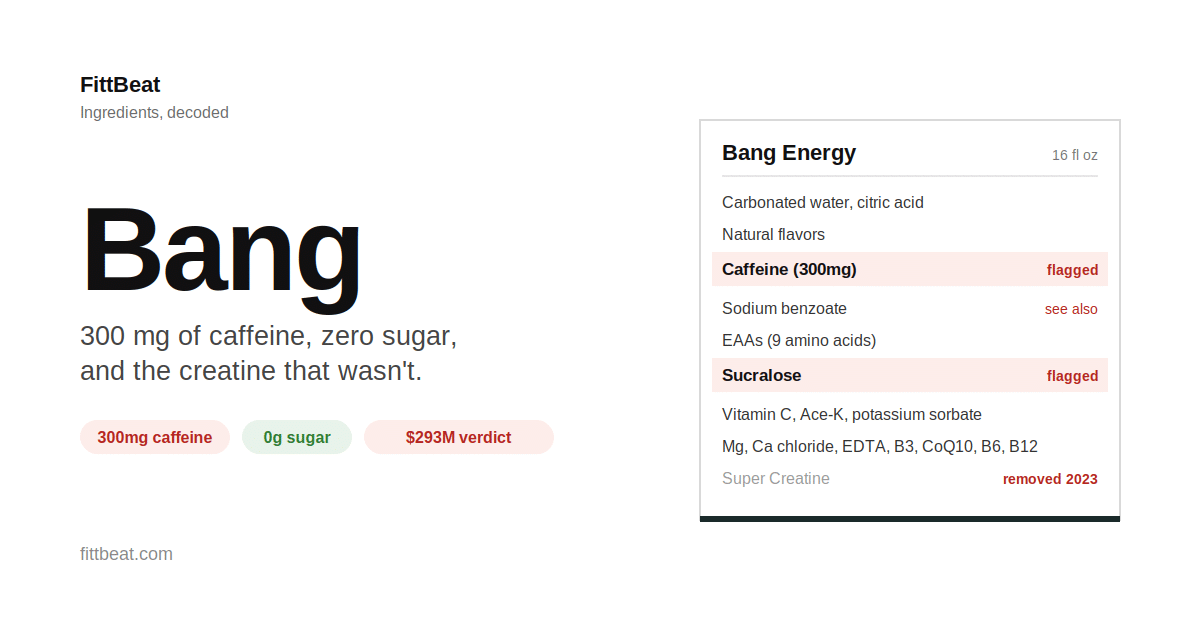

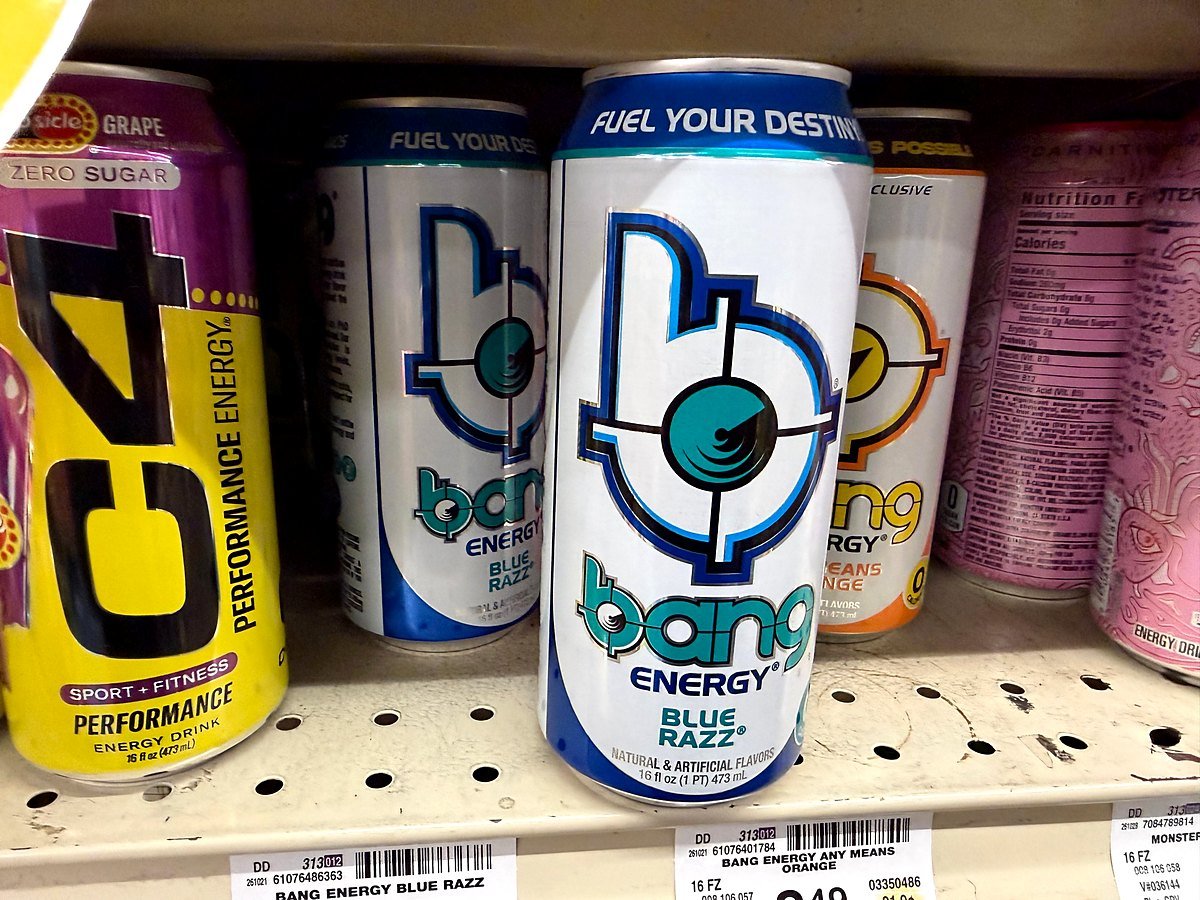
Last reviewed: October 2026. Reflects the current U.S. 16 fl oz Bang Energy under Monster Beverage ownership; the can photographed for this post is Blue Razz (©2023 Bang Energy LLC, manufactured in Corona, California — Monster’s hometown). Cans produced before 2023 listed “Super Creatine”; current cans do not. Check your can.
Bang is the energy drink that pushed the category to 300 mg of caffeine — nearly twice a Monster, almost four Red Bulls, three-quarters of the FDA’s daily guidance in one can — and built its brand on an ingredient called “Super Creatine” that a federal jury decided in 2022 wasn’t creatine at all. The verdict was $293 million, the company went bankrupt, and Monster bought the brand and quietly took the ingredient off the can. What’s left is a zero-sugar, extremely high-caffeine drink with a short run of amino acids and vitamins that do very little. Here’s all the Bang Energy ingredients, what the lawsuit established, and what the research says about drinking 300 mg of caffeine at once.
Quick answer: what’s in Bang Energy?
Bang is carbonated water, citric acid, natural and artificial flavors, caffeine, sodium benzoate, potassium citrate, sucralose, four amino acids (leucine, isoleucine, valine, lysine), potassium phosphate, vitamin C, acesulfame potassium, potassium sorbate, magnesium chloride, calcium chloride, calcium disodium EDTA, niacinamide, CoQ10, B6, and B12. A 16 oz can has 0 calories, 0 g sugar, 2 g carbohydrate, 40 mg sodium, and 300 mg of caffeine — the highest of any mainstream energy drink and 75% of the FDA’s 400 mg daily guidance for healthy adults. “Super Creatine,” the ingredient the brand was built on, is gone: a 2022 jury found it wasn’t creatine and didn’t raise creatine levels, and Monster removed it after buying Bang in 2023. The caffeine is the whole story. Everything after it is a supplement-aisle label at doses too small to matter.
Jump to: The label · Each ingredient · 300 mg of caffeine · The Super Creatine lawsuit · Nutrition · Verdict · FAQ
The full Bang Energy ingredients list
Carbonated Water, Citric Acid (pH Control), Natural & Artificial Flavors, Caffeine, Sodium Benzoate (Preservative), Potassium Citrate, Sucralose, Essential Amino Acids (L-Leucine, L-Isoleucine, L-Valine, L-Lysine), Potassium Phosphate, Ascorbic Acid (Vit. C), Acesulfame Potassium, Potassium Sorbate (Preservative), Magnesium Chloride, Calcium Chloride, Calcium Disodium EDTA, Niacinamide (Vit. B3), Coenzyme Q-10, Pyridoxine Hydrochloride (Vit. B6), Methylcobalamin (Vit. B12). Contains no fruit juice. Caffeine: 300 mg per can.
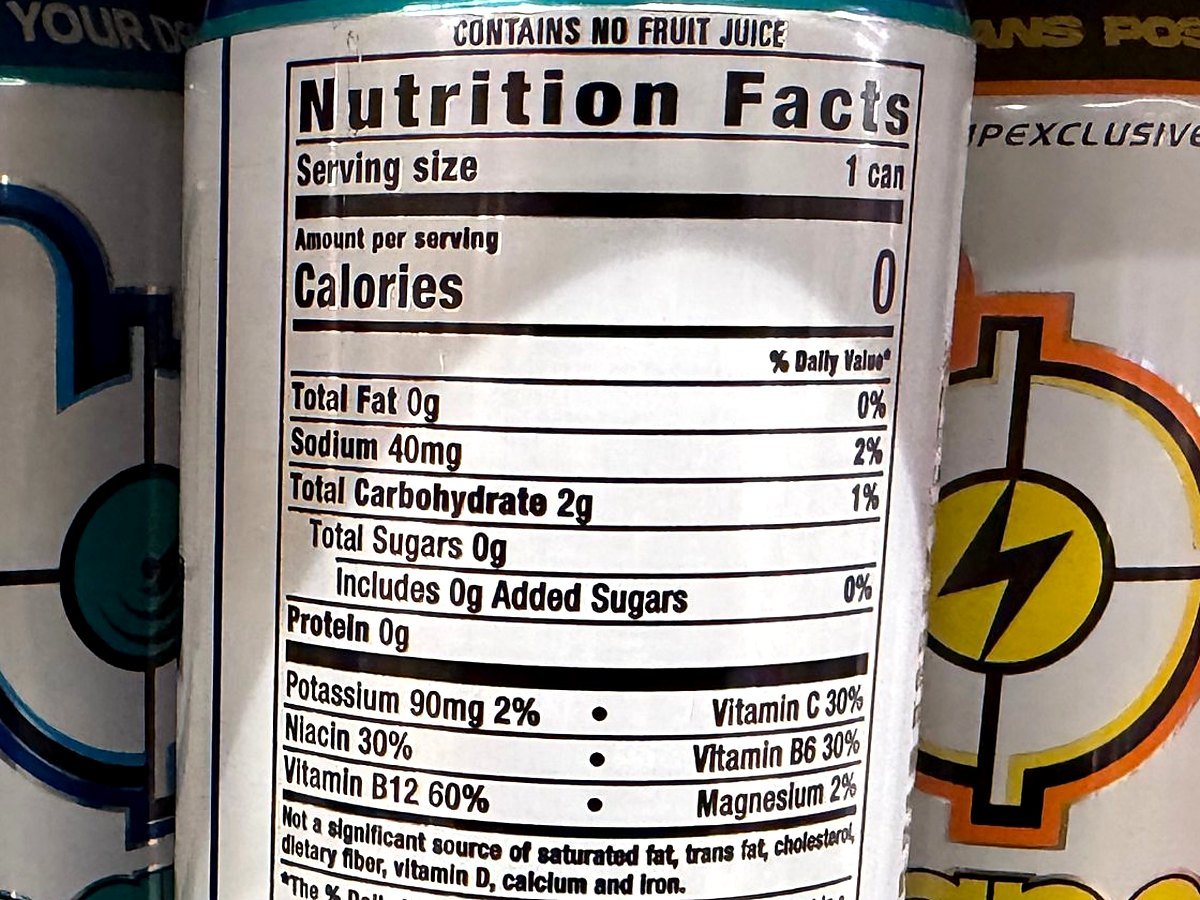
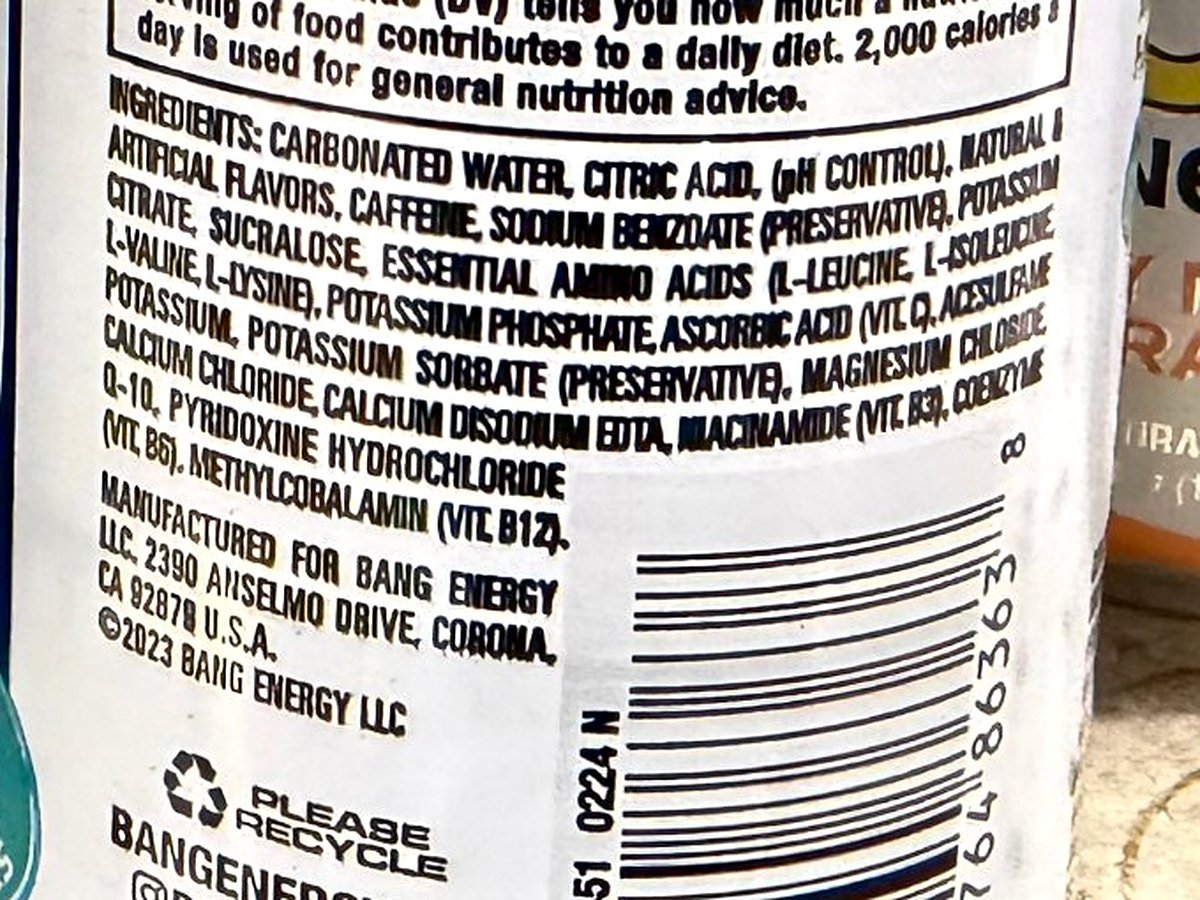
Three things to notice. Caffeine is the fourth ingredient by weight — in Monster it’s eleventh — which tells you how much of this can is stimulant. Sodium benzoate and ascorbic acid are both on the label, the one combination that can form trace benzene; Bang adds EDTA to limit it, but it’s the pairing our sodium benzoate breakdown says to look for. And the middle of the list — four amino acids labeled “essential amino acids,” three mineral salts, four vitamins, and CoQ10 — is the supplement marketing that survived the lawsuit; none of it is dosed at a level the research would call effective.
Bang Energy ingredients explained
Carbonated water Fine
The base. Bang is lightly carbonated compared with soda.
Citric acid Fine, with a teeth note
Tartness and the acidity — the can lists it as “pH control.” Bang sits around pH 3.2, enamel-softening range. Sip less, rinse after.
Natural & artificial flavors Undisclosed
The candy-adjacent flavor names (Blue Razz, Rainbow Unicorn, Cotton Candy) are flavor blends, and the current cans say “natural & artificial” on both the front and the ingredient list — some of the flavor is synthetic. Neither word means simple or disclosed. The flavors also do a lot of work covering the bitterness of 300 mg of caffeine and the amino acids.
Caffeine 300 mg
The ingredient. Covered in its own section below.
Sodium benzoate and potassium sorbate Flagged, for the pairing
Two preservatives, both safe at these levels. The flag is for what’s next to them: ascorbic acid, further down the label. Benzoate plus ascorbic acid plus heat or light can form trace benzene, which is why the FDA surveyed beverages in 2006 and several reformulated. Bang includes calcium disodium EDTA, which binds the metals that catalyze the reaction, and tested products in the category have been well below the drinking-water limit. Low concern in practice; it’s still the one chemistry note on this label.
Potassium citrate, potassium phosphate, magnesium chloride, calcium chloride “Electrolytes,” barely
These let Bang list electrolytes. The panel shows how small the amounts are: 90 mg of potassium (2% of the daily value), magnesium at 2%, and 40 mg of sodium. For comparison, Gatorade has 270 mg of sodium per 20 oz and BodyArmor 680 mg of potassium. Bang is not a hydration drink, and with 300 mg of caffeine, it’s a poor choice for replacing fluid during exercise regardless of the mineral salts.
Essential amino acids (leucine, isoleucine, valine, lysine) Marketing dose
The can calls them “essential amino acids,” but lists four of the nine: the three branched-chain amino acids (leucine, isoleucine, valine) plus lysine. Amino acids support muscle protein synthesis at doses of roughly 10–20 g of protein equivalent after exercise; Bang’s total is undisclosed but, based on label position, around a gram or less across all four. That’s the amino-acid content of a bite of chicken. They’re here so the can can say “EAAs,” and they contribute bitterness that the sweeteners then cover.
Sucralose Flagged
The primary sweetener, listed ahead of the amino acids, doing the work sugar does in Monster’s original. FDA-approved since 1998 and safe at any realistic intake by regulatory standards; the research since 2022 has linked it to gut-bacteria changes, altered glucose tolerance in some people, and increased hunger signaling. In Bang the dose is high because it has to mask a lot of bitterness. Our sucralose breakdown covers each study.
Vitamin C (ascorbic acid) The pairing
30% of the daily value per can. Harmless on its own; its only significance here is as the other half of the benzoate reaction above.
Acesulfame potassium Flagged
The second sweetener, paired with sucralose because the two together taste more like sugar than either alone. Not metabolized, excreted unchanged, approved everywhere, with thin human data and a few animal studies on gut and cognitive effects. Our Ace-K breakdown covers it.
Calcium disodium EDTA Low concern
A chelating agent binding trace metals. Here it’s doing real work: suppressing the benzene reaction. Poorly absorbed, excreted unchanged, no concern at this amount.
B vitamins (B3, B6, B12) Overdosed, harmless
Niacinamide and pyridoxine at 30% of the daily value each, methylcobalamin (B12) at 60%. B vitamins help convert food to energy, which is where the “energy” logic comes from, but extra B vitamins don’t give extra energy unless you were deficient. Excess is excreted.
Coenzyme Q-10 Marketing dose
The rim of the can says “Ultra CoQ10.” Coenzyme Q10 is a real compound with real research — in heart failure and statin-related muscle symptoms, at 100–300 mg a day. Bang’s amount is undisclosed and, by label position near the end of the list, a few milligrams. It’s there to be named.
300 mg of caffeine: what that actually means
Bang’s caffeine is the reason it exists. 300 mg in 16 oz is 18.75 mg per ounce — nearly double Monster’s 10 mg, double Red Bull’s 9.5 mg, and above Celsius’s 16.7. In absolute terms, one can is:
- About three cups of home-brewed coffee, or one and a half 12 oz Starbucks drips
- 75% of the FDA’s 400 mg daily guidance for healthy adults
- 150% of the 200 mg guidance in pregnancy
- Three times the amount the AAP considers the ceiling for an adolescent, in a product that until 2023 was marketed almost entirely to people under 25
At 300 mg at once, the common effects — raised heart rate and blood pressure for several hours, anxiety and jitteriness in people who don’t drink much caffeine, a five-hour half-life that leaves 150 mg active at bedtime from a mid-afternoon can — stop being minor. Caffeine toxicity is real above roughly 1,000 mg in a short period, which is three to four Bangs plus nothing else; the energy-drink deaths in the case literature have involved multiple cans in a few hours, often with an underlying heart condition. One can is within the range healthy adults tolerate. Two is 600 mg and over the line. Bang originally shipped with 357 mg and lowered it to 300 mg; the can’s own warning says not for children, pregnant women, or people sensitive to caffeine, and it’s one of the few places that warning reads as understatement.
The Super Creatine lawsuit
From 2016 to 2023, every Bang can said “Super Creatine” in bold, and the company’s founder, Jack Owoc, claimed it was a stable, water-soluble form of creatine 20 times more effective at reaching the brain than ordinary creatine. Creatine is one of the most studied sports supplements in existence; the standard effective dose is 3–5 g a day. Bang never disclosed how much Super Creatine was in a can, but by label position it was a few milligrams, and more importantly, it wasn’t creatine: the compound, creatyl-L-leucine, is creatine bonded to the amino acid leucine, and the body doesn’t break that bond to release usable creatine.
Monster Beverage sued for false advertising. In September 2022 a federal jury in California found that Bang’s Super Creatine claims were false and misleading — that it did not contain creatine and did not raise the body’s creatine levels — and awarded Monster $293 million. Separately, VPX lost a $175 million arbitration to Monster and Orange Bang over trademark use. VPX filed for Chapter 11 bankruptcy a month after the verdict; Owoc was removed as CEO in March 2023; and Monster acquired Bang out of bankruptcy in July 2023 for about $362 million.
Monster removed Super Creatine from the formula. The can photographed for this post — copyright 2023, made for “Bang Energy LLC” in Corona — lists four amino acids, CoQ10, and vitamins but no creatine of any kind, and the “Super Creatine” wordmark is gone. If a can you’re holding still says it, it’s from before the acquisition — and it never contained creatine either way.
Bang Energy nutrition facts
| Per can | Bang (16 oz) | Celsius (12 oz) | Monster Zero Ultra (16 oz) | Red Bull (8.4 oz) | Coffee (12 oz) |
|---|---|---|---|---|---|
| Calories | 0 | 10 | 10 | 110 | 5 |
| Sugar | 0 g | 0 g | 0 g | 27 g | 0 g |
| Caffeine | 300 mg | 200 mg | 140 mg | 80 mg | ~140 mg |
| Caffeine per oz | 18.8 mg | 16.7 mg | 8.8 mg | 9.5 mg | ~12 mg |
| Sweetener | Sucralose + Ace-K | Sucralose | Sucralose + Ace-K | Sucrose + glucose | None |
| Taurine | 0 mg | 0 mg | ~2,000 mg | 1,000 mg | 0 mg |
| Sodium | 40 mg | 0 mg | 180 mg | 105 mg | 5 mg |
| Benzoate + ascorbate pairing | Yes | No | No | No | No |
Bang figures are from the can photographed for this post (caffeine from Bang’s published label); the others are from current labels and our breakdowns of each.
Is Bang Energy bad for you?
FittBeat verdict
A 300 mg caffeine dose with a supplement label stapled to it. Nothing in the can is dangerous except the amount of the one thing that works. Zero sugar is a real advantage over Monster’s original; the four amino acids, CoQ10, mineral salts, and vitamins are present at doses that exist to be printed, not to do anything; and the ingredient the brand was built on turned out not to be what it said. One can is the most caffeine a healthy adult should take at once from any single product. Two in a day is too many. Not for anyone under 18, anyone pregnant, or anyone with a heart condition — and not as a hydration drink, where 40 mg of sodium and a big caffeine dose are the wrong tool.
The concerns, ranked by evidence:
- Caffeine dose. 300 mg at once is at the top of the range healthy adults tolerate; stacking two cans or a can plus coffee crosses it. Palpitations, anxiety, insomnia, and in susceptible people arrhythmia are the documented outcomes.
- Caffeine in teens. Bang’s marketing was built on social media and a young audience; 300 mg in a 120 lb body is a very different dose than in a 180 lb one.
- Teeth. Acidic and sipped; the sweeteners don’t feed bacteria but the acid still erodes.
- Sucralose and Ace-K. Safe by regulatory standards; the gut and appetite research is why moderation makes sense.
- Benzoate plus ascorbic acid. The benzene pairing, mitigated by EDTA. Low concern; worth knowing.
- Everything else. Amino acids, CoQ10, vitamins, and mineral salts: no evidence of harm, and no evidence of effect, at these doses.
Bang for teens, pregnancy, and pre-workout
Teens: no. The AAP’s position is that adolescents shouldn’t consume energy drinks at all; Bang is the strongest mainstream one.
Pregnancy: no — one can is 150% of the 200 mg daily guidance.
Pre-workout: the research on caffeine and performance uses 3–6 mg per kg, which for a 150 lb person is 200–400 mg — so Bang’s dose is in range for that purpose. But it carries almost no sodium, so pair it with water and real electrolytes, and don’t add a pre-workout powder on top (most contain 150–300 mg more caffeine).
Cleaner alternatives
For high caffeine without the supplement list: cold brew (about 200 mg per 16 oz, nothing else). For an energy-drink format with less caffeine: Celsius at 200 mg or Monster Zero Ultra at 140. For no artificial sweeteners: Zevia Energy (120 mg, stevia). If you actually want creatine, buy creatine monohydrate — 3–5 g a day, the most studied supplement there is, and about ten cents a dose.
Frequently asked questions
How much caffeine is in Bang?
300 mg per 16 oz can — about three cups of coffee, 75% of the FDA’s 400 mg daily guidance, and the most of any mainstream energy drink. Bang originally contained 357 mg.
Does Bang have creatine?
No. It contained “Super Creatine” (creatyl-L-leucine) until 2023, which a federal jury found was not creatine and did not raise creatine levels. Monster removed it after acquiring Bang. Current cans contain no creatine.
What was the Bang Super Creatine lawsuit?
Monster sued Bang’s maker, VPX, for false advertising over Super Creatine claims. In September 2022 a jury awarded Monster $293 million. VPX filed for bankruptcy weeks later, and Monster bought Bang in July 2023.
Who owns Bang now?
Monster Beverage, since July 2023. Cans now say “manufactured for Bang Energy LLC, Corona, CA.”
Does Bang have sugar?
No — 0 g sugar and 0 calories, with 2 g of carbohydrate. It’s sweetened with sucralose and acesulfame potassium.
What amino acids are in Bang?
Four, labeled “essential amino acids”: L-leucine, L-isoleucine, L-valine, and L-lysine. The amounts aren’t disclosed and are far below the doses studied for muscle recovery.
Is Bang worse than Monster?
Bang has nearly twice the caffeine (300 vs 160 mg) and no sugar; Monster’s original has 54 g of sugar and half the caffeine. Bang is the riskier dose of stimulant; Monster is the bigger sugar problem.
How many Bangs a day is safe?
One, for a healthy adult who isn’t drinking other caffeine. Two is 600 mg, well over the FDA guidance.
Sources
- Bang Energy LLC (Monster Beverage). Nutrition facts and ingredients, Bang Energy Blue Razz, 16 fl oz, ©2023. Product label, photographed October 2026; caffeine content from Bang’s published label.
- Monster Energy Co. v. Vital Pharmaceuticals, Inc., C.D. Cal., jury verdict September 29, 2022 ($293 million, false advertising re: “Super Creatine”).
- Monster Beverage Corporation. Monster Beverage completes acquisition of Bang Energy. Press release, July 31, 2023. investors.monsterbevcorp.com
- U.S. FDA. Spilling the beans: how much caffeine is too much? fda.gov
- EFSA. Scientific opinion on the safety of caffeine. EFSA Journal, 2015. doi:10.2903/j.efsa.2015.4102
- Schneider MB, Benjamin HJ, AAP Committee on Nutrition. Sports drinks and energy drinks for children and adolescents. Pediatrics, 2011. doi:10.1542/peds.2011-0965
- Kreider RB, et al. International Society of Sports Nutrition position stand: safety and efficacy of creatine supplementation. Journal of the International Society of Sports Nutrition, 2017. doi:10.1186/s12970-017-0173-z
- Guest NS, et al. International Society of Sports Nutrition position stand: caffeine and exercise performance. Journal of the International Society of Sports Nutrition, 2021. doi:10.1186/s12970-020-00383-4
- U.S. FDA. Data on benzene in soft drinks and other beverages. fda.gov
- Suez J, et al. Personalized microbiome-driven effects of non-nutritive sweeteners on human glucose tolerance. Cell, 2022. doi:10.1016/j.cell.2022.07.016
This article is for informational purposes and is not medical advice. Talk to a doctor or registered dietitian about your individual nutrition needs.
