
Last reviewed: October 2026. Reflects a current U.S. 12 fl oz Celsius can photographed in store (Fizz-Free Blue Razz Lemonade; the Originals, Vibe, and Fizz-Free lines share the formula). Celsius Essentials and Hydration differ — see the product table below.
Celsius went from a gym-bag niche brand to the third-biggest energy drink in America by selling itself as the fitness alternative to Monster and Red Bull: no sugar, no artificial colors, no preservatives, seven vitamins, and a blend that supposedly makes you burn calories. The can is cleaner than most of its competitors, and that’s true. It’s also 200 mg of caffeine in 12 ounces — the strongest mainstream energy drink per ounce — plus taurine, guarana, green tea extract, and a sweetener worth knowing about, and the “no preservatives” claim cost the company a $7.8 million settlement. Here’s all the Celsius ingredients as it’s printed today, what the marketing leaves out, and what changed on the label.
Quick answer: what’s in Celsius?
Celsius is filtered water, citric acid, taurine, guarana seed extract, green tea extract, caffeine, ascorbic acid, sucralose, glucuronolactone, ginger root extract, natural flavors, seven vitamins, chromium, and beta-carotene for color. A 12 oz can has 10 calories, 0 g sugar, 5 mg sodium, and 200 mg of caffeine — about two cups of coffee, half the FDA’s daily guidance, and 16.7 mg per ounce, more than Monster or Red Bull. The caffeine does the work; the taurine, guarana, and green tea are at undisclosed doses; the “burns up to 100 calories” claim comes from small company-funded studies and mostly reflects the caffeine. One sweetener (sucralose), no dyes, no benzoate. Not for anyone under 18 or pregnant, and the can says so.
Jump to: The label · Each ingredient · The calorie-burn claim · Nutrition · Celsius vs. Monster vs. Red Bull vs. coffee · Which Celsius is which · Verdict · FAQ
The full Celsius ingredients list
Filtered Water, Citric Acid, Taurine, Guarana Seed Extract, Green Tea Extract, Caffeine, Ascorbic Acid, Sucralose, Glucuronolactone, Ginger Root Extract, Natural Flavors, Calcium Pantothenate, Niacinamide, Pyridoxine Hydrochloride, Riboflavin, Beta-Carotene (Color), Chromium Chelate, Biotin, Cyanocobalamin. Caffeine content: 200 mg. Contains 0% juice.
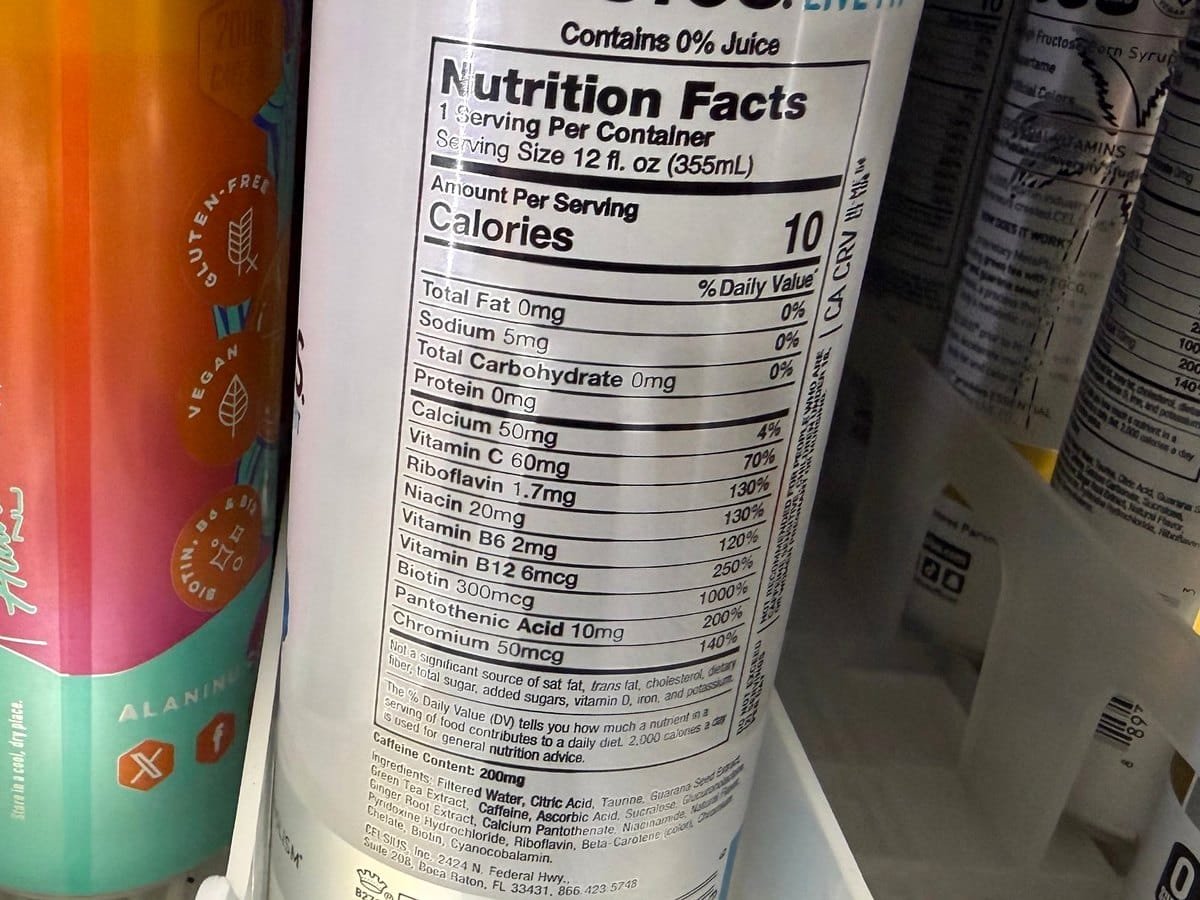
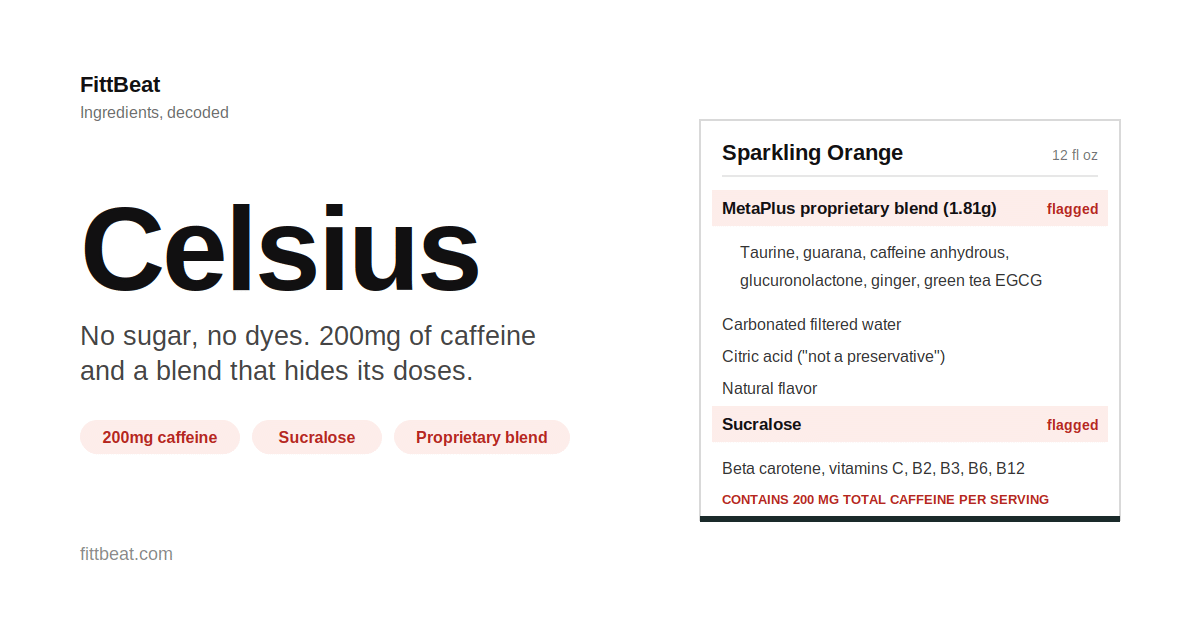
Three things to notice. For years Celsius cans carried a Supplement Facts panel with a 1.81 g “MetaPlus Proprietary Blend” that disclosed only the total weight; the current can is a conventional Nutrition Facts label with the ingredients in plain descending order, which is more informative — you can now see that taurine is third, guarana fourth, and green tea extract fifth, all ahead of the caffeine itself. Doses still aren’t printed. Second, there’s no sodium benzoate or potassium sorbate; citric acid is the only thing resembling a preservative, which is the subject of the lawsuit below. Third, beta-carotene is the color and sucralose is the only sweetener — no dyes, no Ace-K, no aspartame.
Celsius ingredients explained
Filtered water and citric acid Fine, with a legal footnote
The base and the tartness. Citric acid is the same molecule as in citrus, made commercially by fermentation, and it has a preservative effect whatever the can says — which is why the Originals cans carry the odd clause “citric acid is added for flavor; it is not used as a preservative.” That language is the result of a 2022 class action over Celsius marketing “no preservatives” while listing citric acid; it settled for $7.8 million. Mildly acidic; the enamel advice applies to any sparkling citrus drink sipped all day.
Taurine Safe, mostly inert
Third on the label, so a meaningful amount — likely in the 1,000 mg range typical of the category, though Celsius doesn’t say. An amino acid your body makes, concentrated in muscle, heart, and brain tissue; abundant in fish and meat; safe to 6 g a day by EFSA’s assessment. Not a stimulant despite the name association — if anything it slightly blunts caffeine’s effect on blood pressure. Our taurine breakdown covers it.
Guarana seed extract More caffeine
A Brazilian seed that’s two to four times coffee’s caffeine by weight, plus traces of theobromine and theophylline. The 200 mg on the can is the total from all sources, so guarana isn’t extra on top. Its caffeine is bound to tannins and releases a little more slowly, which is the basis for the “smoother” reputation; it’s still caffeine with a plant name.
Green tea extract The thermogenic claim, dose unknown
Fifth on the list and the ingredient behind “accelerates metabolism.” EGCG, the main green tea catechin, has modest evidence for a small increase in calorie burn, mainly alongside caffeine. The studies showing an effect used 300–900 mg of catechins; the amount here isn’t printed and, by position, is well below that. One thing worth knowing: concentrated green tea extract is the supplement ingredient most often linked to liver injury in case reports — at doses far above a can, but it’s the reason not to stack Celsius with green tea extract pills.
Caffeine — 200 mg 200 mg
The ingredient that works. 200 mg per 12 oz is 16.7 mg per ounce — more than a 16 oz Monster (10) or an 8.4 oz Red Bull (9.5), the same as Alani Nu, below Bang’s 18.8. Two cups of coffee, half the FDA’s 400 mg daily guidance, the full pregnancy guidance in one can. Caffeine anhydrous is dehydrated caffeine powder, chemically identical to coffee’s and absorbed fast because nothing in the drink slows it. The can itself says not recommended for people sensitive to caffeine, children under 18, or women pregnant or nursing. Celsius Essentials, in 16 oz cans, is 270 mg.
Ascorbic acid Fine
Vitamin C, 60 mg (70% DV). No benzoate on this label, so the benzene pairing covered in our sodium benzoate breakdown doesn’t apply — a point in Celsius’s favor over Ghost and Bang.
Sucralose Flagged
The only sweetener, and the reason it’s sweet at 10 calories. FDA-approved and safe at any realistic intake by regulatory standards; the research since 2022 links it to increased hunger signaling, gut-bacteria changes, and altered glucose tolerance in some people — a little ironic for a drink marketed on weight management. Our sucralose breakdown covers each study. Celsius doesn’t offer a stevia version.
Glucuronolactone Safe, inert
A sugar derivative the body makes, in energy drinks since Red Bull on the theory that it fights fatigue. The human evidence at drink doses is close to nonexistent; the old internet hoax about it has no basis. Harmless, and there because every energy drink has it.
Ginger root extract Fine
Real evidence for nausea and mild anti-inflammatory effects, at doses almost certainly larger than what’s here. Mostly flavor and label appeal.
Natural flavors Undisclosed
The flavor profile — Blue Razz Lemonade, Sparkling Orange, Kiwi Guava. Plant-derived flavor compounds; proprietary. No juice.
Beta-carotene (color) No synthetic dyes
A legitimate point in Celsius’s favor. Monster, Rockstar, and most of the category use Red 40, Blue 1, or Yellow 5; Celsius colors with beta-carotene (and vegetable juice in some berry flavors). None of the FD&C dyes anywhere in the lineup.
Vitamin C, B vitamins, biotin, chromium Overdosed, harmless
The “seven essential vitamins”: vitamin C 60 mg (70%), riboflavin 1.7 mg (130%), niacin 20 mg (130%), B6 2 mg (120%), B12 6 mcg (250%), biotin 300 mcg (1,000%), pantothenic acid 10 mg (200%), and chromium 50 mcg (140%). B vitamins are water-soluble, so excess is excreted, which is why brands can megadose them for the panel; they “support energy metabolism” in the sense your body needs them, not in the sense that extra ones energize you. Chromium is included on weak evidence that it blunts carb cravings. None of this is harmful. None of it is why you feel the drink.
Does Celsius actually burn calories?
The can says “burns up to 100 calories and more per can” with moderate exercise. That comes from a handful of small studies, mostly funded by Celsius and run at the University of Oklahoma around 2009–2010, which found that drinking Celsius before exercise raised energy expenditure modestly compared with placebo. The effect was real, small, measured over a few hours, and consistent with what 200 mg of caffeine plus green tea extract does in any form — coffee produces a similar bump.
Three things to keep in mind. “Up to 100 calories” is a rounding error against a 2,000-calorie day. The fine print on every can concedes that Celsius alone doesn’t produce weight loss without diet and exercise. And the sweetener research cuts the other way: if sucralose increases appetite, a drink that burns 100 calories and makes you eat 150 more isn’t a weight-loss tool. Treat Celsius as a clean-ish caffeine delivery system, not a fat burner.
Celsius nutrition facts
| Per 12 oz can | Amount | % Daily Value |
|---|---|---|
| Calories | 10 | — |
| Total carbohydrate | 0–2 g | 0–1% |
| Sugar | 0 g | — |
| Sodium | 5 mg | 0% |
| Caffeine | 200 mg | 50% of FDA daily guidance |
| Vitamin C | 60 mg | 70% |
| Riboflavin (B2) | 1.7 mg | 130% |
| Niacin (B3) | 20 mg | 130% |
| Vitamin B6 | 2 mg | 120% |
| Vitamin B12 | 6 mcg | 250% |
| Biotin | 300 mcg | 1,000% |
| Pantothenic acid (B5) | 10 mg | 200% |
| Chromium | 50 mcg | 140% |
| Calcium | 50 mg | 4% |
Celsius vs. Monster vs. Red Bull vs. coffee
| Celsius (12 oz) | Monster (16 oz) | Red Bull (8.4 oz) | Coffee (12 oz) | |
|---|---|---|---|---|
| Caffeine | 200 mg | 160 mg | 80 mg | ~140 mg |
| Caffeine per oz | 16.7 mg | 10 mg | 9.5 mg | ~12 mg |
| Sugar | 0 g | 54 g | 26 g | 0 g |
| Calories | 10 | 230 | 110 | 5 |
| Sweetener | Sucralose | Sugar + glucose + sucralose | Sucrose + glucose | None |
| Taurine | Yes, undisclosed | ~2,000 mg | 1,000 mg | None |
| Synthetic dyes | No | No (caramel) | Yes | No |
| Preservatives | None (citric acid) | Benzoic + sorbic acid | None | None |
Against sugared Monster and Red Bull, Celsius wins on nearly every line: no sugar, no dyes, fewer additives. Against Monster Zero Ultra or Red Bull Sugarfree, the gap narrows — those use sucralose and Ace-K, and Celsius still has more caffeine per ounce than either. Against black coffee, Celsius loses: no sweetener, no undisclosed extracts, comparable caffeine for pennies. Our Monster and Red Bull breakdowns cover the two it’s most compared against, and the energy drinks comparison puts all six on one table.
Which Celsius is which?
| Product line | Size | Caffeine | What’s different |
|---|---|---|---|
| Celsius Originals / Vibe / Fizz-Free | 12 oz | 200 mg | The formula in this post; Fizz-Free is the non-carbonated version |
| Celsius Essentials | 16 oz | 270 mg | Higher caffeine, adds amino acids; sold as the “performance” line |
| Celsius Hydration | Powder | 0 mg | Electrolyte sticks, no energy blend |
| Celsius On-The-Go | Powder | 200 mg | Same formula as Originals in a stick |
| Alani Nu | 12 oz | 200 mg | Owned by Celsius since April 2025; two sweeteners, two preservatives, 200 mg sodium |
Is Celsius bad for you?
FittBeat verdict
Cleaner than Monster. Still 200 mg of caffeine in 12 ounces. No sugar, no dyes, no benzoate, one sweetener, and a label that now lists its ingredients in plain order — nothing on it a regulator objects to. But it’s the strongest mainstream energy drink per ounce, the taurine, guarana, and green tea doses aren’t printed, the sweetener has real open questions, and the “burns calories” pitch is caffeine dressed up as science. One a day is fine for most adults. Two a day plus coffee is a lot. Not for teens.
The concerns, ranked by evidence:
- Caffeine load. The single most important fact about Celsius. Half the adult daily guidance per can; count your coffee.
- Caffeine in the wrong hands. Marketed as a fitness drink, which reads as “healthy” to teenagers; the can says 18+.
- Teeth. Acidic citrus drink, sipped.
- Sucralose. Fine occasionally; worth reconsidering at several a day, especially for weight goals.
- Undisclosed doses. A transparency problem, not a safety one — you can’t evaluate the green tea claim from the can.
- Athletes. Celsius dropped its NCAA warning after a 2023 settlement, but guarana, taurine, and high-dose caffeine can still affect caffeine-threshold testing. If you’re tested, check your program’s list, not the can.
Celsius for teens, pregnancy, and pre-workout
Teens: no — the AAP’s position on energy drinks applies, and the can says under 18 shouldn’t.
Pregnancy: one can is the full 200 mg daily guidance; the can says not recommended.
Pre-workout: 200 mg is in the range the performance research uses (3–6 mg/kg). Reasonable for an adult, with water, without a caffeinated powder on top.
Cleaner alternatives
For the caffeine without the sweetener: black coffee or cold brew, or unsweetened green tea for real EGCG at a known dose. For a can with every dose printed: Ghost. For no artificial sweeteners: Zevia Energy (120 mg, stevia). If you just like Celsius, the honest move is to count it as your coffee, not as a health drink.
Frequently asked questions
How much caffeine is in Celsius?
200 mg per 12 oz can of Originals, Vibe, and Fizz-Free. Celsius Essentials (16 oz) has 270 mg. Celsius Hydration has none.
Does Celsius have taurine?
Yes — it’s the third ingredient on the can, though the amount isn’t disclosed. It’s safe and not a stimulant.
What happened to the MetaPlus blend?
Older cans used a Supplement Facts panel with a 1.81 g “MetaPlus Proprietary Blend.” Current cans use a standard Nutrition Facts label with the same ingredients listed in descending order: taurine, guarana, green tea extract, caffeine, glucuronolactone, ginger. Doses still aren’t printed, except the 200 mg total caffeine.
Does Celsius have sugar?
No. It has 0 g sugar and 10 calories, sweetened with sucralose alone.
Does Celsius have artificial colors or aspartame?
No. The color is beta-carotene (or vegetable juice in some flavors), and the only sweetener is sucralose.
Does Celsius really burn calories?
Small company-funded studies found a modest increase in energy expenditure before exercise, roughly what 200 mg of caffeine does in any form. The can states Celsius alone doesn’t produce weight loss.
Why does the Celsius can say citric acid isn’t a preservative?
Because Celsius settled a $7.8 million lawsuit in 2022 over marketing “no preservatives” while the drinks contained citric acid. The clarifying language is the result.
Is Celsius banned by the NCAA?
No, but it contains guarana, taurine, and high-dose caffeine, which can affect caffeine-threshold testing. Celsius removed its NCAA warning after a 2023 settlement; tested athletes should check their program’s guidance.
Sources
- Celsius Holdings. Nutrition facts and ingredients, Celsius Fizz-Free Blue Razz Lemonade, 12 fl oz. Product label, photographed October 2026.
- U.S. FDA. Spilling the beans: how much caffeine is too much? fda.gov
- EFSA. Scientific opinion on the safety of caffeine. EFSA Journal, 2015. doi:10.2903/j.efsa.2015.4102
- EFSA. The use of taurine and D-glucurono-γ-lactone as constituents of the so-called “energy” drinks. EFSA Journal, 2009. doi:10.2903/j.efsa.2009.935
- Hursel R, Viechtbauer W, Westerterp-Plantenga MS. The effects of green tea on weight loss and weight maintenance: a meta-analysis. International Journal of Obesity, 2009. doi:10.1038/ijo.2009.135
- Dalbo VJ, et al. Acute effects of ingesting a commercial thermogenic drink on changes in energy expenditure and markers of lipolysis. Journal of the International Society of Sports Nutrition, 2008. doi:10.1186/1550-2783-5-6
- Suez J, et al. Personalized microbiome-driven effects of non-nutritive sweeteners on human glucose tolerance. Cell, 2022. doi:10.1016/j.cell.2022.07.016
- Schneider MB, Benjamin HJ, AAP Committee on Nutrition. Sports drinks and energy drinks for children and adolescents. Pediatrics, 2011. doi:10.1542/peds.2011-0965
- Prescod v. Celsius Holdings, Inc., C.D. Cal. — $7.8 million class settlement (2022–2023) over the “no preservatives” claim.
This article is for informational purposes and is not medical advice. Talk to a doctor or registered dietitian about your individual nutrition needs.
