
Last reviewed: October 2026. Reflects the U.S. 16 fl oz Monster Energy (Original). Monster has over 300 flavors worldwide; this covers the green can. Zero Sugar and Ultra variants are compared below.
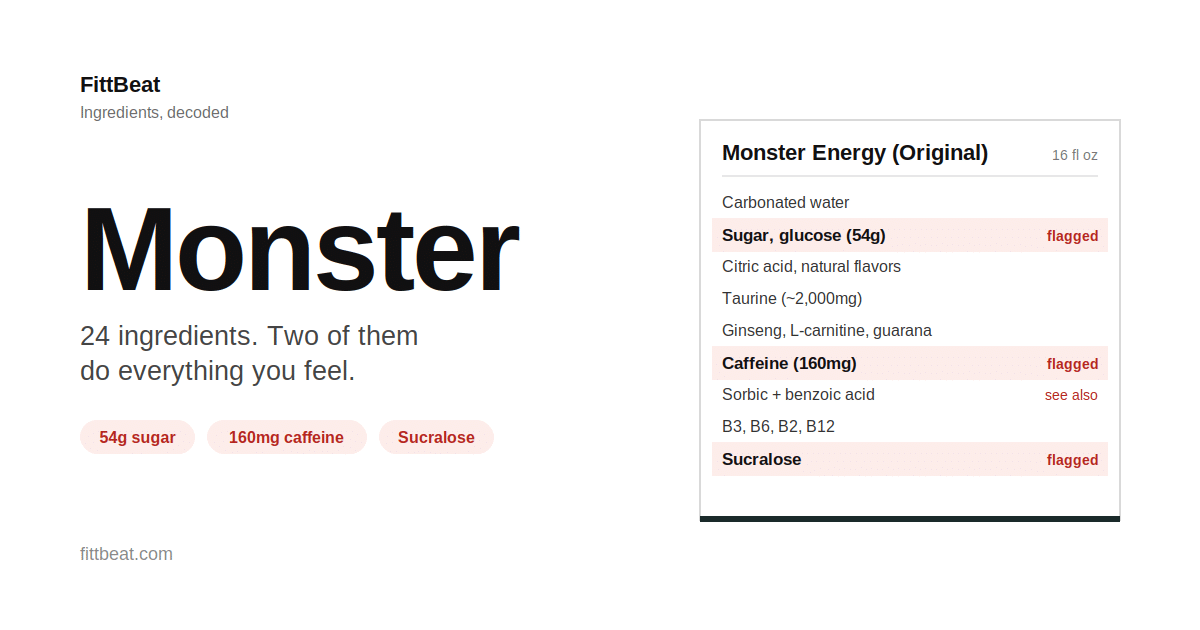
Monster Energy has 24 ingredients. Two of them do almost everything you feel: 54 grams of sugar and 160 milligrams of caffeine. The other 22 — taurine, ginseng, L-carnitine, guarana, glucuronolactone, inositol, four B vitamins, two preservatives, and a sweetener you’d never expect in a sugared drink — are what Monster calls its “Energy Blend,” and the honest science is that most of it is along for the ride. Here’s all the Monster Energy ingredients, what it does, and what the evidence says.
Quick answer: what’s in Monster Energy?
Monster Energy is carbonated water, sugar, glucose, citric acid, natural flavors, taurine, sodium citrate, color, Panax ginseng, L-carnitine, caffeine, sorbic acid, benzoic acid, niacinamide, sucralose, salt, glucuronolactone, inositol, guarana, vitamins B6, B2, and B12, and maltodextrin. A 16 oz can has 230 calories, 54 g of sugar (108% of the daily added-sugar value), 160 mg of caffeine, and 370 mg of sodium. The caffeine is the equivalent of about one and a half cups of coffee — meaningful but not extreme for a healthy adult. The sugar is more than a can of Coke and a half. Taurine and the rest of the blend are safe and mostly inert. The can says not for children, and it’s right.
The full Monster Energy ingredients list
Carbonated Water, Sugar, Glucose, Citric Acid, Natural Flavors, Taurine, Sodium Citrate, Color Added, Panax Ginseng Extract, L-Carnitine L-Tartrate, Caffeine, Sorbic Acid (Preservative), Benzoic Acid (Preservative), Niacinamide (Vit. B3), Sucralose, Salt, D-Glucuronolactone, Inositol, Guarana Extract, Pyridoxine Hydrochloride (Vit. B6), Riboflavin (Vit. B2), Maltodextrin, Cyanocobalamin (Vit. B12). Caffeine from all sources: 160 mg per can.
Three things to notice. Sugar and glucose are ingredients two and three — a double dose of fast carbohydrate. Caffeine sits eleventh, which looks modest until you read the “caffeine from all sources: 160 mg” line, required because guarana adds more. And sucralose is on the list of a drink with 54 g of sugar: it’s there to push sweetness higher without adding even more calories, and it’s a tell that the sugar content was already at the limit of what a can could carry.
Monster Energy ingredients explained
Carbonated water Fine
Lightly carbonated, less than a soda. The base.
Sugar and glucose Flagged
54 g per can — about 13 teaspoons, and more than a 16 oz Coke (52 g). Sucrose and glucose together, absorbed fast, with nothing to slow them down. This is the ingredient that makes Monster “energy”: a blood-glucose spike that arrives in about 20 minutes and often leaves a crash an hour later, which the caffeine is there to paper over. The health picture is the same as any sugar soda, scaled up: daily intake at this dose is consistently linked to weight gain, type 2 diabetes, and fatty liver in large cohort studies. The can’s own label puts it at 108% of a full day’s added sugar. Our sugar and corn syrup breakdown covers the research; the specific sugar here is cane or beet, not HFCS, and the body doesn’t care.
Citric acid Fine
Tartness and a mild preservative effect. Makes Monster acidic enough (pH around 3) to erode enamel — a real issue since the drink is sipped, not chugged.
Natural flavors Undisclosed
The proprietary Monster taste. Plant-derived flavor compounds; details not disclosed.
Taurine Safe, mostly inert
The most misunderstood ingredient in energy drinks. Taurine is an amino acid your body makes and that you eat daily in meat and fish; it’s not from bulls (the name comes from the Latin for bull because it was first isolated from ox bile in 1827). Monster has roughly 1,000 mg per 8 oz serving, about 2,000 mg per can — an amount EFSA reviewed in 2009 and found safe. What it doesn’t do is give you energy. Controlled trials of taurine alone show no meaningful effect on alertness; the stimulant in the can is caffeine. There’s some evidence taurine mildly supports heart muscle function and may blunt caffeine’s blood-pressure bump, which is probably why it’s there. A taurine explainer is coming to the index.
Sodium citrate and salt 370 mg sodium
Acidity regulators that also add up to 370 mg of sodium per can, 16% of the daily limit — more than a Gatorade. Nobody drinks Monster for electrolytes, but it’s worth knowing it’s a salty drink.
Color added Caramel
The original’s brown-green tint comes from caramel color; Monster doesn’t specify the class on the label. See our caramel color breakdown for the 4-MEI question. Other Monster flavors use synthetic dyes (Red 40, Blue 1), which are a different concern.
Panax ginseng extract Low dose
Ginseng has modest evidence for mental performance in trials using 200–400 mg of standardized extract. Monster lists about 400 mg of “extract” per can but doesn’t disclose standardization, so the active dose is unknown. Safe; unlikely to be doing much.
L-carnitine L-tartrate Low dose
An amino-acid derivative involved in fat metabolism, sold as a supplement at 1–3 g a day. Monster’s amount isn’t disclosed but is far below that. A 2013 study linked carnitine from red meat to TMAO, a compound associated with heart disease, which generated headlines; the relevance to a trace amount in a drink is unclear. Safe; marketing.
Caffeine 160 mg
The ingredient that actually works. 160 mg per can, 10 mg per ounce — the same concentration as Red Bull, and more per can because the can is twice the size. That’s roughly a cup and a half of coffee, 40% of the FDA’s 400 mg daily guidance for healthy adults, and well under the 200 mg in a Celsius. The 24 oz Mega can is 240 mg. Caffeine’s effects are well understood: raised heart rate and blood pressure for a few hours, a half-life of about five hours (so an afternoon can is still a third active at bedtime), and dependence with daily use. The acute danger is real only at high doses or in susceptible people — the deaths associated with energy drinks have involved multiple cans in short periods, often with underlying heart conditions. The can’s warning against more than 48 oz a day (three cans, 480 mg) is reasonable; a lower ceiling is better.
Sorbic acid and benzoic acid Preservatives
Two preservatives against mold and bacteria. Benzoic acid is the same chemistry as sodium benzoate and can form trace benzene with vitamin C — Monster has no added vitamin C, so the main trigger is absent. Both are safe at these levels.
B vitamins (B3, B6, B2, B12) Overdosed, harmless
Niacinamide, pyridoxine, riboflavin, and cyanocobalamin — at roughly 200% of the daily value each, per serving. B vitamins help convert food to energy, which is where “energy drink” gets its vitamin logic, but extra B vitamins don’t give extra energy unless you were deficient. The excess is water-soluble and excreted. The one to watch across many cans a day is B6; chronic high intake (hundreds of milligrams) can cause nerve problems, though Monster’s dose is far below that.
Sucralose Flagged
Yes, in the sugared version. It boosts perceived sweetness past what 54 g of sugar delivers alone. The research since 2022 links sucralose to gut-bacteria changes and altered glucose response in some people; in a drink already carrying 54 g of sugar, it’s a secondary concern, but it means Monster Original isn’t an “artificial-sweetener-free” choice. Our sucralose breakdown has the detail.
D-glucuronolactone Safe
A naturally occurring compound involved in detoxification pathways in the liver. An old internet hoax claimed it was a Vietnam-era military chemical that caused brain tumors; it wasn’t and doesn’t. EFSA reviewed it in 2009 and found no concern at energy-drink levels. No evidence it does anything for energy either.
Inositol Safe
A sugar alcohol found in fruit and beans, involved in cell signaling. Supplement doses (2–4 g) have been studied for PCOS and anxiety; Monster’s amount is far smaller. Harmless filler.
Guarana extract Hidden caffeine
A Brazilian seed that’s about 4% caffeine by weight — twice coffee beans. It’s a second caffeine source, which is why the label is required to state caffeine “from all sources.” Already counted in the 160 mg.
Maltodextrin Trace
A starch-derived carbohydrate used as a carrier for the blend ingredients. Trace amount; adds nothing meaningful.
Monster Energy nutrition facts
| Per can | Monster Original (16 oz) | Monster Zero Sugar (16 oz) | Monster Zero Ultra (16 oz) | Red Bull (8.4 oz) | Celsius (12 oz) |
|---|---|---|---|---|---|
| Calories | 230 | 10 | 10 | 110 | 10 |
| Sugar | 54 g | 0 g | 0 g | 27 g | 0 g |
| Sweetener | Sugar + glucose + sucralose | Sucralose + Ace-K | Sucralose + Ace-K | Sucrose + glucose | Sucralose |
| Caffeine | 160 mg | 160 mg | 140 mg | 80 mg | 200 mg |
| Caffeine per oz | 10 mg | 10 mg | 8.8 mg | 9.5 mg | 16.7 mg |
| Taurine | ~2,000 mg | ~2,000 mg | ~2,000 mg | 1,000 mg | 0 mg |
| Sodium | 370 mg | 370 mg | 180 mg | 105 mg | 0 mg |
| Synthetic dye | No (caramel) | No | No | Yes | No |
Monster vs. Red Bull: is one worse?
Per ounce they’re almost the same drink: ~10 mg caffeine and ~3.3 g sugar per ounce, both with taurine, B vitamins, and glucuronolactone. The difference is the can. A 16 oz Monster is twice the caffeine and twice the sugar of an 8.4 oz Red Bull, and people drink one can of either. Monster adds ginseng, carnitine, guarana, inositol, and sucralose; Red Bull keeps a shorter list with synthetic colors. If you’re going to drink one, the Red Bull can is the smaller dose; if you’d drink two Red Bulls, it’s a wash. Our Red Bull breakdown goes line by line.
Is Monster Energy bad for you?
FittBeat verdict
The sugar is the problem. The caffeine is the risk. The blend is the marketing. One original Monster is a 54 g sugar soda with a strong coffee in it — not dangerous for a healthy adult once in a while, and a poor daily habit for anyone. The exotic ingredients are safe and mostly inert. If you want the caffeine, Monster Zero Sugar is the same 160 mg without the sugar; if you want neither, you want a different drink. Not for kids, not for pregnancy, not with alcohol, and not more than one a day.
The concerns, ranked by evidence:
- Sugar. 54 g is the largest single-serving sugar dose in the common beverage aisle. Daily intake at this level is the clearest long-term harm.
- Caffeine timing and dose. 160 mg is fine for most adults; the issues are stacking (a Monster plus coffee plus pre-workout), drinking it late, and the 24 oz can. Heart palpitations, anxiety, and poor sleep are the common complaints, and they track total daily caffeine.
- Teeth. Acid plus sugar, sipped over an hour. Energy drinks test as more erosive than most sodas in lab studies.
- Caffeine plus alcohol. Masks intoxication without reducing it. The CDC specifically warns against the combination, and it’s the context behind many energy-drink ER visits.
- Everything else. Taurine, ginseng, carnitine, glucuronolactone, inositol, and B vitamins have no credible evidence of harm at these doses — and little evidence of benefit.
Monster Energy for kids, teens, and pregnancy
Kids and teens: no. The AAP says children and adolescents should not consume energy drinks at all — not because of the blend, but because 160 mg of caffeine in a 100 lb body is a very different dose than in a 180 lb one, and because the sugar is a full day’s allowance. Monster’s own label says it’s not recommended for children. The 2011 death of a 14-year-old after two 24 oz cans in 24 hours is the case that drove the warning.
Pregnancy: guidance is under 200 mg of caffeine a day; one Monster is 160 mg of it. Most obstetric advice is to skip energy drinks entirely because of the sugar and the uncertain blend.
Cleaner alternatives
For the caffeine without the sugar: Monster Zero Sugar (same 160 mg, sucralose and Ace-K), or plain coffee — a 12 oz cup is about 140 mg with nothing else. For less caffeine: Red Bull at 80 mg, or a shot of espresso at 65. For no artificial sweeteners: Zevia Energy (120 mg, stevia) or unsweetened cold brew. The most useful comparison is that a cup of coffee and a glass of water give you everything in a Monster that works, minus the 54 g of sugar.
See the full ingredients index for every drink we’ve broken down, including Celsius, Prime, and Coca-Cola.
Frequently asked questions
How much caffeine is in a Monster?
160 mg per 16 oz can, including the caffeine from guarana. The 24 oz Mega Monster has 240 mg. That’s about one and a half cups of coffee per 16 oz can.
How much sugar is in a Monster?
54 g per 16 oz can — about 13 teaspoons, and 108% of the FDA’s daily value for added sugar. Monster Zero Sugar and Zero Ultra have 0 g.
Is taurine bad for you?
No. Taurine is an amino acid your body produces and that’s found in meat and fish. The ~2,000 mg in a Monster is within the range EFSA considers safe. It also doesn’t provide energy; the stimulant in Monster is caffeine.
Does Monster have artificial sweeteners?
Yes — even the sugared original contains sucralose, added to increase sweetness. Monster Zero Sugar and Ultra use sucralose and acesulfame potassium.
Is Monster worse than Red Bull?
Per ounce they’re nearly identical in caffeine and sugar. Per can, a 16 oz Monster has twice the caffeine (160 vs 80 mg) and twice the sugar (54 vs 27 g) of an 8.4 oz Red Bull, because the can is twice as big.
Is Monster Zero Sugar healthier?
It removes the 54 g of sugar, which is the biggest issue, and keeps the 160 mg of caffeine and the full blend. It swaps sugar for sucralose and Ace-K. Better than the original; still a strong caffeine dose.
How many Monsters a day is safe?
The can says no more than 48 oz (three 16 oz cans, 480 mg caffeine). For most healthy adults, one a day is a reasonable ceiling given the sugar; two puts you at 320 mg of caffeine before any coffee.
Can kids drink Monster?
No. The American Academy of Pediatrics says children and teens should not consume energy drinks, and Monster’s label says it’s not recommended for children.
This article is for informational purposes and is not medical advice. Talk to a doctor or registered dietitian about your individual nutrition needs.
Leave a Reply