
Last reviewed: October 2026. Reflects the U.S. 20 fl oz Gatorade Zero Thirst Quencher (Lemon-Lime). PepsiCo is replacing the synthetic dyes in the fruit punch, lemon-lime, and orange flavors with fruit and vegetable colors through fall 2026, so bottles on shelves may show either color line; everything else on the label is unchanged.
Gatorade Zero is Gatorade with the 34 grams of sugar taken out and two artificial sweeteners put in. That’s the whole trade, and whether it’s a good one depends on what you were worried about. Here’s all Gatorade Zero ingredients, what it does, what the research says about the two sweeteners, and when the electrolytes are actually worth having.
Quick answer: what’s in Gatorade Zero?
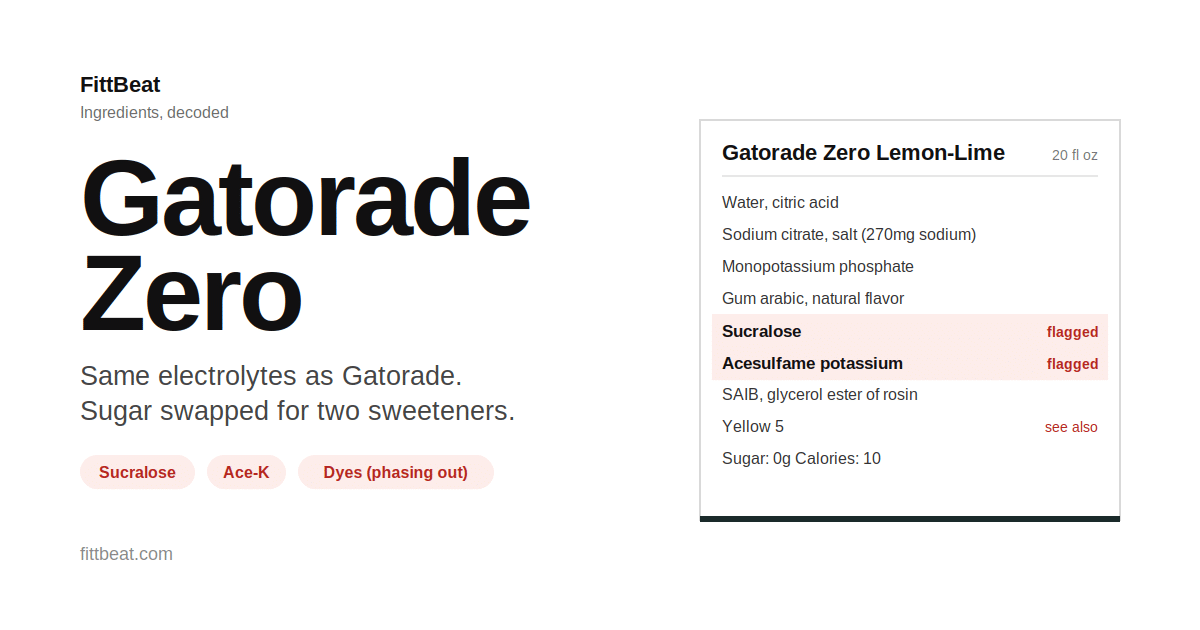
Gatorade Zero is water, citric acid, sodium citrate, salt, monopotassium phosphate, gum arabic, natural flavor, sucralose, acesulfame potassium, sucrose acetate isobutyrate, glycerol ester of rosin, and (in most flavors, through 2026) a synthetic dye. A 20 oz bottle has 10 calories, 0 g sugar, 270 mg sodium, and 75 mg potassium — the same electrolytes as regular Gatorade. The sweeteners are the only real question: sucralose and Ace-K are FDA-approved and safe at these doses, but the research since 2022 links sucralose to gut-bacteria changes and a blunted insulin response in some people. For a sweaty hour-plus workout, it does the job without the sugar. For sipping at your desk, it’s flavored, dyed water with two sweeteners you don’t need.
The full Gatorade Zero ingredients list
Water, Citric Acid, Sodium Citrate, Salt, Monopotassium Phosphate, Gum Arabic, Natural Flavor, Sucralose, Acesulfame Potassium, Sucrose Acetate Isobutyrate, Glycerol Ester of Rosin, Yellow 5.
Compare that to regular Gatorade: water, sugar, dextrose, citric acid, salt, sodium citrate, monopotassium phosphate, gum arabic, glycerol ester of rosin, natural flavor, color. Zero removes sugar and dextrose and adds sucralose, Ace-K, and sucrose acetate isobutyrate. The electrolytes and everything else are identical. Flavor determines the dye: Yellow 5 in lemon-lime, Red 40 in fruit punch, Blue 1 in Glacier Freeze, Yellow 6 in orange.
Gatorade Zero ingredients explained
Water Fine
Not carbonated. The base is 97% of the bottle.
Citric acid Fine
Tartness, and a mild preservative effect. It’s what makes Gatorade acidic (pH around 3), which matters for teeth if you sip it over hours — a real issue for athletes who nurse a bottle through practice.
Sodium citrate and salt The point
Together these deliver 270 mg of sodium per bottle, which is the ingredient that justifies a sports drink’s existence. Sodium is the electrolyte you lose most in sweat (typically 500–1,500 mg per liter), and replacing it helps the body hold onto the water you drink. For comparison, Prime Hydration has 10 mg of sodium per bottle — it has the marketing of a sports drink and the sodium of tap water. Gatorade Zero’s 270 mg is a real, useful dose for a long workout and an unnecessary one for a sedentary afternoon.
Monopotassium phosphate Fine
The potassium source, 75 mg per bottle. A small amount — a banana has about 400 mg — and potassium loss in sweat is minor, so this is mostly here to round out the label.
Gum arabic Fine
Acacia tree sap, used as an emulsifier to keep flavor oils dispersed. It’s a soluble fiber at trace levels. No concern.
Natural flavor Undisclosed
The lemon-lime (or fruit punch, or “Glacier Freeze”) taste. Plant-derived flavor compounds; the specific mix is proprietary.
Sucralose Flagged
The primary sweetener. Sucralose is sugar with three chlorine atoms swapped in, which makes it 600 times sweeter and mostly indigestible — about 85% passes through unabsorbed. It’s been FDA-approved since 1998 and the acceptable daily intake is far above what any drink delivers. The research worth knowing: a 2022 trial found sucralose changed gut bacteria and impaired glucose tolerance in some healthy adults within two weeks; a 2023 study found a sucralose metabolite damaged DNA in cell cultures; and a 2025 brain-imaging study found sucralose increased hunger-related activity compared with sugar. None of these show harm at a bottle a day, but together they’re why “zero calories” shouldn’t be read as “zero effect.” Our sucralose breakdown goes through each study.
Acesulfame potassium (Ace-K) Flagged
The second sweetener, paired with sucralose because the two together taste more like sugar than either alone — sucralose is slow to register, Ace-K is fast with a slightly bitter finish, and they cover for each other. Ace-K is not metabolized; it’s excreted unchanged. Animal studies have linked long-term intake to gut-bacteria shifts and, in one mouse study, cognitive effects, but human data is thin and regulators consider it safe. Its main practical significance is that if you’re trying to avoid artificial sweeteners entirely, Ace-K is in nearly every “zero sugar” drink and rarely listed on the front. Our acesulfame potassium breakdown covers it.
Sucrose acetate isobutyrate (SAIB) Low concern
A weighting agent: it makes flavor oils the same density as water so they stay evenly mixed. It replaced brominated vegetable oil (BVO), which the FDA banned in 2024. SAIB has a long safety record at these levels.
Glycerol ester of rosin Low concern
A second weighting agent made from pine resin and glycerol, doing the same job as SAIB. Unusual-sounding, not harmful at trace amounts. It’s also in Fanta and most citrus sodas.
Yellow 5 / Red 40 / Blue 1 (by flavor) Flagged, being removed
Synthetic dyes, there so the drink matches the flavor name. These carry the EU child-behavior warning label and are part of the FDA’s voluntary 2026–2027 phase-out. PepsiCo announced in April 2026 that fruit punch, lemon-lime, and orange Gatorade Zero would switch to fruit- and vegetable-derived colors by fall 2026, with the rest of the portfolio by end of 2027. Check the label: a reformulated bottle will list something like “vegetable juice (color)” instead of a numbered dye. Our Red 40 breakdown covers the behavioral research and the phase-out timeline.
Gatorade Zero nutrition facts
| Per 20 oz bottle | Gatorade Zero | Gatorade Thirst Quencher | Powerade Zero | Prime Hydration (16.9 oz) |
|---|---|---|---|---|
| Calories | 10 | 140 | 0 | 25 |
| Sugar | 0 g | 34 g | 0 g | 2 g |
| Sweetener | Sucralose + Ace-K | Sugar + dextrose | Sucralose + Ace-K | Sucralose + Ace-K |
| Sodium | 270 mg | 270 mg | 250 mg | 10 mg |
| Potassium | 75 mg | 75 mg | 60 mg | 700 mg |
| Synthetic dye | Yes (phasing out) | Yes (phasing out) | Yes | No |
| Caffeine | 0 mg | 0 mg | 0 mg | 0 mg |
The sodium row is the one to read. Gatorade Zero and Powerade Zero are near-identical products; Prime is a different category wearing the same costume.
Gatorade Zero vs. regular Gatorade: which is better?
It depends on what you’re doing. Regular Gatorade’s 34 g of sugar isn’t a flaw in its design — it’s the design. During hard exercise over an hour, fast carbohydrate is fuel, and sports-medicine guidance recommends 30–60 g of carbs per hour for endurance efforts. In that context the sugar is doing a job and Gatorade Zero is leaving it undone.
Outside that context — a 30-minute gym session, a walk, a hot day at a desk — the sugar is 140 empty calories and the electrolytes are more than you lost. There, Gatorade Zero wins on calories but you’re still drinking two artificial sweeteners and (for now) a dye to replace something water would have handled.
The honest ranking for most people: water for workouts under an hour, Gatorade Zero for long or very sweaty sessions where you want sodium without sugar, regular Gatorade for endurance events where you need fuel. Gatorade Zero as a daily beverage is the use the product wasn’t built for, and it’s the most common one.
Is Gatorade Zero bad for you?
FittBeat verdict
Better than regular Gatorade for most workouts. Not a water substitute. The electrolytes are real and useful when you’ve been sweating hard. The two sweeteners are safe by every regulator’s measure and increasingly questioned by the research on gut bacteria and appetite. The dye is on its way out. One after a long workout is a sensible choice; one every afternoon is a sucralose habit you didn’t need.
The concerns, ranked by evidence:
- Teeth. Citric acid at pH 3, sipped slowly over a practice — the most direct harm, and the one dentists see in athletes. Zero sugar helps but acid still erodes enamel.
- Sucralose. Safe at this dose by regulatory standards; the 2022–2025 research on gut bacteria, glucose tolerance, and appetite is why moderation makes sense.
- Sodium you don’t need. 270 mg is 12% of the daily limit. Fine after sweating; pointless added sodium if you weren’t.
- Dyes. Modest behavioral effect in some children; being removed. Matters most if a kid drinks it daily.
- Ace-K. Lowest concern on the list; thin human evidence either way.
Gatorade Zero for keto, diabetes, and kids
Keto: under 1 g of carbs per bottle. It won’t break ketosis, and the electrolytes are useful on keto, where sodium loss is common early on.
Diabetes: no sugar, so no direct glucose spike. The sucralose research on insulin response is worth knowing if you track your numbers, but for most people it’s a far better option than regular Gatorade.
Kids: the AAP says children don’t need sports drinks for ordinary activity and should drink water. Gatorade Zero removes the sugar objection but keeps the sweeteners and dye. For a kid playing a tournament in heat, it’s reasonable; for a kid at a one-hour practice, water.
Cleaner alternatives
For electrolytes without artificial sweeteners: LMNT (1,000 mg sodium, stevia, no dyes — strong, for heavy sweaters), Liquid I.V. Sugar-Free (stevia and allulose), Nuun Sport tablets (stevia, 300 mg sodium), or Gatorade Lower Sugar, launched in 2026 with 75% less sugar and no artificial sweeteners or colors. For real-food electrolytes: coconut water for potassium, or water with a pinch of salt and a squeeze of citrus, which is Gatorade Zero’s actual recipe minus the sweeteners.
See the full ingredients index for every drink we’ve broken down, including Celsius and Coke Zero, which use the same sweetener pairing.
Frequently asked questions
What sweetener is in Gatorade Zero?
Sucralose and acesulfame potassium (Ace-K). It contains no sugar, aspartame, or stevia.
Is Gatorade Zero bad for you?
Not in moderation. The electrolytes are useful after heavy sweating, and the sweeteners are FDA-approved. The main cautions are tooth erosion from the acid, the emerging research on sucralose and gut bacteria, and that it’s unnecessary as an everyday drink.
Does Gatorade Zero have electrolytes?
Yes — 270 mg sodium and 75 mg potassium per 20 oz, the same as regular Gatorade.
Does Gatorade Zero have dyes?
Most flavors use a synthetic dye (Yellow 5, Red 40, Blue 1, or Yellow 6 depending on flavor). PepsiCo is replacing them with fruit and vegetable colors in the fruit punch, lemon-lime, and orange flavors by fall 2026, and across the portfolio by end of 2027.
Is Gatorade Zero keto-friendly?
Yes. Under 1 g of carbs, 0 g sugar.
Is Gatorade Zero better than water?
Only after prolonged or heavy sweating, when the sodium helps you rehydrate. For ordinary hydration, water is better.
Does Gatorade Zero have caffeine?
No. Gatorade Zero is caffeine-free. Gatorade’s caffeinated line is Fast Twitch.
Gatorade Zero vs. Powerade Zero: what’s the difference?
Very little. Both use sucralose and Ace-K; Gatorade Zero has slightly more sodium (270 vs 250 mg) and Powerade Zero adds B vitamins. Pick by taste.
This article is for informational purposes and is not medical advice. Talk to a doctor or registered dietitian about your individual nutrition needs.
Leave a Reply