
Last reviewed: October 2026. Reflects the current U.S. Powerade Mountain Berry Blast label, 28 fl oz bottle (©2026), photographed in store. Other flavors differ in dye; Powerade Zero is covered below.
Powerade sells itself on electrolytes — the front of the bottle says “50% more electrolytes vs the leading sports drink,” and for once the claim checks out. Flip it around, though, and the first two ingredients are water and high fructose corn syrup, the same opening as a can of Sprite, and the color comes from Blue 1. Here’s all the Powerade ingredients, what the electrolyte blend actually delivers, how it compares to Gatorade (it has more sodium, which most people don’t expect), and when it’s worth drinking at all.
Quick answer: what’s in Powerade?
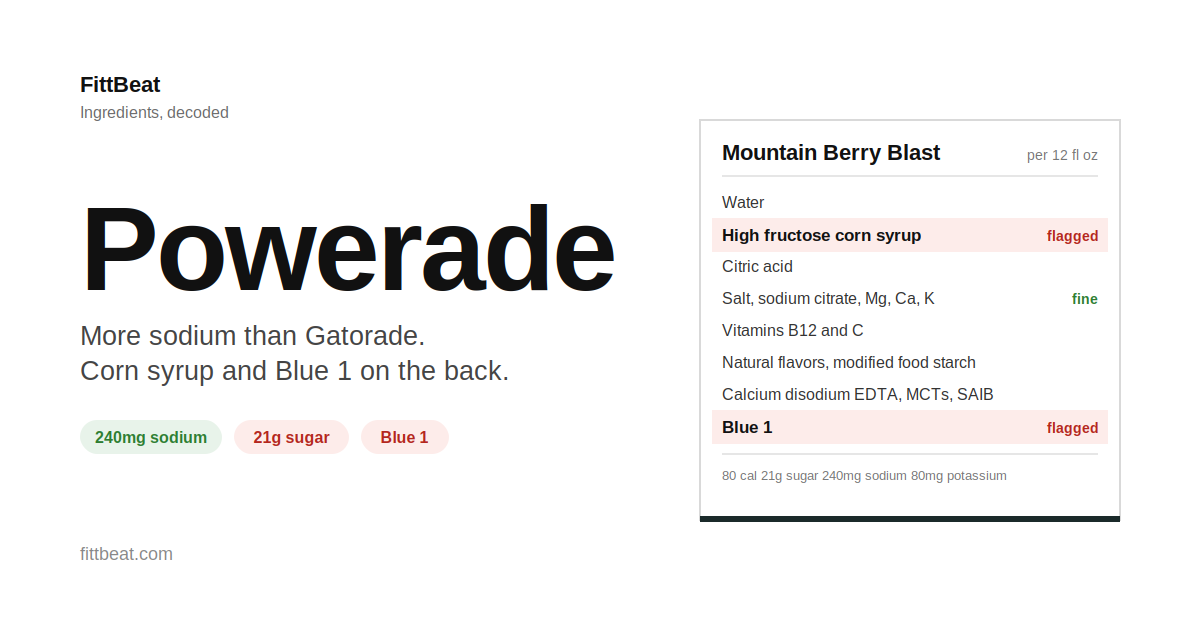
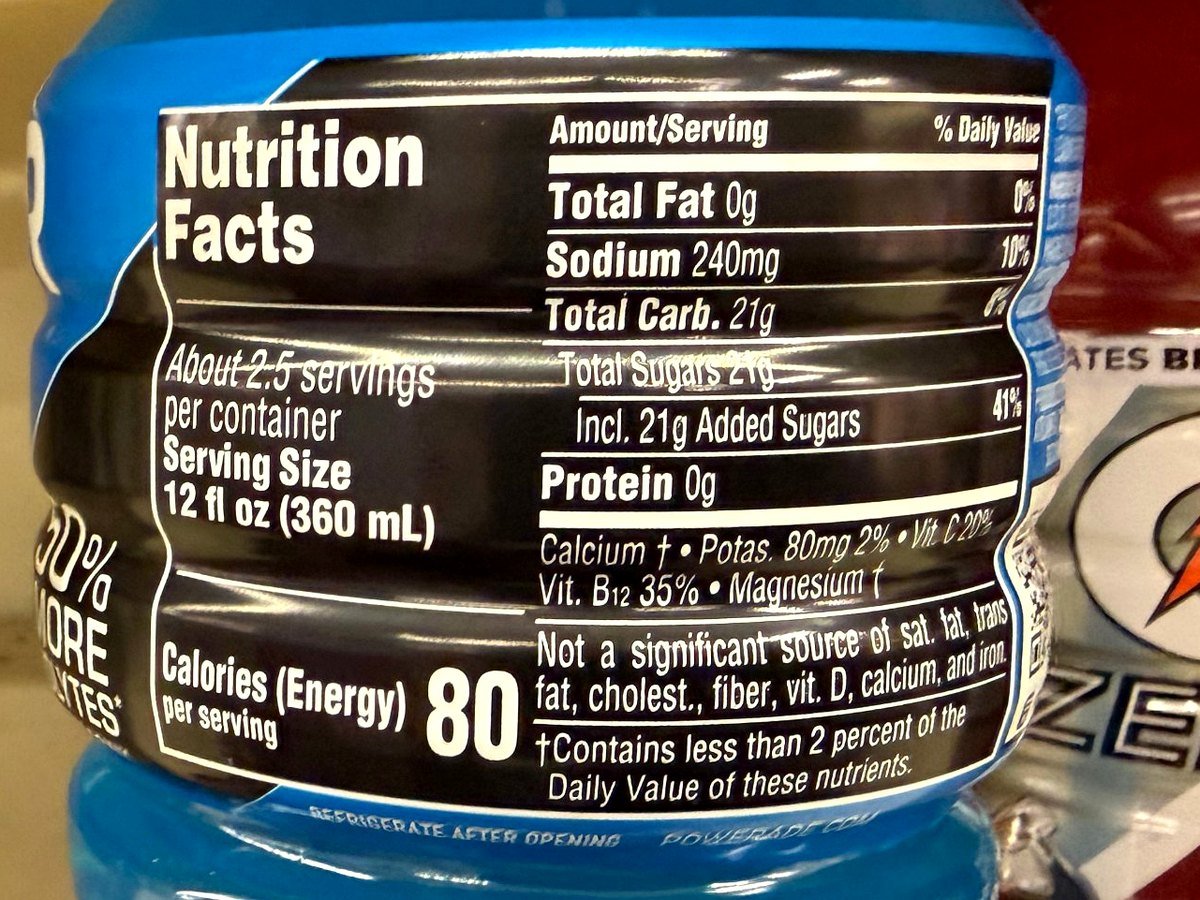
Powerade Mountain Berry Blast is water, high fructose corn syrup, and less than 0.5% of citric acid, an electrolyte blend (salt, sodium citrate, magnesium and calcium chlorides, mono-potassium phosphate), vitamins B12 and C, natural flavors, modified food starch, calcium disodium EDTA, medium-chain triglycerides, sucrose acetate isobutyrate, and Blue 1. A 12 oz serving has 80 calories, 21 g of added sugar, 240 mg of sodium, and 80 mg of potassium; the 28 oz bottle is about 2.3 servings — roughly 190 calories, 49 g of sugar, and 560 mg of sodium. No caffeine. The sodium is real and higher than Gatorade’s (240 vs 160 mg per 12 oz). The corn syrup is the cost, and the dye is purely cosmetic. Powerade Zero swaps the corn syrup for sucralose and Ace-K.
Jump to: The label · Each ingredient · The electrolyte claim · Nutrition · Powerade Zero · Powerade vs. Gatorade · Verdict · FAQ
The full Powerade ingredients list
Water, High Fructose Corn Syrup, Less Than 0.5% of: Citric Acid, Electrolytes (Salt, Sodium Citrate, Magnesium and Calcium Chlorides, Mono-Potassium Phosphate), Vitamins B12 and C (Cyanocobalamin and Ascorbic Acid), Natural Flavors, Modified Food Starch, Calcium Disodium EDTA (To Protect Color), Medium Chain Triglycerides, Sucrose Acetate Isobutyrate, Blue 1.
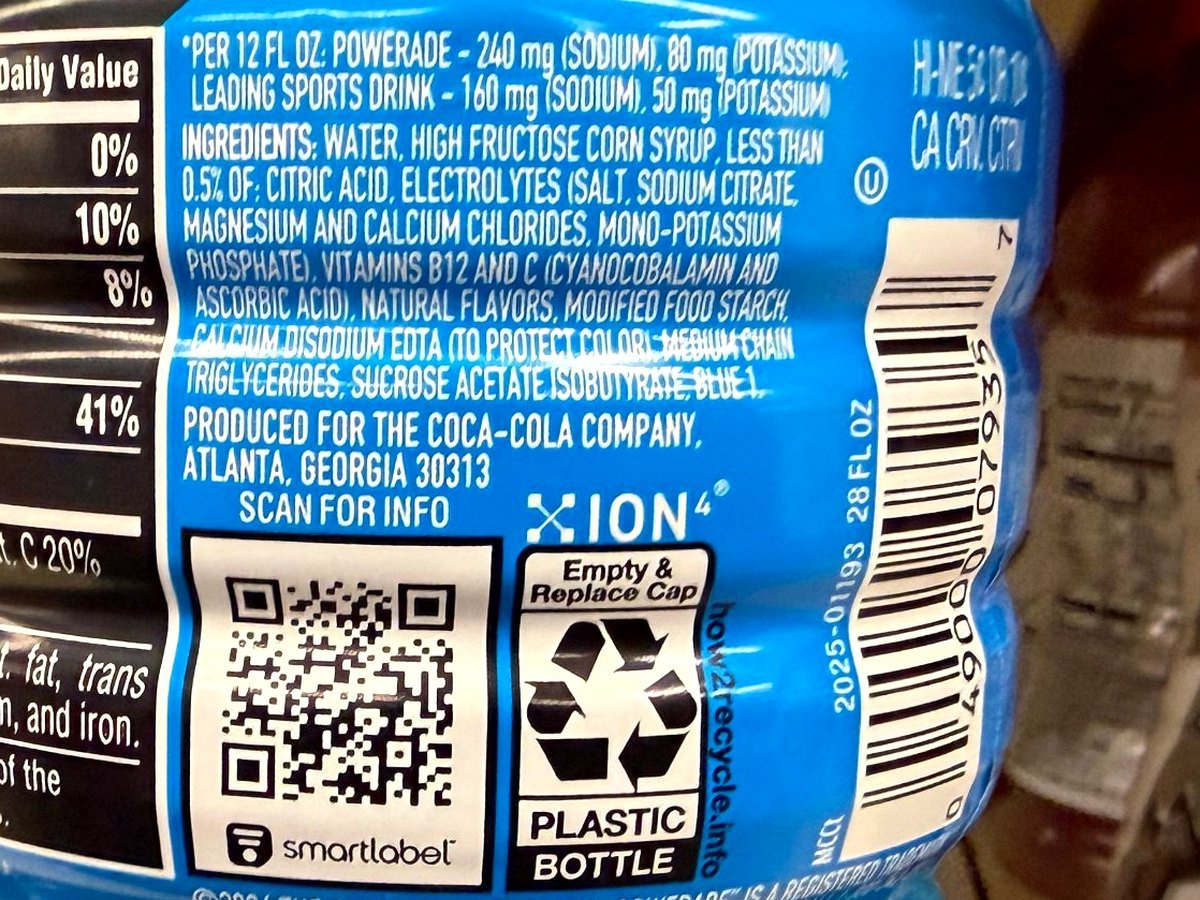
Three things to notice. Everything after the corn syrup — the electrolytes, vitamins, stabilizers, and dye combined — is “less than 0.5%” of the bottle; by weight, Powerade is sugar water with salt in it. The label prints its own comparison: 240 mg sodium and 80 mg potassium per 12 oz versus 160 mg and 50 mg for “the leading sports drink,” which is Gatorade. And there’s one dye, Blue 1, in this flavor; Fruit Punch uses Red 40, and Grape and the Sour line use both.
Powerade ingredients explained
Water Fine
The base. Not carbonated.
High fructose corn syrup Flagged, by the dose
The only sweetener and the ingredient that matters most. In a sports drink it does a real job: Powerade is about a 6% carbohydrate solution, the range sports-nutrition research supports for fueling exercise over an hour. The problem is dosage outside that setting. A 28 oz bottle is about 49 g of added sugar — the American Heart Association’s entire daily limit for men, nearly double it for women. At mile eight that sugar is fuel; at a desk it’s a soda. Our high fructose corn syrup breakdown covers why the molecule matters less than the amount.
Citric acid Fine, with a teeth note
Tartness and a mild preservative effect. Same molecule as in citrus, made commercially by fermentation. Acidic drinks sipped through a practice are hard on enamel; rinse with water after.
Electrolyte blend: salt, sodium citrate, magnesium and calcium chlorides, mono-potassium phosphate The real part
Powerade’s “ION4” — four minerals lost in sweat. The sodium (from salt and sodium citrate) is the one that counts: 240 mg per 12 oz is meaningful, 50% more than Gatorade, and the electrolyte sweat actually loses. Potassium from mono-potassium phosphate is 80 mg, useful but small (a banana has about five times as much). Magnesium and calcium are present in amounts too small to register on the panel. Covered in detail below.
Vitamins B12 and C Panel filler
Cyanocobalamin (B12, 35% DV) and ascorbic acid (vitamin C, 20% DV). Harmless, and the reason the bottle can say “with vitamins.” Neither aids hydration or performance in people who aren’t deficient.
Natural flavors Undisclosed
The “mixed berry” profile. Blue raspberry isn’t a real fruit flavor; “natural” means the flavor molecules came from natural sources, not that they taste like anything that grows.
Modified food starch Fine
A corn-derived emulsifier that keeps the flavor oils suspended so the drink doesn’t separate. In thousands of products; no concern.
Calcium disodium EDTA Cosmetic, low concern
Labeled “to protect color.” A chelator that binds trace metals so they don’t react with the dye and vitamins and cause fading. Permitted in small amounts, poorly absorbed, and the same ingredient in 7 Up and Mountain Dew. It’s there for the look, not for you.
Medium-chain triglycerides Fine
A fat, used here as a carrier for the flavor oils — far too little to show on the panel (0 g fat).
Sucrose acetate isobutyrate (SAIB) Low concern
A weighting agent: flavor oils are lighter than water and would float, and SAIB makes them dense enough to stay mixed. FDA-approved and used in citrus drinks for decades; one of the ingredients that took over the job brominated vegetable oil used to do before the 2024 BVO ban (Powerade dropped BVO in 2014).
Blue 1 Flagged
The neon blue, and nothing else. A petroleum-derived dye on the FDA’s 2025 phase-out list; it wasn’t in the Southampton trial and has less behavioral evidence against it than Red 40, but it’s purely cosmetic. Fruit Punch uses Red 40 instead, and Grape and the Sour line use both. There’s no dye-free Powerade in the U.S. lineup. Our synthetic food dyes hub covers all nine.
The “50% more electrolytes” claim
It’s true, and it’s the most interesting thing about Powerade. The bottle compares itself to Gatorade per 12 oz: 240 mg sodium plus 80 mg potassium (320 mg) against 160 plus 50 (210 mg) — about 52% more. More importantly, the extra is mostly sodium, which is the electrolyte sweat loses in quantity (roughly 500–1,500 mg per liter) and the one that helps your body hold onto the water you drink. Scaled to a 20 oz bottle, Powerade is about 400 mg of sodium to Gatorade’s 270, which puts it second only to Liquid I.V. among the six drinks in our sports drinks comparison, and far ahead of Prime (10 mg) and BodyArmor (25 mg).
The magnesium and calcium in “ION4” are a marketing count, not a nutritional one — they’re present, but too little to list. Read the claim as “more sodium than Gatorade,” which is the part that matters.
Powerade nutrition facts
| Nutrient | Per 12 oz | Per 28 oz bottle (approx.) |
|---|---|---|
| Calories | 80 | 190 |
| Added sugar | 21 g (41% DV) | 49 g |
| Sodium | 240 mg (10% DV) | 560 mg |
| Potassium | 80 mg (2% DV) | 185 mg |
| Vitamin C | 20% DV | ~47% DV |
| Vitamin B12 | 35% DV | ~82% DV |
| Fat / protein | 0 g | 0 g |
| Caffeine | 0 mg | 0 mg |
Powerade Zero: what changes
Powerade Zero removes the corn syrup and the stabilizers that came with it (no MCTs, SAIB, or modified starch) and sweetens with sucralose and acesulfame potassium. The electrolyte blend and sodium are essentially the same, and most flavors keep a synthetic dye (Mixed Berry Zero uses Red 40 and Blue 1). Zero calories and zero carbs, so it won’t affect blood sugar or ketosis. It’s the better pick if you want the sodium without the sugar — but you trade corn syrup for two sweeteners with open research questions, and you lose the fast carbs that are the reason to drink a sugared sports drink during long exercise.
Powerade vs. Gatorade
| Per 12 oz | Powerade | Gatorade Thirst Quencher | Powerade Zero | Gatorade Zero |
|---|---|---|---|---|
| Sweetener | HFCS | Sugar + dextrose | Sucralose + Ace-K | Sucralose + Ace-K |
| Calories | 80 | 80 | 0 | 0 |
| Sugar | 21 g | 21 g | 0 g | 0 g |
| Sodium | 240 mg | 160 mg | ~240 mg | 160 mg |
| Potassium | 80 mg | 50 mg | ~80 mg | 50 mg |
| Added vitamins | B12, C | None | B12, C | None |
| Synthetic dye | Yes | Yes | Yes | Yes |
Closer than the marketing suggests: same calories, same sugar, both dyed. Powerade wins on sodium and potassium; Gatorade uses sucrose and dextrose instead of corn syrup, which some people prefer, though metabolically the difference is small. For rehydration specifically, Powerade’s extra sodium is a genuine edge. Our Gatorade and Gatorade Zero breakdowns cover the other side.
Is Powerade bad for you?
FittBeat verdict
A real sports drink with more sodium than Gatorade — and 49 g of corn syrup in the bottle. During or after hard exercise over an hour, in heat, or when you’re losing fluids to illness, Powerade does its job: 240 mg of sodium per 12 oz with fast carbohydrates is a legitimate rehydration formula, better on sodium than the market leader. As an everyday drink it’s a 190-calorie bottle of corn syrup with a blue dye, and the electrolytes don’t cancel the sugar. Drink it when you’re sweating; drink water when you’re not.
The concerns, ranked by evidence:
- Sugar outside exercise. 49 g per bottle; the dose is the problem, not the molecule.
- Teeth. Sugar plus citric acid, sipped.
- Blue 1 (and Red 40 in other flavors). Purely cosmetic, on the FDA phase-out list, and no dye-free flavor exists.
- Sucralose and Ace-K (Zero only). Approved; long-term research still evolving.
- EDTA, SAIB, MCTs, modified starch. Stabilizers in tiny amounts; low concern.
Powerade for kids, illness, and keto
Kids: the AAP says children don’t need sports drinks for ordinary activity. For a long tournament in heat, the sodium is useful; otherwise water.
Illness: if you’re losing fluids to vomiting or diarrhea and can’t eat, the sugar-and-sodium combination helps. Diluting half and half with water lowers the sugar concentration, which is closer to an oral rehydration solution like Liquid I.V. or Pedialyte.
Keto: regular Powerade, no (21 g carbs per 12 oz). Powerade Zero, yes.
Cleaner alternatives
For the sodium without sugar or dye: Liquid I.V. Sugar-Free (500 mg, allulose and stevia) or LMNT (1,000 mg, stevia). For a bottled drink without synthetic dyes: BodyArmor — though its sodium is low. For a hard workout on a budget: water with a quarter teaspoon of salt and a squeeze of citrus.
Frequently asked questions
What are the main ingredients in Powerade?
Water, high fructose corn syrup, citric acid, an electrolyte blend (salt, sodium citrate, magnesium and calcium chlorides, mono-potassium phosphate), vitamins B12 and C, natural flavors, stabilizers (modified food starch, EDTA, MCTs, SAIB), and a synthetic dye — Blue 1 in Mountain Berry Blast.
Does Powerade have more sodium than Gatorade?
Yes — 240 mg per 12 oz versus Gatorade’s 160 mg, which is what the bottle’s “50% more electrolytes” claim refers to.
Does Powerade have high fructose corn syrup?
Yes. HFCS is the second ingredient and the only sugar. Powerade Zero contains none.
Does Powerade contain caffeine?
No. Regular Powerade, Powerade Zero, and Powerade Sour are caffeine-free in the U.S.
What sweeteners are in Powerade Zero?
Sucralose and acesulfame potassium (Ace-K). Zero calories, zero sugar.
Is Powerade healthier than Gatorade?
For rehydration, Powerade has the edge on sodium and potassium. Calories, sugar, and the use of synthetic dyes are the same. Neither is a health drink.
Does Powerade have Red 40?
Fruit Punch, Grape, and most Zero flavors do. Mountain Berry Blast uses Blue 1 only. There’s no dye-free Powerade in the U.S.
Is Powerade good when you’re sick?
It can help if you’re losing fluids and can’t eat, since it supplies sodium and sugar together. Diluting it half and half with water brings it closer to an oral rehydration solution.
Sources
- The Coca-Cola Company. Nutrition facts and ingredients, Powerade Mountain Berry Blast, 28 fl oz (©2026 label). Product label, photographed October 2026.
- Sawka MN, et al. American College of Sports Medicine position stand: exercise and fluid replacement. Medicine & Science in Sports & Exercise, 2007. doi:10.1249/mss.0b013e318031c8e7
- Baker LB. Sweating rate and sweat sodium concentration in athletes. Sports Medicine, 2017. doi:10.1007/s40279-017-0691-5
- Schneider MB, Benjamin HJ, AAP Committee on Nutrition. Sports drinks and energy drinks for children and adolescents. Pediatrics, 2011. doi:10.1542/peds.2011-0965
- Malik VS, et al. Sugar-sweetened beverages and risk of metabolic syndrome and type 2 diabetes. Diabetes Care, 2010. doi:10.2337/dc10-1079
- HHS and FDA. HHS, FDA to phase out petroleum-based synthetic dyes in nation’s food supply. April 22, 2025. fda.gov
- McCann D, et al. Food additives and hyperactive behaviour in 3-year-old and 8/9-year-old children in the community. The Lancet, 2007. doi:10.1016/S0140-6736(07)61306-3
- U.S. FDA. FDA revokes authorization for the use of brominated vegetable oil in food, 2024. fda.gov
This article is for informational purposes and is not medical advice. Talk to a doctor or registered dietitian about your individual nutrition needs.
