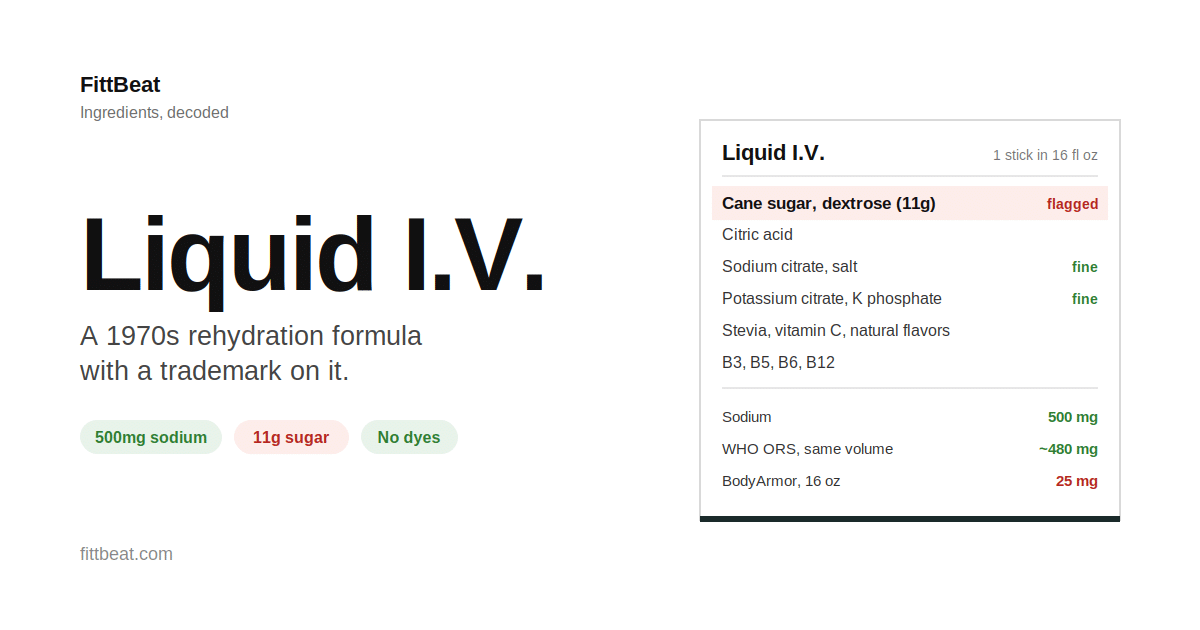

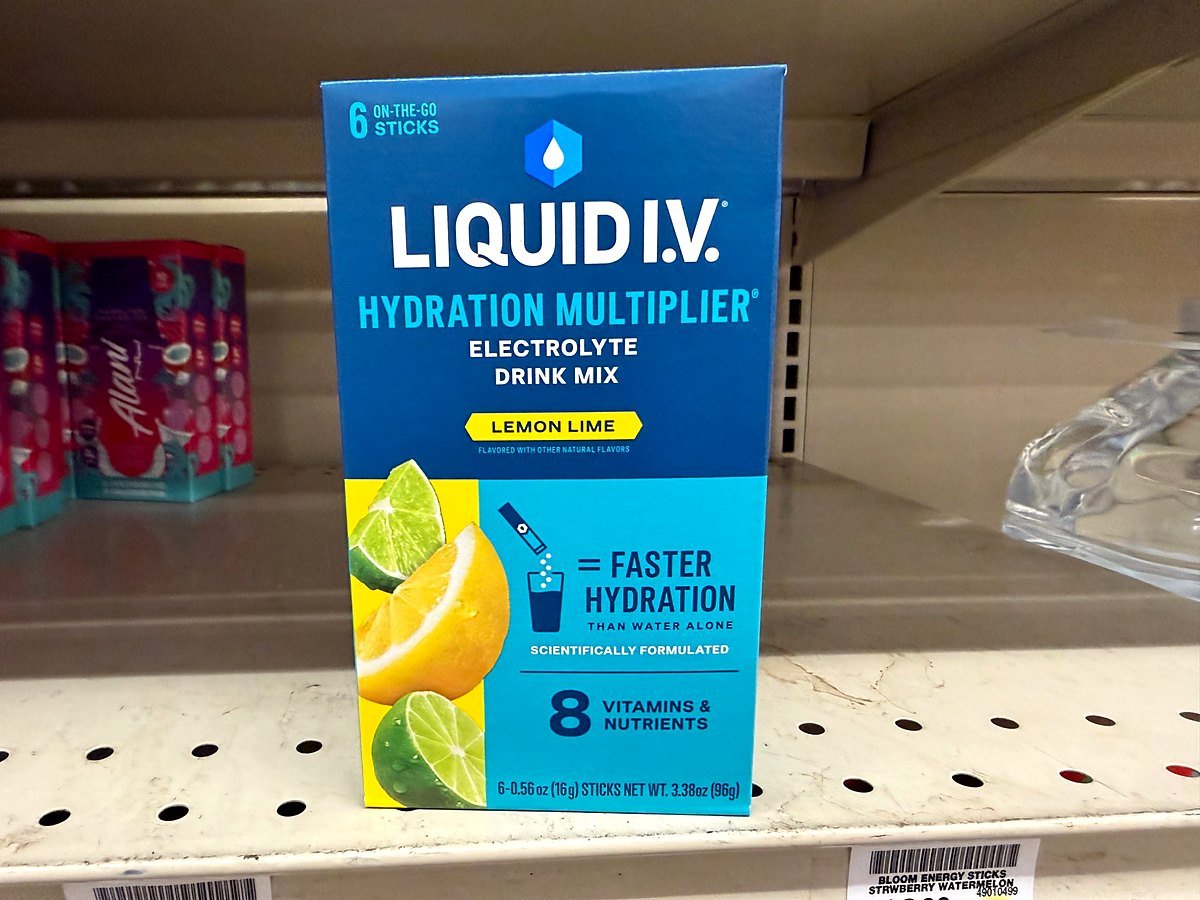
Last reviewed: October 2026. Reflects the current U.S. Liquid I.V. Hydration Multiplier, Lemon Lime, one 16 g stick mixed into 16 oz of water, read from the box in store. Sugar-Free is compared below. Liquid I.V. has been owned by Unilever since 2020; the box lists The LIV Group Inc. as distributor and Canada as the country of manufacture.
Liquid I.V. is the powder that made “electrolytes” a thing people buy in sticks. Its pitch has always been that it hydrates faster than water — the box says so in big type — and the brand calls the idea “Cellular Transport Technology.” Read the label and the technology is an old one: salt, sugar, and potassium in water, the oral rehydration principle the World Health Organization built its rehydration salts on in the 1970s. That’s not a knock; it’s the reason Liquid I.V. is the one product in this category that works for what it’s sold for. It’s also why it has 11 g of sugar and 560 mg of sodium, which matter more than the brand’s “one stick a day” suggestion lets on. Here’s all the Liquid IV ingredients from the current box, how close it really is to medical rehydration solutions, and when you actually need it.
Quick answer: what’s in Liquid I.V.?
Liquid I.V. Hydration Multiplier is cane sugar, dextrose, citric acid, salt, potassium citrate, sodium citrate, dipotassium phosphate, silicon dioxide, stevia leaf extract, vitamin C, natural flavors, and vitamins B3, B5, B6, and B12. One stick in 16 oz of water has 50 calories, 11 g of sugar (all added), 560 mg of sodium, and 370 mg of potassium. No dyes, no artificial sweeteners, no preservatives. The sodium is twice Gatorade’s and more than twenty times BodyArmor’s, and that’s the point: with the sugar, it’s an oral-rehydration-style drink, very close to Pedialyte, and the most effective thing on the shelf for replacing fluid after heavy sweat, illness, or a hangover. For a desk day, it’s 11 g of sugar and a quarter of your daily sodium you didn’t lose. Sugar-Free swaps the sugar for allulose and stevia and keeps the salt.
Jump to: The label · Each ingredient · “Faster than water” and the ORS science · Nutrition · Sugar-Free · When you need it · Verdict · FAQ
The full Liquid IV ingredients list
Cane Sugar, Dextrose, Citric Acid, Salt, Potassium Citrate, Sodium Citrate, Dipotassium Phosphate, Silicon Dioxide, Stevia Leaf Extract (Rebaudioside A), Vitamin C (Ascorbic Acid), Natural Flavors, Vitamin B3 (Niacinamide), Vitamin B5 (Calcium D-Pantothenate), Vitamin B6 (Pyridoxine Hydrochloride), Vitamin B12 (Cyanocobalamin). Vegan; soy-free; dairy-free; certified gluten-free; Non-GMO Project verified.
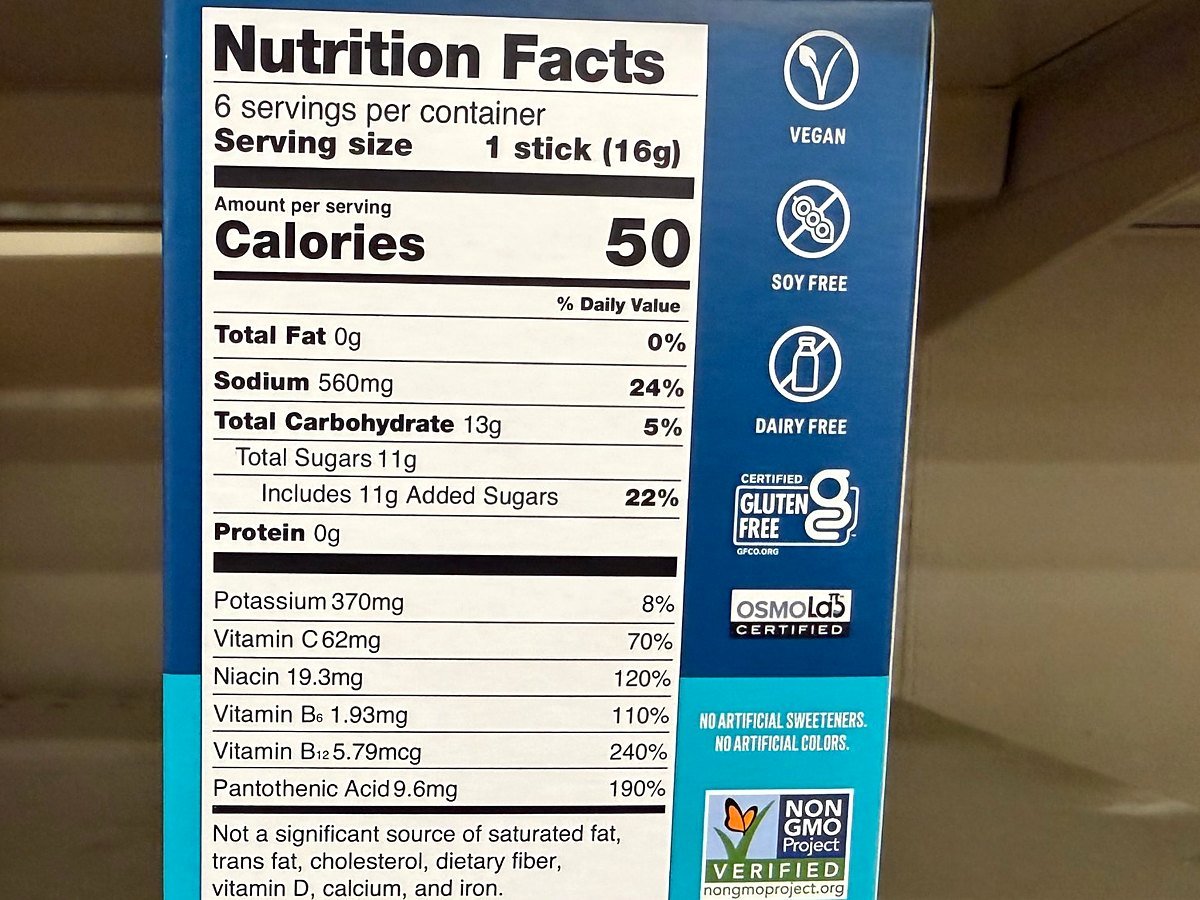
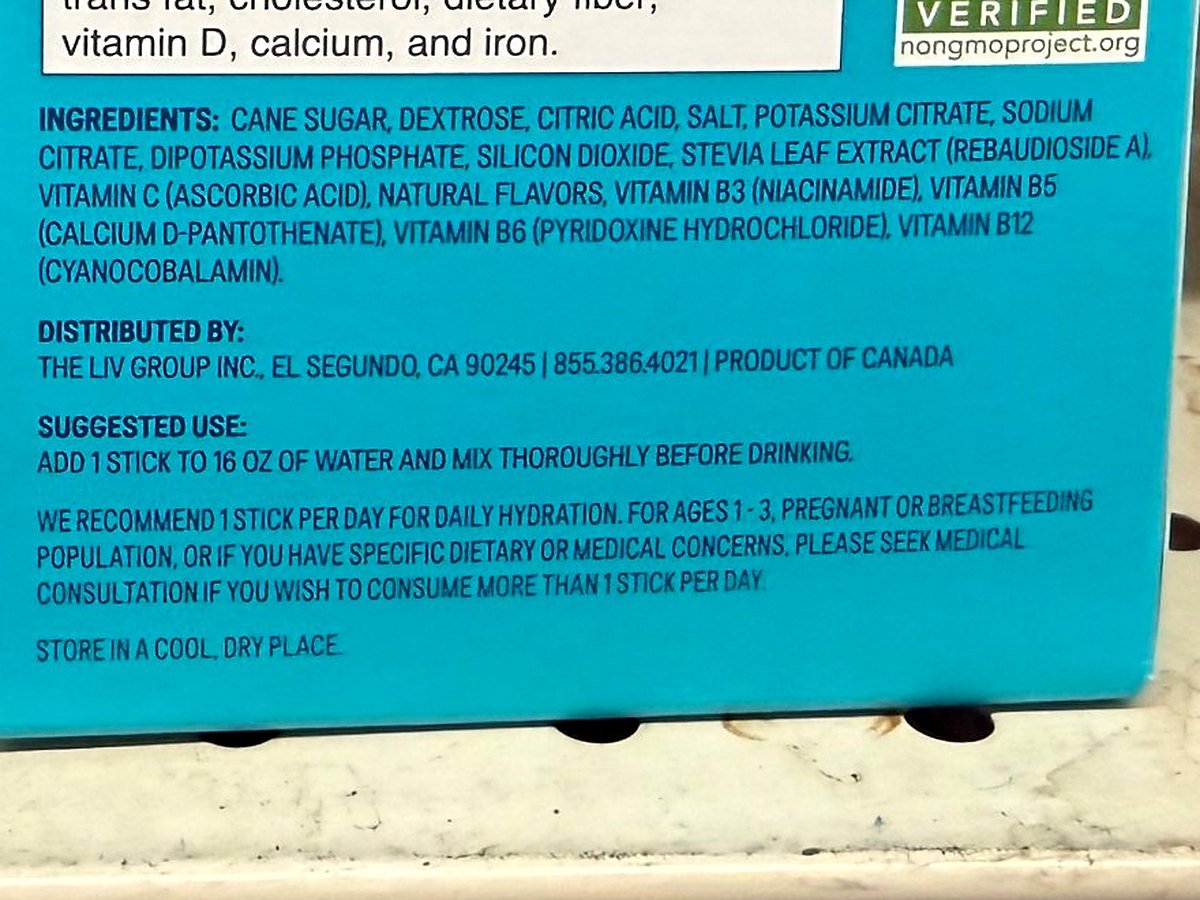
Three things to notice. Sugar is the first ingredient by weight — the stick is mostly sugar, which is part of how the formula works rather than a flaw. Salt is fourth and sodium citrate sixth: two plain sodium sources, listed openly rather than as a branded “electrolyte blend,” which is how you get to 560 mg. And there’s no coconut water, no proprietary extract, and nothing undisclosed. Note also that this is a Nutrition Facts panel, not a Supplement Facts panel — Liquid I.V. is sold as a food, a drink mix, which matters for how its claims are regulated.
Liquid IV ingredients explained
Cane sugar and dextrose 11 g, and it’s doing a job
Together, 11 g per stick, all of it added — about 3 teaspoons, 22% of the daily value, a third of a Gatorade. In most drinks on this site, the sugar is the cost. Here it’s part of the mechanism: glucose is what pulls sodium, and with it water, across the intestinal wall. A rehydration drink without sugar absorbs more slowly; one with far too much (a regular soda) draws water into the gut instead. Dextrose is pure glucose; cane sugar is half glucose and half fructose. Liquid I.V. carries more sugar than the WHO formula — about 23 g per liter against the WHO’s 13.5 g of glucose — and lands closer to Pedialyte. The cost is still 11 g of sugar if you’re drinking it for taste.
Citric acid Fine
Tartness, and it makes the salt palatable — 560 mg of sodium in plain water tastes like seawater. Mildly acidic; the teeth note applies, though a stick drunk at once is less of an issue than a soda sipped for hours.
Salt and sodium citrate — 560 mg sodium The point
560 mg per stick, 24% of the daily value — twice Gatorade’s 270 per 20 oz, more than 20 times BodyArmor’s 25, and more than 50 times Prime’s. Sweat loses roughly 500–1,500 mg of sodium per liter, so after an hour of hard sweating, this is the first product on the shelf that replaces a meaningful fraction of it. Citrate rather than chloride for part of the sodium is the WHO’s choice too: it buffers the acid and is gentler on an upset stomach. If you’re not sweating, sick, or hungover, this is a quarter of your daily sodium you didn’t need; people on sodium-restricted diets should treat a stick as a meal’s worth of salt.
Potassium citrate and dipotassium phosphate — 370 mg potassium Fine
8% of the daily value. Potassium loss in sweat is small, so this is a supporting player; the ratio to sodium (about 1.5 to 1) is sensible, and the reverse of BodyArmor and Prime.
Silicon dioxide Fine
An anti-caking agent so the powder pours. Essentially fine sand; inert and excreted.
Stevia leaf extract (Rebaudioside A) Low concern
Reb A is the purified sweet compound from the stevia leaf, a zero-calorie sweetener that tops up the sweetness without adding sugar beyond what the formula needs. Clean regulatory record; the only thing some people notice is its aftertaste. The box says “no artificial sweeteners,” and that’s accurate — stevia is plant-derived.
Vitamin C (ascorbic acid) Fine
62 mg, 70% of the daily value. No benzoate on this label, so the benzene pairing covered in our sodium benzoate breakdown doesn’t apply — a dry powder doesn’t need a preservative.
Natural flavors Undisclosed
Lemon lime, or whichever flavor. Plant-derived; proprietary.
B vitamins (B3, B5, B6, B12) Overdosed, harmless
Niacin at 120% of the daily value, B6 at 110%, pantothenic acid at 190%, B12 at 240%. They don’t aid hydration or energy in people who aren’t deficient; they’re here for the “8 vitamins & nutrients” on the front of the box. Excess is excreted. The one worth a thought is B6 if you’re stacking several sticks a day with other supplements — chronic high intake is linked to nerve symptoms, though one stick is far below that level.
“Faster hydration than water” — and the ORS science behind it
The claim on the box is “faster hydration than water alone,” and the brand’s name for why is Cellular Transport Technology. What it describes is sodium-glucose cotransport, worked out in the 1960s: a protein in the gut wall (SGLT1) moves sodium and glucose across together, and water follows. That mechanism is the basis of oral rehydration solution, the WHO formula credited with saving tens of millions of lives from diarrheal disease. Give someone salt and sugar in water in a sensible ratio and they absorb it faster, and retain more of it, than plain water.
How close is Liquid I.V. to the medical version? Closer to one than the other. The WHO’s reduced-osmolarity ORS, scaled to 16 oz, is about 815 mg of sodium, 370 mg of potassium, and 6.4 g of glucose. Liquid I.V. matches the potassium exactly, has about 70% of the sodium, and nearly twice the sugar — it’s sweeter and less salty than the clinical formula, which is a reasonable trade for something people drink voluntarily. Pedialyte, scaled to 16 oz, is about 490 mg of sodium, 370 mg of potassium, and 12 g of sugar — and Liquid I.V. is within a few percent of it on all three. So the fair description is an ORS-style drink built like Pedialyte, not a copy of the WHO solution.
Two honest caveats. The “faster than water” claim rests on the general ORS literature and the brand’s own testing, not on independent trials of Liquid I.V. specifically. And ORS was designed for people losing fluid to illness; for ordinary exercise, the evidence that a sodium-glucose drink beats water is strongest for sessions over an hour in the heat, and weak for anything shorter. Liquid I.V. works. It works for the situations ORS was built for, which are fewer than the marketing implies.
Liquid I.V. nutrition facts
| Per serving | Liquid I.V. (1 stick / 16 oz) | Liquid I.V. Sugar-Free | Pedialyte (16 oz) | WHO ORS (16 oz) | Gatorade (20 oz) | BodyArmor (16 oz) | Prime (16.9 oz) |
|---|---|---|---|---|---|---|---|
| Calories | 50 | 0 | ~47 | ~25 | 140 | 110 | 25 |
| Sugar | 11 g | 0 g | ~12 g | ~6.4 g glucose | 34 g | 25 g | 2 g |
| Sweetener | Cane sugar + dextrose + stevia | Allulose + stevia | Dextrose + sucralose + Ace-K | Glucose | Sugar + dextrose | Cane sugar + stevia | Sucralose + Ace-K |
| Sodium | 560 mg | ~510 mg | ~490 mg | ~815 mg | 270 mg | 25 mg | 10 mg |
| Potassium | 370 mg | ~380 mg | ~370 mg | ~370 mg | 80 mg | 680 mg | 700 mg |
| Sodium : potassium | 1.5 : 1 | 1.3 : 1 | 1.3 : 1 | 2.2 : 1 | 3.4 : 1 | 1 : 27 | 1 : 70 |
| Dyes / preservatives | None | None | Dye (most flavors) | None | Yellow 5 | None | None |
Liquid I.V., Gatorade, and BodyArmor figures are from packages photographed for FittBeat in October 2026; Sugar-Free, Pedialyte, and Prime from current labels (Pedialyte Classic scaled from 12 oz); the WHO column is reduced-osmolarity ORS (75 mmol/L sodium, 20 mmol/L potassium, 13.5 g/L glucose) scaled to 16 oz. Read the sodium and sugar rows together: Liquid I.V. and Pedialyte are the same drink in different packaging, and the WHO formula is saltier and less sweet than both.
Liquid I.V. Sugar-Free
Swaps the 11 g of cane sugar and dextrose for allulose (a rare sugar that isn’t metabolized for calories) and stevia, and keeps the sodium and potassium. Without glucose, the sodium-glucose cotransport mechanism doesn’t engage, so it absorbs more like salted water — still useful for replacing sodium, somewhat slower on the “multiplier” claim. For someone avoiding sugar who sweats a lot, it’s the better everyday choice; for illness or a hangover, the original’s sugar is doing work. Allulose can cause mild stomach upset in some people at larger amounts.
When you actually need it
The box’s own suggestion is “1 stick per day for daily hydration,” with a note to check with a doctor before taking more for toddlers, pregnancy, breastfeeding, or medical conditions. That’s a marketing recommendation more than a physiological one; whether a stick does anything for you depends on whether you’ve lost sodium.
- After heavy sweat: an hour-plus in the heat, a hard practice, a long run. Yes — this is the product’s real use case, and it beats Gatorade on sodium and BodyArmor by a mile.
- Illness: vomiting or diarrhea in an adult. Yes — it’s an ORS-style drink, essentially Pedialyte in a stick. For young children, use Pedialyte, which is dosed and labeled for them.
- Hangover: alcohol is a diuretic and you’ve lost fluid and some sodium; a stick in the morning helps with that part. It doesn’t fix anything else.
- Travel, flights, “daily hydration”: usually no. You lose almost no sodium sitting in a seat or at a desk. A stick a day is 11 g of added sugar and 560 mg of sodium on top of a diet that, for most Americans, already has too much of both. Water.
- Short workouts: no. Under an hour, water is enough; the ORS benefit doesn’t show up until losses are substantial.
Is Liquid I.V. good for you?
FittBeat verdict
The one hydration product that’s built right — for the few times you need it. Liquid I.V. is a clean, honest ORS-style formula: sodium and sugar in a ratio that works, no dyes, no artificial sweeteners, no preservatives, and nothing on the label hiding. It’s sweeter and less salty than the WHO solution and nearly identical to Pedialyte, which is the right comparison. After heavy sweat, illness, or a hangover, it does what it says. As the daily habit the box suggests, it’s a quarter of your sodium and three teaspoons of sugar for a problem most people don’t have. Use it like medicine, not like a beverage.
The concerns, ranked by evidence:
- Sodium, when unneeded. 560 mg is the design; for people on sodium-restricted diets or with high blood pressure, or anyone drinking one a day at a desk, it’s a lot.
- Sugar, when unneeded. 11 g is modest and functional in the right context; daily use without sweat is just added sugar.
- The “daily hydration” recommendation. Not a harm, but the biggest gap between what the product does and how it’s sold — now printed on the box.
- Teeth. Mildly acidic; drunk at once, a minor issue.
- Everything else. Stevia, vitamins, silicon dioxide: no concern at one stick.
Liquid I.V. for kids, keto, pregnancy, and blood pressure
Kids: for illness, Pedialyte is formulated and dosed for children, and the Liquid I.V. box itself says to seek medical advice before giving more than one stick to children ages 1–3. For sports, a kid needs it even less than an adult does.
Keto: the original has 13 g of carbs; Sugar-Free is near zero and the sodium is genuinely useful in the first weeks of keto, when sodium loss is common.
Pregnancy: no caffeine and no sweeteners of concern; fine as an occasional rehydration drink, with the sodium in mind. The box asks pregnant and breastfeeding users to check with a clinician before using more than one stick a day.
High blood pressure: 560 mg of sodium per stick is a meaningful dose. Occasional use after real losses is fine; daily use isn’t.
Cleaner alternatives
For the same thing, often cheaper: Pedialyte or a store-brand electrolyte powder, or a homemade ORS — the WHO’s home recipe is about half a level teaspoon of salt and six level teaspoons of sugar in a liter of water. For more sodium and no sugar: LMNT (1,000 mg, stevia). For less sodium and a cleaner label on an ordinary day: just water, which is the point of this section. Liquid I.V. isn’t the problem in this category; using it when you don’t need it is.
Frequently asked questions
How much sugar is in Liquid I.V.?
11 g per stick, all added, from cane sugar and dextrose — about 3 teaspoons and 22% of the daily value. The sugar is part of the rehydration mechanism (glucose helps the gut absorb sodium and water). Liquid I.V. Sugar-Free uses allulose and stevia instead.
How much sodium is in Liquid I.V.?
560 mg per stick, 24% of the daily value — twice Gatorade and more than 20 times BodyArmor. That’s the design: it replaces what heavy sweat or illness loses.
Is Liquid I.V. the same as Pedialyte?
Nearly. Scaled to the same 16 oz, the two have about the same sodium (560 vs ~490 mg), the same potassium (370 mg), and similar sugar (11 vs ~12 g). Liquid I.V. uses cane sugar and stevia and has no dye; Pedialyte uses dextrose with sucralose and Ace-K. Both are ORS-style drinks; the WHO’s clinical ORS is saltier and less sweet than either.
What is Cellular Transport Technology?
Liquid I.V.’s name for sodium-glucose cotransport — the decades-old mechanism behind oral rehydration solutions, in which salt and sugar together speed water absorption in the gut. The science is real; the name is marketing.
Is Liquid I.V. better than Gatorade?
For rehydration after heavy sweat or illness, yes: twice the sodium, a third of the sugar, no dyes. For fueling a long workout, Gatorade’s higher carbohydrate is useful. For a casual drink, neither is better than water.
Can you drink Liquid I.V. every day?
The box recommends one stick a day, and one is safe for most healthy adults. But there’s no benefit unless you’re losing sodium; without sweat or illness, a daily stick is 11 g of added sugar and a quarter of your daily sodium for nothing. People with high blood pressure or on sodium-restricted diets should not use it daily.
Does Liquid I.V. have artificial sweeteners or dyes?
No. The original uses cane sugar, dextrose, and stevia (Reb A); Sugar-Free uses allulose and stevia. No colors added and no preservatives.
Is Liquid I.V. good for a hangover?
For the dehydration part, yes — alcohol increases fluid loss. It doesn’t address anything else about a hangover.
Sources
- The LIV Group Inc. (Unilever). Nutrition facts, ingredients, and suggested use, Liquid I.V. Hydration Multiplier Lemon Lime, 16 g stick, 6-stick box. Product label, photographed October 2026.
- World Health Organization / UNICEF. Oral rehydration salts: production of the new ORS (reduced osmolarity formula). WHO, 2006. who.int
- Binder HJ, et al. Oral rehydration therapy in the second decade of the twenty-first century. Current Gastroenterology Reports, 2014. doi:10.1007/s11894-014-0376-2
- Sawka MN, et al. American College of Sports Medicine position stand: exercise and fluid replacement. Medicine & Science in Sports & Exercise, 2007. doi:10.1249/mss.0b013e31802ca597
- Baker LB. Sweating rate and sweat sodium concentration in athletes. Sports Medicine, 2017. doi:10.1007/s40279-017-0691-5
- Maughan RJ, et al. A randomized trial to assess the potential of different beverages to affect hydration status: development of a beverage hydration index. American Journal of Clinical Nutrition, 2016. doi:10.3945/ajcn.115.114769
- U.S. FDA. Sodium in your diet. fda.gov
- U.S. FDA. Declaration of allulose and calories from allulose on Nutrition and Supplement Facts labels (Sugar-Free version). fda.gov
Pedialyte figures are from Abbott’s current label for Pedialyte Classic, scaled from 12 oz to 16 oz. Sugar-Free figures are from the manufacturer’s current label and are approximate.
This article is for informational purposes and is not medical advice. Talk to a doctor or registered dietitian about your individual nutrition needs.
