
Last reviewed: October 2026. Reflects the current U.S. 16 fl oz BodyArmor Sports Drink (Fruit Punch). BodyArmor Lyte, Zero Sugar, and Flash I.V. are compared below. BodyArmor has been owned by Coca-Cola since 2021.
BodyArmor is the sports drink that sells itself as the better Gatorade: coconut water instead of a salt-and-sugar solution, real fruit color instead of dyes, vitamins, no artificial sweeteners. Most of that is true, and the label is one of the cleanest in the cooler. It also has one of the lowest sodium counts in the cooler — 25 mg in a 16 oz bottle, against Gatorade’s 270 in 20 — which means the thing it’s named for is the thing it does least. Here’s all the BodyArmor ingredients, what the potassium-heavy formula does and doesn’t do, and how the Lyte and Zero versions change the picture.
Quick answer: what’s in BodyArmor?
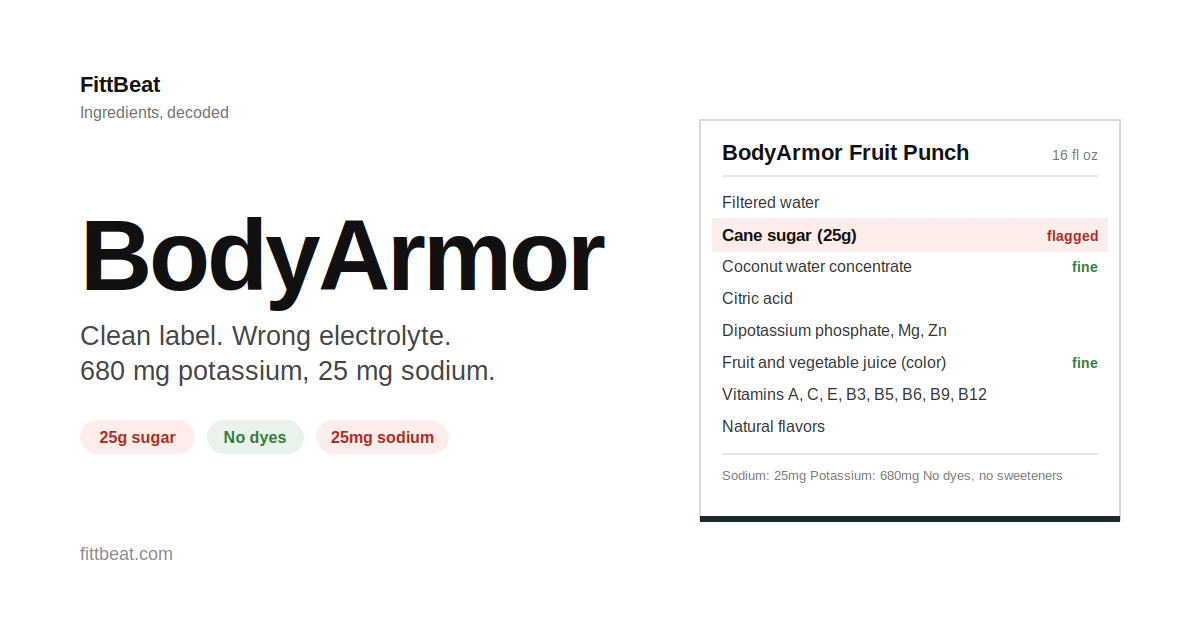
BodyArmor is filtered water, cane sugar, coconut water concentrate, citric acid, an electrolyte blend (dipotassium phosphate, magnesium oxide, zinc oxide), fruit and vegetable juice for color, eight vitamins, and natural flavors. A 16 oz bottle has 120 calories, 25 g of sugar, 680 mg of potassium, and 25 mg of sodium. No dyes, no artificial sweeteners, no preservatives. The sugar is the main cost; it’s a third less than Gatorade per ounce but still 23 g added. The sodium is the design flaw: sweat is mostly sodium, and BodyArmor has almost none — like Prime, it’s a potassium drink wearing a sports-drink label. Good as a cleaner flavored drink; weak as a rehydration drink.
Jump to: The label · Each ingredient · The sodium problem · Nutrition · Lyte, Zero Sugar, Flash I.V. · Verdict · FAQ
The full BodyArmor ingredients list
Filtered Water, Cane Sugar, Coconut Water Concentrate, Citric Acid, Electrolyte Blend (Dipotassium Phosphate, Magnesium Oxide, Zinc Oxide), Fruit and Vegetable Juice (Color), Vitamins (Ascorbic Acid, Calcium D-Pantothenate, Niacinamide, Alpha-Tocopheryl Acetate, Pyridoxine Hydrochloride, Vitamin A Palmitate, Folic Acid, Cyanocobalamin), Natural Flavors.
Two things to notice. There’s no salt and no sodium citrate — the two ingredients that give Gatorade and Powerade their sodium — which is why the sodium line reads 25 mg. And the color comes from fruit and vegetable juice, which is why BodyArmor can say “no artificial dyes” and mean it; the whole dye phase-out story doesn’t apply here.
BodyArmor ingredients explained
Filtered water Fine
Not carbonated. Most of the bottle.
Cane sugar Flagged
25 g per 16 oz, 23 g of it added — about 6 teaspoons, and roughly a third less than Gatorade per ounce. Cane sugar rather than corn syrup, which changes nothing nutritionally. During hard exercise over an hour, this is useful fuel; at a desk it’s 120 empty calories, and daily sugar-sweetened drinks are linked to weight gain and type 2 diabetes across the research. Our sugar breakdown covers why the molecule doesn’t matter and the dose does.
Coconut water concentrate Fine, potassium source
The headline ingredient and the main source of potassium. Coconut water is naturally high in potassium, with some magnesium and a little sodium; “from concentrate” means the water was removed for shipping and added back. The brand positions it as the reason BodyArmor is “natural,” which is fair, and as the reason it hydrates better, which isn’t — potassium-rich coconut water is a worse rehydration fluid than a salt solution for exactly the reason covered in the sodium section.
Citric acid Fine, with a teeth note
Tartness and mild preservation. BodyArmor’s pH is around 3.5; it’s a sipping drink, so the enamel advice applies.
Electrolyte blend: dipotassium phosphate, magnesium oxide, zinc oxide Potassium-heavy
Dipotassium phosphate adds more potassium on top of the coconut water, reaching 680 mg a bottle (about 15% of the daily value — a banana and a half). Magnesium oxide is a poorly absorbed form, which is fine for a label claim and less so for actual magnesium. Zinc oxide is there to print zinc on the panel; you don’t lose meaningful zinc in sweat. None of these is a concern; none of them is sodium.
Fruit and vegetable juice (color) Fine
Concentrated juice — typically carrot, black carrot, or beet — used purely for color. It’s the honest version of what Red 40 does in Gatorade, and it’s why the colors are muted. No concern.
Vitamins (A, C, E, B3, B5, B6, folate, B12) Overdosed, harmless
At 100% or more of daily value each. Vitamins don’t aid hydration or performance in people who aren’t deficient; they’re here because “antioxidants” and “B vitamins” sell. Excess water-soluble vitamins are excreted; the fat-soluble A and E are at amounts that don’t matter from one bottle.
Natural flavors Undisclosed
The fruit punch. Plant-derived flavor compounds; proprietary.
The sodium problem
Sweat is salty, not bananas. The electrolyte you lose most in sweat is sodium — typically 500 to 1,500 mg per liter, depending on the person — with potassium a distant second at around 150 mg. Rehydrating after heavy sweat works best with a drink that replaces sodium alongside water, because sodium is what signals the body to hold onto the fluid. That’s the science behind oral rehydration solutions and the reason Gatorade’s original 1965 formula was built on salt.
BodyArmor flips the ratio. 680 mg of potassium against 25 mg of sodium is 27 to 1 — an inverse of sweat — and it’s the same ratio problem as Prime Hydration, which the brand’s Flash I.V. line quietly admits by adding 500 mg of sodium. For a long, hot workout, a bottle of BodyArmor gives you water and sugar and almost none of the mineral you actually lost. For everyday drinking, the low sodium is arguably a feature. The label calls it a sports drink; the formula is a flavored coconut-water drink with vitamins.
Read next: Liquid I.V. — 500 mg of sodium in a stick, and why it works like a rehydration solution →
BodyArmor nutrition facts
| Per bottle | BodyArmor (16 oz) | BodyArmor Lyte (16 oz) | BodyArmor Zero Sugar (16 oz) | Gatorade (20 oz) | Prime (16.9 oz) |
|---|---|---|---|---|---|
| Calories | 120 | 20 | 0 | 140 | 25 |
| Sugar | 25 g | 4 g | 0 g | 34 g | 2 g |
| Sweetener | Cane sugar | Cane sugar + allulose/erythritol + stevia | Stevia | Sugar + dextrose | Sucralose + Ace-K |
| Sodium | 25 mg | 30 mg | 25 mg | 270 mg | 10 mg |
| Potassium | 680 mg | 680 mg | 620 mg | 75 mg | 700 mg |
| Synthetic dye | None | None | None | Yes (phasing out) | None |
| Artificial sweetener | None | None | None | None | Yes |
| Preservative | None | None | None | None | None |
BodyArmor Lyte and Zero Sugar formulations vary by flavor and have changed over time (Lyte moved from erythritol to allulose in some flavors); check the bottle. Flash I.V., BodyArmor’s rehydration line, has about 500 mg of sodium and 700 mg of potassium per serving and is the only BodyArmor product built for sweat.
Lyte, Zero Sugar, and Flash I.V.
- BodyArmor Lyte cuts the sugar to about 4 g using a little cane sugar plus stevia and a sugar alcohol (erythritol or allulose, by flavor). It keeps the potassium, the vitamins, and the sodium problem. The cleanest low-sugar sports drink on the shelf by ingredients, and still not a sweat drink.
- BodyArmor Zero Sugar uses stevia alone. Zero calories, no artificial sweeteners, same electrolyte profile. If you want a flavored drink with nothing to object to, this is close.
- BodyArmor Flash I.V. is the brand’s answer to Liquid I.V.: a higher-sodium formula (around 500 mg) in zero-sugar and cane-sugar versions. It’s the only BodyArmor product that matches what sweat actually loses, which is a useful admission about the rest of the line.
Is BodyArmor good for you?
FittBeat verdict
A clean label and the wrong electrolyte. By ingredients, BodyArmor beats Gatorade on everything but sodium: no dyes, no artificial sweeteners, less sugar per ounce, real color. By function, it fails the one test a sports drink exists to pass. If you’re sweating hard, you want sodium, and BodyArmor has 25 mg; Gatorade, for all its corn syrup and Red 40, has ten times that. For a cleaner flavored drink to sip on an ordinary day, BodyArmor Zero or Lyte is a good choice. For a two-hour practice in July, it isn’t, and Flash I.V. is the brand telling you so.
The concerns, ranked by evidence:
- Sugar (Original). 25 g per bottle — fuel during long exercise, 120 empty calories otherwise.
- Sodium mismatch. Not a harm, a failure to help: it doesn’t replace what sweat loses.
- Teeth. Citric acid, sipped. Milder than soda; still rinse.
- Potassium. 680 mg is fine for nearly everyone; people on potassium-restricted diets (kidney disease, certain medications) should treat this like a banana and a half.
- Everything else. Vitamins, juice color, coconut water: no concern.
BodyArmor for kids, keto, and workouts
Kids: the AAP says children don’t need sports drinks for ordinary activity. Among sports drinks, BodyArmor Zero is the one with the least to object to — no sugar, no dyes, no artificial sweeteners — if a kid wants something flavored.
Keto: Original has 25 g of carbs; Zero Sugar is zero-carb, and the potassium and magnesium are useful on keto.
Workouts: under an hour, water. Over an hour and sweating hard, you need sodium BodyArmor doesn’t have — Gatorade, Liquid I.V., or BodyArmor Flash I.V. are the right tools. The Original’s sugar is useful fuel in that setting, but it’s fuel without the salt.
Cleaner alternatives
For real sodium without dyes or sugar: LMNT (1,000 mg, stevia), Liquid I.V. Sugar-Free (500 mg, allulose and stevia), or BodyArmor Flash I.V. Zero. For a clean everyday drink: BodyArmor Zero Sugar already is one. For the coconut water, plain coconut water is the same potassium with less flavoring — and a pinch of salt fixes the ratio.
Frequently asked questions
Is BodyArmor healthier than Gatorade?
By ingredients, yes — no dyes, no artificial sweeteners, less sugar per ounce. By function, no: BodyArmor has 25 mg of sodium to Gatorade’s 270, and sodium is what sweat loses. Cleaner drink, worse sports drink.
How much sugar is in BodyArmor?
25 g per 16 oz bottle (23 g added). BodyArmor Lyte has about 4 g; Zero Sugar has none.
Does BodyArmor have artificial sweeteners?
No. Original uses cane sugar; Lyte uses cane sugar with stevia and a sugar alcohol; Zero Sugar uses stevia.
Does BodyArmor have dyes?
No. The color comes from fruit and vegetable juice concentrates.
Why is BodyArmor so low in sodium?
Its electrolytes come from coconut water and potassium phosphate rather than salt. The result is 680 mg potassium and 25 mg sodium — the reverse of what sweat contains. BodyArmor’s Flash I.V. line adds about 500 mg of sodium for that reason.
Is BodyArmor good for hydration?
For ordinary hydration, it’s water with flavor, sugar, and potassium — fine. For rehydrating after heavy sweat, its lack of sodium makes it a poor choice compared with Gatorade or an oral rehydration mix.
Who owns BodyArmor?
The Coca-Cola Company, which bought the remaining stake in 2021 for about $5.6 billion.
Is BodyArmor keto?
Original isn’t (25 g carbs). BodyArmor Zero Sugar is zero-carb.
Sources
- BodyArmor / Coca-Cola Company. Nutrition facts and ingredients, BodyArmor Fruit Punch, 16 fl oz. Product label, photographed October 2026.
- Sawka MN, et al. American College of Sports Medicine position stand: exercise and fluid replacement (sweat sodium and potassium losses). Medicine & Science in Sports & Exercise, 2007. doi:10.1249/mss.0b013e318031c8e7
- Baker LB. Sweating rate and sweat sodium concentration in athletes: a review of methodology and intra/interindividual variability. Sports Medicine, 2017. doi:10.1007/s40279-017-0691-5
- Schneider MB, Benjamin HJ, AAP Committee on Nutrition. Sports drinks and energy drinks for children and adolescents: are they appropriate? Pediatrics, 2011. doi:10.1542/peds.2011-0965
- Malik VS, et al. Sugar-sweetened beverages and risk of metabolic syndrome and type 2 diabetes. Diabetes Care, 2010. doi:10.2337/dc10-1079
- National Institutes of Health, Office of Dietary Supplements. Potassium fact sheet for health professionals. ods.od.nih.gov
- Kalman DS, et al. Comparison of coconut water and a carbohydrate-electrolyte sport drink on measures of hydration and physical performance in exercise-trained men. Journal of the International Society of Sports Nutrition, 2012. doi:10.1186/1550-2783-9-1
Coca-Cola’s BodyArmor acquisition from the company’s November 2021 announcement.
This article is for informational purposes and is not medical advice. Talk to a doctor or registered dietitian about your individual nutrition needs.
