
Last reviewed: October 2026. Ingredient lists reflect the current U.S. 16.9 fl oz formula. Prime has reformulated several times since 2022 and flavors differ slightly, so check your bottle.
Prime Hydration launched in 2022 on the backs of Logan Paul and KSI, sold out everywhere, and briefly resold for ten times its price. The marketing leans on “10% coconut water,” “BCAAs,” “antioxidants,” and “zero added sugar.” Most of that is technically true. But the ingredient list tells a more interesting story — including one electrolyte problem that makes Prime a strange choice for the thing it’s named after. Here’s every ingredient, what it does, and whether it matters.
Quick answer: what is in Prime Hydration?
Prime Hydration is a low-calorie electrolyte drink made from filtered water, about 10% coconut water from concentrate, citric acid, potassium and magnesium salts, natural flavors, two artificial sweeteners (sucralose and acesulfame potassium), 250 mg of branched-chain amino acids, and added vitamins A, E, B6 and B12. A bottle has 20–25 calories, 1–2 g sugar (from the coconut water), 700 mg potassium, 125 mg magnesium — and only 10–20 mg sodium. It is caffeine-free; don’t confuse it with Prime Energy, which has 200 mg.
The full Prime Hydration ingredients list
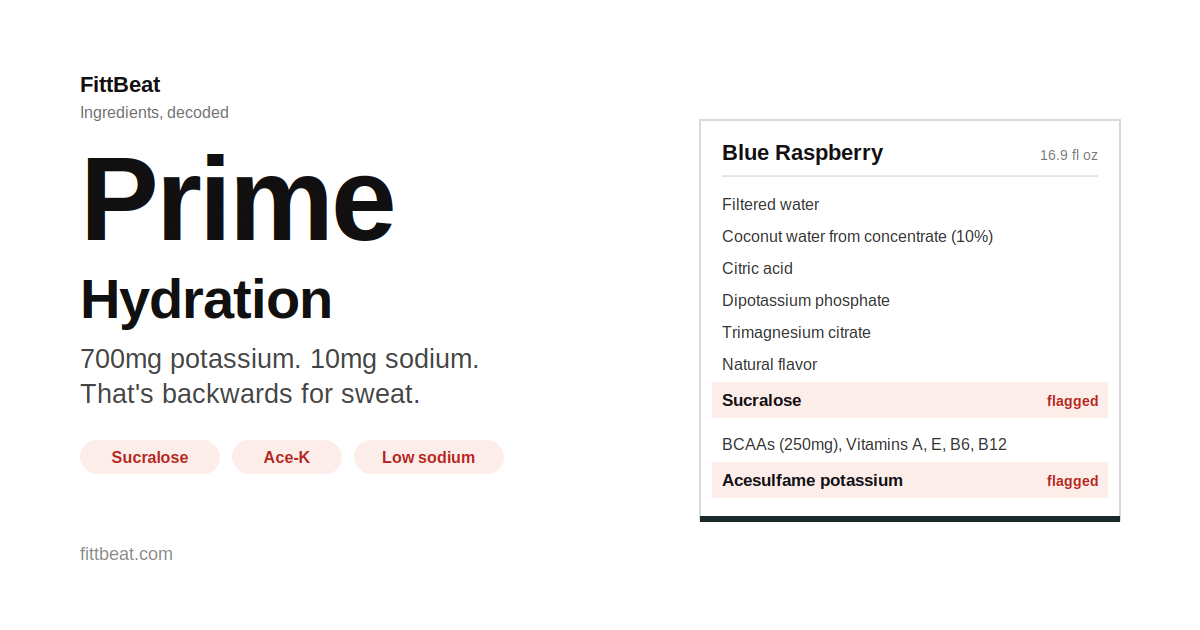
From a current Blue Raspberry bottle:
Filtered Water, Coconut Water from Concentrate, Citric Acid, Dipotassium Phosphate, Trimagnesium Citrate, Natural Flavor, Sucralose, L-Isoleucine, L-Leucine, L-Valine, D-Alpha Tocopheryl Acetate (Vitamin E), Acesulfame Potassium, Retinyl Palmitate (Vitamin A), Pyridoxine Hydrochloride (Vitamin B6), Cyanocobalamin (Vitamin B12). Contains: Tree Nuts (Coconut).
Depending on flavor you’ll also see gum arabic and ester gum / glycerol esters of wood rosin (Meta Moon, Glowberry, Cherry Freeze, Ice line), beta carotene for color (Orange, Lemon Lime), fruit and vegetable juice for color (older Tropical Punch and Grape), and zinc aspartate (some flavors, tied to the “zinc for immunity” claim). None of the U.S. flavors use synthetic dyes like Red 40 or Blue 1 — the Blue Raspberry is nearly colorless.
Prime Hydration ingredients explained
Filtered water
Roughly 90% of the bottle.
Coconut water from concentrate
Prime’s headline ingredient, at about 10% of the drink. Coconut water is naturally rich in potassium and contains some magnesium and a little sodium, which is where much of Prime’s electrolyte content comes from. “From concentrate” means the water was removed for shipping and added back during bottling — standard for packaged juices, and nutritionally close to the original. This is also why the label carries a tree nut allergen warning (the FDA classifies coconut as a tree nut, even though botanically it isn’t one) and why Prime has 1–2 g of natural sugar despite “zero added sugar.”
Citric acid
Supplies the tartness and acts as a mild preservative. Same molecule as in lemons, but commercially produced by fermenting a mold on sugar feedstock. The main consideration is dental: Prime is acidic, and sipping any acidic drink all day erodes enamel.
Dipotassium phosphate
A potassium salt that does double duty as an electrolyte source and a pH buffer that keeps the drink stable. Combined with the coconut water, it’s how Prime reaches 700 mg of potassium — 15% of the daily value and far more than Gatorade or Powerade. More on why that’s a mixed blessing below.
Trimagnesium citrate
Prime’s magnesium source, delivering 125 mg per bottle (30% DV). Magnesium is lost in sweat in small amounts and most Americans are mildly under-consuming it, so this is one of the more defensible additions. Magnesium citrate is well absorbed; in large doses it has a laxative effect, but 125 mg is well below that threshold.
Natural flavor
The FDA-permitted catch-all for proprietary flavor blends derived from natural sources. You can’t know the exact compounds. “Blue Raspberry,” “Meta Moon,” and “Glowberry” are not flavors that exist in nature, so “natural” refers to where the molecules were sourced, not what they taste like.
Sucralose
The first of two artificial sweeteners and the reason Prime can be sweet at 20 calories. Sucralose (the sweetener in Splenda) is about 600 times sweeter than sugar and is FDA-approved. The ongoing debate centers on gut microbiome effects and a possible impact on insulin response in some studies; the evidence is mixed and the regulatory position is that normal consumption is safe. This Sucralose Side Effects Post covers it in depth.
Acesulfame potassium (Ace-K)
The second sweetener, usually paired with sucralose because the two cover each other’s aftertaste. Also FDA-approved and in thousands of products. The Center for Science in the Public Interest has long argued it was under-tested; most regulators disagree. If you’re trying to avoid artificial sweeteners entirely, Prime is not your drink.
L-Isoleucine, L-Leucine, L-Valine (BCAAs)
The three branched-chain amino acids, totaling 250 mg. BCAAs are marketed for muscle recovery, and leucine does trigger muscle protein synthesis — but the research-supported dose is roughly 2–5 grams, i.e. 10 to 20 times what’s in a Prime. 250 mg is a marketing dose: enough to print on the front of the bottle, not enough to do anything a glass of milk wouldn’t do better. Not harmful, just not functional.
Vitamin E (d-alpha tocopheryl acetate)
This is the “antioxidants” claim. Current formula provides about 30% DV per bottle (earlier bottles listed 100%). Vitamin E is fat-soluble and stored in the body; a few bottles a day of the older formula would have pushed well past the daily value. The reduction appears deliberate.
Vitamin A (retinyl palmitate)
Also fat-soluble, also reduced from 100% DV to around 30% in current bottles. This mattered because Prime’s core audience skews young, and vitamin A is one of the few vitamins where chronic excess causes real harm (liver stress, bone issues). At the current dose, one or two bottles a day is fine. If you have older stock labeled 100%, don’t treat it like water.
Vitamins B6 and B12
200% DV of each. B vitamins are water-soluble, so the excess is excreted, which is why brands can mega-dose them for the label. They “support energy metabolism” in the sense that your body needs them, not in the sense that extra ones make you feel energized. Most people eating normally aren’t deficient.
Gum arabic and ester gum (some flavors)
Stabilizers that keep flavor oils evenly suspended so the drink doesn’t separate. Gum arabic is a tree sap; ester gum (glycerol esters of wood rosin) is derived from pine resin. Both are FDA-approved and used in citrus sodas for decades. Cosmetic, not nutritional.
Beta carotene / fruit and vegetable juice (color)
Prime gets its orange and purple hues from plant-derived color rather than synthetic dyes. This is a genuine point in its favor over Gatorade and Powerade, both of which use Red 40, Blue 1, or Yellow 5. This Red 40 post explains why that matters.
Zinc aspartate (some flavors)
Behind the “zinc for immunity” line on some bottles. Zinc does play a role in immune function, but the amount in Prime isn’t listed on the nutrition panel, which usually means it’s below the threshold worth declaring. Treat the immunity claim as decoration.
Prime Hydration nutrition facts
Per 16.9 fl oz bottle (one serving). Ranges reflect flavor-to-flavor variation:
| Nutrient | Amount | % Daily Value |
|---|---|---|
| Calories | 20–25 | — |
| Total carbohydrates | 5–6 g | 2% |
| Total sugars | 1–2 g (0 g added) | — |
| Sodium | 10–20 mg | 0–1% |
| Potassium | 700 mg | 15% |
| Magnesium | 125 mg | 30% |
| Vitamin A | 270 mcg | 30% |
| Vitamin E | 4.5 mg | 30% |
| Vitamin B6 | 3.4 mg | 200% |
| Vitamin B12 | 4.8 mcg | 200% |
| BCAAs | 250 mg | — |
| Caffeine | 0 mg | — |
The electrolyte problem: lots of potassium, almost no sodium
This is the part most reviews skip. When you sweat, the electrolyte you lose by far the most of is sodium — typically 500 to 1,500 mg per liter of sweat, versus around 100–200 mg of potassium. A sports drink built for rehydration should be sodium-forward, which is why Gatorade has 160 mg per 12 oz and Powerade 250 mg.
Prime has 10 to 20 mg of sodium per bottle. That’s less than a slice of bread. Its “700 mg electrolytes” are almost entirely potassium and magnesium — minerals you lose in small amounts and mostly replace through food.
Practically, this means Prime is fine as a flavored, low-calorie drink with some minerals in it. It is not a good choice for replacing what you lose during a hard, sweaty workout, a long run in the heat, or a stomach bug, and the “hydration” name oversells it. If you’re sweating heavily, Powerade, a proper oral rehydration mix, or even salted water does the job better.
Prime Hydration vs. Prime Energy: don’t mix them up
They look nearly identical on the shelf, but they’re very different products:
- Prime Hydration (16.9 oz bottle) — caffeine-free, the drink covered in this article.
- Prime Energy (12 oz can) — 200 mg of caffeine, roughly two cups of coffee and more than a Red Bull and a Monster combined per ounce. The can states it’s not recommended for children under 18, pregnant or nursing women, or people sensitive to caffeine. It drew a 2023 Senate request for an FDA investigation over marketing to kids and was pulled from Canadian shelves for exceeding caffeine limits.
If you or your kids are drinking Prime, check whether it’s a bottle or a can. The bottle has no caffeine at all.
Prime vs. Gatorade vs. Powerade
| Per 12 oz | Prime Hydration | Gatorade | Powerade |
|---|---|---|---|
| Calories | ~15 | 80 | 80 |
| Sugar | ~1 g (natural) | 21 g (added) | 21 g (added) |
| Sweetener | Sucralose, Ace-K | Sugar, dextrose | HFCS |
| Sodium | ~10 mg | 160 mg | 250 mg |
| Potassium | ~500 mg | 50 mg | 80 mg |
| Magnesium | ~90 mg | 0 | Trace |
| Artificial dyes | No | Yes | Yes |
| Best for | Low-cal everyday drink | Endurance exercise | Endurance exercise |
Prime wins on calories, sugar, and dyes. Gatorade and Powerade win on the thing a sports drink is actually for. Powerade Zero or Gatorade Zero sit somewhere in between: no sugar, real sodium, but synthetic dyes. See our Powerade ingredients breakdown for the full comparison.
Is Prime Hydration bad for you?
No, within normal limits — and it’s cleaner than its reputation suggests. Compared to a Gatorade it has no added sugar, no synthetic dyes, and meaningful magnesium. The honest criticisms are:
- It’s not a real hydration drink. Near-zero sodium means it doesn’t replace what sweat takes.
- Two artificial sweeteners. Approved and widely used, but a dealbreaker for some people and still under active research.
- Fat-soluble vitamin stacking. At the current 30% DV the risk is low, but a kid drinking three bottles a day of the older 100% formula was getting far too much vitamin A. Prime appears to have reduced the dose for this reason.
- Marketing doses. 250 mg of BCAAs and an unlisted amount of zinc are there for the label, not for you.
- Price. You’re paying roughly $2 for flavored water with potassium. Coconut water alone gives you more of the same minerals.
For context, Prime was also the subject of a 2024 class-action lawsuit alleging PFAS (“forever chemicals”) in its Grape flavor; the company disputed the claim and the case did not establish contamination. We mention it because it comes up in searches, not because it’s confirmed.
Who should (and shouldn’t) drink it
Reasonable for: people who want something sweeter than water without sugar or dyes; anyone cutting calories who finds plain water hard to drink enough of; light exercise.
Skip it for: serious endurance training or heavy sweating (not enough sodium); anyone avoiding artificial sweeteners; anyone with a coconut or tree nut allergy; people on potassium restriction for kidney disease (700 mg is a lot in that context — ask your doctor).
Browse our full ingredients index for breakdowns of Gatorade, Celsius, BodyArmor, and more.
Frequently asked questions
What are the main ingredients in Prime Hydration?
Filtered water, coconut water from concentrate (about 10%), citric acid, dipotassium phosphate, trimagnesium citrate, natural flavor, sucralose, acesulfame potassium, BCAAs (leucine, isoleucine, valine), and vitamins A, E, B6 and B12.
Does Prime Hydration have caffeine?
No. Prime Hydration (the bottle) is caffeine-free. Prime Energy (the can) contains 200 mg of caffeine.
Does Prime have sugar?
About 1–2 g of natural sugar from coconut water and zero added sugar. It’s sweetened with sucralose and acesulfame potassium.
Is Prime Hydration good for hydration?
It provides fluid plus potassium and magnesium, but only 10–20 mg of sodium — the electrolyte you lose most in sweat. For heavy sweating, a sodium-based sports drink or oral rehydration solution works better.
Is Prime Hydration safe for kids?
The caffeine-free Hydration bottle has no age warning and is generally considered fine in moderation; the artificial sweeteners and high B-vitamin doses are the main things parents ask about. Prime Energy, with 200 mg caffeine, is labeled not for under-18s.
Does Prime contain artificial colors?
No. Colored flavors use beta carotene or fruit and vegetable juice. No Red 40, Blue 1, or Yellow 5.
Why does Prime have a tree nut warning?
Because it contains coconut water, and the FDA classifies coconut as a tree nut for labeling purposes.
This article is for informational purposes and is not medical advice. Talk to a doctor or registered dietitian about your individual nutrition needs.
Leave a Reply