Author: FittBeat

  • Taurine in Energy Drinks: What It Does and Doesn’t Do (2026)

    Taurine in Energy Drinks: What It Does and Doesn’t Do (2026)

    Last reviewed: October 2026.

    Taurine is the ingredient that made energy drinks sound dangerous. It has a name that sounds like a hormone, a rumor that it comes from bull testicles, and top billing on every can next to the caffeine. The truth is almost the opposite: it’s an amino acid your body makes on its own, you eat it every time you have fish or chicken, and in a can of Red Bull it’s probably the least concerning thing on the label. It also doesn’t give you energy. Here’s what taurine actually is, what the research says it does, how much is in each drink, and where the upper limit is.

    Quick answer: is taurine bad for you?

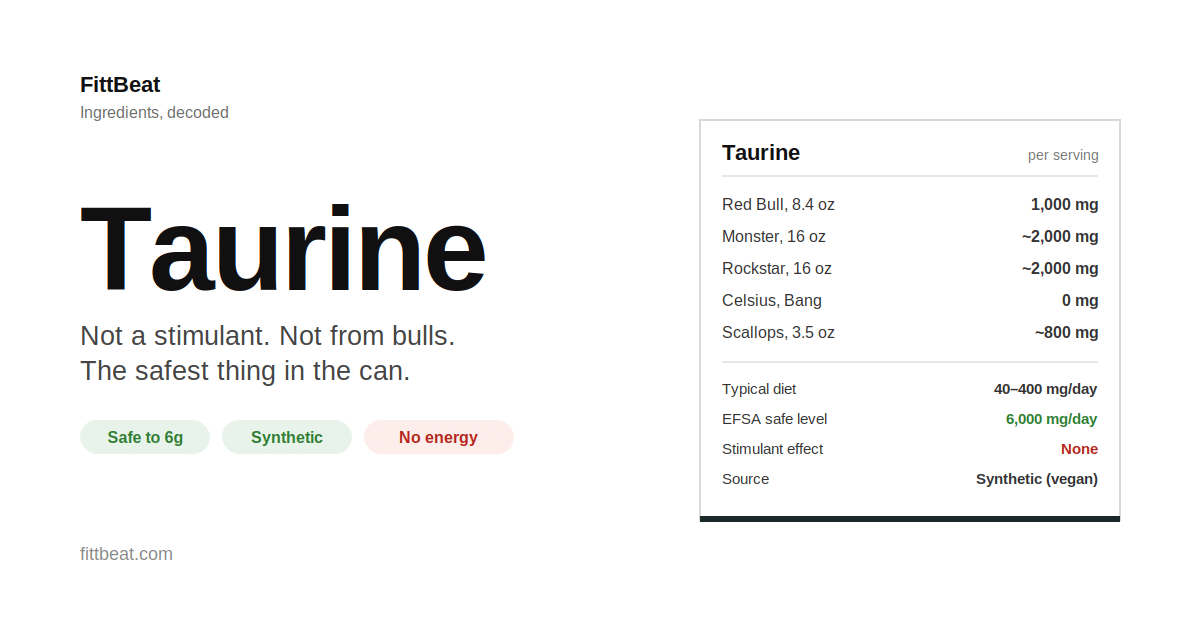
    No. Taurine is a sulfur-containing amino acid that your liver produces and that’s abundant in meat, fish, and shellfish; a typical diet supplies 40–400 mg a day. Energy drinks add about 1,000 mg per 8 oz serving — a Red Bull has 1,000 mg, a 16 oz Monster about 2,000. The European Food Safety Authority reviewed those levels in 2009 and set a safe intake of 6,000 mg a day, and Japan prescribes 3,000 mg a day as a heart-failure drug. It is not a stimulant: in controlled trials, taurine alone has no effect on alertness. The caffeine does that. Taurine’s real effects are mild — supporting heart muscle, bile production, and the retina — and it may slightly blunt the blood-pressure rise from caffeine, which is probably why it’s in the can.

    What taurine is

    Taurine (2-aminoethanesulfonic acid) is one of the most abundant free amino acids in the human body — concentrated in the heart, muscles, brain, and retina. Unlike the 20 amino acids that build proteins, taurine isn’t incorporated into them; it floats free in cells doing other jobs: regulating water and mineral balance, forming bile salts that digest fat, stabilizing cell membranes, and acting as a mild antioxidant.

    Your liver makes it from the amino acid cysteine, so it’s “conditionally essential” — most adults produce enough, but infants, people with liver disease, and some vegans run low. Cats can’t make it at all, which is why it’s added to every cat food. Dietary sources are all animal: scallops and mussels (800–1,000 mg per 100 g), dark-meat turkey and chicken, tuna, salmon, beef. Plants contain essentially none.

    No, it’s not from bulls

    The persistent rumor is that taurine comes from bull urine, semen, or testicles. It doesn’t, and it never did in any commercial product. The name comes from Taurus, Latin for bull, because German chemists Friedrich Tiedemann and Leopold Gmelin first isolated it from ox bile in 1827. Every milligram of taurine in energy drinks today is synthesized in a lab from ethylene oxide and sodium bisulfite — no animals involved, which is why Red Bull and Monster are both technically vegan. “Red Bull” the brand name came from the Thai drink Krating Daeng (“red gaur,” a species of wild bull) that it was based on, not from the taurine.

    Does taurine give you energy?

    No. This is the most important thing to understand about energy drinks: the “energy” comes from caffeine (a stimulant) and sugar (fuel). Taurine is neither. In placebo-controlled trials of taurine alone — no caffeine — there’s no reliable improvement in alertness, reaction time, or subjective energy. A 2012 trial of Red Bull components found caffeine produced the alerting effect and taurine added nothing measurable on top of it; some studies found taurine alone made people slightly calmer, consistent with its role as a mild inhibitory neurotransmitter in the brain.

    Why is it in the can, then? Two plausible reasons. The first is marketing history: Krating Daeng included it, Red Bull kept it, and every competitor copied Red Bull. The second is physiology: taurine has a mild effect on heart contractility and vascular tone, and a few studies suggest it blunts the blood-pressure and heart-rate rise caffeine causes. Whether the dose in a can actually does that in practice isn’t settled, but it’s the most defensible rationale for pairing them.

    How much taurine is in each energy drink?

    DrinkServingTaurineCaffeineNotes
    Red Bull8.4 oz1,000 mg80 mgThe original formulation; 12 oz can has ~1,430 mg
    Monster Energy16 oz~2,000 mg160 mgListed as 1,000 mg per 8 oz serving, two servings per can
    Rockstar Original16 oz~2,000 mg160 mgSame 1,000 mg per 8 oz as Monster
    NOS16 oz~2,000 mg160 mgAlso adds L-citrulline
    5-hour Energy1.9 oz~200 mg200 mgPart of an undisclosed “energy blend”
    Celsius12 oz0 mg200 mgUses green tea, guarana, ginger instead
    Bang16 oz0 mg300 mgUses “super creatine” and BCAAs instead
    Coffee, 12 oz12 oz0 mg~140 mg—
    Scallops, 3.5 oz—~800 mg0 mgFor comparison: dinner has as much as a Red Bull

    The pattern is that the classic drinks all standardized on 1,000 mg per 8 oz, and the newer “fitness” energy drinks (Celsius, Bang) dropped taurine entirely without anyone noticing a difference in how they feel — which is its own evidence about what taurine contributes.

    What the research actually says

    Heart health Mild benefit

    Taurine is concentrated in heart muscle and helps regulate calcium handling in cardiac cells. Japan has approved it since the 1980s as a prescription treatment for congestive heart failure at 3,000 mg a day, and small trials show modest improvements in heart function and exercise capacity in heart-failure patients. In healthy people, meta-analyses find a small blood-pressure reduction (around 3 mmHg) with supplementation. None of this makes an energy drink heart-healthy — the caffeine and sugar dominate — but it does mean taurine is pulling in the opposite direction from the rest of the can.

    Exercise performance Small, inconsistent

    A 2018 meta-analysis found that 1–6 g of taurine taken one to three hours before exercise improved endurance performance by a small margin, with no clear dose-response. Effects on strength and sprinting are inconsistent. The energy-drink dose (1,000–2,000 mg) is at the low end of what’s been studied, and the trials used taurine alone, not mixed with 54 g of sugar.

    Longevity Interesting, unproven

    The study that made headlines: a 2023 paper in Science reported that taurine levels decline with age in mice, monkeys, and humans, and that taurine supplementation extended lifespan in mice by 10–12% and improved health markers in middle-aged monkeys. The follow-up in 2025, also in Science, complicated the story: using better longitudinal data, researchers found taurine levels do not reliably decline with age in humans and vary too much between individuals to work as an aging biomarker. The mouse lifespan finding stands; the idea that you’re taurine-deficient because you’re getting older doesn’t. No human trial has tested taurine for longevity, and nobody serious is recommending energy drinks as the delivery vehicle.

    Brain and mood Mild

    Taurine acts on GABA and glycine receptors, the brain’s inhibitory systems — which is why it tends to be calming rather than stimulating in isolation. There’s early research on taurine for anxiety, epilepsy, and in combination with antipsychotics, but nothing conclusive at dietary doses.

    Interaction with caffeine Probably favorable

    This is the question that matters for energy drinks. The concern raised in the 2000s was that taurine might amplify caffeine’s cardiovascular effects. Research since then points the other way: several trials found taurine either had no effect on, or slightly reduced, the heart-rate and blood-pressure increase from caffeine. EFSA’s 2009 review concluded there was no evidence of a harmful interaction at energy-drink levels. The adverse cardiac events linked to energy drinks track caffeine dose and quantity consumed, not taurine.

    How much taurine is too much?

    EFSA’s 2009 opinion found no adverse effects in rats at 1,000 mg per kg per day, and set an observed safe level for humans at 6,000 mg a day — six Red Bulls’ worth, or three Monsters. The EFSA review also noted that even heavy energy-drink consumers (a liter and a half a day) stayed under that. Human supplementation trials have used up to 10 g a day without reported harm beyond mild stomach upset. There’s no established toxic dose, and taurine excess is excreted in urine.

    The honest risk ranking inside an energy drink: sugar first, caffeine second, acidity (teeth) third — and taurine doesn’t make the list. If you drink energy drinks and want to worry about something, worry about the 54 g of sugar in a Monster, not the 2,000 mg of taurine.

    Two caveats. People with kidney disease should check with a doctor before supplementing, since taurine is cleared by the kidneys. And taurine supplements (powders, capsules) are regulated as dietary supplements, so quality varies; the taurine in a major-brand energy drink is more consistent than what’s in a random online powder.

    Is taurine in energy drinks bad for you?

    FittBeat verdict

    Safe, mildly beneficial, and mostly beside the point. Taurine is the ingredient energy drinks put on the front of the can and the one with the least to worry about. It’s not a stimulant, it’s not from an animal, and at 1,000–2,000 mg it’s within a range regulators and clinicians consider safe several times over. If anything, it slightly softens what the caffeine does to your heart rate. Judge an energy drink by its sugar and caffeine; ignore the taurine.

    Taurine for vegans, athletes, and supplements

    Vegans: plant foods contain essentially no taurine, and studies show vegans have lower plasma levels — though the body’s synthesis usually covers it. A supplement of 500–1,000 mg is reasonable and cheap if you want to close the gap; an energy drink is a poor way to do it.

    Athletes: the evidence for 1–3 g before endurance exercise is modestly positive. If you’re going to try it, a plain taurine powder costs pennies per dose and skips the sugar.

    Supplements: 500–2,000 mg a day is the common range; it’s one of the cheapest amino acids sold. There’s no need to megadose, and no reason to take it with caffeine specifically.

    Frequently asked questions

    Is taurine from bulls?

    No. It was first isolated from ox bile in 1827, which is where the name comes from, but all taurine in energy drinks is synthetic. No animal products are involved.

    Does taurine give you energy?

    No. It isn’t a stimulant. Controlled trials show taurine alone doesn’t improve alertness; if anything it’s mildly calming. The energy in energy drinks comes from caffeine and sugar.

    How much taurine is in Red Bull?

    1,000 mg in the 8.4 oz can, about 1,430 mg in the 12 oz. Monster and Rockstar have about 2,000 mg per 16 oz can.

    How much taurine is safe per day?

    EFSA set an observed safe level of 6,000 mg a day. Human trials have used up to 10 g a day without serious effects. A typical diet provides 40–400 mg; an energy drink adds 1,000–2,000 mg.

    What are the side effects of taurine?

    At energy-drink doses, essentially none are documented. Very high supplemental doses can cause mild stomach upset. People with kidney disease should consult a doctor before supplementing.

    Why is taurine in energy drinks?

    Partly history — the Thai drink Red Bull was based on included it. Partly because it may slightly blunt caffeine’s effect on heart rate and blood pressure. It does not contribute to the stimulant effect.

    Does taurine help you live longer?

    A 2023 study found taurine supplementation extended lifespan in mice. A 2025 follow-up found taurine levels don’t reliably decline with age in humans, undermining the idea that most people are deficient. No human longevity trial exists.

    Is taurine vegan?

    The synthetic taurine in energy drinks and supplements is vegan. Dietary taurine comes only from animal foods, so vegans tend to have lower levels, though the body makes its own.

    This article is for informational purposes and is not medical advice. Talk to a doctor or registered dietitian about your individual nutrition needs.
  • Synthetic Food Dyes: Every FD&C Color Explained (2026)

    Synthetic Food Dyes: Every FD&C Color Explained (2026)

    Last reviewed: October 2026. Regulatory status is changing quickly; the timeline below reflects announcements through this date.

    There are nine synthetic food dyes approved for food in the United States, and seven of them do almost all the work: two reds, two yellows, two blues, and a green, made from petroleum, mixed in combinations to produce every color on the candy aisle. One of them was banned in January 2025. The other six are the subject of an FDA phase-out, two state bans, and a warning label across the EU. Here’s each one — what it is, what the evidence says, where it’s restricted, and what’s replacing it — in one place.

    Quick answer: are synthetic food dyes bad for you?

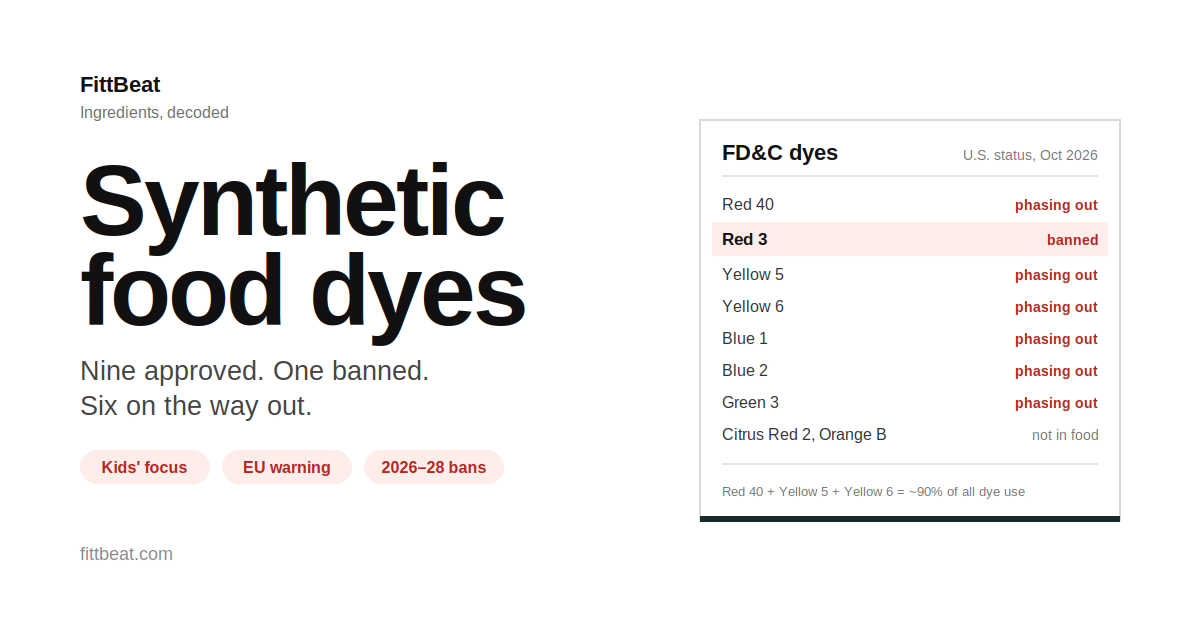
    The nine FD&C dyes are petroleum-derived colorings approved by the FDA, with no nutritional purpose. One, Red 3, is banned (revoked January 2025, off shelves by 2027) because it caused thyroid tumors in rats. The others are legal but under pressure: a 2007 randomized trial found that mixtures of these dyes modestly increased hyperactivity in children, which led the EU to require a warning label in 2010 and the FDA to request a voluntary phase-out in 2025. There’s no credible evidence the remaining dyes cause cancer at food levels. The reasonable summary is: low risk for adults, worth limiting for children, and increasingly unnecessary because the food industry is replacing them anyway.

    Jump to a dye: Red 40 · Red 3 · Yellow 5 · Yellow 6 · Blue 1 · Blue 2 · Green 3 · Phase-out timeline

    The nine U.S. synthetic food dyes at a glance

    DyeAlso calledColorU.S. status (Oct 2026)EU statusMain concern
    Red 40Allura Red, E129Orange-redLegal; voluntary phase-out; WV ban 2028Warning labelChild behavior
    Red 3Erythrosine, E127Pink-redBanned — food deadline Jan 2027Mostly bannedThyroid tumors (rats)
    Yellow 5Tartrazine, E102Lemon yellowLegal; voluntary phase-out; WV ban 2028Warning labelChild behavior, sensitivity
    Yellow 6Sunset Yellow, E110OrangeLegal; voluntary phase-out; WV ban 2028Warning labelChild behavior
    Blue 1Brilliant Blue, E133Bright blueLegal; voluntary phase-out; WV ban 2028Permitted, no warningLow
    Blue 2Indigo Carmine, E132Royal blueLegal; voluntary phase-out; WV ban 2028Permitted, no warningLow; one old rat study
    Green 3Fast Green, E143Sea greenLegal; voluntary phase-out; WV ban 2028BannedLow; rarely used
    Citrus Red 2—OrangeLegal, orange peels only; FDA revokingBannedAnimal carcinogen; not eaten
    Orange B—OrangeLegal, sausage casings only; unused; FDA revokingBannedNot in use

    Red 40, Yellow 5, and Yellow 6 together account for roughly 90% of all dye used in U.S. food. If you avoid those three, you’ve avoided almost all of it.

    What synthetic dyes are and why they’re in everything

    “FD&C” means approved for food, drugs, and cosmetics. These dyes are made from petroleum-derived aromatic hydrocarbons, which is where “petroleum-based” comes from — there is no oil in the finished product, but the starting materials come from it. Six of the seven common ones are azo dyes (they share a nitrogen double bond); the two blues and the green are triarylmethane dyes. They won out over plant colors a century ago for the same reasons they persist: they’re cheap, intensely colored, stable in heat, light, and acid, and identical from batch to batch. A beet-juice red fades in a clear bottle on a hot shelf; Red 40 doesn’t.

    Their job is purely cosmetic. They make fruit-flavored products look like fruit, make processed cheese orange, make pickles greener, and make children’s medicine pink. Nothing tastes different without them, which is the central fact in every argument about them: whatever the risk is, there’s no benefit to weigh against it except appearance.

    What the research actually says

    Hyperactivity in children The finding that holds up

    The 2007 University of Southampton study gave about 300 children from the general population drinks containing one of two dye mixtures (Yellow 5, Yellow 6, Red 40, and three dyes not used in the U.S., plus the preservative sodium benzoate) or a placebo, in a randomized, double-blind crossover design. Both mixtures increased hyperactivity as rated by parents, teachers, and a computerized attention test. The effect was small on average and varied widely between kids. The EU acted on it in 2010. The FDA’s 2011 advisory committee agreed a link existed in “certain susceptible children” but voted 8–6 against a warning label. California’s 2021 OEHHA assessment reviewed 27 trials and concluded that synthetic dyes can affect behavior in some children, and that the FDA’s intake limits, set decades ago, never considered behavioral effects at all. That’s the evidence base behind the 2025 federal phase-out.

    Cancer One dye, old studies, high doses

    Red 3 is the exception: it caused thyroid tumors in male rats at high doses, which triggered the 1990 cosmetic ban and, 35 years later, the food ban under the Delaney Clause. For the others, the evidence is thin. Some older animal studies showed tumors at very high doses (Blue 2 and brain gliomas, Green 3 and bladder tumors, Yellow 6 and adrenal tumors), none consistently replicated. The more concrete concern is contaminants: azo dyes can carry trace benzidine and 4-aminobiphenyl, both known carcinogens, which the FDA limits to very low levels in certified batches. A 2022 mouse study linking Red 40 to gut inflammation and DNA damage at high doses is under review by EFSA.

    Allergy and sensitivity Rare, real

    Yellow 5 is the one with a documented sensitivity: hives, asthma flare-ups, and other reactions in a small number of people, particularly those sensitive to aspirin. That’s why the FDA has required Yellow 5 to be named specifically on labels since 1980. Red 40 and Yellow 6 have occasional reports; the blues almost none.

    Each dye explained

    Red 40 (Allura Red) Flagged

    The most-used dye in the U.S. by volume. Behavioral evidence from Southampton; no credible cancer link; carries the EU warning; banned statewide in West Virginia from 2028 and from California school food from 2028. It’s in red and purple drinks, candy, cereal, snacks, and kids’ medicine. It has its own full page.

    Red 3 (Erythrosine) Banned

    A pink-red iodine-based dye, chemically unrelated to Red 40. Rats fed high doses developed thyroid tumors in studies from the 1980s; the FDA banned it in cosmetics in 1990 but left it in food for 35 years until a 2022 petition forced the issue. The ban was finalized January 15, 2025, with food makers given until January 15, 2027 and drug makers until January 18, 2028 to reformulate. It was used in maraschino cherries, candy corn, Peeps, strawberry-flavored products, and some medications. Its replacement is usually Red 40 — so the ban may increase Red 40 use in the short run — or beet and carmine in reformulated products.

    Yellow 5 (Tartrazine) Flagged

    Lemon yellow, the second most-used dye. It was in both Southampton dye mixtures and carries the EU warning. It’s the only dye with a well-documented sensitivity reaction — hives and asthma in a small number of people, more often those with aspirin sensitivity — which is why it’s been required to be named on U.S. labels since 1980 rather than hidden as “artificial color.” Found in lemon-lime Gatorade and Gatorade Zero, Mountain Dew, pickles, boxed mac and cheese (until Kraft removed it in 2016), yellow candy, and mixed with Blue 1 to make green. Phase-out: voluntary by end of 2026–2027; West Virginia ban 2028; California school ban 2028.

    Yellow 6 (Sunset Yellow) Flagged

    Orange, and the dye that makes orange soda orange. In the Southampton mixtures; carries the EU warning, which is why European Fanta is colored with carrot and pumpkin and U.S. Fanta isn’t. Older rat studies showed adrenal and testicular tumors at high doses, not replicated at relevant levels; the FDA considers it safe within limits. Found in Fanta, Sunkist, orange Gatorade, Cheetos, Doritos, cheese crackers, and orange candy — nearly always paired with Red 40. Phase-out: same as Yellow 5.

    Blue 1 (Brilliant Blue) Low concern

    The bright blue in Powerade Mountain Berry Blast, Glacier Freeze Gatorade, blue raspberry anything, and most green foods (blended with Yellow 5). It wasn’t in the Southampton study and the EU permits it without a warning. The one specific episode: in 2003 the FDA warned against adding Blue 1 to tube-feeding formula after several critically ill patients absorbed it through compromised guts, and some died — a hospital practice, not a food exposure. Otherwise the evidence of harm is weak. It’s on the FDA’s phase-out list by association rather than by evidence; the FDA simultaneously approved two natural blues (galdieria algae extract and butterfly pea flower) in 2025 to replace it.

    Blue 2 (Indigo Carmine) Low concern

    A darker, royal blue, less common than Blue 1 — used in some candy (blue M&M’s), cereal, and pet food. A 1980s rat study found brain gliomas in male rats at high doses, which has not been replicated and which the FDA judged not to be dye-related. EU permits it without warning. On the phase-out list.

    Green 3 (Fast Green) Low concern, rare

    The least-used of the seven — most green foods use Yellow 5 plus Blue 1 instead. One old study linked it to bladder tumors in rats; it’s banned in the EU but not for that reason (it was never approved there). You’ll find it in some mint-flavored products, canned peas, and sauces. On the phase-out list.

    Citrus Red 2 and Orange B Not in your food

    Two restricted dyes rounding out the nine. Citrus Red 2 is permitted only on the skins of Florida oranges that aren’t for processing, and it’s a known animal carcinogen — which is fine as long as you don’t eat the peel. Orange B is approved only for hot dog and sausage casings and hasn’t been manufactured in years. The FDA began the process of formally revoking both in April 2025.

    The phase-out timeline

    DateActionApplies to
    2010EU child-behavior warning label requiredRed 40, Yellow 5, Yellow 6, and three non-U.S. dyes
    Sept 2024California School Food Safety Act signed (effective Dec 31, 2027)Red 40, Yellow 5, Yellow 6, Blue 1, Blue 2, Green 3 in public school food
    Jan 15, 2025FDA revokes Red 3 (food deadline Jan 15, 2027; drugs Jan 18, 2028)Red 3
    Mar 2025West Virginia HB 2354 signed — school food Aug 2025, statewide Jan 1, 2028All seven common dyes
    Apr 22, 2025FDA/HHS announce voluntary phase-out by end of 2026; begin revoking Citrus Red 2 and Orange B; fast-track natural color approvalsRed 40, Yellow 5, Yellow 6, Blue 1, Blue 2, Green 3
    2025FDA approves galdieria extract blue, butterfly pea flower, calcium phosphate white, gardenia blue as natural alternativesReplacements
    2025–2026Kraft Heinz, General Mills, Nestlé, PepsiCo, Tyson, Hershey, Smucker, Conagra and others commit to removal, mostly by end of 2027Corporate
    Apr 2026PepsiCo announces Gatorade and Gatorade Zero core flavors go dye-free by fall 2026Corporate
    Dec 31, 2026FDA’s original voluntary targetLikely to slip to 2027
    Dec 31, 2027California school ban effective; most corporate deadlines—
    Jan 1, 2028West Virginia statewide ban effective—

    The pattern: the FDA’s phase-out has no enforcement behind it, so the real deadlines are the state laws and the companies’ own commitments. Expect dyes to linger longest in candy and beverages, where natural colors are hardest to match, and to disappear first from cereal, yogurt, and snacks.

    Why Europe and the U.S. differ

    The same chemicals, different rules. The EU’s 2010 warning requirement — “may have an adverse effect on activity and attention in children” — didn’t ban anything, but it made the dyes commercially toxic: no company wanted the label, so most reformulated. That’s why a European Skittles bag, Fanta can, or Froot Loops box uses paprika, turmeric, spirulina, and vegetable juices. The U.S. version of each product still used the synthetic dyes through 2025, and the gap is closing only now, as state laws and the federal phase-out replicate the EU’s pressure fifteen years later.

    What’s replacing them

    Natural colors are extracted from plants, algae, insects, and minerals: beet juice and carmine (cochineal insects) for red, paprika and annatto for orange, turmeric and safflower for yellow, spirulina and the newly approved galdieria and butterfly pea extracts for blue, and chlorophyllin for green. They’re more expensive, less stable, and often paler — which is why reformulated products look duller, and why candy and soda are the slowest to switch. “No artificial colors” on a label now means plant-derived colorants are used; it doesn’t mean no color was added. Carmine, worth noting, isn’t vegan and can trigger rare allergic reactions of its own.

    One more distinction: caramel color, the brown in cola, is not an FD&C dye and isn’t part of the phase-out. It has its own, separate question (4-MEI), covered on its own page.

    Are synthetic dyes bad for you?

    FittBeat verdict

    Low risk for adults, worth limiting for children, and about to become much easier to avoid. The cancer fears belong almost entirely to Red 3, which is banned. The remaining dyes’ documented effect is a modest increase in hyperactivity in some kids — enough that the EU, California, West Virginia, and now the FDA have all acted. For an adult, dyes are far down the list of label concerns, well below sugar. For a child who eats dyed foods daily, cutting them is a reasonable experiment with no downside. And since the products are reformulating anyway, the easiest strategy is to read the color line and prefer the version without a numbered dye.

    How to avoid synthetic dyes

    1. Read the end of the ingredient list. Colors are listed last. Any name with a number (Red 40, Yellow 5, Blue 1) or “Lake” after it is synthetic. “Color added” or “artificial color” without a name means a dye is present but unnamed.
    2. Be suspicious of bright, fruit-flavored, juice-free products. If it’s red, orange, blue, or green and lists no fruit, it’s dyed.
    3. Check green. Most green foods are Yellow 5 plus Blue 1, so “green” means two dyes.
    4. Check kids’ medicine and vitamins. Many liquid and chewable formulations are dyed; dye-free versions exist for most.
    5. Watch reformulated packaging. Through 2027 the same brand may be dyed in one package and dye-free in the next. “No artificial colors” on the front is the signal.

    Frequently asked questions

    Are food dyes banned in the U.S.?

    Only Red 3, revoked in January 2025 with a January 2027 deadline for food. The other six common dyes are legal but subject to a voluntary FDA phase-out and to state bans in West Virginia (2028) and California schools (2028).

    Which food dyes are banned in Europe?

    Green 3, Citrus Red 2, and Orange B were never approved there; Red 3 is restricted to a few uses. Red 40, Yellow 5, Yellow 6, Blue 1, and Blue 2 are legal in the EU, but the first three require a warning label about effects on children’s activity and attention, which led most manufacturers to reformulate.

    Do food dyes cause ADHD?

    No. Randomized trials show dye mixtures can modestly increase hyperactivity and reduce attention in some children for a few hours after consumption, including children without any diagnosis. They don’t cause the disorder.

    Do food dyes cause cancer?

    Red 3 caused thyroid tumors in rats, which is why it’s banned. For the other dyes there’s no consistent evidence of cancer at food-level exposure; regulators limit carcinogenic contaminants (benzidine) in certified batches.

    What is Yellow 5 and why is it named on labels?

    Yellow 5 (tartrazine) is a lemon-yellow azo dye. Because a small number of people have allergic-type reactions to it — hives, asthma — the FDA has required it to be named specifically on labels since 1980.

    Which dyes are in green food?

    Usually Yellow 5 plus Blue 1. Green 3 exists but is rarely used.

    What does “no artificial colors” mean?

    That the colors are derived from plants, minerals, algae, or insects (carmine) rather than petroleum. It doesn’t mean no color was added.

    Is caramel color a synthetic dye?

    No. Caramel color is made by heating sugar and isn’t an FD&C dye or part of the phase-out. It has a separate concern, 4-MEI, covered on our caramel color page.

    This article is for informational purposes and is not medical advice. Talk to a doctor or registered dietitian about your individual nutrition needs.
  • Red Bull Ingredients: What’s Actually in the Can (2026)

    Red Bull Ingredients: What’s Actually in the Can (2026)

    Last reviewed: October 2026. Reflects the U.S. 8.4 fl oz Red Bull Energy Drink. Red Bull Sugarfree and Zero are compared below.

    Red Bull is the drink that invented the category, and its label is shorter than you’d expect: 14 ingredients, and only two of them — sugar and caffeine — do anything you’d notice. The rest is taurine, B vitamins, two mineral salts, flavors, and dyes, in a can small enough that the numbers are gentler than Monster’s. Here’s all Red Bull ingredients in order, what it does, and what the research actually says about the famous ones.

    Quick answer: what’s in Red Bull?

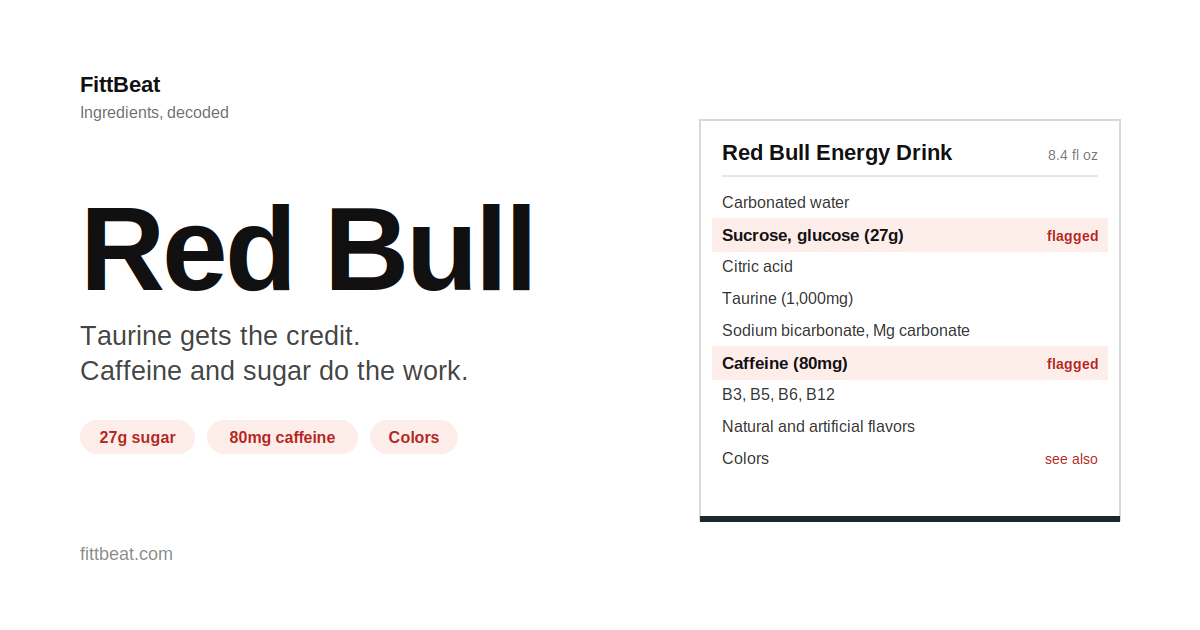
    Red Bull is carbonated water, sucrose, glucose, citric acid, taurine, sodium bicarbonate, magnesium carbonate, caffeine, niacinamide, calcium pantothenate, pyridoxine HCl, vitamin B12, natural and artificial flavors, and colors. An 8.4 oz can has 110 calories, 27 g of sugar, 80 mg of caffeine, 1,000 mg of taurine, and 105 mg of sodium. The caffeine is about a cup of coffee’s worth; the sugar is about 7 teaspoons, a bit less than a can of Coke. Taurine is safe and doesn’t give you energy — caffeine does. One can is a modest dose for a healthy adult; the problems come from stacking cans, mixing with alcohol, and giving it to kids.

    The full Red Bull ingredients list

    Red Bull Energy Drink8.4 fl oz

    Carbonated Water, Sucrose, Glucose, Citric Acid, Taurine, Sodium Bicarbonate, Magnesium Carbonate, Caffeine, Niacinamide, Calcium Pantothenate, Pyridoxine HCl, Vitamin B12, Natural and Artificial Flavors, Colors.

    Two things to notice. Sugar comes as two ingredients (sucrose and glucose) in positions two and three, same as Monster. And “colors” is listed without naming them — in the U.S. the label doesn’t have to, and Red Bull’s amber tint uses caramel color plus small amounts of synthetic dye depending on the variant. The flavor is “natural and artificial,” which is an honest label most competitors avoid.

    Red Bull ingredients explained

    Carbonated water Fine

    Lightly carbonated. The base.

    Sucrose and glucose Flagged

    27 g per can — table sugar plus glucose, about 7 teaspoons. That’s less than a 12 oz Coke (39 g) because the can is smaller, but per ounce it’s the same sugar density as soda, and the 12 oz Red Bull is 38 g. Fast-absorbing, no fiber or protein to slow it, and the source of the “energy” you feel in the first 20 minutes and the dip an hour later. The long-term picture is the same as any sugar-sweetened drink: daily intake is linked to weight gain, type 2 diabetes, and fatty liver. Red Bull uses beet sugar in Europe and cane or beet in the U.S. — not corn syrup, though the body treats them identically. Our sugar breakdown covers the research.

    Citric acid Fine

    Tartness and shelf stability. Makes Red Bull acidic (pH around 3.3), which is the mechanism behind energy drinks testing as highly erosive to tooth enamel in lab studies.

    Taurine Safe, mostly inert

    The ingredient Red Bull is famous for, and the most misunderstood. Taurine is an amino acid your body synthesizes and that’s abundant in meat, fish, and breast milk; Red Bull’s is made synthetically, not from animals, and the “bull” in the name is a coincidence of etymology (it was first isolated from ox bile in 1827). 1,000 mg per can is the dose EFSA reviewed in 2009 and found safe even at several cans a day. What it doesn’t do is stimulate: in controlled trials, taurine alone has no reliable effect on alertness or performance. The caffeine does the work. Taurine’s documented effects are mild — it supports heart muscle contraction and may slightly blunt caffeine’s blood-pressure increase, which is a plausible reason it’s included. A taurine explainer is coming to the index.

    Sodium bicarbonate and magnesium carbonate Fine

    Baking soda and a magnesium salt, used to buffer the acidity and adjust flavor. They contribute the 105 mg of sodium and a trace of magnesium. No concern.

    Caffeine 80 mg

    The active ingredient. 80 mg per 8.4 oz — about the same as a cup of home-brewed coffee, less than a 12 oz Starbucks drip (around 230 mg), and 9.5 mg per ounce, the same concentration as Monster. The 12 oz can is 114 mg, the 16 oz is 151 mg. Red Bull’s caffeine is synthetic, which is chemically identical to the plant-derived kind. Effects are the familiar ones: a few hours of raised alertness, heart rate, and blood pressure; a five-hour half-life (a 4 pm can is still a third active at 9 pm); and dependence with daily use. For a healthy adult, 80 mg is a moderate dose — the FDA’s guidance is 400 mg a day. The risks are in stacking: three Red Bulls plus two coffees is over the line, and the deaths linked to energy drinks have involved large quantities in short periods, often with underlying heart conditions.

    B vitamins (B3, B5, B6, B12) Overdosed, harmless

    Niacinamide, calcium pantothenate, pyridoxine, and vitamin B12, each at roughly 100–200% of the daily value per can. The logic is that B vitamins are cofactors in converting food to energy — true, but extra B vitamins don’t produce extra energy unless you were deficient, and almost nobody drinking Red Bull is. The excess is water-soluble and excreted; the one worth watching across many cans a day is B6, where chronic high intake can affect nerves, though Red Bull’s dose is far below that threshold.

    Natural and artificial flavors Undisclosed

    The distinctive Red Bull taste — often described as tutti-frutti or medicinal — is proprietary. “Artificial” means some flavor molecules were synthesized rather than extracted; it’s a labeling distinction, not a safety one.

    Colors Unnamed

    Red Bull’s U.S. label says “colors” without specifying. The amber tint of the original is caramel color; flavored editions (Red, Blue, Yellow, Watermelon, etc.) use synthetic dyes including Red 40 and Blue 1, which carry the EU child-behavior warning and are part of the FDA’s voluntary 2026–2027 phase-out. The company states it uses no synthetic dyes in the original, though the label’s vagueness doesn’t let you verify that from the can. See our caramel color and Red 40 breakdowns.

    Red Bull nutrition facts

    Per canRed Bull (8.4 oz)Red Bull (12 oz)Red Bull Sugarfree (8.4 oz)Monster (16 oz)Coffee (12 oz)
    Calories110160102305
    Sugar27 g38 g0 g54 g0 g
    SweetenerSucrose + glucoseSucrose + glucoseAspartame + Ace-KSugar + glucose + sucraloseNone
    Caffeine80 mg114 mg80 mg160 mg~140 mg
    Caffeine per oz9.5 mg9.5 mg9.5 mg10 mg~12 mg
    Taurine1,000 mg1,430 mg1,000 mg~2,000 mg0 mg
    Sodium105 mg150 mg105 mg370 mg5 mg
    Added colorsYesYesYesCaramelNo

    Red Bull Sugarfree vs. Red Bull: what changes?

    Sugarfree drops the 27 g of sugar and replaces it with aspartame and acesulfame potassium — the same pairing as Coke Zero. Caffeine, taurine, and vitamins are identical. Red Bull Zero (a separate product) uses sucralose and Ace-K instead and is formulated to taste closer to the original. Sugarfree cans carry the “phenylketonurics: contains phenylalanine” warning that every aspartame product does. For most people Sugarfree is the better daily choice if they’re going to drink one at all — 27 g of sugar is the biggest issue on the original’s label — with the usual sweetener caveats covered in our sucralose and aspartame posts.

    Red Bull vs. Monster vs. coffee

    Per ounce, Red Bull and Monster are close to the same drink. The 8.4 oz can is Red Bull’s real advantage: half the caffeine and half the sugar of a 16 oz Monster, which matters because people drink by the can, not the ounce. Against coffee, Red Bull is a weaker caffeine dose (80 vs ~140 mg per 12 oz brewed) attached to 27 g of sugar and a lot of ingredients that don’t do much. If the goal is alertness, coffee delivers more of it with nothing else attached. Our Monster breakdown goes line by line on the bigger can.

    Is Red Bull bad for you?

    FittBeat verdict

    The mildest of the big energy drinks, and still a sugar soda with coffee in it. One 8.4 oz can is a moderate caffeine dose and 7 teaspoons of sugar — not harmful for a healthy adult now and then. Taurine and the B vitamins are safe and mostly decorative. The real risks are the ones the can warns about: multiple cans, mixing with alcohol, children, and pregnancy. If you drink it daily, Sugarfree removes the biggest problem. If you drink it for the caffeine, coffee is cheaper and stronger.

    The concerns, ranked by evidence:

    1. Sugar. 27 g per small can, 38 g in the 12 oz. The clearest long-term harm at daily intake.
    2. Caffeine stacking. 80 mg is modest; the trouble is three or four cans, or cans on top of coffee and pre-workout. Palpitations, anxiety, and insomnia track total daily caffeine.
    3. Alcohol. Red Bull-and-vodka is the archetypal combination. Caffeine masks intoxication without reducing it, and the CDC specifically warns against mixing.
    4. Teeth. Acidic and sugary; energy drinks are among the most erosive beverages in lab testing.
    5. Taurine, B vitamins, flavors. No credible evidence of harm at these doses.

    Red Bull for kids, teens, and pregnancy

    Kids and teens: no. The AAP says children and adolescents should not consume energy drinks, and Red Bull’s label says not recommended for children. 80 mg of caffeine in a small body is a meaningfully larger dose, and the sugar is most of a day’s allowance.

    Pregnancy: guidance caps caffeine at 200 mg a day. One Red Bull fits under that, but most obstetric advice is to skip energy drinks given the sugar and the unstudied blend in pregnancy. The label says not recommended.

    Cleaner alternatives

    For caffeine without sugar or sweeteners: coffee or cold brew (about 140 mg per 12 oz, nothing else), green tea (30–50 mg), or yerba mate (about 80 mg per cup — the same dose as a Red Bull with no additives). For an energy-drink format without artificial sweeteners: Zevia Energy (120 mg, stevia). For the taurine, eat fish. The honest comparison is that a Red Bull is one cup of coffee’s caffeine plus a small soda’s sugar, and you can have those separately on your own terms.

    See the full ingredients index for every drink we’ve broken down, including Celsius, Prime, and Coca-Cola.

    Frequently asked questions

    How much caffeine is in a Red Bull?

    80 mg in the 8.4 oz can, 114 mg in the 12 oz, and 151 mg in the 16 oz — about 9.5 mg per ounce. An 8.4 oz can is roughly equal to a cup of home-brewed coffee.

    How much sugar is in a Red Bull?

    27 g in the 8.4 oz can (about 7 teaspoons) and 38 g in the 12 oz. Red Bull Sugarfree and Zero have 0 g.

    Is taurine in Red Bull bad for you?

    No. Taurine is an amino acid your body makes and that’s found in meat and fish. Red Bull’s 1,000 mg per can is synthetic (not from animals) and within the range EFSA found safe. It doesn’t provide energy — caffeine does.

    Is Red Bull made from bull?

    No. Taurine was first isolated from ox bile in 1827, which is where the name comes from, but Red Bull’s taurine is made synthetically. The drink contains no animal products.

    What sweetener is in Red Bull Sugarfree?

    Aspartame and acesulfame potassium. Red Bull Zero, a separate product, uses sucralose and acesulfame potassium.

    Is Red Bull worse than coffee?

    For caffeine alone, coffee is stronger (about 140 mg per 12 oz vs 80 mg per Red Bull) with no sugar. Red Bull adds 27 g of sugar, taurine, B vitamins, flavors, and colors. If you want alertness, coffee is the cleaner source.

    Is Red Bull worse than Monster?

    Per ounce they’re nearly identical. Per can, Red Bull’s 8.4 oz has half the caffeine (80 vs 160 mg) and half the sugar (27 vs 54 g) of a 16 oz Monster, so one Red Bull is the smaller dose.

    How many Red Bulls a day is safe?

    By caffeine alone, a healthy adult could have four or five 8.4 oz cans before reaching the FDA’s 400 mg guideline — but at 27 g of sugar each, one a day is the sensible ceiling for the original. Red Bull’s own label recommends moderate consumption.

    This article is for informational purposes and is not medical advice. Talk to a doctor or registered dietitian about your individual nutrition needs.
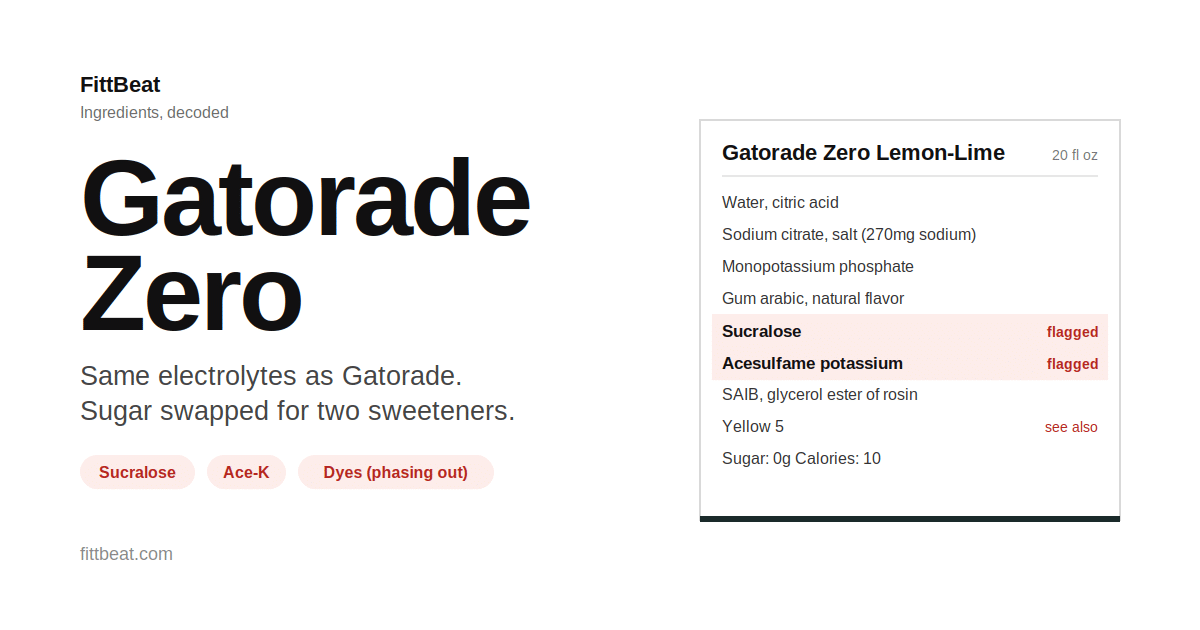
  • Monster Energy Ingredients: What’s Really in the Green Can (2026)

    Monster Energy Ingredients: What’s Really in the Green Can (2026)

    Last reviewed: October 2026. Reflects the U.S. 16 fl oz Monster Energy (Original). Monster has over 300 flavors worldwide; this covers the green can. Zero Sugar and Ultra variants are compared below.

    Monster Energy has 24 ingredients. Two of them do almost everything you feel: 54 grams of sugar and 160 milligrams of caffeine. The other 22 — taurine, ginseng, L-carnitine, guarana, glucuronolactone, inositol, four B vitamins, two preservatives, and a sweetener you’d never expect in a sugared drink — are what Monster calls its “Energy Blend,” and the honest science is that most of it is along for the ride. Here’s all the Monster Energy ingredients, what it does, and what the evidence says.

    Quick answer: what’s in Monster Energy?

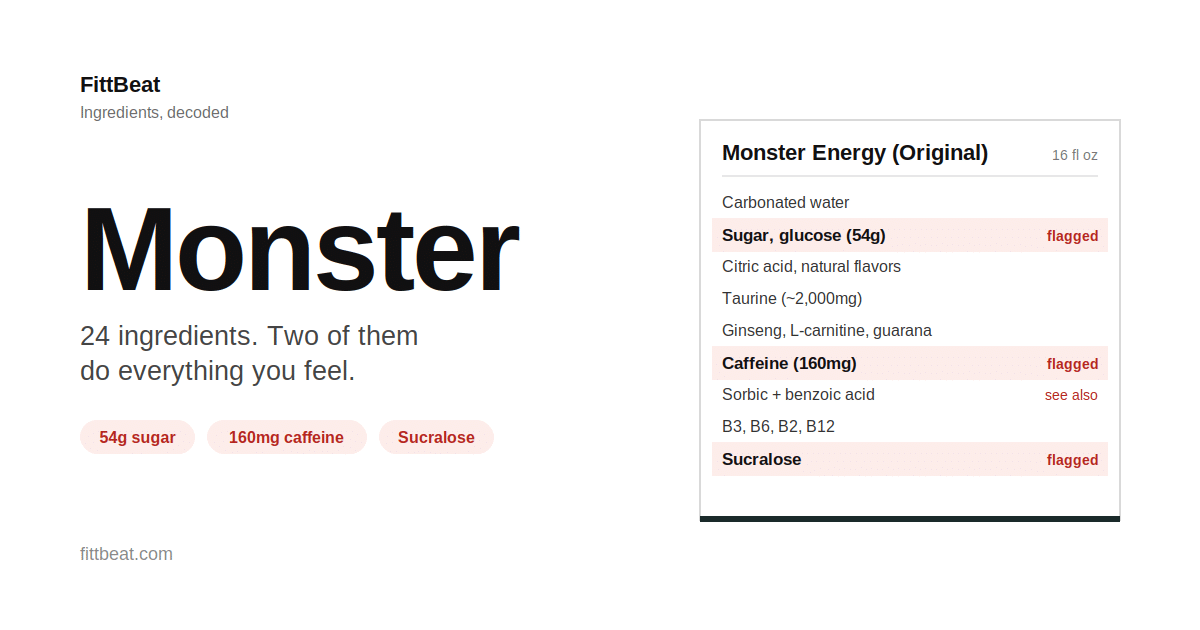
    Monster Energy is carbonated water, sugar, glucose, citric acid, natural flavors, taurine, sodium citrate, color, Panax ginseng, L-carnitine, caffeine, sorbic acid, benzoic acid, niacinamide, sucralose, salt, glucuronolactone, inositol, guarana, vitamins B6, B2, and B12, and maltodextrin. A 16 oz can has 230 calories, 54 g of sugar (108% of the daily added-sugar value), 160 mg of caffeine, and 370 mg of sodium. The caffeine is the equivalent of about one and a half cups of coffee — meaningful but not extreme for a healthy adult. The sugar is more than a can of Coke and a half. Taurine and the rest of the blend are safe and mostly inert. The can says not for children, and it’s right.

    The full Monster Energy ingredients list

    Monster Energy (Original)16 fl oz

    Carbonated Water, Sugar, Glucose, Citric Acid, Natural Flavors, Taurine, Sodium Citrate, Color Added, Panax Ginseng Extract, L-Carnitine L-Tartrate, Caffeine, Sorbic Acid (Preservative), Benzoic Acid (Preservative), Niacinamide (Vit. B3), Sucralose, Salt, D-Glucuronolactone, Inositol, Guarana Extract, Pyridoxine Hydrochloride (Vit. B6), Riboflavin (Vit. B2), Maltodextrin, Cyanocobalamin (Vit. B12). Caffeine from all sources: 160 mg per can.

    Three things to notice. Sugar and glucose are ingredients two and three — a double dose of fast carbohydrate. Caffeine sits eleventh, which looks modest until you read the “caffeine from all sources: 160 mg” line, required because guarana adds more. And sucralose is on the list of a drink with 54 g of sugar: it’s there to push sweetness higher without adding even more calories, and it’s a tell that the sugar content was already at the limit of what a can could carry.

    Monster Energy ingredients explained

    Carbonated water Fine

    Lightly carbonated, less than a soda. The base.

    Sugar and glucose Flagged

    54 g per can — about 13 teaspoons, and more than a 16 oz Coke (52 g). Sucrose and glucose together, absorbed fast, with nothing to slow them down. This is the ingredient that makes Monster “energy”: a blood-glucose spike that arrives in about 20 minutes and often leaves a crash an hour later, which the caffeine is there to paper over. The health picture is the same as any sugar soda, scaled up: daily intake at this dose is consistently linked to weight gain, type 2 diabetes, and fatty liver in large cohort studies. The can’s own label puts it at 108% of a full day’s added sugar. Our sugar and corn syrup breakdown covers the research; the specific sugar here is cane or beet, not HFCS, and the body doesn’t care.

    Citric acid Fine

    Tartness and a mild preservative effect. Makes Monster acidic enough (pH around 3) to erode enamel — a real issue since the drink is sipped, not chugged.

    Natural flavors Undisclosed

    The proprietary Monster taste. Plant-derived flavor compounds; details not disclosed.

    Taurine Safe, mostly inert

    The most misunderstood ingredient in energy drinks. Taurine is an amino acid your body makes and that you eat daily in meat and fish; it’s not from bulls (the name comes from the Latin for bull because it was first isolated from ox bile in 1827). Monster has roughly 1,000 mg per 8 oz serving, about 2,000 mg per can — an amount EFSA reviewed in 2009 and found safe. What it doesn’t do is give you energy. Controlled trials of taurine alone show no meaningful effect on alertness; the stimulant in the can is caffeine. There’s some evidence taurine mildly supports heart muscle function and may blunt caffeine’s blood-pressure bump, which is probably why it’s there. A taurine explainer is coming to the index.

    Sodium citrate and salt 370 mg sodium

    Acidity regulators that also add up to 370 mg of sodium per can, 16% of the daily limit — more than a Gatorade. Nobody drinks Monster for electrolytes, but it’s worth knowing it’s a salty drink.

    Color added Caramel

    The original’s brown-green tint comes from caramel color; Monster doesn’t specify the class on the label. See our caramel color breakdown for the 4-MEI question. Other Monster flavors use synthetic dyes (Red 40, Blue 1), which are a different concern.

    Panax ginseng extract Low dose

    Ginseng has modest evidence for mental performance in trials using 200–400 mg of standardized extract. Monster lists about 400 mg of “extract” per can but doesn’t disclose standardization, so the active dose is unknown. Safe; unlikely to be doing much.

    L-carnitine L-tartrate Low dose

    An amino-acid derivative involved in fat metabolism, sold as a supplement at 1–3 g a day. Monster’s amount isn’t disclosed but is far below that. A 2013 study linked carnitine from red meat to TMAO, a compound associated with heart disease, which generated headlines; the relevance to a trace amount in a drink is unclear. Safe; marketing.

    Caffeine 160 mg

    The ingredient that actually works. 160 mg per can, 10 mg per ounce — the same concentration as Red Bull, and more per can because the can is twice the size. That’s roughly a cup and a half of coffee, 40% of the FDA’s 400 mg daily guidance for healthy adults, and well under the 200 mg in a Celsius. The 24 oz Mega can is 240 mg. Caffeine’s effects are well understood: raised heart rate and blood pressure for a few hours, a half-life of about five hours (so an afternoon can is still a third active at bedtime), and dependence with daily use. The acute danger is real only at high doses or in susceptible people — the deaths associated with energy drinks have involved multiple cans in short periods, often with underlying heart conditions. The can’s warning against more than 48 oz a day (three cans, 480 mg) is reasonable; a lower ceiling is better.

    Sorbic acid and benzoic acid Preservatives

    Two preservatives against mold and bacteria. Benzoic acid is the same chemistry as sodium benzoate and can form trace benzene with vitamin C — Monster has no added vitamin C, so the main trigger is absent. Both are safe at these levels.

    B vitamins (B3, B6, B2, B12) Overdosed, harmless

    Niacinamide, pyridoxine, riboflavin, and cyanocobalamin — at roughly 200% of the daily value each, per serving. B vitamins help convert food to energy, which is where “energy drink” gets its vitamin logic, but extra B vitamins don’t give extra energy unless you were deficient. The excess is water-soluble and excreted. The one to watch across many cans a day is B6; chronic high intake (hundreds of milligrams) can cause nerve problems, though Monster’s dose is far below that.

    Sucralose Flagged

    Yes, in the sugared version. It boosts perceived sweetness past what 54 g of sugar delivers alone. The research since 2022 links sucralose to gut-bacteria changes and altered glucose response in some people; in a drink already carrying 54 g of sugar, it’s a secondary concern, but it means Monster Original isn’t an “artificial-sweetener-free” choice. Our sucralose breakdown has the detail.

    D-glucuronolactone Safe

    A naturally occurring compound involved in detoxification pathways in the liver. An old internet hoax claimed it was a Vietnam-era military chemical that caused brain tumors; it wasn’t and doesn’t. EFSA reviewed it in 2009 and found no concern at energy-drink levels. No evidence it does anything for energy either.

    Inositol Safe

    A sugar alcohol found in fruit and beans, involved in cell signaling. Supplement doses (2–4 g) have been studied for PCOS and anxiety; Monster’s amount is far smaller. Harmless filler.

    Guarana extract Hidden caffeine

    A Brazilian seed that’s about 4% caffeine by weight — twice coffee beans. It’s a second caffeine source, which is why the label is required to state caffeine “from all sources.” Already counted in the 160 mg.

    Maltodextrin Trace

    A starch-derived carbohydrate used as a carrier for the blend ingredients. Trace amount; adds nothing meaningful.

    Monster Energy nutrition facts

    Per canMonster Original (16 oz)Monster Zero Sugar (16 oz)Monster Zero Ultra (16 oz)Red Bull (8.4 oz)Celsius (12 oz)
    Calories230101011010
    Sugar54 g0 g0 g27 g0 g
    SweetenerSugar + glucose + sucraloseSucralose + Ace-KSucralose + Ace-KSucrose + glucoseSucralose
    Caffeine160 mg160 mg140 mg80 mg200 mg
    Caffeine per oz10 mg10 mg8.8 mg9.5 mg16.7 mg
    Taurine~2,000 mg~2,000 mg~2,000 mg1,000 mg0 mg
    Sodium370 mg370 mg180 mg105 mg0 mg
    Synthetic dyeNo (caramel)NoNoYesNo

    Monster vs. Red Bull: is one worse?

    Per ounce they’re almost the same drink: ~10 mg caffeine and ~3.3 g sugar per ounce, both with taurine, B vitamins, and glucuronolactone. The difference is the can. A 16 oz Monster is twice the caffeine and twice the sugar of an 8.4 oz Red Bull, and people drink one can of either. Monster adds ginseng, carnitine, guarana, inositol, and sucralose; Red Bull keeps a shorter list with synthetic colors. If you’re going to drink one, the Red Bull can is the smaller dose; if you’d drink two Red Bulls, it’s a wash. Our Red Bull breakdown goes line by line.

    Is Monster Energy bad for you?

    FittBeat verdict

    The sugar is the problem. The caffeine is the risk. The blend is the marketing. One original Monster is a 54 g sugar soda with a strong coffee in it — not dangerous for a healthy adult once in a while, and a poor daily habit for anyone. The exotic ingredients are safe and mostly inert. If you want the caffeine, Monster Zero Sugar is the same 160 mg without the sugar; if you want neither, you want a different drink. Not for kids, not for pregnancy, not with alcohol, and not more than one a day.

    The concerns, ranked by evidence:

    1. Sugar. 54 g is the largest single-serving sugar dose in the common beverage aisle. Daily intake at this level is the clearest long-term harm.
    2. Caffeine timing and dose. 160 mg is fine for most adults; the issues are stacking (a Monster plus coffee plus pre-workout), drinking it late, and the 24 oz can. Heart palpitations, anxiety, and poor sleep are the common complaints, and they track total daily caffeine.
    3. Teeth. Acid plus sugar, sipped over an hour. Energy drinks test as more erosive than most sodas in lab studies.
    4. Caffeine plus alcohol. Masks intoxication without reducing it. The CDC specifically warns against the combination, and it’s the context behind many energy-drink ER visits.
    5. Everything else. Taurine, ginseng, carnitine, glucuronolactone, inositol, and B vitamins have no credible evidence of harm at these doses — and little evidence of benefit.

    Monster Energy for kids, teens, and pregnancy

    Kids and teens: no. The AAP says children and adolescents should not consume energy drinks at all — not because of the blend, but because 160 mg of caffeine in a 100 lb body is a very different dose than in a 180 lb one, and because the sugar is a full day’s allowance. Monster’s own label says it’s not recommended for children. The 2011 death of a 14-year-old after two 24 oz cans in 24 hours is the case that drove the warning.

    Pregnancy: guidance is under 200 mg of caffeine a day; one Monster is 160 mg of it. Most obstetric advice is to skip energy drinks entirely because of the sugar and the uncertain blend.

    Cleaner alternatives

    For the caffeine without the sugar: Monster Zero Sugar (same 160 mg, sucralose and Ace-K), or plain coffee — a 12 oz cup is about 140 mg with nothing else. For less caffeine: Red Bull at 80 mg, or a shot of espresso at 65. For no artificial sweeteners: Zevia Energy (120 mg, stevia) or unsweetened cold brew. The most useful comparison is that a cup of coffee and a glass of water give you everything in a Monster that works, minus the 54 g of sugar.

    See the full ingredients index for every drink we’ve broken down, including Celsius, Prime, and Coca-Cola.

    Frequently asked questions

    How much caffeine is in a Monster?

    160 mg per 16 oz can, including the caffeine from guarana. The 24 oz Mega Monster has 240 mg. That’s about one and a half cups of coffee per 16 oz can.

    How much sugar is in a Monster?

    54 g per 16 oz can — about 13 teaspoons, and 108% of the FDA’s daily value for added sugar. Monster Zero Sugar and Zero Ultra have 0 g.

    Is taurine bad for you?

    No. Taurine is an amino acid your body produces and that’s found in meat and fish. The ~2,000 mg in a Monster is within the range EFSA considers safe. It also doesn’t provide energy; the stimulant in Monster is caffeine.

    Does Monster have artificial sweeteners?

    Yes — even the sugared original contains sucralose, added to increase sweetness. Monster Zero Sugar and Ultra use sucralose and acesulfame potassium.

    Is Monster worse than Red Bull?

    Per ounce they’re nearly identical in caffeine and sugar. Per can, a 16 oz Monster has twice the caffeine (160 vs 80 mg) and twice the sugar (54 vs 27 g) of an 8.4 oz Red Bull, because the can is twice as big.

    Is Monster Zero Sugar healthier?

    It removes the 54 g of sugar, which is the biggest issue, and keeps the 160 mg of caffeine and the full blend. It swaps sugar for sucralose and Ace-K. Better than the original; still a strong caffeine dose.

    How many Monsters a day is safe?

    The can says no more than 48 oz (three 16 oz cans, 480 mg caffeine). For most healthy adults, one a day is a reasonable ceiling given the sugar; two puts you at 320 mg of caffeine before any coffee.

    Can kids drink Monster?

    No. The American Academy of Pediatrics says children and teens should not consume energy drinks, and Monster’s label says it’s not recommended for children.

    This article is for informational purposes and is not medical advice. Talk to a doctor or registered dietitian about your individual nutrition needs.
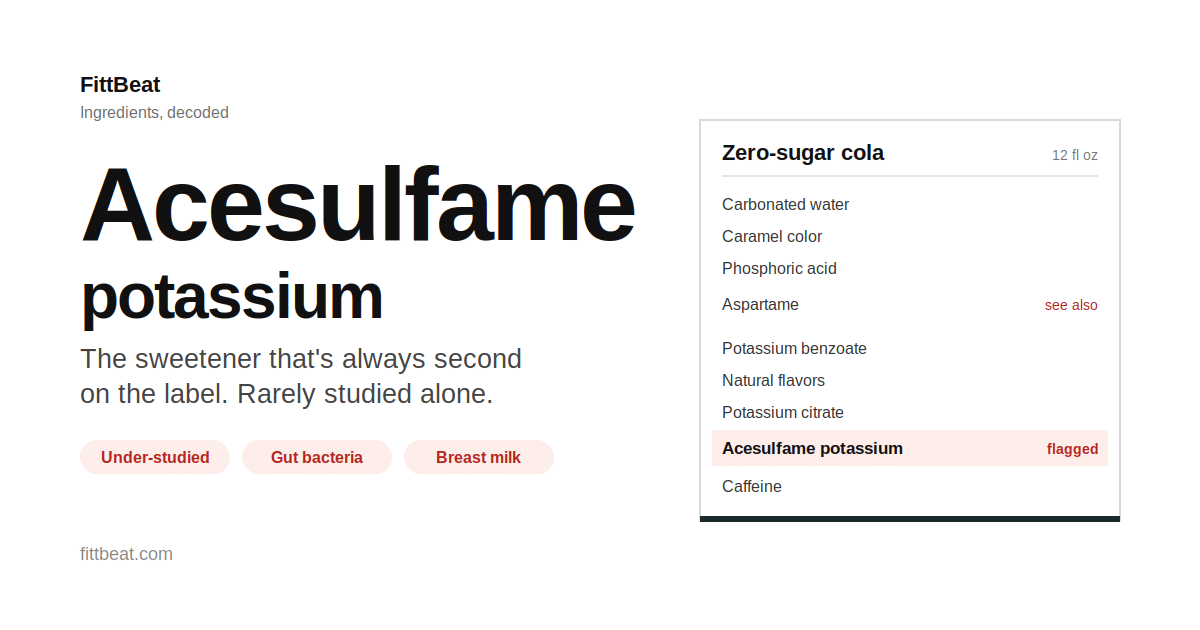
  • Gatorade Zero Ingredients: What’s in the Sugar-Free Version (2026)

    Gatorade Zero Ingredients: What’s in the Sugar-Free Version (2026)

    Last reviewed: October 2026. Reflects the U.S. 20 fl oz Gatorade Zero Thirst Quencher (Lemon-Lime). PepsiCo is replacing the synthetic dyes in the fruit punch, lemon-lime, and orange flavors with fruit and vegetable colors through fall 2026, so bottles on shelves may show either color line; everything else on the label is unchanged.

    Gatorade Zero is Gatorade with the 34 grams of sugar taken out and two artificial sweeteners put in. That’s the whole trade, and whether it’s a good one depends on what you were worried about. Here’s all Gatorade Zero ingredients, what it does, what the research says about the two sweeteners, and when the electrolytes are actually worth having.

    Quick answer: what’s in Gatorade Zero?

    Gatorade Zero is water, citric acid, sodium citrate, salt, monopotassium phosphate, gum arabic, natural flavor, sucralose, acesulfame potassium, sucrose acetate isobutyrate, glycerol ester of rosin, and (in most flavors, through 2026) a synthetic dye. A 20 oz bottle has 10 calories, 0 g sugar, 270 mg sodium, and 75 mg potassium — the same electrolytes as regular Gatorade. The sweeteners are the only real question: sucralose and Ace-K are FDA-approved and safe at these doses, but the research since 2022 links sucralose to gut-bacteria changes and a blunted insulin response in some people. For a sweaty hour-plus workout, it does the job without the sugar. For sipping at your desk, it’s flavored, dyed water with two sweeteners you don’t need.

    The full Gatorade Zero ingredients list

    Gatorade Zero Lemon-Lime20 fl oz

    Water, Citric Acid, Sodium Citrate, Salt, Monopotassium Phosphate, Gum Arabic, Natural Flavor, Sucralose, Acesulfame Potassium, Sucrose Acetate Isobutyrate, Glycerol Ester of Rosin, Yellow 5.

    Compare that to regular Gatorade: water, sugar, dextrose, citric acid, salt, sodium citrate, monopotassium phosphate, gum arabic, glycerol ester of rosin, natural flavor, color. Zero removes sugar and dextrose and adds sucralose, Ace-K, and sucrose acetate isobutyrate. The electrolytes and everything else are identical. Flavor determines the dye: Yellow 5 in lemon-lime, Red 40 in fruit punch, Blue 1 in Glacier Freeze, Yellow 6 in orange.

    Gatorade Zero ingredients explained

    Water Fine

    Not carbonated. The base is 97% of the bottle.

    Citric acid Fine

    Tartness, and a mild preservative effect. It’s what makes Gatorade acidic (pH around 3), which matters for teeth if you sip it over hours — a real issue for athletes who nurse a bottle through practice.

    Sodium citrate and salt The point

    Together these deliver 270 mg of sodium per bottle, which is the ingredient that justifies a sports drink’s existence. Sodium is the electrolyte you lose most in sweat (typically 500–1,500 mg per liter), and replacing it helps the body hold onto the water you drink. For comparison, Prime Hydration has 10 mg of sodium per bottle — it has the marketing of a sports drink and the sodium of tap water. Gatorade Zero’s 270 mg is a real, useful dose for a long workout and an unnecessary one for a sedentary afternoon.

    Monopotassium phosphate Fine

    The potassium source, 75 mg per bottle. A small amount — a banana has about 400 mg — and potassium loss in sweat is minor, so this is mostly here to round out the label.

    Gum arabic Fine

    Acacia tree sap, used as an emulsifier to keep flavor oils dispersed. It’s a soluble fiber at trace levels. No concern.

    Natural flavor Undisclosed

    The lemon-lime (or fruit punch, or “Glacier Freeze”) taste. Plant-derived flavor compounds; the specific mix is proprietary.

    Sucralose Flagged

    The primary sweetener. Sucralose is sugar with three chlorine atoms swapped in, which makes it 600 times sweeter and mostly indigestible — about 85% passes through unabsorbed. It’s been FDA-approved since 1998 and the acceptable daily intake is far above what any drink delivers. The research worth knowing: a 2022 trial found sucralose changed gut bacteria and impaired glucose tolerance in some healthy adults within two weeks; a 2023 study found a sucralose metabolite damaged DNA in cell cultures; and a 2025 brain-imaging study found sucralose increased hunger-related activity compared with sugar. None of these show harm at a bottle a day, but together they’re why “zero calories” shouldn’t be read as “zero effect.” Our sucralose breakdown goes through each study.

    Acesulfame potassium (Ace-K) Flagged

    The second sweetener, paired with sucralose because the two together taste more like sugar than either alone — sucralose is slow to register, Ace-K is fast with a slightly bitter finish, and they cover for each other. Ace-K is not metabolized; it’s excreted unchanged. Animal studies have linked long-term intake to gut-bacteria shifts and, in one mouse study, cognitive effects, but human data is thin and regulators consider it safe. Its main practical significance is that if you’re trying to avoid artificial sweeteners entirely, Ace-K is in nearly every “zero sugar” drink and rarely listed on the front. Our acesulfame potassium breakdown covers it.

    Sucrose acetate isobutyrate (SAIB) Low concern

    A weighting agent: it makes flavor oils the same density as water so they stay evenly mixed. It replaced brominated vegetable oil (BVO), which the FDA banned in 2024. SAIB has a long safety record at these levels.

    Glycerol ester of rosin Low concern

    A second weighting agent made from pine resin and glycerol, doing the same job as SAIB. Unusual-sounding, not harmful at trace amounts. It’s also in Fanta and most citrus sodas.

    Yellow 5 / Red 40 / Blue 1 (by flavor) Flagged, being removed

    Synthetic dyes, there so the drink matches the flavor name. These carry the EU child-behavior warning label and are part of the FDA’s voluntary 2026–2027 phase-out. PepsiCo announced in April 2026 that fruit punch, lemon-lime, and orange Gatorade Zero would switch to fruit- and vegetable-derived colors by fall 2026, with the rest of the portfolio by end of 2027. Check the label: a reformulated bottle will list something like “vegetable juice (color)” instead of a numbered dye. Our Red 40 breakdown covers the behavioral research and the phase-out timeline.

    Gatorade Zero nutrition facts

    Per 20 oz bottleGatorade ZeroGatorade Thirst QuencherPowerade ZeroPrime Hydration (16.9 oz)
    Calories10140025
    Sugar0 g34 g0 g2 g
    SweetenerSucralose + Ace-KSugar + dextroseSucralose + Ace-KSucralose + Ace-K
    Sodium270 mg270 mg250 mg10 mg
    Potassium75 mg75 mg60 mg700 mg
    Synthetic dyeYes (phasing out)Yes (phasing out)YesNo
    Caffeine0 mg0 mg0 mg0 mg

    The sodium row is the one to read. Gatorade Zero and Powerade Zero are near-identical products; Prime is a different category wearing the same costume.

    Gatorade Zero vs. regular Gatorade: which is better?

    It depends on what you’re doing. Regular Gatorade’s 34 g of sugar isn’t a flaw in its design — it’s the design. During hard exercise over an hour, fast carbohydrate is fuel, and sports-medicine guidance recommends 30–60 g of carbs per hour for endurance efforts. In that context the sugar is doing a job and Gatorade Zero is leaving it undone.

    Outside that context — a 30-minute gym session, a walk, a hot day at a desk — the sugar is 140 empty calories and the electrolytes are more than you lost. There, Gatorade Zero wins on calories but you’re still drinking two artificial sweeteners and (for now) a dye to replace something water would have handled.

    The honest ranking for most people: water for workouts under an hour, Gatorade Zero for long or very sweaty sessions where you want sodium without sugar, regular Gatorade for endurance events where you need fuel. Gatorade Zero as a daily beverage is the use the product wasn’t built for, and it’s the most common one.

    Is Gatorade Zero bad for you?

    FittBeat verdict

    Better than regular Gatorade for most workouts. Not a water substitute. The electrolytes are real and useful when you’ve been sweating hard. The two sweeteners are safe by every regulator’s measure and increasingly questioned by the research on gut bacteria and appetite. The dye is on its way out. One after a long workout is a sensible choice; one every afternoon is a sucralose habit you didn’t need.

    The concerns, ranked by evidence:

    1. Teeth. Citric acid at pH 3, sipped slowly over a practice — the most direct harm, and the one dentists see in athletes. Zero sugar helps but acid still erodes enamel.
    2. Sucralose. Safe at this dose by regulatory standards; the 2022–2025 research on gut bacteria, glucose tolerance, and appetite is why moderation makes sense.
    3. Sodium you don’t need. 270 mg is 12% of the daily limit. Fine after sweating; pointless added sodium if you weren’t.
    4. Dyes. Modest behavioral effect in some children; being removed. Matters most if a kid drinks it daily.
    5. Ace-K. Lowest concern on the list; thin human evidence either way.

    Gatorade Zero for keto, diabetes, and kids

    Keto: under 1 g of carbs per bottle. It won’t break ketosis, and the electrolytes are useful on keto, where sodium loss is common early on.

    Diabetes: no sugar, so no direct glucose spike. The sucralose research on insulin response is worth knowing if you track your numbers, but for most people it’s a far better option than regular Gatorade.

    Kids: the AAP says children don’t need sports drinks for ordinary activity and should drink water. Gatorade Zero removes the sugar objection but keeps the sweeteners and dye. For a kid playing a tournament in heat, it’s reasonable; for a kid at a one-hour practice, water.

    Cleaner alternatives

    For electrolytes without artificial sweeteners: LMNT (1,000 mg sodium, stevia, no dyes — strong, for heavy sweaters), Liquid I.V. Sugar-Free (stevia and allulose), Nuun Sport tablets (stevia, 300 mg sodium), or Gatorade Lower Sugar, launched in 2026 with 75% less sugar and no artificial sweeteners or colors. For real-food electrolytes: coconut water for potassium, or water with a pinch of salt and a squeeze of citrus, which is Gatorade Zero’s actual recipe minus the sweeteners.

    See the full ingredients index for every drink we’ve broken down, including Celsius and Coke Zero, which use the same sweetener pairing.

    Frequently asked questions

    What sweetener is in Gatorade Zero?

    Sucralose and acesulfame potassium (Ace-K). It contains no sugar, aspartame, or stevia.

    Is Gatorade Zero bad for you?

    Not in moderation. The electrolytes are useful after heavy sweating, and the sweeteners are FDA-approved. The main cautions are tooth erosion from the acid, the emerging research on sucralose and gut bacteria, and that it’s unnecessary as an everyday drink.

    Does Gatorade Zero have electrolytes?

    Yes — 270 mg sodium and 75 mg potassium per 20 oz, the same as regular Gatorade.

    Does Gatorade Zero have dyes?

    Most flavors use a synthetic dye (Yellow 5, Red 40, Blue 1, or Yellow 6 depending on flavor). PepsiCo is replacing them with fruit and vegetable colors in the fruit punch, lemon-lime, and orange flavors by fall 2026, and across the portfolio by end of 2027.

    Is Gatorade Zero keto-friendly?

    Yes. Under 1 g of carbs, 0 g sugar.

    Is Gatorade Zero better than water?

    Only after prolonged or heavy sweating, when the sodium helps you rehydrate. For ordinary hydration, water is better.

    Does Gatorade Zero have caffeine?

    No. Gatorade Zero is caffeine-free. Gatorade’s caffeinated line is Fast Twitch.

    Gatorade Zero vs. Powerade Zero: what’s the difference?

    Very little. Both use sucralose and Ace-K; Gatorade Zero has slightly more sodium (270 vs 250 mg) and Powerade Zero adds B vitamins. Pick by taste.

    This article is for informational purposes and is not medical advice. Talk to a doctor or registered dietitian about your individual nutrition needs.
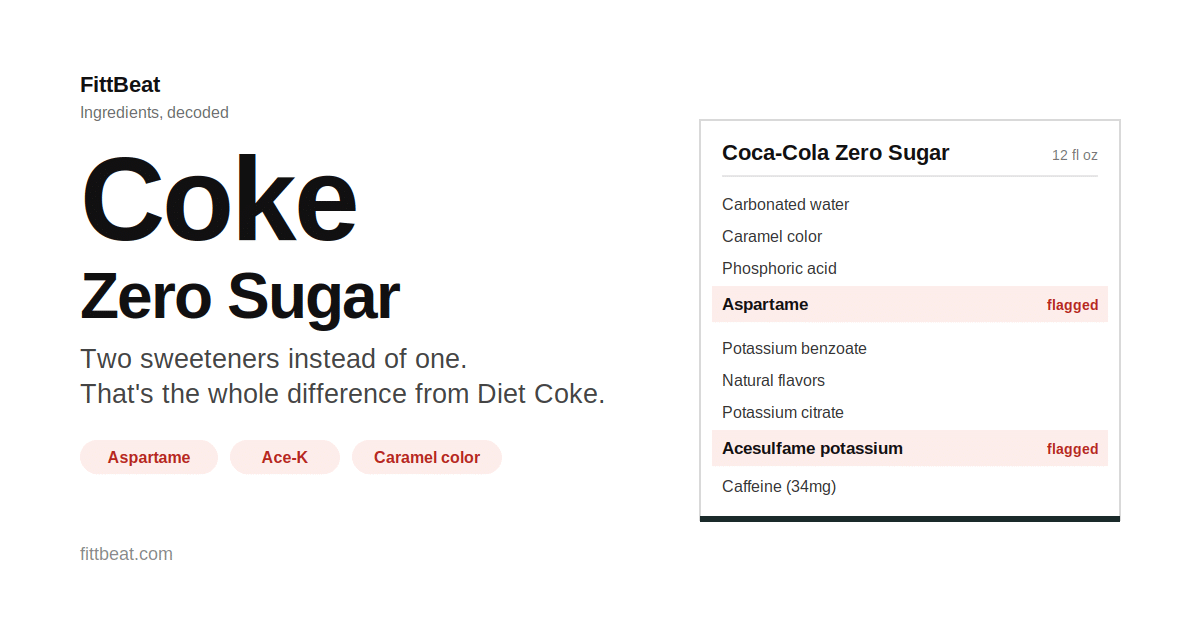
  • Acesulfame Potassium (Ace-K): The Sweetener Hiding Behind the Other One

    Acesulfame Potassium (Ace-K): The Sweetener Hiding Behind the Other One

    Last reviewed: October 2026. Summarizes published research and regulatory positions current as of that date, including EFSA’s April 2025 re-evaluation.

    Acesulfame potassium is the artificial sweetener you’ve probably consumed the most of without ever searching for it. It’s rarely the headline sweetener on a label — that’s aspartame or sucralose — but it sits beside them in Coke Zero, Pepsi Zero, Powerade Zero, Prime Hydration, Monster Zero Ultra, Red Bull Sugarfree, and nearly every protein shake on the shelf. Food scientists call it the “blending” sweetener: it fixes the other sweetener’s aftertaste and makes the whole thing taste more like sugar. This article covers what acesulfame potassium is, why it’s always paired with something else, what the 2025 European safety review concluded, and which of the acesulfame potassium side effects people worry about have evidence behind them.

    Quick answer: is acesulfame potassium bad for you?

    Not according to any major regulator. The FDA has approved it since 1988, and in April 2025 the European Food Safety Authority finished its first full re-evaluation in 25 years, found no genotoxicity concern, and actually raised the acceptable daily intake from 9 to 15 mg/kg. The honest caveats: Ace-K is the least independently studied of the big sweeteners, animal studies have linked high doses to gut-bacteria changes and weight gain, it crosses the placenta and shows up in breast milk, and EFSA flagged a manufacturing impurity (5-chloro-acesulfame) that needs more data. Nothing has been shown to harm people at the amounts in a few drinks a day. “Under-studied but approved” is the fair summary.

    What is acesulfame potassium?

    Acesulfame potassium — also written acesulfame K, Ace-K, or E950 in Europe — is a synthetic sweetener discovered by accident in 1967 by a German chemist at Hoechst who licked his fingers while working on a different compound (the same origin story as saccharin, cyclamate, and aspartame). Chemically it’s a potassium salt of a small sulfur-and-nitrogen ring compound; it doesn’t resemble sugar at all, and the “potassium” in the name is just the salt form, not a meaningful potassium source.

    Three properties explain why it’s everywhere:

    • It’s about 200 times sweeter than sugar, so a can of soda needs only 40–60 mg.
    • It’s heat- and acid-stable, unlike aspartame, so it survives baking, shelf life, and acidic drinks.
    • Your body doesn’t metabolize it. About 99% is absorbed and excreted unchanged in urine within 24 hours. That’s the basis for “zero calories” and for the regulatory view that it’s inert.

    Its one flaw is taste: on its own, Ace-K has a bitter, metallic aftertaste at higher concentrations. That’s why you almost never see it alone. Paired with aspartame or sucralose, each sweetener masks the other’s off-notes, the mix tastes closer to sugar, and manufacturers can use less of each. This is the “synergy” that keeps it in business.

    Where acesulfame potassium hides

    Zero-sugar sports drink20 fl oz

    Water, Citric Acid, Electrolytes (Salt, Sodium Citrate, Magnesium and Calcium Chlorides, Mono-Potassium Phosphate), Vitamins B12 and C, Natural Flavors, Sucralose, Acesulfame Potassium, Calcium Disodium EDTA, Red 40, Blue 1.

    Spot the pattern: it’s usually a few places after the main sweetener. From our breakdowns and beyond:

    • Coke Zero Sugar, Sprite Zero, Pepsi Zero Sugar, Diet Pepsi, Diet Dr Pepper, Diet Mountain Dew (paired with aspartame or sucralose)
    • Powerade Zero, Gatorade Zero, Propel, BodyArmor Lyte (paired with sucralose)
    • Prime Hydration (paired with sucralose)
    • Monster Zero Ultra, Red Bull Sugarfree, Rockstar Zero, Ghost, Alani Nu, Reign
    • Premier Protein, Fairlife Core Power, Muscle Milk, and most whey protein powders
    • Sugar-free gum (Trident, Extra), sugar-free syrups, “light” yogurts, sugar-free Jell-O
    • Many children’s chewable vitamins and liquid medicines
    • Coffee creamers, “zero sugar” ketchup and BBQ sauces, keto snacks

    One useful tell: if a product says “zero sugar” and the sweetener list has two names, one of them is almost always acesulfame potassium. The notable holdout is Diet Coke, which still uses aspartame alone. Celsius is a rare exception that uses sucralose alone.

    Acesulfame potassium side effects: what the evidence shows

    Ranked from most to least substantiated.

    1. It’s been studied less than the others The core concern

    This isn’t a side effect so much as the reason the question stays open. Ace-K was approved in the U.S. in 1988 largely on the basis of two rat studies from the 1970s and 80s. The Center for Science in the Public Interest petitioned the FDA in 1996 arguing those studies were poorly designed and that two of them suggested tumors; the FDA disagreed and expanded approval to soft drinks in 1998 and general use in 2003. Compared to aspartame (hundreds of human studies) and sucralose (dozens), the independent human literature on Ace-K alone is thin — partly because it’s nearly always consumed in a blend, which makes it hard to isolate.

    EFSA’s 2025 re-evaluation is the most thorough look so far. It reviewed everything published since the 2000 assessment, found no evidence of DNA damage from Ace-K or its breakdown products, set an ADI of 15 mg/kg based on a chronic rat study, and noted that even the highest-consuming Europeans stay below it. It also recommended tighter limits on lead and mercury in commercial Ace-K and asked for genotoxicity data on an impurity called 5-chloro-acesulfame. So: a clean bill of health on the main compound, with a note to check the manufacturing quality.

    2. Gut bacteria and weight gain in animals Animal data

    A 2017 study in PLOS ONE gave mice Ace-K for four weeks and found shifts in gut bacteria, with male mice gaining weight and female mice showing different bacterial changes. Other rodent studies have found similar microbiome effects. The relevance to humans is uncertain: doses were high, mouse microbiomes differ from ours, and no human trial has reproduced a weight effect. This is the finding behind most “Ace-K causes weight gain” headlines.

    3. It reaches the fetus and breast milk Confirmed, significance unclear

    A 2015 study in the Journal of Perinatology detected Ace-K and sucralose in breast milk from most of the mothers tested, and other work has found it in amniotic fluid and cord blood. Because the body doesn’t metabolize it, it circulates intact. Whether that matters is unknown — one mouse study found that exposure during pregnancy and nursing altered the offspring’s sweet-taste preference and metabolism. Regulators consider it safe in pregnancy at normal intake. Moderation is the sensible default when the data is this thin.

    4. Cancer Weak association in one cohort

    No regulator classifies Ace-K as carcinogenic, and EFSA’s 2025 review specifically found no genotoxicity. The one human signal comes from the French NutriNet-Santé cohort (2022), where higher intake of artificial sweeteners overall was associated with modestly higher cancer risk, and Ace-K was one of the two sweeteners (with aspartame) driving the association. It’s observational, heavy diet-soda drinkers differ from non-drinkers in many ways, and Ace-K and aspartame are consumed together, which makes the two hard to separate. The 1970s rat studies CSPI cited have not been replicated.

    5. Cognitive effects One mouse study

    A 2013 study found that mice fed Ace-K for 40 weeks showed memory impairment and metabolic changes. It’s cited often but hasn’t been replicated in a way that translates to people.

    6. Blood sugar and insulin No direct effect shown

    Ace-K contains no carbohydrate and doesn’t raise blood glucose. Some early research suggested it might stimulate insulin release through the sweet-taste receptors on the pancreas (the same concern now better documented for aspartame and sucralose), but human trials have generally not shown a meaningful effect from Ace-K itself.

    7. Methylene chloride Not detected in product

    A persistent online claim is that Ace-K contains methylene chloride, a solvent that’s a potential carcinogen. Methylene chloride was historically used in one manufacturing route, and CSPI raised it in the 1990s. The FDA’s position is that it is not detectable in the finished sweetener. Not a credible concern for the product on shelves.

    8. Headaches, nausea, mood Anecdotal

    Reported by some people, not reproduced in controlled trials. As with any additive, if you notice a pattern, an elimination test is reasonable.

    How much acesulfame potassium is “safe”?

    The FDA’s acceptable daily intake is 15 mg per kilogram of body weight; EFSA raised its ADI to the same 15 mg/kg in 2025 (from 9). For a 155 lb (70 kg) adult, that’s about 1,050 mg a day.

    ProductApprox. Ace-KServings to reach ADI (155 lb adult)
    Coke Zero Sugar, 12 oz~45 mg~23 cans
    Diet Pepsi, 12 oz~45 mg~23 cans
    Powerade Zero, 20 oz~50 mg (est.)~21 bottles
    Zero-sugar energy drink, 16 oz~40–70 mg (est.)~15–26 cans
    Protein shake, 11 oz~30–60 mg (est.)~18–35 shakes
    Stick of sugar-free gum~2–5 mghundreds

    Brands don’t have to disclose amounts, so most of these are estimates from the few published analyses. The ADI is hard to reach. The more realistic concern is cumulative exposure for someone having a protein shake, two diet sodas, a zero-sugar energy drink, and gum every day — still under the limit, but a steady daily dose of a compound with a thin human-research base. And because the ADI is weight-based, a child reaches it at a third of the adult amount.

    Acesulfame potassium vs. sucralose vs. aspartame vs. stevia

    Acesulfame KSucraloseAspartameStevia
    What it isSynthetic potassium saltChlorinated sugarTwo amino acidsPlant extract
    Sweetness vs sugar200×600×200×200–300×
    Metabolized?No — excreted intactMostly notYes — fullyPartly, by gut bacteria
    Heat stableYesTo ~250°FNoYes
    Cancer classificationNoneNoneIARC 2BNone
    Human research baseThinModerateExtensiveModerate
    Main concernUnder-studied; animal gut dataHunger, gut, heatingPKU, IARC 2B, heart dataAftertaste
    Usually paired withSucralose or aspartameAce-KAce-KErythritol, monk fruit

    Our sucralose and aspartame breakdowns cover its two usual partners in depth. If you’re reading a label and see any two of these three names together, you’re looking at the standard zero-sugar formula.

    Should you avoid acesulfame potassium?

    FittBeat verdict

    Approved, re-checked in 2025, and still the sweetener we know the least about. No human harm demonstrated; animal data on gut bacteria and some open questions on manufacturing impurities. Since it’s almost never consumed alone, the practical question isn’t “is Ace-K safe” but “how many zero-sugar products am I drinking a day” — and the answer to that governs your exposure to all of them at once.

    • Occasional diet drink or protein shake: no meaningful concern.
    • Multiple zero-sugar products daily: you’re getting a steady dose of Ace-K plus whatever it’s paired with. Worth trimming, mainly because of the sucralose and aspartame findings on hunger and insulin rather than anything specific to Ace-K.
    • Pregnancy and breastfeeding: approved, but it crosses to the baby intact and the long-term data doesn’t exist. Reasonable to keep it occasional.
    • Kids: weight-based ADI means a child reaches it far faster, and it’s in chewable vitamins and medicines they may already be taking.
    • Trying to avoid artificial sweeteners entirely: Ace-K is the one most likely to slip past you, because it’s never the headline. Check the full list, not just the first sweetener.

    See the full ingredients index for every drink we’ve broken down and which sweeteners each one uses.

    Frequently asked questions

    What is acesulfame potassium?

    A calorie-free synthetic sweetener about 200 times sweeter than sugar, approved by the FDA since 1988. It’s usually blended with aspartame or sucralose to improve taste. Also called acesulfame K, Ace-K, or E950.

    Is acesulfame potassium safe?

    The FDA, EFSA, and WHO consider it safe within the acceptable daily intake of 15 mg/kg body weight. EFSA’s April 2025 re-evaluation found no genotoxicity concern. It has been studied less in humans than aspartame or sucralose.

    Does acesulfame potassium cause cancer?

    No regulator classifies it as a carcinogen, and EFSA’s 2025 review found no DNA-damage concern. One French cohort study linked high artificial sweetener intake, including Ace-K, to modestly higher cancer risk, but it was observational and couldn’t separate Ace-K from aspartame.

    Is acesulfame potassium the same as aspartame?

    No. They’re different compounds that are often used together. Aspartame is made from amino acids and is fully metabolized; Ace-K is a synthetic salt that passes through unchanged. Ace-K doesn’t carry the PKU warning.

    Why is acesulfame potassium always combined with another sweetener?

    On its own it has a bitter aftertaste at higher concentrations. Blending it with sucralose or aspartame masks that, makes the drink taste closer to sugar, and lets manufacturers use less of each.

    Does acesulfame potassium raise blood sugar?

    No. It contains no carbohydrate and human trials have not shown a meaningful effect on blood glucose or insulin from Ace-K itself.

    Is acesulfame potassium safe during pregnancy?

    Regulators consider it safe at normal intake. It does cross the placenta and appear in breast milk unchanged, and long-term data is limited, so many people choose to keep it occasional.

    Is acesulfame potassium a source of potassium?

    No. The potassium in the name is just the salt form; a can of soda provides a negligible amount.

    This article is for informational purposes and is not medical advice. Talk to a doctor or registered dietitian about your individual nutrition needs.
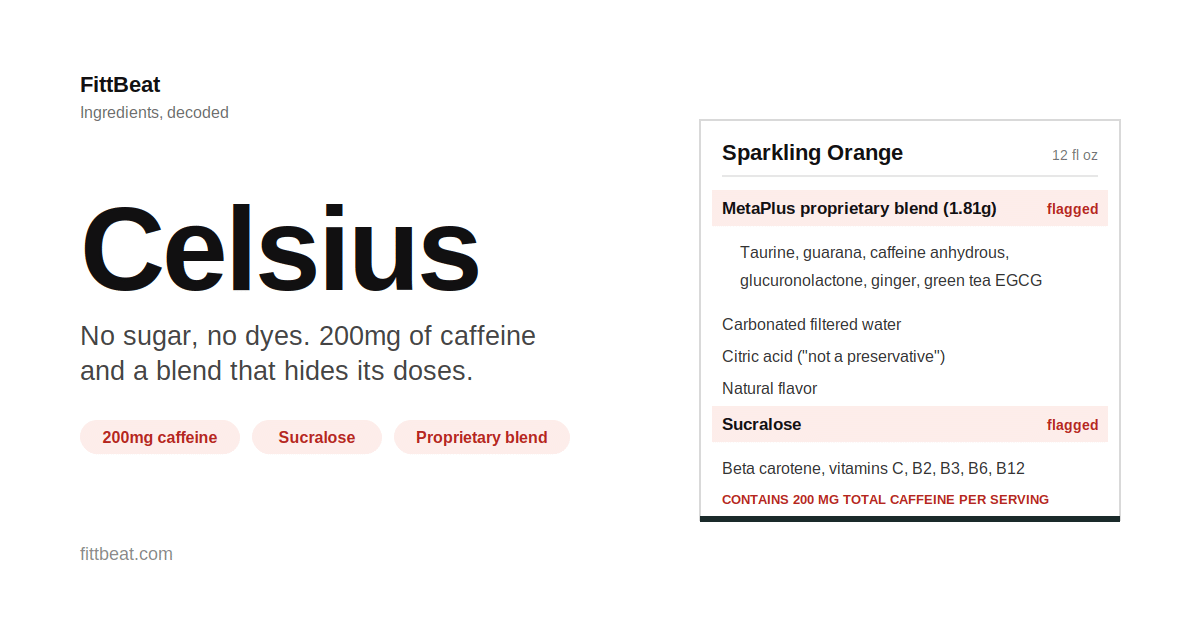
  • Coke Zero Ingredients: What’s in Coca-Cola Zero Sugar (2026)

    Coke Zero Ingredients: What’s in Coca-Cola Zero Sugar (2026)

    Last reviewed: October 2026. Reflects the current U.S. 12 fl oz Coca-Cola Zero Sugar formula. Coke Zero was reformulated in 2017 and again in 2021; the ingredient list didn’t change, but the flavor balance did.

    Coca-Cola Zero Sugar is the fastest-growing product Coca-Cola makes, and the drink that finally got people who hated Diet Coke to go sugar-free. The pitch is simple: tastes like Coke, zero sugar, zero calories. The label is nine ingredients long, and two of them are artificial sweeteners — one of which the WHO’s cancer agency flagged in 2023. Here’s every Coke Zero ingredient, what it does, how it differs from Diet Coke, and whether any of it is worth worrying about.

    Quick answer: what’s in Coke Zero?

    Coca-Cola Zero Sugar is carbonated water, caramel color, phosphoric acid, two artificial sweeteners (aspartame and acesulfame potassium), potassium benzoate as a preservative, natural flavors, potassium citrate, and 34 mg of caffeine per 12 oz. It has zero sugar, zero calories, and about 40 mg of sodium. The main things to know: it contains aspartame, so it carries a PKU warning; the sweetener research since 2022 suggests “zero calories” doesn’t mean “no metabolic effect”; and the caramel color is the reason a can of Coke in California carries a cancer-warning label. Compared with a regular Coke’s 39 g of sugar, it’s the better trade. Compared with water, it isn’t.

    The full Coke Zero ingredients list

    Coca-Cola Zero Sugar12 fl oz

    Carbonated Water, Caramel Color, Phosphoric Acid, Aspartame, Potassium Benzoate (To Protect Taste), Natural Flavors, Potassium Citrate, Acesulfame Potassium, Caffeine. Phenylketonurics: Contains Phenylalanine.

    For comparison, here’s Diet Coke:

    Diet Coke12 fl oz

    Carbonated Water, Caramel Color, Aspartame, Phosphoric Acid, Potassium Benzoate (To Protect Taste), Natural Flavors, Citric Acid, Caffeine. Phenylketonurics: Contains Phenylalanine.

    Spot the differences: Coke Zero adds acesulfame potassium as a second sweetener and potassium citrate as a flavor buffer, and drops the citric acid. Aspartame sits lower in the list (less of it, since Ace-K picks up part of the sweetness). That’s the whole formula gap — and it’s why Coke Zero tastes rounder and closer to regular Coke while Diet Coke keeps its sharper, more distinct flavor.

    Coke Zero ingredients explained

    Carbonated water Fine

    Filtered water with dissolved carbon dioxide. The carbonation forms a small amount of carbonic acid, which contributes to the drink’s acidity but far less than the phosphoric acid does.

    Caramel color Flagged

    Second ingredient by weight, and the one that gives cola its color. The type used in colas (Class IV, “E150d”) is made by heating sugars with ammonium and sulfite compounds, which produces a byproduct called 4-methylimidazole (4-MEI). 4-MEI caused cancer in mouse studies at high doses, and California lists it under Proposition 65 — which is why Coca-Cola reformulated its caramel color in 2012 to drop 4-MEI below the level that would require a warning on every can. Current levels are low, and the FDA considers them safe, but it’s the ingredient with the most interesting regulatory history on the label. Our caramel color breakdown covers the full story.

    Phosphoric acid Dental and bone questions

    Gives cola its distinctive tang and keeps the drink shelf-stable by lowering pH to about 2.5–3. It’s also the ingredient most strongly linked to cola’s reputation for tooth erosion, and observational studies have associated heavy cola intake with lower bone density, likely because phosphoric acid shifts calcium balance. The effects are dose-dependent — a can a day is a different story than a liter a day. Our phosphoric acid breakdown goes deeper.

    Aspartame Flagged

    The primary sweetener. Aspartame is about 200 times sweeter than sugar and breaks down in the body to phenylalanine, aspartic acid, and methanol. In 2023 the WHO’s cancer agency classified it as “possibly carcinogenic” (Group 2B) on limited evidence, while the FDA and the WHO’s own food-safety committee kept it approved at current limits. A 12 oz Coke Zero has roughly 85–90 mg — about half as much as Diet Coke, because Ace-K shares the load — so you’d need something like 30 cans a day to reach the FDA’s acceptable daily intake. The “Phenylketonurics: Contains Phenylalanine” line is a legal requirement for anyone with PKU, who must avoid it entirely. Our aspartame breakdown covers the cancer question, the 2025 cardiovascular research, and who should actually be careful.

    Potassium benzoate (to protect taste) Low concern here

    A preservative that stops mold and bacteria from growing in the acidic environment. It’s the potassium version of sodium benzoate; Coke uses it partly to keep the sodium count down. The known issue with benzoates is that they can form benzene — a carcinogen — when combined with vitamin C and exposed to heat or light. Coke Zero contains no vitamin C, so that pathway isn’t relevant here; it’s a bigger concern in fruit-flavored drinks that pair benzoate with ascorbic acid. Our sodium benzoate breakdown explains the chemistry.

    Natural flavors Unknown blend

    The proprietary cola flavor — a blend of citrus oils, spices, and vanilla-type notes whose exact composition is Coca-Cola’s most famous trade secret. “Natural” means the flavor molecules were derived from plant or animal sources; it doesn’t tell you what they are.

    Potassium citrate Fine

    A buffering agent that smooths the acidity and rounds out the aftertaste of the sweeteners. It’s also why Coke Zero lists about 60 mg of potassium on the nutrition panel. Harmless at this dose; it’s the same compound used to treat kidney stones at much higher amounts.

    Acesulfame potassium (Ace-K) Flagged

    The second sweetener, and the one that makes Coke Zero taste different from Diet Coke. Ace-K is about 200 times sweeter than sugar, passes through the body unmetabolized, and is almost always paired with another sweetener because on its own it has a bitter aftertaste. It’s FDA-approved and widely used, but it’s the least-studied of the major sweeteners: critics (notably the Center for Science in the Public Interest) have argued for decades that the safety testing from the 1970s–80s was inadequate, and recent rodent studies have linked it to gut microbiome changes. No human harm has been demonstrated. Our acesulfame potassium breakdown covers what is and isn’t known.

    Caffeine 34 mg — low

    34 mg per 12 oz. That’s less than Diet Coke (46 mg), about a third of a cup of coffee, and a sixth of a Celsius. Mild for most adults. Coca-Cola Zero Sugar Caffeine Free exists if you want none.

    Coke Zero nutrition facts

    Per 12 oz canCoke Zero SugarDiet CokeCoca-Cola Classic
    Calories00140
    Sugar0 g0 g39 g
    SweetenerAspartame + Ace-KAspartameHigh fructose corn syrup
    Aspartame (approx.)~87 mg~187 mgNone
    Caffeine34 mg46 mg34 mg
    Sodium40 mg40 mg45 mg
    Potassium60 mg0 mg0 mg
    AcidPhosphoricPhosphoric + citricPhosphoric
    Caramel colorYesYesYes
    PreservativePotassium benzoatePotassium benzoateNone

    Regular Coke doesn’t need a preservative because 39 g of sugar and high acidity already make it hostile to microbes. Remove the sugar and you need benzoate — one of the quiet trade-offs of going “zero.”

    Coke Zero vs. Diet Coke: which is better?

    They’re closer than the marketing suggests. Both are zero-calorie, aspartame-sweetened, caramel-colored, phosphoric-acid colas with the same preservative. The real differences:

    • Taste. Coke Zero is engineered to taste like regular Coke; Diet Coke was never meant to and has its own flavor. This is personal, and it’s the reason the two coexist.
    • Sweeteners. Coke Zero uses two (aspartame + Ace-K) at lower doses each; Diet Coke uses aspartame alone at roughly double the amount. If you’re specifically limiting aspartame, Coke Zero has less. If you want to avoid Ace-K, Diet Coke has none.
    • Caffeine. Diet Coke has about a third more (46 vs 34 mg). Still low either way.
    • Everything else is a wash.

    Neither is healthier in a meaningful sense. Pick the one you prefer the taste of, and drink less of it.

    Is Coke Zero bad for you?

    FittBeat verdict

    Better than regular Coke. Not a health drink. Swapping 39 g of sugar for two artificial sweeteners is a real win if you were going to drink a cola anyway. But “zero calories” isn’t “zero effect”: aspartame carries a WHO hazard flag and emerging heart data, Ace-K is under-studied, the caramel color has a Prop 65 history, and the phosphoric acid is tough on teeth. One a day is fine for most adults. Make it the treat, not the hydration.

    The specific concerns, ranked:

    1. Artificial sweeteners (aspartame + Ace-K). Approved and safe at normal intake, but the WHO advises against using them for weight control, and 2022–2025 research links heavy intake to modest increases in cardiovascular risk and to insulin spikes without sugar. The practical takeaway: don’t assume a diet soda is “free” and let it replace water.
    2. Phosphoric acid. Dental erosion with frequent sipping; possible bone-density effects with heavy long-term use.
    3. Caramel color (4-MEI). Reduced since 2012, regulated, and low-dose in a can — but it’s a manufactured carcinogen byproduct, and it’s there purely for color.
    4. Potassium benzoate. Not a concern in Coke Zero specifically, since there’s no vitamin C to react with.
    5. PKU. If you have it, no aspartame, full stop.

    What about Coke Zero for keto, diabetes, and weight loss?

    Keto: zero carbs, zero sugar, so it won’t break ketosis. Most keto guides allow it.

    Diabetes: it won’t raise blood glucose directly. The caveat is a 2025 animal study showing aspartame triggers insulin release through the sweet-taste response, and a 2022 human trial where sucralose impaired glucose tolerance in some people via the gut. If you track your numbers, watch for an individual effect rather than assuming none.

    Weight loss: replacing regular Coke with Coke Zero saves about 140 calories a can, which adds up. But the WHO’s 2023 review found no long-term weight benefit from non-sugar sweeteners, and the hunger research suggests they can keep sweet cravings alive. Use it as a step-down from sugar soda, not a permanent fixture.

    Cleaner alternatives

    If you want cola without aspartame or Ace-K, Zevia Cola is sweetened with stevia and has no caramel color (it’s clear). Olipop Vintage Cola and Poppi Classic Cola use a mix of juice, stevia, and fiber with a few grams of sugar. Diet Pepsi dropped aspartame in 2020 and uses sucralose and Ace-K instead — a different sweetener, not necessarily a better one. And unsweetened sparkling water with a squeeze of lime is the honest answer for daily hydration.

    See the full ingredients index for every soda we’ve broken down, including Coca-Cola and Diet Coke.

    Frequently asked questions

    Does Coke Zero have aspartame?

    Yes. Aspartame is the primary sweetener, at roughly 85–90 mg per 12 oz can, alongside acesulfame potassium. The can carries the required “contains phenylalanine” warning.

    What’s the difference between Coke Zero and Diet Coke?

    Coke Zero uses aspartame plus acesulfame potassium and is formulated to taste like regular Coke; Diet Coke uses aspartame only, adds citric acid, has more caffeine (46 vs 34 mg), and has its own distinct flavor. Both are zero-calorie.

    How much caffeine is in Coke Zero?

    34 mg per 12 oz can, the same as regular Coca-Cola. A caffeine-free version is also sold.

    Is Coke Zero keto-friendly?

    Yes. It has zero carbohydrates and zero sugar, so it won’t affect ketosis.

    Is Coke Zero OK for diabetics?

    It contains no sugar and doesn’t raise blood glucose directly. Some research suggests artificial sweeteners may affect insulin or glucose tolerance in certain people, so monitoring your own response is sensible.

    Why does Coke Zero have a cancer warning in California?

    Because of 4-methylimidazole (4-MEI), a byproduct of the caramel color, which California lists under Proposition 65. Coca-Cola reduced 4-MEI levels in 2012, and the FDA considers current amounts safe.

    Is Coke Zero better than regular Coke?

    For sugar and calories, yes — it saves 39 g of sugar and 140 calories per can. It trades that for two artificial sweeteners and a preservative. It’s the better choice if you’re going to drink cola; water is better than both.

    Does Coke Zero have sodium?

    About 40 mg per 12 oz, roughly 2% of the daily value. It also has about 60 mg of potassium from potassium citrate.

    This article is for informational purposes and is not medical advice. Talk to a doctor or registered dietitian about your individual nutrition needs.
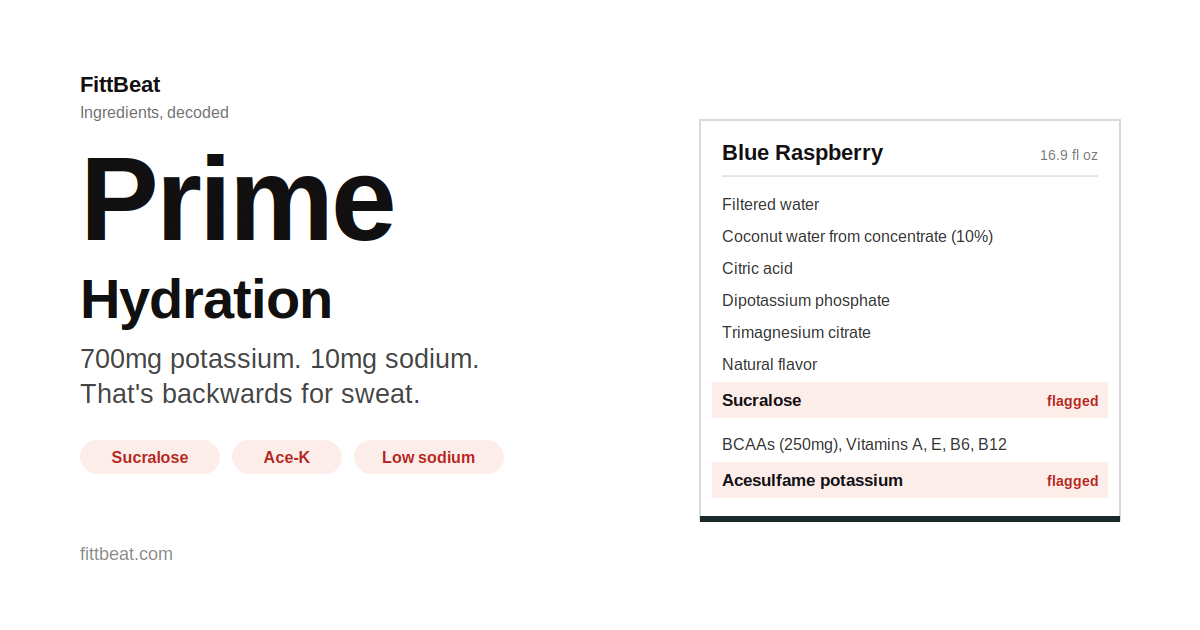
  • Celsius Ingredients: What’s in the Can and Is It Bad for You?

    Celsius Ingredients: What’s in the Can and Is It Bad for You?

    Last reviewed: October 2026. Reflects the current U.S. 12 fl oz Celsius Originals label. Celsius Essentials, Hydration, and Vibe lines differ — see the product comparison below.

    Celsius went from a gym-bag niche brand to the third-biggest energy drink in America by selling itself as the “fitness” alternative to Monster and Red Bull: no sugar, no artificial colors, no preservatives, seven vitamins, and a “MetaPlus” blend that supposedly makes you burn calories. The can is cleaner than most of its competitors. It’s also carrying 200 mg of caffeine, a proprietary blend that hides its doses, a sweetener you should know about, and a “no preservatives” claim that cost the company a $7.8 million settlement. Here’s all the Celsius ingredients, what it does, and what the marketing leaves out.

    Quick answer: what’s in Celsius?

    Celsius is a zero-sugar energy drink with 200 mg of caffeine per 12 oz can — about two cups of coffee, and more per ounce than Monster or Red Bull. The energy comes from a 1.81 g “MetaPlus” proprietary blend of taurine, guarana, caffeine, glucuronolactone, ginger, and green tea extract, in undisclosed amounts. It’s sweetened with sucralose, colored with vegetable juice or beta carotene, and fortified with vitamin C, five B vitamins, biotin, and chromium. No sugar, no artificial dyes, no aspartame. The “burns up to 100 calories” claim is based on small company-funded studies and mostly reflects the caffeine.

    The full Celsius ingredients list

    Celsius Originals — Sparkling Orange12 fl oz

    MetaPlus Proprietary Blend (1.81 g): Taurine, Guarana Extract (Seed), Caffeine (as Caffeine Anhydrous), Glucuronolactone, Ginger Extract (Root), Green Tea Leaf Extract Standardized to 15% EGCG. Other Ingredients: Carbonated Filtered Water, Citric Acid (Citric Acid Is Added for Flavor; It Is Not Used as a Preservative), Natural Flavor, Sucralose, Beta Carotene for Color. Vitamins: Vitamin C, Riboflavin, Niacin, Vitamin B6, Vitamin B12, Biotin, Pantothenic Acid, Chromium. Contains 200 mg total caffeine per serving.

    Two things stand out on this label before you even get to the individual ingredients.

    The blend is “proprietary.” That means Celsius only has to disclose the total weight (1.81 g) and list the ingredients in descending order — not how much of each. Taurine is listed first, so it’s the largest component, and caffeine is third. Beyond that, you can’t know whether you’re getting a meaningful dose of green tea extract or a sprinkle for the label. The caffeine is the exception: FDA rules require the total to be stated, and Celsius prints 200 mg.

    That parenthetical about citric acid — “added for flavor; not used as a preservative” — is legal language. Celsius marketed its drinks as having “no preservatives” for years while listing citric acid, which is a recognized preservative. A 2022 class-action lawsuit ended in a $7.8 million settlement, Celsius changed the wording, and the odd clause on the can is the result.

    Celsius ingredients explained

    Caffeine (as caffeine anhydrous) 200 mg — high

    The ingredient that matters most. 200 mg per 12 oz can is the same as a 16 oz Monster and two and a half Red Bulls, in a smaller container. The FDA considers up to 400 mg a day safe for healthy adults, so one can is half your daily budget, and two cans plus a coffee puts you over. Caffeine anhydrous is simply dehydrated caffeine powder — synthetic or extracted, chemically identical to what’s in coffee, but absorbed fast because there’s nothing else in the drink to slow it down.

    Who should be careful: anyone under 18 (the American Academy of Pediatrics advises against energy drinks for kids and teens entirely), pregnant women (200 mg is the common daily ceiling, so one can is the whole allowance), people with heart rhythm issues or anxiety, and anyone who metabolizes caffeine slowly. The can itself says “not recommended for people who are caffeine sensitive, children under 18, or women pregnant or nursing.”

    Note that Celsius Essentials (16 oz cans) has 270 mg, and Celsius Hydration has none. The “Celsius” name alone doesn’t tell you the dose.

    Guarana extract (seed) More caffeine

    Guarana is a Brazilian seed that contains caffeine — by weight, two to four times as much as coffee beans — plus small amounts of theobromine and theophylline, the stimulants in chocolate and tea. Celsius’s “200 mg total caffeine” includes the guarana contribution, so it isn’t extra on top. The practical effect is that guarana’s caffeine is bound to tannins and releases more slowly, which is why many people describe Celsius energy as “smoother.” It’s a real ingredient, but it’s still caffeine wearing a plant name.

    Taurine Standard energy-drink ingredient

    An amino acid your body makes on its own, concentrated in muscle, heart, and brain tissue. It’s in Red Bull, Monster, and nearly every energy drink. Taurine has decent evidence for modest benefits in exercise performance and it’s not a stimulant despite the “bull” association. Since it’s first in the proprietary blend, it’s the largest single component — probably in the 1,000 mg range, though Celsius doesn’t say. Considered safe at typical doses.

    Glucuronolactone Marketing ingredient

    A naturally occurring compound involved in detoxification pathways, added to energy drinks since the Red Bull era on the theory that it fights fatigue. The human evidence for any effect at drink doses is close to nonexistent. Not harmful; just there because every energy drink has it.

    Ginger extract (root) Fine

    Ginger has real evidence for easing nausea and mild anti-inflammatory effects, but the amount here is unknown and likely small. It’s mostly for flavor and for the “natural” feel on the label. No concerns.

    Green tea leaf extract (15% EGCG) Dose unknown

    This is the ingredient behind Celsius’s “thermogenesis” claim. EGCG, the main catechin in green tea, has modest evidence for increasing calorie burn, mainly when combined with caffeine. The catch is dose: studies showing an effect typically used 300–900 mg of catechins, and since green tea extract is last in a 1.81 g blend that also has to fit ~1 g of taurine and 200 mg of caffeine, the amount in a Celsius is probably well below that. One more thing worth knowing: concentrated green tea extract is the supplement ingredient most often linked to liver injury in case reports. The doses involved were far higher than anything in a can of Celsius, but it’s the reason not to stack Celsius with green tea extract pills.

    Citric acid Low concern

    Tartness, pH control, and — despite the label’s insistence — some preservative effect. Same molecule as in citrus fruit, commercially made by fermentation. The main downside of any acidic energy drink is dental erosion with frequent sipping.

    Sucralose Flagged

    Celsius’s only sweetener, and the reason it can be sweet with 10 calories. Sucralose is FDA-approved and widely used, but research since 2022 has found it can increase hunger signaling in the brain, alter gut bacteria at higher doses, and affect glucose tolerance in some people — which is a little ironic for a drink marketed on weight management. Our sucralose breakdown covers the research in detail. If you’re avoiding artificial sweeteners, Celsius is out; it doesn’t offer a stevia version.

    Natural flavor Unknown blend

    Proprietary flavor compounds from natural sources. You can’t know what’s in it.

    Beta carotene / fruit and vegetable juice (color) No synthetic dyes

    A legitimate point in Celsius’s favor. Monster, Rockstar, and most energy drinks use Red 40, Blue 1, or Yellow 5; Celsius colors with beta carotene (orange flavors) or vegetable juice (berry flavors). No This Red 40 Post anywhere in the lineup.

    Vitamin C, B vitamins, biotin, chromium Marketing doses

    The “7 essential vitamins.” Per can: 60 mg vitamin C (67% DV), riboflavin, niacin, B6 and B12 at 100–250% DV, biotin at 100%, pantothenic acid at 100%, and chromium at 50 mcg (143% DV). B vitamins are water-soluble, so excess is excreted, which is why brands can mega-dose them for the label; they “support energy metabolism” in the sense your body needs them, not in the sense that extra ones make you feel energized. Chromium is included because of weak evidence it blunts carb cravings. None of this is harmful. None of it is why you feel the drink.

    Celsius nutrition facts

    Per 12 oz canAmount% Daily Value
    Calories10—
    Total carbohydrates2 g1%
    Sugar0 g—
    Sodium0–5 mg0%
    Caffeine200 mg50% of FDA daily guideline
    MetaPlus blend1,810 mg—
    Vitamin C60 mg67%
    Riboflavin (B2)1.7 mg130%
    Niacin (B3)20 mg125%
    Vitamin B62 mg120%
    Vitamin B126 mcg250%
    Biotin300 mcg1,000%
    Pantothenic acid10 mg200%
    Chromium50 mcg143%

    Does Celsius actually burn calories?

    The can says “burns up to 100 calories and more per can” with moderate exercise. This comes from a handful of small studies, mostly funded by Celsius and run at the University of Oklahoma around 2009–2010, which found that drinking Celsius before exercise raised energy expenditure modestly compared to placebo. The effect was real but small, it was measured over a few hours, and it’s consistent with what 200 mg of caffeine plus green tea extract does in any form — coffee produces a similar bump.

    Three things to keep in mind. First, “up to 100 calories” is a rounding error against a 2,000-calorie day. Second, the fine print on every can concedes that “Celsius alone does not produce weight loss in the absence of a healthy diet and moderate exercise.” Third, the sweetener research cuts the other way: if sucralose increases appetite, a drink that burns 100 calories and makes you eat 150 more isn’t a weight-loss tool. Treat Celsius as a clean-ish caffeine delivery system, not a fat burner.

    Celsius vs. Monster vs. Red Bull vs. coffee

    Celsius (12 oz)Monster (16 oz)Red Bull (8.4 oz)Coffee (12 oz)
    Caffeine200 mg160 mg80 mg~140 mg
    Caffeine per oz16.7 mg10 mg9.5 mg~12 mg
    Sugar0 g54 g27 g0 g
    Calories102101105
    SweetenerSucraloseSugar, glucoseSugarNone
    Artificial dyesNoYesNoNo
    Proprietary blendYesYesNoNo
    PreservativesCitric acidSodium benzoate, sorbateNoneNone

    Against sugared Monster and Red Bull, Celsius wins on nearly every line: no sugar, no dyes, fewer additives. Against Monster Zero Ultra or Red Bull Sugarfree, the gap narrows — those also use sucralose and Ace-K, and Celsius still has more caffeine per ounce than either. Against black coffee, Celsius loses: coffee has no sweetener, no proprietary blend, and comparable caffeine for pennies. See our Monster and Red Bull breakdowns for the two it’s most often compared against.

    Which Celsius is which?

    Product lineSizeCaffeineWhat’s different
    Celsius Originals / Vibe12 oz200 mgThe standard can covered in this article
    Celsius Essentials16 oz270 mgHigher caffeine, adds amino acids; sold as the “performance” line
    Celsius HydrationPowder0 mgElectrolyte sticks, no MetaPlus blend
    Celsius On-The-GoPowder200 mgSame formula as Originals in a stick

    Is Celsius bad for you?

    FittBeat verdict

    Cleaner than Monster. Still 200 mg of caffeine in 12 ounces. No sugar, no dyes, nothing on the label a regulator objects to — but it’s the strongest mainstream energy drink per ounce, the blend doesn’t disclose doses, the sweetener has real open questions, and the “burns calories” pitch is caffeine dressed up as science. One a day is fine for most adults. Two a day plus coffee is a lot. Not for teens.

    The specific things to weigh:

    1. Caffeine load. The single most important fact about Celsius. Track your total; the can is half the adult daily guideline on its own.
    2. Proprietary blend. You can’t know the green tea extract or taurine doses. That’s a transparency problem, not a safety one.
    3. Sucralose. Fine occasionally; worth reconsidering if you’re drinking several a day, especially for weight goals.
    4. Athletes. Celsius dropped the NCAA warning from its cans after a 2023 lawsuit, but guarana, taurine, and high-dose caffeine can still trip collegiate testing thresholds. If you’re tested, check your program’s list rather than the can.
    5. Acidity. Like every sparkling citrus drink, it’s hard on tooth enamel if sipped all day.

    Cleaner alternatives

    If you want the caffeine without the blend and sweetener: black coffee or cold brew, unsweetened green tea (real EGCG at a known dose), or a caffeine tablet with water for pure dosing. If you want a canned energy drink with fewer question marks, look for ones that disclose every dose and use stevia or monk fruit — they exist, though they’re pricier and harder to find. If you just like Celsius, the honest move is to count it as your coffee, not as a health drink.

    See the Full Ingredients Index for every drink we’ve broken down.

    Frequently asked questions

    How much caffeine is in Celsius?

    200 mg per 12 oz can of Celsius Originals and Vibe. Celsius Essentials (16 oz) has 270 mg. Celsius Hydration has none.

    What is the MetaPlus blend?

    Celsius’s 1.81 g proprietary blend of taurine, guarana seed extract, caffeine anhydrous, glucuronolactone, ginger root extract, and green tea leaf extract. Only the total weight and the 200 mg caffeine are disclosed, not the amount of each ingredient.

    Does Celsius have sugar?

    No. It has 0 g sugar and 10 calories, sweetened with sucralose.

    Does Celsius have artificial colors or aspartame?

    No. Colors come from beta carotene or fruit and vegetable juice, and the sweetener is sucralose, not aspartame.

    Does Celsius really burn calories?

    Small company-funded studies found a modest increase in energy expenditure before exercise, roughly what 200 mg of caffeine does in any form. The can itself states Celsius alone doesn’t produce weight loss.

    Is Celsius safe to drink every day?

    One can a day is within caffeine guidelines for most healthy adults, as long as other caffeine sources are counted. It’s not recommended for people under 18, pregnant or nursing women, or anyone caffeine-sensitive.

    Why does the Celsius can say citric acid isn’t a preservative?

    Because Celsius settled a $7.8 million lawsuit in 2022 over marketing the drinks as having “no preservatives” while containing citric acid. The clarifying language is a result of that settlement.

    Is Celsius banned by the NCAA?

    Celsius isn’t banned, but it contains guarana, taurine, and high-dose caffeine, which can affect caffeine-threshold testing. Celsius removed its NCAA warning after a 2023 settlement; tested athletes should check their own program’s guidance.

    This article is for informational purposes and is not medical advice. Talk to a doctor or registered dietitian about your individual nutrition needs.
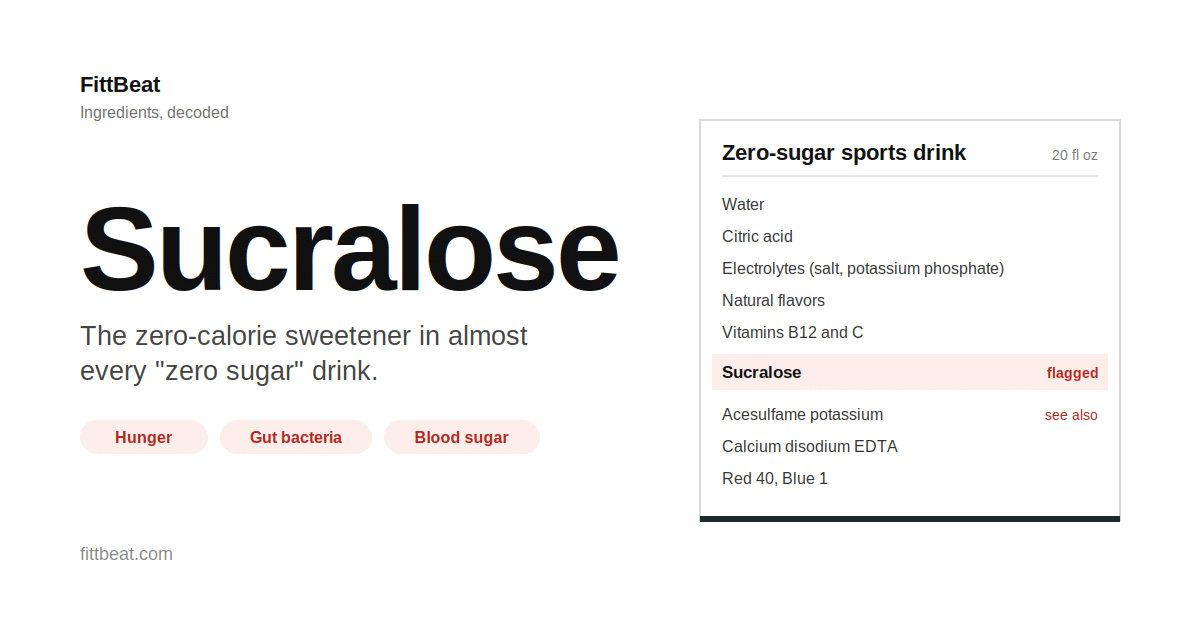
  • Prime Hydration Ingredients: What’s Actually in the Bottle

    Prime Hydration Ingredients: What’s Actually in the Bottle

    Last reviewed: October 2026. Ingredient lists reflect the current U.S. 16.9 fl oz formula. Prime has reformulated several times since 2022 and flavors differ slightly, so check your bottle.

    Prime Hydration launched in 2022 on the backs of Logan Paul and KSI, sold out everywhere, and briefly resold for ten times its price. The marketing leans on “10% coconut water,” “BCAAs,” “antioxidants,” and “zero added sugar.” Most of that is technically true. But the ingredient list tells a more interesting story — including one electrolyte problem that makes Prime a strange choice for the thing it’s named after. Here’s every ingredient, what it does, and whether it matters.

    Quick answer: what is in Prime Hydration?

    Prime Hydration is a low-calorie electrolyte drink made from filtered water, about 10% coconut water from concentrate, citric acid, potassium and magnesium salts, natural flavors, two artificial sweeteners (sucralose and acesulfame potassium), 250 mg of branched-chain amino acids, and added vitamins A, E, B6 and B12. A bottle has 20–25 calories, 1–2 g sugar (from the coconut water), 700 mg potassium, 125 mg magnesium — and only 10–20 mg sodium. It is caffeine-free; don’t confuse it with Prime Energy, which has 200 mg.

    The full Prime Hydration ingredients list

    From a current Blue Raspberry bottle:

    Filtered Water, Coconut Water from Concentrate, Citric Acid, Dipotassium Phosphate, Trimagnesium Citrate, Natural Flavor, Sucralose, L-Isoleucine, L-Leucine, L-Valine, D-Alpha Tocopheryl Acetate (Vitamin E), Acesulfame Potassium, Retinyl Palmitate (Vitamin A), Pyridoxine Hydrochloride (Vitamin B6), Cyanocobalamin (Vitamin B12). Contains: Tree Nuts (Coconut).

    Depending on flavor you’ll also see gum arabic and ester gum / glycerol esters of wood rosin (Meta Moon, Glowberry, Cherry Freeze, Ice line), beta carotene for color (Orange, Lemon Lime), fruit and vegetable juice for color (older Tropical Punch and Grape), and zinc aspartate (some flavors, tied to the “zinc for immunity” claim). None of the U.S. flavors use synthetic dyes like Red 40 or Blue 1 — the Blue Raspberry is nearly colorless.

    Prime Hydration ingredients explained

    Filtered water

    Roughly 90% of the bottle.

    Coconut water from concentrate

    Prime’s headline ingredient, at about 10% of the drink. Coconut water is naturally rich in potassium and contains some magnesium and a little sodium, which is where much of Prime’s electrolyte content comes from. “From concentrate” means the water was removed for shipping and added back during bottling — standard for packaged juices, and nutritionally close to the original. This is also why the label carries a tree nut allergen warning (the FDA classifies coconut as a tree nut, even though botanically it isn’t one) and why Prime has 1–2 g of natural sugar despite “zero added sugar.”

    Citric acid

    Supplies the tartness and acts as a mild preservative. Same molecule as in lemons, but commercially produced by fermenting a mold on sugar feedstock. The main consideration is dental: Prime is acidic, and sipping any acidic drink all day erodes enamel.

    Dipotassium phosphate

    A potassium salt that does double duty as an electrolyte source and a pH buffer that keeps the drink stable. Combined with the coconut water, it’s how Prime reaches 700 mg of potassium — 15% of the daily value and far more than Gatorade or Powerade. More on why that’s a mixed blessing below.

    Trimagnesium citrate

    Prime’s magnesium source, delivering 125 mg per bottle (30% DV). Magnesium is lost in sweat in small amounts and most Americans are mildly under-consuming it, so this is one of the more defensible additions. Magnesium citrate is well absorbed; in large doses it has a laxative effect, but 125 mg is well below that threshold.

    Natural flavor

    The FDA-permitted catch-all for proprietary flavor blends derived from natural sources. You can’t know the exact compounds. “Blue Raspberry,” “Meta Moon,” and “Glowberry” are not flavors that exist in nature, so “natural” refers to where the molecules were sourced, not what they taste like.

    Sucralose

    The first of two artificial sweeteners and the reason Prime can be sweet at 20 calories. Sucralose (the sweetener in Splenda) is about 600 times sweeter than sugar and is FDA-approved. The ongoing debate centers on gut microbiome effects and a possible impact on insulin response in some studies; the evidence is mixed and the regulatory position is that normal consumption is safe. This Sucralose Side Effects Post covers it in depth.

    Acesulfame potassium (Ace-K)

    The second sweetener, usually paired with sucralose because the two cover each other’s aftertaste. Also FDA-approved and in thousands of products. The Center for Science in the Public Interest has long argued it was under-tested; most regulators disagree. If you’re trying to avoid artificial sweeteners entirely, Prime is not your drink.

    L-Isoleucine, L-Leucine, L-Valine (BCAAs)

    The three branched-chain amino acids, totaling 250 mg. BCAAs are marketed for muscle recovery, and leucine does trigger muscle protein synthesis — but the research-supported dose is roughly 2–5 grams, i.e. 10 to 20 times what’s in a Prime. 250 mg is a marketing dose: enough to print on the front of the bottle, not enough to do anything a glass of milk wouldn’t do better. Not harmful, just not functional.

    Vitamin E (d-alpha tocopheryl acetate)

    This is the “antioxidants” claim. Current formula provides about 30% DV per bottle (earlier bottles listed 100%). Vitamin E is fat-soluble and stored in the body; a few bottles a day of the older formula would have pushed well past the daily value. The reduction appears deliberate.

    Vitamin A (retinyl palmitate)

    Also fat-soluble, also reduced from 100% DV to around 30% in current bottles. This mattered because Prime’s core audience skews young, and vitamin A is one of the few vitamins where chronic excess causes real harm (liver stress, bone issues). At the current dose, one or two bottles a day is fine. If you have older stock labeled 100%, don’t treat it like water.

    Vitamins B6 and B12

    200% DV of each. B vitamins are water-soluble, so the excess is excreted, which is why brands can mega-dose them for the label. They “support energy metabolism” in the sense that your body needs them, not in the sense that extra ones make you feel energized. Most people eating normally aren’t deficient.

    Gum arabic and ester gum (some flavors)

    Stabilizers that keep flavor oils evenly suspended so the drink doesn’t separate. Gum arabic is a tree sap; ester gum (glycerol esters of wood rosin) is derived from pine resin. Both are FDA-approved and used in citrus sodas for decades. Cosmetic, not nutritional.

    Beta carotene / fruit and vegetable juice (color)

    Prime gets its orange and purple hues from plant-derived color rather than synthetic dyes. This is a genuine point in its favor over Gatorade and Powerade, both of which use Red 40, Blue 1, or Yellow 5. This Red 40 post explains why that matters.

    Zinc aspartate (some flavors)

    Behind the “zinc for immunity” line on some bottles. Zinc does play a role in immune function, but the amount in Prime isn’t listed on the nutrition panel, which usually means it’s below the threshold worth declaring. Treat the immunity claim as decoration.

    Prime Hydration nutrition facts

    Per 16.9 fl oz bottle (one serving). Ranges reflect flavor-to-flavor variation:

    NutrientAmount% Daily Value
    Calories20–25—
    Total carbohydrates5–6 g2%
    Total sugars1–2 g (0 g added)—
    Sodium10–20 mg0–1%
    Potassium700 mg15%
    Magnesium125 mg30%
    Vitamin A270 mcg30%
    Vitamin E4.5 mg30%
    Vitamin B63.4 mg200%
    Vitamin B124.8 mcg200%
    BCAAs250 mg—
    Caffeine0 mg—

    The electrolyte problem: lots of potassium, almost no sodium

    This is the part most reviews skip. When you sweat, the electrolyte you lose by far the most of is sodium — typically 500 to 1,500 mg per liter of sweat, versus around 100–200 mg of potassium. A sports drink built for rehydration should be sodium-forward, which is why Gatorade has 160 mg per 12 oz and Powerade 250 mg.

    Prime has 10 to 20 mg of sodium per bottle. That’s less than a slice of bread. Its “700 mg electrolytes” are almost entirely potassium and magnesium — minerals you lose in small amounts and mostly replace through food.

    Practically, this means Prime is fine as a flavored, low-calorie drink with some minerals in it. It is not a good choice for replacing what you lose during a hard, sweaty workout, a long run in the heat, or a stomach bug, and the “hydration” name oversells it. If you’re sweating heavily, Powerade, a proper oral rehydration mix, or even salted water does the job better.

    Prime Hydration vs. Prime Energy: don’t mix them up

    They look nearly identical on the shelf, but they’re very different products:

    • Prime Hydration (16.9 oz bottle) — caffeine-free, the drink covered in this article.
    • Prime Energy (12 oz can) — 200 mg of caffeine, roughly two cups of coffee and more than a Red Bull and a Monster combined per ounce. The can states it’s not recommended for children under 18, pregnant or nursing women, or people sensitive to caffeine. It drew a 2023 Senate request for an FDA investigation over marketing to kids and was pulled from Canadian shelves for exceeding caffeine limits.

    If you or your kids are drinking Prime, check whether it’s a bottle or a can. The bottle has no caffeine at all.

    Prime vs. Gatorade vs. Powerade

    Per 12 ozPrime HydrationGatoradePowerade
    Calories~158080
    Sugar~1 g (natural)21 g (added)21 g (added)
    SweetenerSucralose, Ace-KSugar, dextroseHFCS
    Sodium~10 mg160 mg250 mg
    Potassium~500 mg50 mg80 mg
    Magnesium~90 mg0Trace
    Artificial dyesNoYesYes
    Best forLow-cal everyday drinkEndurance exerciseEndurance exercise

    Prime wins on calories, sugar, and dyes. Gatorade and Powerade win on the thing a sports drink is actually for. Powerade Zero or Gatorade Zero sit somewhere in between: no sugar, real sodium, but synthetic dyes. See our Powerade ingredients breakdown for the full comparison.

    Is Prime Hydration bad for you?

    No, within normal limits — and it’s cleaner than its reputation suggests. Compared to a Gatorade it has no added sugar, no synthetic dyes, and meaningful magnesium. The honest criticisms are:

    1. It’s not a real hydration drink. Near-zero sodium means it doesn’t replace what sweat takes.
    2. Two artificial sweeteners. Approved and widely used, but a dealbreaker for some people and still under active research.
    3. Fat-soluble vitamin stacking. At the current 30% DV the risk is low, but a kid drinking three bottles a day of the older 100% formula was getting far too much vitamin A. Prime appears to have reduced the dose for this reason.
    4. Marketing doses. 250 mg of BCAAs and an unlisted amount of zinc are there for the label, not for you.
    5. Price. You’re paying roughly $2 for flavored water with potassium. Coconut water alone gives you more of the same minerals.

    For context, Prime was also the subject of a 2024 class-action lawsuit alleging PFAS (“forever chemicals”) in its Grape flavor; the company disputed the claim and the case did not establish contamination. We mention it because it comes up in searches, not because it’s confirmed.

    Who should (and shouldn’t) drink it

    Reasonable for: people who want something sweeter than water without sugar or dyes; anyone cutting calories who finds plain water hard to drink enough of; light exercise.

    Skip it for: serious endurance training or heavy sweating (not enough sodium); anyone avoiding artificial sweeteners; anyone with a coconut or tree nut allergy; people on potassium restriction for kidney disease (700 mg is a lot in that context — ask your doctor).

    Browse our full ingredients index for breakdowns of Gatorade, Celsius, BodyArmor, and more.

    Frequently asked questions

    What are the main ingredients in Prime Hydration?

    Filtered water, coconut water from concentrate (about 10%), citric acid, dipotassium phosphate, trimagnesium citrate, natural flavor, sucralose, acesulfame potassium, BCAAs (leucine, isoleucine, valine), and vitamins A, E, B6 and B12.

    Does Prime Hydration have caffeine?

    No. Prime Hydration (the bottle) is caffeine-free. Prime Energy (the can) contains 200 mg of caffeine.

    Does Prime have sugar?

    About 1–2 g of natural sugar from coconut water and zero added sugar. It’s sweetened with sucralose and acesulfame potassium.

    Is Prime Hydration good for hydration?

    It provides fluid plus potassium and magnesium, but only 10–20 mg of sodium — the electrolyte you lose most in sweat. For heavy sweating, a sodium-based sports drink or oral rehydration solution works better.

    Is Prime Hydration safe for kids?

    The caffeine-free Hydration bottle has no age warning and is generally considered fine in moderation; the artificial sweeteners and high B-vitamin doses are the main things parents ask about. Prime Energy, with 200 mg caffeine, is labeled not for under-18s.

    Does Prime contain artificial colors?

    No. Colored flavors use beta carotene or fruit and vegetable juice. No Red 40, Blue 1, or Yellow 5.

    Why does Prime have a tree nut warning?

    Because it contains coconut water, and the FDA classifies coconut as a tree nut for labeling purposes.

    This article is for informational purposes and is not medical advice. Talk to a doctor or registered dietitian about your individual nutrition needs.

  • Sucralose Side Effects: What the Research Actually Shows (2026)

    Sucralose Side Effects: What the Research Actually Shows (2026)

    Last reviewed: October 2026. This article summarizes published research and regulatory positions current as of that date; the science on non-nutritive sweeteners is active and we update it as findings change.

    Sucralose is the sweetener in Splenda, and the reason Powerade Zero, Prime Hydration, Celsius, Gatorade Zero, and most “zero sugar” drinks taste sweet without calories. It’s 600 times sweeter than sugar, made by swapping three of sugar’s hydroxyl groups for chlorine atoms, and it’s been FDA-approved since 1998. It is also, after aspartame, the artificial sweetener people ask about most. This article goes through the sucralose side effects that have real evidence behind them, the ones that are overstated, and what regulators decided when they re-examined it in 2026.

    Quick answer: is sucralose bad for you?

    At the amounts in a few diet drinks a day, no major regulator considers sucralose harmful, and the European Food Safety Authority reaffirmed that in February 2026. But the research since 2022 has turned up effects worth knowing about: it can increase hunger signals in the brain, shift gut bacteria at high doses, blunt glucose tolerance in some people, and break down into a compound (sucralose-6-acetate) that damaged DNA in lab tests. Heating it to baking temperatures produces chlorinated compounds, which is why EFSA declined to approve it for baked goods. None of this amounts to “sucralose causes cancer.” It does amount to “sucralose isn’t the inert molecule it was marketed as.”

    What is sucralose?

    Sucralose starts as ordinary table sugar (sucrose). Manufacturers replace three hydrogen-oxygen groups on the sugar molecule with chlorine atoms. The result tastes like sugar but your digestive enzymes don’t recognize it, so it passes through mostly unabsorbed — about 85% leaves in stool and the rest is excreted in urine within a day or so. That’s where the “zero calories” and the “it just passes through” claims come from, and both are mostly accurate.

    On labels it appears as sucralose or, in Europe, E955. Splenda is a brand name; the yellow packets are sucralose bulked up with dextrose and maltodextrin, which is why a packet technically has a few calories. In drinks, it’s almost always paired with acesulfame potassium (Ace-K) because the two mask each other’s aftertaste.

    Where sucralose hides

    You’ll find it in most products labeled “zero sugar,” “diet,” “lite,” or “no sugar added.” A few from our ingredient breakdowns:

    • Powerade Zero (sucralose + Ace-K)
    • Prime Hydration (sucralose + Ace-K)
    • Gatorade Zero, BodyArmor Lyte, Propel
    • Celsius, Monster Zero Ultra, Red Bull Sugarfree, Ghost, Alani Nu
    • Sparkling Ice, Crystal Light, MiO
    • Most protein powders, protein bars, and “keto” snacks
    • Sugar-free syrups, gum, yogurt, and ice cream
    • Diet Coke uses aspartame, not sucralose — but Coke Zero Sugar uses both aspartame and Ace-K, and some Coke “zero” variants outside the U.S. use sucralose.

    Also, by the way, in many children’s medicines and chewable vitamins.

    Sucralose side effects: what the evidence shows

    Ranked roughly from strongest to weakest evidence in humans.

    1. It may make you hungrier

    This is the most solid recent finding. A 2025 randomized study in Nature Metabolism from the University of Southern California gave 75 young adults a sucralose drink, a sugar drink, and water on separate days. After sucralose, blood flow to the hypothalamus — the brain’s hunger center — increased, and participants reported feeling hungrier than after the sugar drink. The effect was stronger in people with obesity. The same lab’s earlier work found greater brain reward responses to food images after sucralose, and that women ate more at a buffet afterward.

    The mechanism makes sense: sweetness without calories may decouple the “sweet taste” signal from the “energy arrived” signal, and the brain compensates. The caveat is that these studies measured a single-session brain response and appetite rating, not weight gain over months. But it fits with the World Health Organization’s 2023 guidance that non-sugar sweeteners don’t help with long-term weight control.

    2. It can affect blood sugar response in some people

    Sucralose itself doesn’t contain carbohydrate and won’t spike blood sugar on its own. However, a 2022 study in Cell found that two weeks of sucralose at typical consumer doses impaired glucose tolerance in some healthy adults, and that the effect tracked with changes in their gut bacteria — researchers could transfer the impaired response to mice by transplanting the participants’ stool. Other trials have found no effect. The honest summary: for most people, nothing happens; for a subset, sucralose seems to nudge glucose handling in the wrong direction. Anyone managing diabetes or insulin resistance should at least watch their own numbers rather than assume “zero sugar” means zero effect.

    3. It shifts gut bacteria (at least at high doses)

    Mouse studies consistently show sucralose alters the microbiome, reducing beneficial species and disrupting the chemical signaling bacteria use to coordinate. Human studies are mixed: the Cell trial above found changes; others at lower doses didn’t. Most of the dramatic results used doses equivalent to many cans a day for weeks. Whether moderate intake matters for gut health in people is unresolved. Regulators have not treated microbiome effects as a reason to restrict sucralose.

    4. Sucralose-6-acetate and DNA damage

    This is the finding behind most of the “sucralose causes cancer” headlines. In 2023, North Carolina State University researchers reported that sucralose-6-acetate — a compound produced when gut bacteria act on sucralose, and also found in trace amounts in some commercial sucralose — broke DNA strands in human blood cells in the lab and made gut tissue “leaky” in cell models. The authors called for a regulatory review and said they’d personally avoid it.

    What happened next: EFSA’s February 2026 re-evaluation looked directly at this work. It concluded the lab results did not establish that ordinary sucralose consumption damages DNA in people, noted that the compounds in the original rat experiments may have been impurities in the sucralose sample rather than something the body makes, and kept the acceptable daily intake unchanged. An August 2026 genotoxicity study of commercial-grade sucralose in Food and Chemical Toxicology was also negative. The FDA has not opened a review. So: a real lab finding, not confirmed in humans, and judged by regulators not to change the safety picture.

    5. Heating it produces chlorinated compounds

    Sucralose is sold as heat-stable, and it mostly is at cooking temperatures. But at roughly 120°C / 250°F and above — oven baking, high-heat frying — it begins to break down and can generate chloropropanols and other chlorinated compounds, some of which are classed as potentially carcinogenic. This is specifically why EFSA’s 2026 review declined to extend sucralose approval to “fine bakery wares” in the EU. For drinks it’s irrelevant. If you bake with Splenda, it’s a reason to prefer a different sweetener in anything that goes in the oven.

    6. Digestive symptoms, headaches, and migraines

    Plenty of people report bloating, gas, loose stools, or headaches after sucralose. Controlled trials haven’t consistently reproduced these as sucralose-specific effects, and the sugar alcohols that often accompany sucralose in “sugar-free” products (sorbitol, maltitol) are a more likely cause of digestive complaints. That said, individual sensitivity is real: if you notice a pattern, you don’t need a trial to justify cutting it out.

    7. Cancer

    No human study has linked sucralose to cancer. The large French NutriNet-Santé cohort (2022) found a modest association between high total artificial sweetener intake and cancer risk, driven mainly by aspartame and Ace-K, with sucralose not showing a significant association on its own. A 2016 Italian mouse study (Ramazzini Institute) reported leukemia in male mice at high doses; its methods have been criticized and the finding hasn’t been replicated. In 2023 the WHO’s cancer agency classified aspartame as “possibly carcinogenic” — a widely misreported story — but that classification did not involve sucralose.

    How much sucralose is “safe”?

    The FDA’s acceptable daily intake is 5 mg per kilogram of body weight per day; EFSA’s is 15 mg/kg. For a 70 kg (155 lb) adult, that’s 350 mg a day by the stricter FDA number.

    ProductApprox. sucraloseServings to hit FDA ADI (155 lb adult)
    Splenda packet12 mg~29 packets
    Powerade Zero, 20 oz~40 mg~9 bottles
    Prime Hydration, 16.9 oz~35–45 mg (est.)~8 bottles
    Zero-sugar energy drink, 16 oz~30–50 mg (est.)~7–11 cans
    Protein powder scoop~20–40 mg (est.)~9–17 scoops

    Brands don’t have to disclose the amount, so the drink figures are estimates from the few that have been published. The takeaway is that the ADI is hard to reach with a normal diet — but it’s not hard for a kid, who weighs less, to get a meaningful fraction of it from a couple of drinks and a flavored yogurt. The ADI also only addresses toxicity; it says nothing about the hunger or glucose effects above, which showed up at ordinary doses.

    Sucralose vs. aspartame vs. Ace-K vs. stevia

    SucraloseAspartameAcesulfame KStevia / monk fruit
    SourceChlorinated sugarTwo amino acidsSyntheticPlant extract
    Sweetness vs sugar600×200×200×200–300×
    Heat stableTo ~250°FNoYesYes
    Cancer classificationNoneIARC 2B (possibly)NoneNone
    Main concernHunger, gut, S-6-APKU; IARC 2BUnder-studiedAftertaste; fewer studies
    Found inZero-sugar sports/energy drinksDiet Coke, Diet PepsiPaired with sucraloseZevia, Olipop, some Poppi

    Our Aspartame post covers that one in detail. If you want to avoid all of them, drinks sweetened with stevia or monk fruit are the usual alternative; they have their own aftertaste debate but fewer open research questions.

    Should you avoid sucralose?

    A reasonable position, based on what’s known in 2026:

    • Occasional diet drink: no meaningful concern. If it replaces a 40 g sugar soda, it’s still the better trade.
    • Several zero-sugar drinks every day: worth cutting back, mainly because of the hunger and glucose findings and because the microbiome research used doses in this range.
    • Trying to lose weight: be skeptical that “zero sugar” is helping. The WHO’s 2023 review found no long-term benefit, and the hunger studies suggest why.
    • Diabetes or insulin resistance: test your own response rather than assuming it’s inert.
    • Baking: use something else.
    • Kids: the ADI is weight-based, so a 60 lb child reaches it at a third of the adult amount. Several U.S. states have restricted artificial sweeteners in school meals since 2025 on precautionary grounds.
    • Pregnancy: approved, but a 2025 review flagged possible epigenetic effects from consistent maternal intake as an open question. Moderation is the sensible default.

    The bigger-picture point: the strongest argument against sucralose isn’t that it’s toxic. It’s that it may not deliver the thing people drink it for. If a sweetener keeps your sweet cravings alive and nudges your appetite up, the calorie savings on the label may not survive contact with the rest of your day.

    See our full full ingredients index for every drink we’ve broken down.

    Frequently asked questions

    Is sucralose safe?

    The FDA, EFSA (as of its 2026 review), and other major regulators consider it safe within the acceptable daily intake. Research since 2022 has raised questions about appetite, gut bacteria, and glucose response that regulators have not treated as grounds for restriction.

    Does sucralose cause cancer?

    No human study has shown that. A 2023 lab study found a sucralose breakdown product damaged DNA in cells; EFSA reviewed it in 2026 and concluded it did not demonstrate a risk at normal intake. Aspartame, not sucralose, is the sweetener IARC classified as “possibly carcinogenic.”

    Does sucralose raise blood sugar?

    Not directly. One 2022 trial found it impaired glucose tolerance in some people after two weeks of daily use, apparently via gut bacteria; other trials found no effect. People with diabetes should monitor their own response.

    Does sucralose cause weight gain?

    Studies haven’t shown direct weight gain, but a 2025 study found it increased hunger signaling in the brain compared to sugar, and the WHO advises against relying on non-sugar sweeteners for weight control.

    Is sucralose bad for your gut?

    High doses alter gut bacteria in animal studies and in at least one human trial. Effects at moderate intake are unclear.

    Can you bake with sucralose?

    Below about 250°F it’s stable. Above that it can break down into chlorinated compounds, and EU regulators declined in 2026 to approve it for baked goods. Use a different sweetener for oven recipes.

    Sucralose vs. aspartame — which is worse?

    They have different concerns. Aspartame carries an IARC “possibly carcinogenic” label and is dangerous for people with PKU; sucralose has the hunger, gut, and heat-breakdown questions. Neither has been shown to cause harm at normal intake.

    This article is for informational purposes and is not medical advice. Talk to a doctor or registered dietitian about your individual nutrition needs.