
Last reviewed: October 2026.
High fructose corn syrup is the second ingredient in Coke, Pepsi, Dr Pepper, Sprite, Mountain Dew, Fanta, Gatorade, and most of what’s left in the drink aisle, which makes it the single most consumed added sugar in the United States. It also has the worst reputation of any sweetener, worse than the artificial ones — and most of that reputation is aimed at the wrong thing. Here’s what HFCS is, what the trials comparing it to cane sugar actually found, why it ended up in everything, and the one fact about it that should change how much you drink.
Quick answer: is high fructose corn syrup worse than sugar?
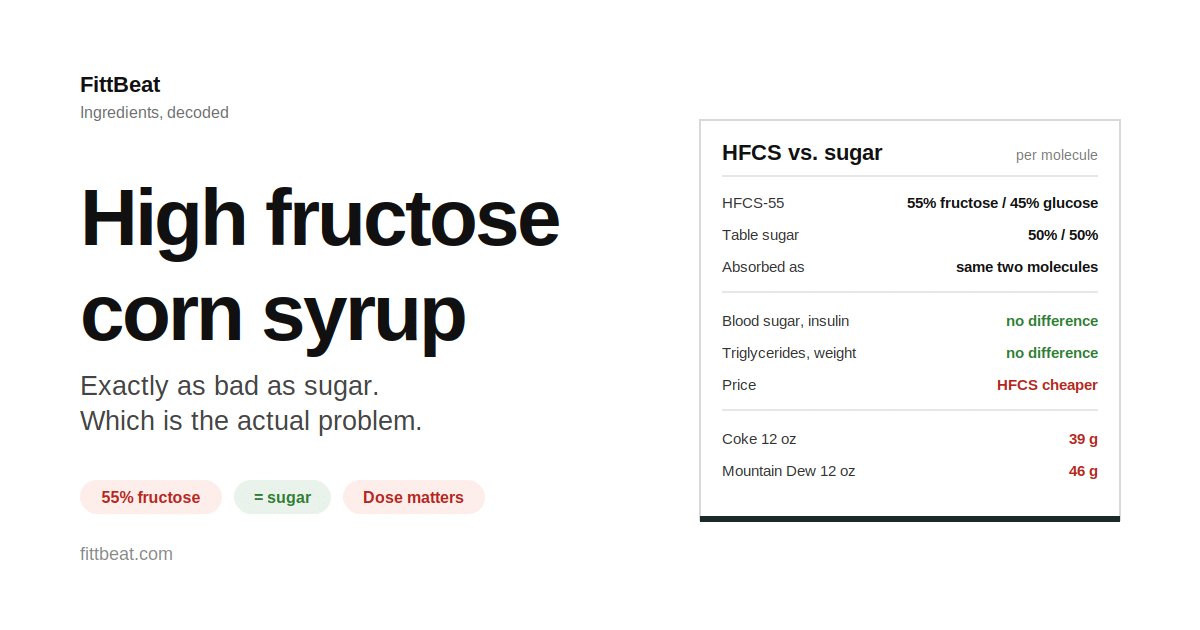
Not meaningfully. HFCS-55, the kind in soda, is 55% fructose and 45% glucose; table sugar is 50/50. Your body breaks both into the same two molecules within minutes, and head-to-head trials find no consistent difference in blood sugar, insulin, triglycerides, appetite, or weight at equal doses. The things that are true: HFCS is cheaper, it’s in far more products than sugar used to be, and the beverages it’s in deliver 40-plus grams of it with nothing to slow absorption. The harm is the dose and the delivery, not the molecule. Swapping a corn-syrup Coke for a cane-sugar Coke changes the taste and nothing else.
Jump to: What it is · HFCS vs. sugar · Why it’s in everything · What actually matters · Myths · Verdict · FAQ
What High Fructose Corn Syrup is
Corn starch is a chain of glucose. Break the chain with enzymes and you get corn syrup — plain glucose, not very sweet. Run that through a third enzyme that converts some of the glucose to fructose, and you get high fructose corn syrup: “high” relative to ordinary corn syrup, which has none, not relative to sugar. The two common grades are HFCS-42 (42% fructose, used in baked goods and some foods) and HFCS-55 (55%, used in soft drinks because it matches sugar’s sweetness).
Table sugar — sucrose, from cane or beet — is a glucose molecule bonded to a fructose molecule, 50/50. Your small intestine splits that bond almost immediately. So by the time either sweetener reaches your bloodstream, the body is seeing free glucose and free fructose in nearly the same ratio. That’s the core of the whole debate, and it’s why the metabolic studies come out the way they do.
High Fructose Corn Syrup vs. sugar: what the trials found
This has been tested directly, repeatedly, in humans. Trials that feed people matched doses of HFCS and sucrose — in drinks, over days to weeks — and measure blood glucose, insulin, triglycerides, uric acid, leptin, ghrelin, and weight find the two indistinguishable. A 2016 review of the controlled trials concluded there was no evidence of a metabolic difference at the amounts people consume. The one clear difference is price.
Where fructose itself gets interesting is at high doses. Fructose is metabolized in the liver, and large amounts drive fat synthesis there — the link to fatty liver and elevated triglycerides is real. But that applies to fructose from sucrose exactly as much as fructose from HFCS, and the 5-point difference in fructose share between the two is too small to matter. The studies that found fructose harmful used pure fructose at doses no sweetener delivers.
Why it’s in everything
Policy, not chemistry. The U.S. has restricted sugar imports with tariffs and quotas since the 1930s, keeping domestic sugar prices well above the world market; at the same time, corn has been subsidized since the 1970s. Once the enzyme process for High Fructose Corn Syrup was commercialized in the 1970s, corn syrup became far cheaper than sugar for American manufacturers, and Coke and Pepsi completed their switch in the mid-1980s. That’s the entire reason “Mexican Coke,” made with cane sugar under different trade rules, exists as a product people seek out — and why Coca-Cola’s 2025 U.S. cane sugar launch was a taste play, not a health one.
It’s also why High Fructose Corn Syrup is a reasonable proxy for “ultra-processed”: it’s in things because they’re cheap to make, and the drinks it’s in are the ones delivering the most sugar per serving. The ingredient tracks the problem without being the problem.
What actually matters: the dose and the drink
Here’s the thing to take from this page. A 12 oz Coke has 39 g of sugar; a 20 oz bottle has 65 g; a 12 oz Mountain Dew has 46 g. Those numbers would be identical with cane sugar, and they’re the numbers that drive every harm in the research: daily sugar-sweetened beverages are among the most consistent dietary predictors of weight gain, type 2 diabetes, fatty liver, and heart disease in large cohort studies. Liquid sugar is worse than the same sugar in food because it doesn’t trigger fullness — people don’t compensate by eating less — and because it’s absorbed fast. The American Heart Association’s daily added-sugar limits are 25 g for women and 36 g for men; one can of almost any soda exceeds the first and most exceed the second.
So the useful question on a label isn’t “corn syrup or sugar?” It’s “how many grams, and is it a drink?” Our product breakdowns put the number first for that reason.
Three myths worth retiring
- “High Fructose Corn Syrup is metabolized differently.” Only in the sense that its fructose and glucose arrive unbonded; sucrose’s are split within minutes. The trials show no downstream difference.
- “HFCS contains mercury.” A 2009 study found trace mercury in some High Fructose Corn Syrup samples made with an older chlor-alkali process; the industry had already moved away from it, and follow-up testing found none. Not a current issue.
- “HFCS is why Americans got fat and sugar wouldn’t have.” The timing fits, which is why the hypothesis was proposed in 2004 — but total added-sugar intake rose alongside HFCS, and countries that use sucrose have had the same trajectory. The paper that proposed the idea has since been walked back by its own authors.
Is high fructose corn syrup bad for you?
FittBeat verdict
Exactly as bad as sugar, which is the actual problem. HFCS isn’t a uniquely harmful molecule; it’s the cheapest way to put 40 g of sugar in a can, and 40 g of sugar in a can is the harm. Avoiding HFCS by switching to cane-sugar versions of the same drinks changes nothing. Avoiding sugared drinks does. If you see HFCS on a label, read it as “this is a sugar product” and check the grams — that’s the number that matters.
Frequently asked questions
Is high fructose corn syrup worse than sugar?
Not in any way controlled trials have been able to detect. HFCS-55 is 55% fructose; sugar is 50%. The body processes both into the same molecules, and studies at matched doses find no difference in blood sugar, insulin, triglycerides, or weight.
What is the difference between corn syrup and high fructose corn syrup?
Corn syrup is almost pure glucose and only mildly sweet. HFCS has had some of that glucose enzymatically converted to fructose, making it as sweet as sugar.
Why is HFCS in so many products?
Cost. U.S. sugar tariffs and corn subsidies have made corn syrup much cheaper than sugar since the 1970s, and soft-drink makers switched in the 1980s.
Is Mexican Coke healthier than American Coke?
No. It uses cane sugar instead of HFCS, which changes the taste and nothing nutritional. Same sugar, same calories.
Does High Fructose Corn Syrup cause diabetes?
Sugar-sweetened beverages, whatever the sweetener, are consistently linked to type 2 diabetes at daily intake. HFCS isn’t a special cause; the dose of sugar in drinks is.
Does High Fructose Corn Syrup contain mercury?
Trace mercury was found in some samples in a 2009 study, tied to an older manufacturing process that has since been phased out. Follow-up testing found none.
Is High Fructose Corn Syrup banned anywhere?
No. The EU limited production quotas for “isoglucose” until 2017 for agricultural reasons, not health ones; it’s now unrestricted there too, though less common because European sugar is cheaper.
How much High Fructose Corn Syrup is too much?
Treat it as added sugar. The AHA limits are 25 g a day for women and 36 g for men; one can of most sodas exceeds the first.
Sources
- Rippe JM, Angelopoulos TJ. Sucrose, high-fructose corn syrup, and fructose: their metabolism and potential health effects — what do we really know? Nutrients, 2016. doi:10.3390/nu8110697
- Stanhope KL, et al. Consuming fructose-sweetened, not glucose-sweetened, beverages increases visceral adiposity and lipids and decreases insulin sensitivity. Journal of Clinical Investigation, 2009. doi:10.1172/JCI37385
- Bray GA, Nielsen SJ, Popkin BM. Consumption of high-fructose corn syrup in beverages may play a role in the epidemic of obesity. American Journal of Clinical Nutrition, 2004 (the original hypothesis). doi:10.1093/ajcn/79.4.537
- Malik VS, et al. Sugar-sweetened beverages and risk of metabolic syndrome and type 2 diabetes: a meta-analysis. Diabetes Care, 2010. doi:10.2337/dc10-1079
- Imamura F, et al. Consumption of sugar sweetened beverages, artificially sweetened beverages, and fruit juice and incidence of type 2 diabetes. BMJ, 2015. doi:10.1136/bmj.h3576
- Dufault R, et al. Mercury from chlor-alkali plants: measured concentrations in food product sugar. Environmental Health, 2009. doi:10.1186/1476-069X-8-2
- U.S. FDA. High fructose corn syrup questions and answers. fda.gov
- American Heart Association. Added sugars: daily limits. heart.org
This article is for informational purposes and is not medical advice. Talk to a doctor or registered dietitian about your individual nutrition needs.
