
Last reviewed: November 2026. Taurine status for Red Bull, Monster, Celsius, Bang, Ghost, Alani Nu, and the Starbucks bottled Frappuccino is from the U.S. labels we photographed in October 2026; Zevia Energy, Reign, C4, and the others are from the manufacturers’ current published ingredient lists. Formulas change — check the can.
Taurine is in almost every energy drink, and a surprising number of people want it out — because they’ve heard it comes from bulls, because they think it’s the stimulant, because a doctor told them to watch it alongside a medication, or just because they’d rather a can with fewer things in it. Whatever the reason, the list of mainstream energy drinks without taurine is short, and most of the cans on it replace taurine with something that deserves more attention than taurine ever did. Here’s the full list of energy drinks without taurine from the labels, what’s in each one instead, and the short version of whether taurine was worth avoiding in the first place.
Quick answer: which energy drinks have no taurine?
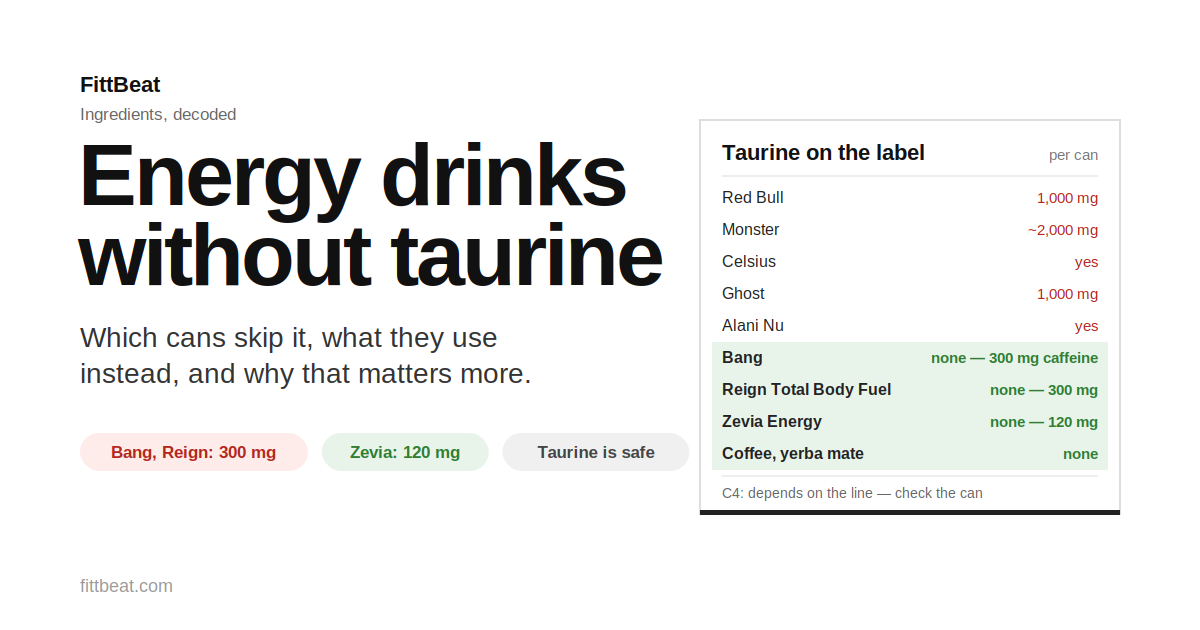
Taurine-free: Bang (300 mg caffeine; creatine, BCAAs, CoQ10), Reign Total Body Fuel (300 mg; BCAAs, CoQ10, electrolytes), Zevia Energy (120 mg; five ingredients, stevia), C4 Performance Energy (200 mg; beta-alanine, betaine — but C4 Ultimate does list taurine, so check the line), coffee and cold brew (80–200 mg), and yerba mate. Contains taurine: Red Bull and Red Bull Sugarfree (1,000 mg), Monster and all its variants (~2,000 mg), Celsius, Ghost (1,000 mg), Alani Nu, Rockstar, 5-hour Energy, and Reign Storm. The catch: taurine is an amino acid your body makes, EFSA has reviewed it as safe at energy-drink doses, and it isn’t a stimulant. The taurine-free “performance” cans swap it for 300 mg of caffeine and a longer ingredient list — a worse trade for most people. If you simply want caffeine without the blend, Zevia Energy or coffee is the honest answer.
Jump to: The list · Label table · Which cans have it · Why avoid it? · What replaces it · Verdict · FAQ
Energy drinks without taurine
Bang 300 mg caffeine
No taurine on the label. Bang’s blend is caffeine, “Super Creatine” (creatyl-L-leucine — a compound a jury found in 2022 isn’t creatine and doesn’t act like it), BCAAs, CoQ10, and sucralose with Ace-K. The 300 mg of caffeine per 16 oz is the most in a mainstream can and three-quarters of the FDA’s daily guidance in one drink. Bang is taurine-free in the way a double espresso is decaf-free: technically true, and not the point. Our Bang breakdown covers the lawsuit and the dose.
Reign Total Body Fuel 300 mg caffeine
Monster’s answer to Bang, and built the same way: 300 mg of caffeine, BCAAs (leucine, isoleucine, valine), CoQ10, electrolytes, sucralose, and Ace-K; no taurine on the current label. Note that Reign Storm, the 200 mg “wellness” line in the smaller can, does list taurine — the two share a name and not a formula.
Zevia Energy 120 mg caffeine
The shortest label in the category: carbonated water, natural flavors, citric acid, stevia leaf extract, caffeine. No taurine, no B vitamins, no glucuronolactone, no artificial sweetener, no color. 120 mg per 12 oz — the same concentration as Monster, and 80 mg less than a 12 oz Celsius. It’s a caffeinated stevia soda rather than an energy drink in the Red Bull sense, which for anyone trying to avoid the blend is exactly the point.
C4 Performance Energy Check the line
The pre-workout brand in a can. C4 Performance Energy (Jolly Rancher and the other 16 oz flavors) lists carbonated water, beta-alanine, betaine, citric and malic acid, flavors, sodium benzoate, caffeine (200 mg), sucralose, Ace-K, and B12 — no taurine. But C4 Ultimate (300 mg, with theacrine and methylliberine) and the Canadian C4 Zero Sugar do list taurine, and C4 Smart Energy uses a different formula again. Read the can, not the brand. The beta-alanine is what causes the tingling; it’s harmless.
Coffee, cold brew, and espresso 80–200 mg
No taurine, no sweetener unless you add it, nothing else. A 12 oz drip coffee is about 140 mg; a 16 oz cold brew from a can is often 150–200; a double espresso is about 130. The bottled coffee drinks mostly skip taurine too — the Starbucks bottled Frappuccino has five ingredients and none of them is taurine, though it does have 46 g of sugar.
Yerba mate (Guayakí and similar) ~80–150 mg
Brewed tea in a can: yerba mate, water, and usually cane sugar or juice. No taurine; the caffeine (plus theobromine) is from the leaf. The sugared flavors run 100–150 mg of caffeine and 20–30 g of sugar per 15.5 oz can, so read the panel.
Taurine on the label: the table
| Drink | Taurine | Caffeine | Sugar | Sweetener | Also in the can |
|---|---|---|---|---|---|
| Bang (16 oz) | None | 300 mg | 0 g | Sucralose + Ace-K | “Super Creatine,” BCAAs, CoQ10 |
| Reign Total Body Fuel (16 oz) | None | 300 mg | 0 g | Sucralose + Ace-K | BCAAs, CoQ10, electrolytes |
| Zevia Energy (12 oz) | None | 120 mg | 0 g | Stevia | Nothing else |
| C4 Performance Energy (16 oz) | None* | 200 mg | 0 g | Sucralose + Ace-K | Beta-alanine, betaine |
| Coffee (12 oz drip) | None | ~140 mg | 0 g | None | Nothing else |
| Red Bull (8.4 oz) | 1,000 mg | 80 mg | 27 g | Sugar | B vitamins, glucuronolactone |
| Monster (16 oz) | ~2,000 mg | 160 mg | 54 g | Sugar + sucralose | Ginseng, carnitine, guarana |
| Celsius (12 oz) | Yes | 200 mg | 0 g | Sucralose | Guarana, green tea, ginger |
| Ghost (16 oz) | 1,000 mg | 200 mg | 0 g | Sucralose + Ace-K | Carnitine, alpha-GPC, NeuroFactor |
| Alani Nu (12 oz) | Yes | 200 mg | 0 g | Sucralose + Ace-K | Glucuronolactone, inositol, biotin |
*C4 Ultimate and some regional C4 cans do list taurine. Three things to notice: every taurine-free can in the top half is either 300 mg of caffeine or a soda with caffeine in it — there’s no middle. Every can in the bottom half pairs taurine with other things (sugar, sucralose, 200 mg of caffeine) that have more evidence behind them as concerns. And the only two rows with “nothing else” in the last column are the two that aren’t marketed as energy drinks at all.
Which energy drinks have taurine?
Almost all of them. From the labels: Red Bull and Red Bull Sugarfree (1,000 mg per 8.4 oz — Red Bull is the drink that put taurine in the category in 1987); Monster Original, Zero Sugar, and Zero Ultra (about 2,000 mg per 16 oz, listed sixth); Celsius (listed third, amount not stated — a point older articles get wrong, including some that said Celsius was taurine-free); Ghost (1,000 mg, printed on the can); Alani Nu; Rockstar; 5-hour Energy; Reign Storm; C4 Ultimate; NOS; Full Throttle; and most store-brand cans. If a can says “energy blend” on it, assume taurine is in the blend until you read otherwise.
Why avoid taurine? (And should you?)
The reasons people give, in order of how often we hear them — and what the evidence says about each.
“It’s from bulls.” It isn’t. Taurine was first isolated from ox bile in 1827, which is where the name comes from (Latin taurus), but the taurine in every energy drink is synthesized. It’s vegan. Your body makes it, and you eat it in meat, fish, and dairy.
“It’s the stimulant.” It isn’t. Taurine has no stimulant effect in controlled trials; if anything it mildly calms the nervous system. The stimulant in every can on this page is caffeine. Avoiding taurine to feel less wired changes nothing.
“It’s unsafe at those doses.” EFSA reviewed taurine in energy drinks in 2009 and found no safety concern at 1,000 mg per can and typical intake; the amounts in Red Bull and Monster are within what the review covered. A 2023 study in Science found taurine supplementation extended lifespan in mice and monkeys, which is the opposite direction from a hazard, though it hasn’t been shown in people. Our taurine explainer goes through all of it.
“My doctor said to avoid it.” This is the one legitimate reason, and it’s specific. Taurine can affect how the body handles lithium, so people on lithium are sometimes told to keep intake consistent; there’s a theoretical interaction with some blood-pressure medications; and anyone told to avoid it for a kidney condition should follow that. If that’s you, this list is for you. If it isn’t, the caffeine and the sugar in the same can are the things worth a conversation with a doctor.
“I’d rather fewer ingredients.” Fair, and the list above shows how to get there — but it leads to Zevia and coffee, not to Bang. Cutting taurine while adding creatyl-L-leucine, BCAAs, CoQ10, and an extra 140 mg of caffeine is not a shorter label.
Read next: Taurine — not a stimulant, not from bulls, and probably the safest thing in the can.
What the taurine-free cans use instead
More caffeine. The clearest pattern on the table. Bang and Reign are 300 mg; C4 Performance is 200; the taurine cans average 80–200. A drink that drops a safe amino acid and nearly doubles the one ingredient with real cardiovascular effects hasn’t gotten cleaner.
BCAAs. Leucine, isoleucine, and valine, at a few hundred milligrams — a fraction of the 5–10 g used in supplement studies, and those studies mostly show no benefit when total protein is adequate. Harmless; marketing.
“Super Creatine.” Bang’s creatyl-L-leucine, which a federal jury found in 2022 wasn’t creatine; the resulting $293 million verdict is the context behind Bang’s bankruptcy and sale to Monster. Still on the can, now with Monster’s name on the back.
CoQ10, electrolytes, beta-alanine, betaine. Pre-workout ingredients at pre-workout fractions. Beta-alanine causes the tingling in C4 and is safe; CoQ10 at these amounts is well under supplement doses; the electrolytes in Reign are a few percent of the daily value.
Nothing. Zevia and coffee. The honest taurine-free energy drink is a caffeine delivery with a short label, and that’s the one to pick if “without taurine” really means “without the blend.”
Energy drinks without taurine: the verdict
FittBeat verdict
Taurine is the wrong ingredient to screen for, but if you must, pick the short label — not the strong can. Taurine is safe, synthetic, non-stimulant, and reviewed; the things sharing a can with it — 54 g of sugar in Monster, 200 mg of caffeine in Celsius, sucralose in nearly all of them — have more evidence as concerns. The cans that leave taurine out mostly replace it with 300 mg of caffeine and a supplement aisle. If you have a medical reason to avoid taurine, Zevia Energy (120 mg, five ingredients) or plain coffee gets you the caffeine with nothing else to think about. If you don’t, read the sugar and caffeine lines instead and let taurine go.
The concerns in a taurine-free can, ranked by evidence:
- Caffeine dose. 300 mg in Bang or Reign is 75% of the FDA’s daily guidance in one can, before coffee. Heart palpitations, anxiety, and poor sleep track this number.
- Sucralose and Ace-K. In Bang, Reign, and C4. Gut-bacteria and glucose-response research since 2022 is real and varies by person.
- Sugar — in the sugared yerba mates and bottled coffees (46 g in a Frappuccino).
- Everything else. BCAAs, CoQ10, beta-alanine, betaine, creatyl-L-leucine: no evidence of harm at these doses, and little of benefit.
Taurine-free energy drinks for kids, pregnancy, and medications
Kids and teens: taurine isn’t the reason the American Academy of Pediatrics says children shouldn’t have energy drinks — caffeine is. A taurine-free Bang at 300 mg is further from appropriate for a teenager than a Red Bull at 80. The answer is none of them.
Pregnancy: guidance is under 200 mg of caffeine a day. Bang and Reign exceed it in one can; Zevia Energy and coffee fit. Taurine itself isn’t the pregnancy concern; the caffeine is.
Medications: if you’ve been told to avoid taurine (lithium is the common one), Zevia Energy, coffee, or yerba mate are the straightforward choices. Still check caffeine against any medication guidance you’ve been given, since that’s the interaction with more evidence.
Cleaner alternatives
For caffeine without taurine or anything else: Zevia Energy (120 mg) or cold brew. For the lowest effective dose: a shot of espresso at about 65 mg, or green tea at 30–50. For a taurine-free can with some flavor that isn’t a pre-workout: Guayakí yerba mate, unsweetened if you can find it. And if taurine was never the issue, the lower-dose taurine cans — Red Bull at 80 mg, Monster’s 12 oz slim can at 120 — are a gentler drink than anything in the taurine-free half of the table except Zevia.
Frequently asked questions
Which energy drinks don’t have taurine?
Bang, Reign Total Body Fuel, Zevia Energy, and C4 Performance Energy don’t list taurine; neither do coffee, cold brew, or yerba mate. C4 Ultimate and Reign Storm do, so check the specific can.
Does Bang have taurine?
No. Bang’s blend is caffeine (300 mg), “Super Creatine” (creatyl-L-leucine), BCAAs, and CoQ10, sweetened with sucralose and Ace-K.
Does Celsius have taurine?
Yes. Taurine is the third ingredient on the current Celsius can, after carbonated water and citric acid. The amount isn’t stated. Some older articles claim Celsius is taurine-free; the label says otherwise.
Does Red Bull have taurine?
Yes — 1,000 mg per 8.4 oz can, in both the original and Sugarfree. Red Bull is the drink that introduced taurine to energy drinks.
Does Monster have taurine?
Yes, about 2,000 mg per 16 oz can, in the original and the Zero Sugar and Ultra lines.
Is taurine bad for you?
No. It’s an amino acid your body produces and that you eat in meat and fish; the energy-drink doses were reviewed by EFSA in 2009 and found safe. It isn’t a stimulant. The caffeine and sugar in the same can have far more evidence as concerns.
Is taurine from bulls? Is it vegan?
The taurine in energy drinks is synthetic, so yes, it’s vegan. The name comes from ox bile, where it was first isolated in 1827, but no energy drink uses animal-derived taurine.
What’s the healthiest energy drink without taurine?
Zevia Energy — 120 mg of caffeine, five ingredients, stevia, no artificial sweeteners or colors — or plain coffee. The other taurine-free cans (Bang, Reign, C4) have 200–300 mg of caffeine and more additives, not fewer.
Sources
- Labels photographed October 2026: Red Bull (8.4 oz), Red Bull Sugarfree (8.4 oz), Monster Energy (12 oz), Celsius (12 oz), Bang (16 oz), Ghost (16 oz), Alani Nu (12 oz), Starbucks Frappuccino (13.7 oz). Zevia Energy, Reign Total Body Fuel, Reign Storm, and C4 ingredient lists from the manufacturers’ current published labels, checked November 2026.
- EFSA. The use of taurine and D-glucurono-γ-lactone as constituents of the so-called “energy” drinks. EFSA Journal, 2009. doi:10.2903/j.efsa.2009.935
- Singh P, et al. Taurine deficiency as a driver of aging. Science, 2023. doi:10.1126/science.abn9257
- U.S. FDA. Spilling the beans: how much caffeine is too much? fda.gov
- Schneider MB, Benjamin HJ, AAP Committee on Nutrition. Sports drinks and energy drinks for children and adolescents: are they appropriate? Pediatrics, 2011. doi:10.1542/peds.2011-0965
- Suez J, et al. Personalized microbiome-driven effects of non-nutritive sweeteners on human glucose tolerance. Cell, 2022. doi:10.1016/j.cell.2022.07.016
- Wolfe RR. Branched-chain amino acids and muscle protein synthesis in humans: myth or reality? Journal of the International Society of Sports Nutrition, 2017. doi:10.1186/s12970-017-0184-9
Taurine status for drinks we haven’t photographed is from the manufacturers’ published lists and may change; a product on this page without a FittBeat link hasn’t been through our full label review yet.
This article is for informational purposes and is not medical advice. Talk to a doctor or registered dietitian about your individual nutrition needs, especially about any medication interaction.
