
Last reviewed: October 2026.
Taurine is the ingredient that made energy drinks sound dangerous. It has a name that sounds like a hormone, a rumor that it comes from bull testicles, and top billing on every can next to the caffeine. The truth is almost the opposite: it’s an amino acid your body makes on its own, you eat it every time you have fish or chicken, and in a can of Red Bull it’s probably the least concerning thing on the label. It also doesn’t give you energy. Here’s what taurine actually is, what the research says it does, how much is in each drink, and where the upper limit is.
Quick answer: is taurine bad for you?
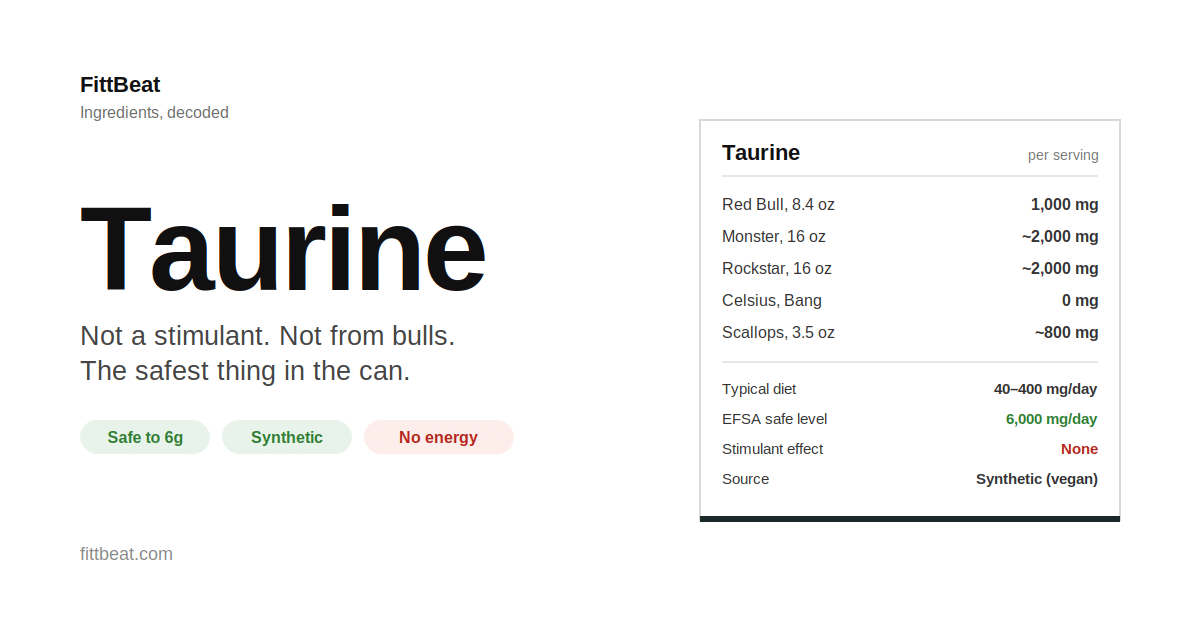
No. Taurine is a sulfur-containing amino acid that your liver produces and that’s abundant in meat, fish, and shellfish; a typical diet supplies 40–400 mg a day. Energy drinks add about 1,000 mg per 8 oz serving — a Red Bull has 1,000 mg, a 16 oz Monster about 2,000. The European Food Safety Authority reviewed those levels in 2009 and set a safe intake of 6,000 mg a day, and Japan prescribes 3,000 mg a day as a heart-failure drug. It is not a stimulant: in controlled trials, taurine alone has no effect on alertness. The caffeine does that. Taurine’s real effects are mild — supporting heart muscle, bile production, and the retina — and it may slightly blunt the blood-pressure rise from caffeine, which is probably why it’s in the can.
Jump to: What taurine is · The bull myth · Does it give you energy? · How much is in each drink · What the research says · How much is too much · Verdict
What taurine is
Taurine (2-aminoethanesulfonic acid) is one of the most abundant free amino acids in the human body — concentrated in the heart, muscles, brain, and retina. Unlike the 20 amino acids that build proteins, taurine isn’t incorporated into them; it floats free in cells doing other jobs: regulating water and mineral balance, forming bile salts that digest fat, stabilizing cell membranes, and acting as a mild antioxidant.
Your liver makes it from the amino acid cysteine, so it’s “conditionally essential” — most adults produce enough, but infants, people with liver disease, and some vegans run low. Cats can’t make it at all, which is why it’s added to every cat food. Dietary sources are all animal: scallops and mussels (800–1,000 mg per 100 g), dark-meat turkey and chicken, tuna, salmon, beef. Plants contain essentially none.
No, it’s not from bulls
The persistent rumor is that taurine comes from bull urine, semen, or testicles. It doesn’t, and it never did in any commercial product. The name comes from Taurus, Latin for bull, because German chemists Friedrich Tiedemann and Leopold Gmelin first isolated it from ox bile in 1827. Every milligram of taurine in energy drinks today is synthesized in a lab from ethylene oxide and sodium bisulfite — no animals involved, which is why Red Bull and Monster are both technically vegan. “Red Bull” the brand name came from the Thai drink Krating Daeng (“red gaur,” a species of wild bull) that it was based on, not from the taurine.
Does taurine give you energy?
No. This is the most important thing to understand about energy drinks: the “energy” comes from caffeine (a stimulant) and sugar (fuel). Taurine is neither. In placebo-controlled trials of taurine alone — no caffeine — there’s no reliable improvement in alertness, reaction time, or subjective energy. A 2012 trial of Red Bull components found caffeine produced the alerting effect and taurine added nothing measurable on top of it; some studies found taurine alone made people slightly calmer, consistent with its role as a mild inhibitory neurotransmitter in the brain.
Why is it in the can, then? Two plausible reasons. The first is marketing history: Krating Daeng included it, Red Bull kept it, and every competitor copied Red Bull. The second is physiology: taurine has a mild effect on heart contractility and vascular tone, and a few studies suggest it blunts the blood-pressure and heart-rate rise caffeine causes. Whether the dose in a can actually does that in practice isn’t settled, but it’s the most defensible rationale for pairing them.
How much taurine is in each energy drink?
| Drink | Serving | Taurine | Caffeine | Notes |
|---|---|---|---|---|
| Red Bull | 8.4 oz | 1,000 mg | 80 mg | The original formulation; 12 oz can has ~1,430 mg |
| Monster Energy | 16 oz | ~2,000 mg | 160 mg | Listed as 1,000 mg per 8 oz serving, two servings per can |
| Rockstar Original | 16 oz | ~2,000 mg | 160 mg | Same 1,000 mg per 8 oz as Monster |
| NOS | 16 oz | ~2,000 mg | 160 mg | Also adds L-citrulline |
| 5-hour Energy | 1.9 oz | ~200 mg | 200 mg | Part of an undisclosed “energy blend” |
| Celsius | 12 oz | 0 mg | 200 mg | Uses green tea, guarana, ginger instead |
| Bang | 16 oz | 0 mg | 300 mg | Uses “super creatine” and BCAAs instead |
| Coffee, 12 oz | 12 oz | 0 mg | ~140 mg | — |
| Scallops, 3.5 oz | — | ~800 mg | 0 mg | For comparison: dinner has as much as a Red Bull |
The pattern is that the classic drinks all standardized on 1,000 mg per 8 oz, and the newer “fitness” energy drinks (Celsius, Bang) dropped taurine entirely without anyone noticing a difference in how they feel — which is its own evidence about what taurine contributes.
What the research actually says
Heart health Mild benefit
Taurine is concentrated in heart muscle and helps regulate calcium handling in cardiac cells. Japan has approved it since the 1980s as a prescription treatment for congestive heart failure at 3,000 mg a day, and small trials show modest improvements in heart function and exercise capacity in heart-failure patients. In healthy people, meta-analyses find a small blood-pressure reduction (around 3 mmHg) with supplementation. None of this makes an energy drink heart-healthy — the caffeine and sugar dominate — but it does mean taurine is pulling in the opposite direction from the rest of the can.
Exercise performance Small, inconsistent
A 2018 meta-analysis found that 1–6 g of taurine taken one to three hours before exercise improved endurance performance by a small margin, with no clear dose-response. Effects on strength and sprinting are inconsistent. The energy-drink dose (1,000–2,000 mg) is at the low end of what’s been studied, and the trials used taurine alone, not mixed with 54 g of sugar.
Longevity Interesting, unproven
The study that made headlines: a 2023 paper in Science reported that taurine levels decline with age in mice, monkeys, and humans, and that taurine supplementation extended lifespan in mice by 10–12% and improved health markers in middle-aged monkeys. The follow-up in 2025, also in Science, complicated the story: using better longitudinal data, researchers found taurine levels do not reliably decline with age in humans and vary too much between individuals to work as an aging biomarker. The mouse lifespan finding stands; the idea that you’re taurine-deficient because you’re getting older doesn’t. No human trial has tested taurine for longevity, and nobody serious is recommending energy drinks as the delivery vehicle.
Brain and mood Mild
Taurine acts on GABA and glycine receptors, the brain’s inhibitory systems — which is why it tends to be calming rather than stimulating in isolation. There’s early research on taurine for anxiety, epilepsy, and in combination with antipsychotics, but nothing conclusive at dietary doses.
Interaction with caffeine Probably favorable
This is the question that matters for energy drinks. The concern raised in the 2000s was that taurine might amplify caffeine’s cardiovascular effects. Research since then points the other way: several trials found taurine either had no effect on, or slightly reduced, the heart-rate and blood-pressure increase from caffeine. EFSA’s 2009 review concluded there was no evidence of a harmful interaction at energy-drink levels. The adverse cardiac events linked to energy drinks track caffeine dose and quantity consumed, not taurine.
How much taurine is too much?
EFSA’s 2009 opinion found no adverse effects in rats at 1,000 mg per kg per day, and set an observed safe level for humans at 6,000 mg a day — six Red Bulls’ worth, or three Monsters. The EFSA review also noted that even heavy energy-drink consumers (a liter and a half a day) stayed under that. Human supplementation trials have used up to 10 g a day without reported harm beyond mild stomach upset. There’s no established toxic dose, and taurine excess is excreted in urine.
The honest risk ranking inside an energy drink: sugar first, caffeine second, acidity (teeth) third — and taurine doesn’t make the list. If you drink energy drinks and want to worry about something, worry about the 54 g of sugar in a Monster, not the 2,000 mg of taurine.
Two caveats. People with kidney disease should check with a doctor before supplementing, since taurine is cleared by the kidneys. And taurine supplements (powders, capsules) are regulated as dietary supplements, so quality varies; the taurine in a major-brand energy drink is more consistent than what’s in a random online powder.
Is taurine in energy drinks bad for you?
FittBeat verdict
Safe, mildly beneficial, and mostly beside the point. Taurine is the ingredient energy drinks put on the front of the can and the one with the least to worry about. It’s not a stimulant, it’s not from an animal, and at 1,000–2,000 mg it’s within a range regulators and clinicians consider safe several times over. If anything, it slightly softens what the caffeine does to your heart rate. Judge an energy drink by its sugar and caffeine; ignore the taurine.
Taurine for vegans, athletes, and supplements
Vegans: plant foods contain essentially no taurine, and studies show vegans have lower plasma levels — though the body’s synthesis usually covers it. A supplement of 500–1,000 mg is reasonable and cheap if you want to close the gap; an energy drink is a poor way to do it.
Athletes: the evidence for 1–3 g before endurance exercise is modestly positive. If you’re going to try it, a plain taurine powder costs pennies per dose and skips the sugar.
Supplements: 500–2,000 mg a day is the common range; it’s one of the cheapest amino acids sold. There’s no need to megadose, and no reason to take it with caffeine specifically.
Frequently asked questions
Is taurine from bulls?
No. It was first isolated from ox bile in 1827, which is where the name comes from, but all taurine in energy drinks is synthetic. No animal products are involved.
Does taurine give you energy?
No. It isn’t a stimulant. Controlled trials show taurine alone doesn’t improve alertness; if anything it’s mildly calming. The energy in energy drinks comes from caffeine and sugar.
How much taurine is in Red Bull?
1,000 mg in the 8.4 oz can, about 1,430 mg in the 12 oz. Monster and Rockstar have about 2,000 mg per 16 oz can.
How much taurine is safe per day?
EFSA set an observed safe level of 6,000 mg a day. Human trials have used up to 10 g a day without serious effects. A typical diet provides 40–400 mg; an energy drink adds 1,000–2,000 mg.
What are the side effects of taurine?
At energy-drink doses, essentially none are documented. Very high supplemental doses can cause mild stomach upset. People with kidney disease should consult a doctor before supplementing.
Why is taurine in energy drinks?
Partly history — the Thai drink Red Bull was based on included it. Partly because it may slightly blunt caffeine’s effect on heart rate and blood pressure. It does not contribute to the stimulant effect.
Does taurine help you live longer?
A 2023 study found taurine supplementation extended lifespan in mice. A 2025 follow-up found taurine levels don’t reliably decline with age in humans, undermining the idea that most people are deficient. No human longevity trial exists.
Is taurine vegan?
The synthetic taurine in energy drinks and supplements is vegan. Dietary taurine comes only from animal foods, so vegans tend to have lower levels, though the body makes its own.
This article is for informational purposes and is not medical advice. Talk to a doctor or registered dietitian about your individual nutrition needs.
Leave a Reply