
Last reviewed: October 2026. Reflects the U.S. 8.4 fl oz Red Bull Energy Drink. Red Bull Sugarfree and Zero are compared below.
Red Bull is the drink that invented the category, and its label is shorter than you’d expect: 14 ingredients, and only two of them — sugar and caffeine — do anything you’d notice. The rest is taurine, B vitamins, two mineral salts, flavors, and dyes, in a can small enough that the numbers are gentler than Monster’s. Here’s all Red Bull ingredients in order, what it does, and what the research actually says about the famous ones.
Quick answer: what’s in Red Bull?
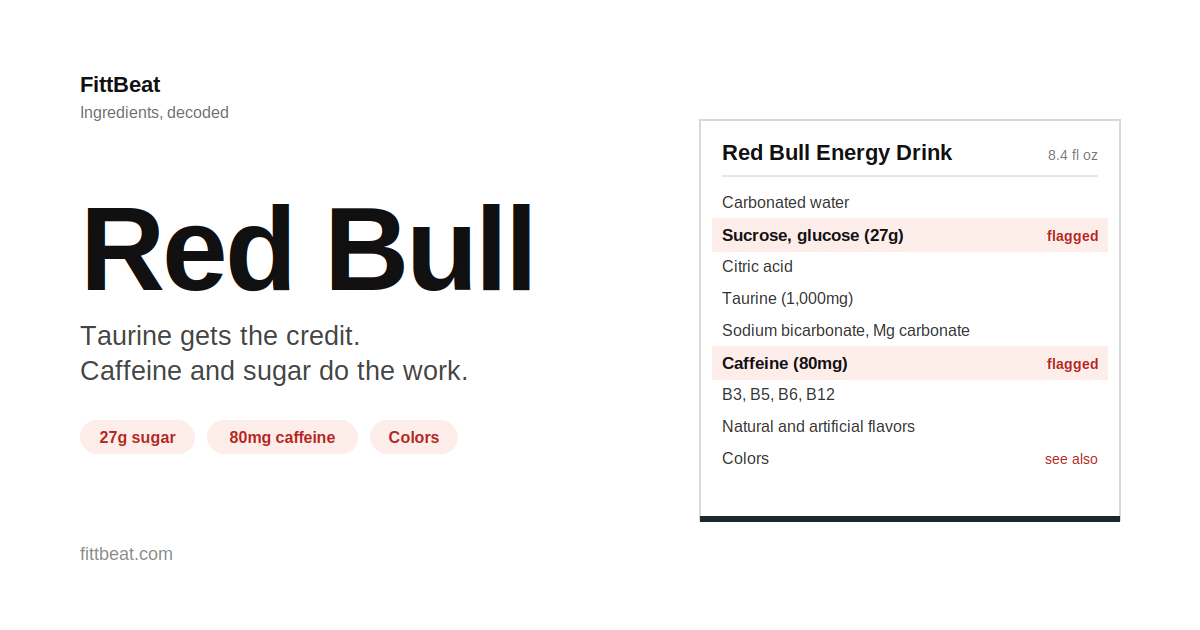
Red Bull is carbonated water, sucrose, glucose, citric acid, taurine, sodium bicarbonate, magnesium carbonate, caffeine, niacinamide, calcium pantothenate, pyridoxine HCl, vitamin B12, natural and artificial flavors, and colors. An 8.4 oz can has 110 calories, 27 g of sugar, 80 mg of caffeine, 1,000 mg of taurine, and 105 mg of sodium. The caffeine is about a cup of coffee’s worth; the sugar is about 7 teaspoons, a bit less than a can of Coke. Taurine is safe and doesn’t give you energy — caffeine does. One can is a modest dose for a healthy adult; the problems come from stacking cans, mixing with alcohol, and giving it to kids.
The full Red Bull ingredients list
Carbonated Water, Sucrose, Glucose, Citric Acid, Taurine, Sodium Bicarbonate, Magnesium Carbonate, Caffeine, Niacinamide, Calcium Pantothenate, Pyridoxine HCl, Vitamin B12, Natural and Artificial Flavors, Colors.
Two things to notice. Sugar comes as two ingredients (sucrose and glucose) in positions two and three, same as Monster. And “colors” is listed without naming them — in the U.S. the label doesn’t have to, and Red Bull’s amber tint uses caramel color plus small amounts of synthetic dye depending on the variant. The flavor is “natural and artificial,” which is an honest label most competitors avoid.
Red Bull ingredients explained
Carbonated water Fine
Lightly carbonated. The base.
Sucrose and glucose Flagged
27 g per can — table sugar plus glucose, about 7 teaspoons. That’s less than a 12 oz Coke (39 g) because the can is smaller, but per ounce it’s the same sugar density as soda, and the 12 oz Red Bull is 38 g. Fast-absorbing, no fiber or protein to slow it, and the source of the “energy” you feel in the first 20 minutes and the dip an hour later. The long-term picture is the same as any sugar-sweetened drink: daily intake is linked to weight gain, type 2 diabetes, and fatty liver. Red Bull uses beet sugar in Europe and cane or beet in the U.S. — not corn syrup, though the body treats them identically. Our sugar breakdown covers the research.
Citric acid Fine
Tartness and shelf stability. Makes Red Bull acidic (pH around 3.3), which is the mechanism behind energy drinks testing as highly erosive to tooth enamel in lab studies.
Taurine Safe, mostly inert
The ingredient Red Bull is famous for, and the most misunderstood. Taurine is an amino acid your body synthesizes and that’s abundant in meat, fish, and breast milk; Red Bull’s is made synthetically, not from animals, and the “bull” in the name is a coincidence of etymology (it was first isolated from ox bile in 1827). 1,000 mg per can is the dose EFSA reviewed in 2009 and found safe even at several cans a day. What it doesn’t do is stimulate: in controlled trials, taurine alone has no reliable effect on alertness or performance. The caffeine does the work. Taurine’s documented effects are mild — it supports heart muscle contraction and may slightly blunt caffeine’s blood-pressure increase, which is a plausible reason it’s included. A taurine explainer is coming to the index.
Sodium bicarbonate and magnesium carbonate Fine
Baking soda and a magnesium salt, used to buffer the acidity and adjust flavor. They contribute the 105 mg of sodium and a trace of magnesium. No concern.
Caffeine 80 mg
The active ingredient. 80 mg per 8.4 oz — about the same as a cup of home-brewed coffee, less than a 12 oz Starbucks drip (around 230 mg), and 9.5 mg per ounce, the same concentration as Monster. The 12 oz can is 114 mg, the 16 oz is 151 mg. Red Bull’s caffeine is synthetic, which is chemically identical to the plant-derived kind. Effects are the familiar ones: a few hours of raised alertness, heart rate, and blood pressure; a five-hour half-life (a 4 pm can is still a third active at 9 pm); and dependence with daily use. For a healthy adult, 80 mg is a moderate dose — the FDA’s guidance is 400 mg a day. The risks are in stacking: three Red Bulls plus two coffees is over the line, and the deaths linked to energy drinks have involved large quantities in short periods, often with underlying heart conditions.
B vitamins (B3, B5, B6, B12) Overdosed, harmless
Niacinamide, calcium pantothenate, pyridoxine, and vitamin B12, each at roughly 100–200% of the daily value per can. The logic is that B vitamins are cofactors in converting food to energy — true, but extra B vitamins don’t produce extra energy unless you were deficient, and almost nobody drinking Red Bull is. The excess is water-soluble and excreted; the one worth watching across many cans a day is B6, where chronic high intake can affect nerves, though Red Bull’s dose is far below that threshold.
Natural and artificial flavors Undisclosed
The distinctive Red Bull taste — often described as tutti-frutti or medicinal — is proprietary. “Artificial” means some flavor molecules were synthesized rather than extracted; it’s a labeling distinction, not a safety one.
Colors Unnamed
Red Bull’s U.S. label says “colors” without specifying. The amber tint of the original is caramel color; flavored editions (Red, Blue, Yellow, Watermelon, etc.) use synthetic dyes including Red 40 and Blue 1, which carry the EU child-behavior warning and are part of the FDA’s voluntary 2026–2027 phase-out. The company states it uses no synthetic dyes in the original, though the label’s vagueness doesn’t let you verify that from the can. See our caramel color and Red 40 breakdowns.
Red Bull nutrition facts
| Per can | Red Bull (8.4 oz) | Red Bull (12 oz) | Red Bull Sugarfree (8.4 oz) | Monster (16 oz) | Coffee (12 oz) |
|---|---|---|---|---|---|
| Calories | 110 | 160 | 10 | 230 | 5 |
| Sugar | 27 g | 38 g | 0 g | 54 g | 0 g |
| Sweetener | Sucrose + glucose | Sucrose + glucose | Aspartame + Ace-K | Sugar + glucose + sucralose | None |
| Caffeine | 80 mg | 114 mg | 80 mg | 160 mg | ~140 mg |
| Caffeine per oz | 9.5 mg | 9.5 mg | 9.5 mg | 10 mg | ~12 mg |
| Taurine | 1,000 mg | 1,430 mg | 1,000 mg | ~2,000 mg | 0 mg |
| Sodium | 105 mg | 150 mg | 105 mg | 370 mg | 5 mg |
| Added colors | Yes | Yes | Yes | Caramel | No |
Red Bull Sugarfree vs. Red Bull: what changes?
Sugarfree drops the 27 g of sugar and replaces it with aspartame and acesulfame potassium — the same pairing as Coke Zero. Caffeine, taurine, and vitamins are identical. Red Bull Zero (a separate product) uses sucralose and Ace-K instead and is formulated to taste closer to the original. Sugarfree cans carry the “phenylketonurics: contains phenylalanine” warning that every aspartame product does. For most people Sugarfree is the better daily choice if they’re going to drink one at all — 27 g of sugar is the biggest issue on the original’s label — with the usual sweetener caveats covered in our sucralose and aspartame posts.
Red Bull vs. Monster vs. coffee
Per ounce, Red Bull and Monster are close to the same drink. The 8.4 oz can is Red Bull’s real advantage: half the caffeine and half the sugar of a 16 oz Monster, which matters because people drink by the can, not the ounce. Against coffee, Red Bull is a weaker caffeine dose (80 vs ~140 mg per 12 oz brewed) attached to 27 g of sugar and a lot of ingredients that don’t do much. If the goal is alertness, coffee delivers more of it with nothing else attached. Our Monster breakdown goes line by line on the bigger can.
Is Red Bull bad for you?
FittBeat verdict
The mildest of the big energy drinks, and still a sugar soda with coffee in it. One 8.4 oz can is a moderate caffeine dose and 7 teaspoons of sugar — not harmful for a healthy adult now and then. Taurine and the B vitamins are safe and mostly decorative. The real risks are the ones the can warns about: multiple cans, mixing with alcohol, children, and pregnancy. If you drink it daily, Sugarfree removes the biggest problem. If you drink it for the caffeine, coffee is cheaper and stronger.
The concerns, ranked by evidence:
- Sugar. 27 g per small can, 38 g in the 12 oz. The clearest long-term harm at daily intake.
- Caffeine stacking. 80 mg is modest; the trouble is three or four cans, or cans on top of coffee and pre-workout. Palpitations, anxiety, and insomnia track total daily caffeine.
- Alcohol. Red Bull-and-vodka is the archetypal combination. Caffeine masks intoxication without reducing it, and the CDC specifically warns against mixing.
- Teeth. Acidic and sugary; energy drinks are among the most erosive beverages in lab testing.
- Taurine, B vitamins, flavors. No credible evidence of harm at these doses.
Red Bull for kids, teens, and pregnancy
Kids and teens: no. The AAP says children and adolescents should not consume energy drinks, and Red Bull’s label says not recommended for children. 80 mg of caffeine in a small body is a meaningfully larger dose, and the sugar is most of a day’s allowance.
Pregnancy: guidance caps caffeine at 200 mg a day. One Red Bull fits under that, but most obstetric advice is to skip energy drinks given the sugar and the unstudied blend in pregnancy. The label says not recommended.
Cleaner alternatives
For caffeine without sugar or sweeteners: coffee or cold brew (about 140 mg per 12 oz, nothing else), green tea (30–50 mg), or yerba mate (about 80 mg per cup — the same dose as a Red Bull with no additives). For an energy-drink format without artificial sweeteners: Zevia Energy (120 mg, stevia). For the taurine, eat fish. The honest comparison is that a Red Bull is one cup of coffee’s caffeine plus a small soda’s sugar, and you can have those separately on your own terms.
See the full ingredients index for every drink we’ve broken down, including Celsius, Prime, and Coca-Cola.
Frequently asked questions
How much caffeine is in a Red Bull?
80 mg in the 8.4 oz can, 114 mg in the 12 oz, and 151 mg in the 16 oz — about 9.5 mg per ounce. An 8.4 oz can is roughly equal to a cup of home-brewed coffee.
How much sugar is in a Red Bull?
27 g in the 8.4 oz can (about 7 teaspoons) and 38 g in the 12 oz. Red Bull Sugarfree and Zero have 0 g.
Is taurine in Red Bull bad for you?
No. Taurine is an amino acid your body makes and that’s found in meat and fish. Red Bull’s 1,000 mg per can is synthetic (not from animals) and within the range EFSA found safe. It doesn’t provide energy — caffeine does.
Is Red Bull made from bull?
No. Taurine was first isolated from ox bile in 1827, which is where the name comes from, but Red Bull’s taurine is made synthetically. The drink contains no animal products.
What sweetener is in Red Bull Sugarfree?
Aspartame and acesulfame potassium. Red Bull Zero, a separate product, uses sucralose and acesulfame potassium.
Is Red Bull worse than coffee?
For caffeine alone, coffee is stronger (about 140 mg per 12 oz vs 80 mg per Red Bull) with no sugar. Red Bull adds 27 g of sugar, taurine, B vitamins, flavors, and colors. If you want alertness, coffee is the cleaner source.
Is Red Bull worse than Monster?
Per ounce they’re nearly identical. Per can, Red Bull’s 8.4 oz has half the caffeine (80 vs 160 mg) and half the sugar (27 vs 54 g) of a 16 oz Monster, so one Red Bull is the smaller dose.
How many Red Bulls a day is safe?
By caffeine alone, a healthy adult could have four or five 8.4 oz cans before reaching the FDA’s 400 mg guideline — but at 27 g of sugar each, one a day is the sensible ceiling for the original. Red Bull’s own label recommends moderate consumption.
This article is for informational purposes and is not medical advice. Talk to a doctor or registered dietitian about your individual nutrition needs.
Leave a Reply