

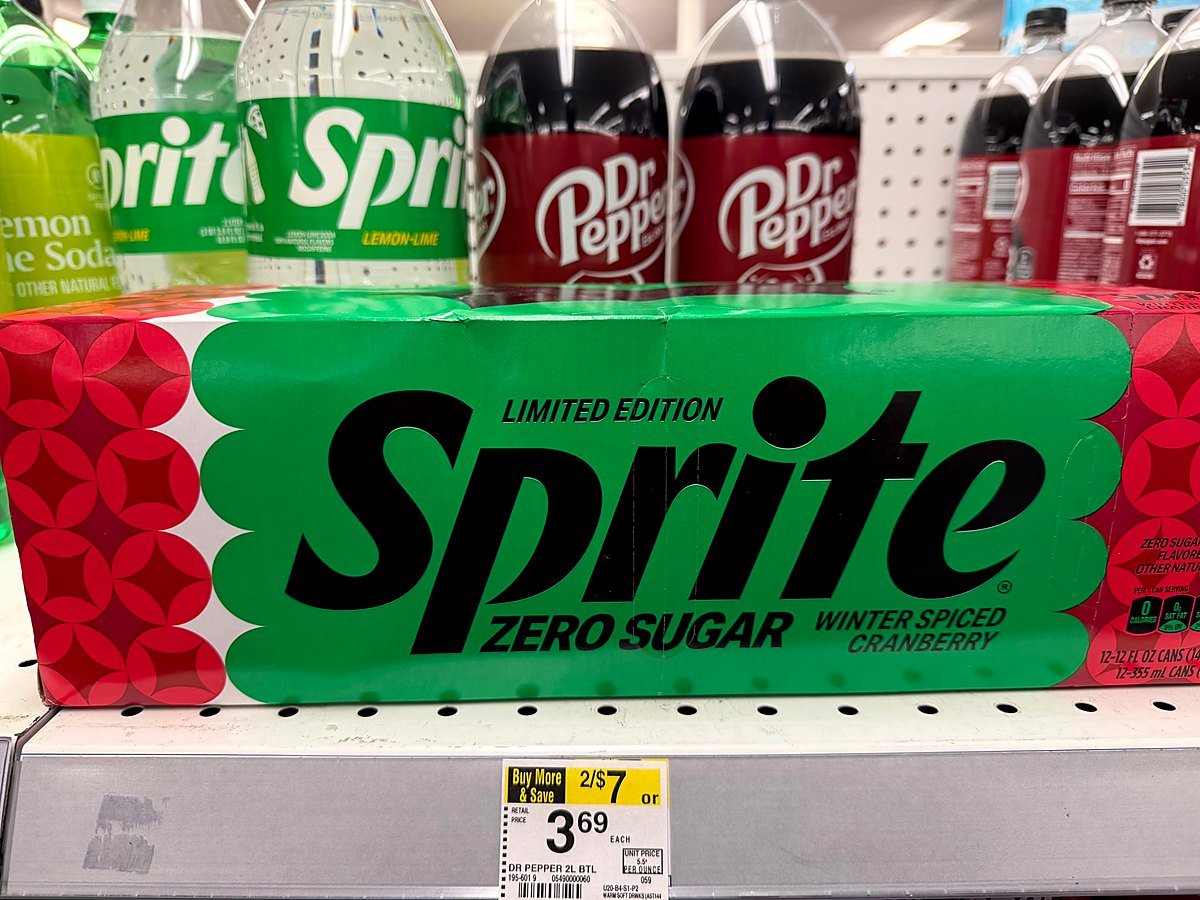
Last reviewed: October 2026. Reflects the U.S. Sprite Zero Sugar label. The box photographed for this post is the limited-edition Winter Spiced Cranberry 12-pack (©2026 label); its ingredient list is the same seven ingredients as year-round lemon-lime Sprite Zero Sugar, with a different natural flavor. Regular Sprite has its own breakdown.
Sprite Zero Sugar has one of the shortest labels in the soda aisle: carbonated water, an acid, flavor, two potassium salts, and two sweeteners. There’s no caffeine, no color, no phosphoric acid, and no sugar. That makes it one of the simplest zero-calorie sodas you can buy — and it means the only real questions are the ones every diet soda shares: aspartame, acesulfame potassium, and whether drinking sweet things all day is a habit worth having. Here’s all the Sprite Zero Sugar ingredients, what it does, and how it compares to regular Sprite and the diet colas.
Quick answer: what’s in Sprite Zero Sugar?
Sprite Zero Sugar is carbonated water and less than 2% of citric acid, natural flavors, potassium citrate, potassium benzoate (to protect taste), aspartame, and acesulfame potassium. A 12 oz can has 0 calories, 0 g of sugar, 35 mg of sodium, and no caffeine. It contains phenylalanine, so it carries the PKU warning. Compared with regular Sprite, it removes 38 g of corn syrup and adds two artificial sweeteners. Both sweeteners are approved and within safe limits at soda doses; aspartame’s 2023 “possibly carcinogenic” classification from the WHO’s cancer agency came with an unchanged safe daily limit. The seasonal Winter Spiced Cranberry flavor has the same ingredient list and no cranberry.
Jump to: Full label · Each ingredient · Nutrition facts · Sprite Zero vs. Sprite · Verdict · FAQ
The full Sprite Zero Sugar ingredients list
Carbonated Water, Less than 2% of: Citric Acid, Natural Flavors, Potassium Citrate, Potassium Benzoate (to Protect Taste), Aspartame, Acesulfame Potassium. Zero sugar. Zero caffeine. 100% natural flavors. Phenylketonurics: contains phenylalanine. A product of The Coca-Cola Company.
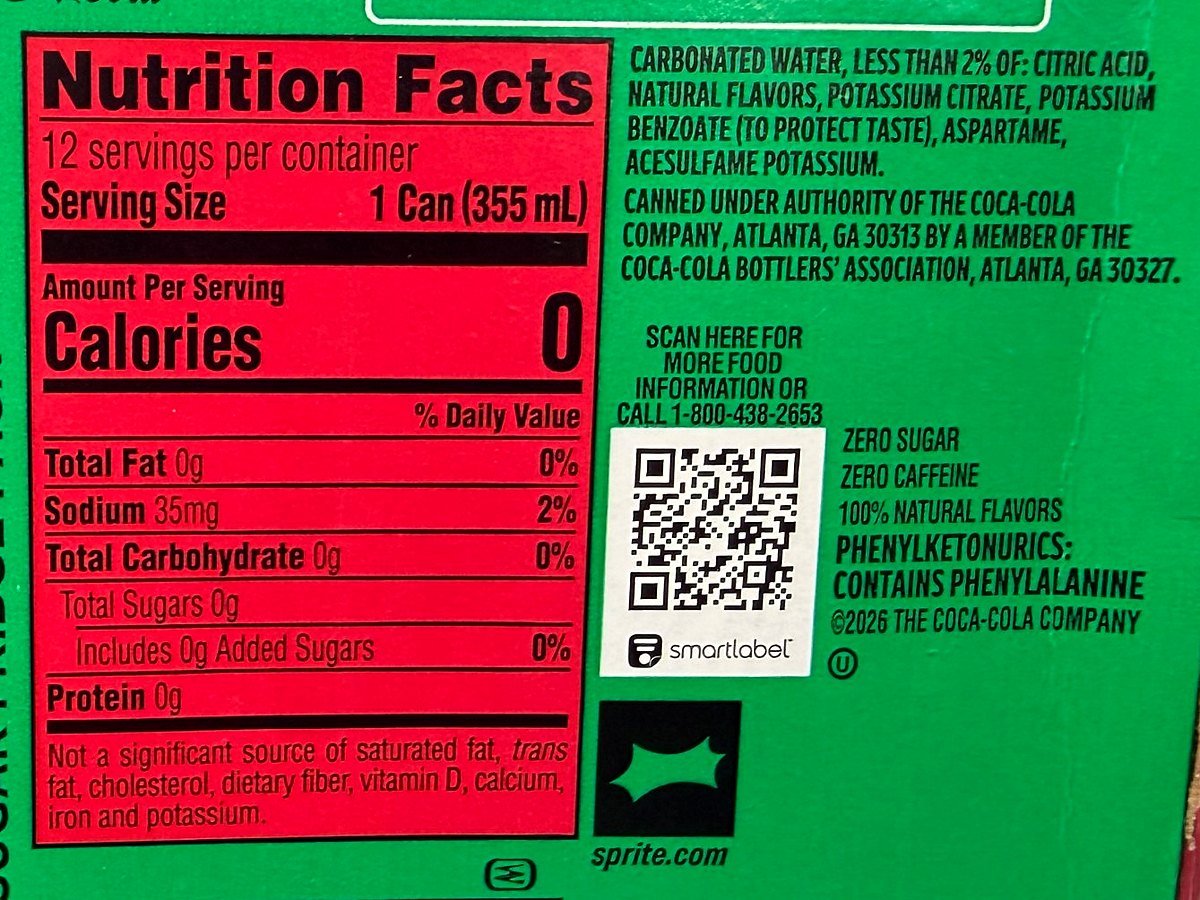
Three things to notice. Everything after the water is under 2% of the can, so this is flavored, sweetened sparkling water with a preservative. There are two sweeteners, not one — aspartame for most of the sweetness, Ace-K to round out the aftertaste — which is the standard pairing in Coca-Cola’s “zero sugar” line. And “100% natural flavors” on the box refers to the flavor only; the sweeteners are synthetic. The “Winter Spiced Cranberry” name comes entirely from that natural flavor line: there’s no cranberry juice in the can.
Sprite Zero Sugar ingredients explained
Carbonated water Fine
Filtered water with dissolved CO₂. It’s nearly the whole can.
Citric acid Fine, with a teeth note
The lemon-lime tartness. It also makes the drink acidic enough to soften enamel when sipped over long periods, sugar or no sugar. Diet sodas are gentler on teeth than sugared ones because there’s no sugar feeding bacteria, but the acid is still there.
Natural flavors Undisclosed
Lemon-lime in the regular can; cranberry and spice notes in the winter one. Plant-derived flavor compounds, not juice.
Potassium citrate Fine
A buffer that tempers the citric acid’s sharpness and keeps the taste stable. It’s the potassium version of the sodium citrate in regular Sprite, which helps keep the sodium low. Harmless.
Potassium benzoate Low concern
The preservative, labeled “to protect taste.” Diet sodas need one because there’s no sugar to help inhibit microbes. Benzoates can form trace benzene in the presence of vitamin C, heat, and light; Sprite Zero has no added vitamin C, so the main trigger is absent. Our sodium benzoate breakdown covers the chemistry, which is the same for the potassium form.
Aspartame Flagged
The main sweetener, about 200 times sweeter than sugar. In 2023 the WHO’s cancer agency (IARC) classified aspartame as “possibly carcinogenic to humans” (Group 2B), its lowest positive category, based on limited evidence; at the same time, the WHO’s food-additive committee (JECFA) reviewed the data and kept the acceptable daily intake at 40 mg per kg of body weight — roughly 14 cans a day for a 150 lb adult. The FDA’s limit is higher. Aspartame breaks down into phenylalanine, which is dangerous for people with phenylketonuria, hence the warning. Our aspartame breakdown has the full context.
Acesulfame potassium (Ace-K) Flagged
The second sweetener, used in small amounts to mask aspartame’s aftertaste and make the sweetness hit faster. It passes through the body unchanged. It’s approved by the FDA and EFSA; critics point to thin early safety testing and newer animal studies on gut bacteria, none of which has led a regulator to change its status. Our acesulfame potassium breakdown covers the debate.
What isn’t on the label Credit where due
No caffeine, no caramel color, no synthetic dyes, no phosphoric acid, and no sodium-based salts. Of all the zero-calorie sodas we’ve broken down, this is the shortest list.
Sprite Zero Sugar nutrition facts
| Per 12 oz can | Sprite Zero Sugar | Sprite | Diet Pepsi | Dr Pepper Zero Sugar |
|---|---|---|---|---|
| Calories | 0 | 140 | 0 | 0 |
| Sugar | 0 g | 38 g | 0 g | 0 g |
| Sweetener | Aspartame + Ace-K | HFCS | Aspartame + Ace-K | Aspartame + Ace-K |
| Caffeine | 0 mg | 0 mg | 35 mg | 41 mg |
| Sodium | 35 mg | 65 mg | 35 mg | 60 mg |
| Color | None | None | Caramel color | Caramel color |
| Acid | Citric | Citric | Phosphoric + citric | Phosphoric |
| Preservative | Potassium benzoate | Sodium benzoate | Potassium benzoate | Sodium benzoate |
Among the zero-sugar sodas, Sprite Zero is the one without caffeine, color, or phosphoric acid. Diet Pepsi and Dr Pepper Zero Sugar figures are from the boxes photographed for our posts on each.
Sprite Zero Sugar vs. regular Sprite
The trade is 38 g of high fructose corn syrup for two artificial sweeteners. On the evidence, that’s a good trade for anyone who drinks soda regularly: the sugar in regular Sprite is the one ingredient with strong, consistent links to weight gain, type 2 diabetes, and tooth decay, while aspartame and Ace-K at soda doses have no comparable evidence of harm. The rest of the label is nearly identical — both have no caffeine and no color. If you’re avoiding artificial sweeteners on principle, regular Sprite is the version without them, but it comes with nearly 10 teaspoons of sugar a can.
Is Sprite Zero Sugar bad for you?
FittBeat verdict
About as simple as a diet soda gets. Sprite Zero Sugar is water, acid, flavor, two salts, and two well-studied sweeteners — no sugar, no caffeine, no color, no phosphoric acid. If you drink soda, it’s one of the lowest-concern cans in the aisle. The open questions are the ones all diet sodas share: the aspartame classification (with an unchanged safe limit), emerging research on sweeteners and gut bacteria, and whether constant sweetness keeps a sweet tooth going. It’s not a health drink; it’s a good swap for a sugared one. Water is still the default.
The concerns, ranked by evidence:
- Aspartame for people with PKU. A real, specific hazard, which is why the warning is on the box.
- Teeth. Citric acid, sipped often. Milder than a sugared soda, but not nothing.
- The sweetener questions. IARC’s 2023 Group 2B classification for aspartame and ongoing gut-bacteria research on both sweeteners — limited evidence, no change to safe intake limits.
- Everything else. Potassium citrate, potassium benzoate, and natural flavors are low concern at these amounts.
Sprite Zero Sugar for kids, pregnancy, and diabetes
Kids: caffeine-free and dye-free, which removes two common concerns, but the American Academy of Pediatrics advises against routine artificially sweetened drinks for children; water and milk are better defaults. An occasional can is a better choice than regular Sprite.
Pregnancy: no caffeine, and aspartame is considered safe in pregnancy at normal intakes unless the mother has PKU.
Diabetes and keto: 0 g of carbohydrate; it won’t raise blood sugar directly.
Cleaner alternatives
For the lemon-lime fizz without artificial sweeteners: plain sparkling water with lemon or lime, or a stevia-sweetened lemon-lime soda. If you want a sweetened soda with a few grams of real sugar and some fiber, Olipop and Poppi are the prebiotic options. If you’re choosing between regular and Zero Sugar Sprite, Zero is the better can.
Frequently asked questions
What are the ingredients in Sprite Zero Sugar?
Carbonated water and less than 2% of citric acid, natural flavors, potassium citrate, potassium benzoate, aspartame, and acesulfame potassium.
Does Sprite Zero Sugar have caffeine?
No. Sprite Zero Sugar is caffeine-free, like regular Sprite.
What sweetener is in Sprite Zero Sugar?
Aspartame and acesulfame potassium (Ace-K). It contains phenylalanine, so people with phenylketonuria should avoid it.
Is Sprite Zero Sugar healthier than regular Sprite?
For most people, yes. It removes 38 g of high fructose corn syrup and 140 calories per can, swapping in two artificial sweeteners that have no comparable evidence of harm at soda doses.
Is aspartame in Sprite Zero safe?
At normal intakes, yes. The WHO’s cancer agency classified aspartame as “possibly carcinogenic” in 2023 based on limited evidence, but the WHO’s food-additive committee kept the safe daily limit at 40 mg per kg of body weight — far more than a few cans a day.
Does Sprite Winter Spiced Cranberry have cranberry juice?
No. The Zero Sugar Winter Spiced Cranberry can has the same seven ingredients as regular Sprite Zero Sugar; the cranberry and spice come from natural flavors.
How much sodium is in Sprite Zero Sugar?
35 mg per 12 oz can, 2% of the daily value.
Does Sprite Zero Sugar have dyes?
No. It has no synthetic dyes and no caramel color; it’s clear.
Sources
- The Coca-Cola Company. Nutrition facts and ingredients, Sprite Zero Sugar Winter Spiced Cranberry, 12 × 12 fl oz cans (©2026 label), photographed October 2026.
- WHO / IARC / JECFA. Aspartame hazard and risk assessment results released. July 14, 2023. who.int
- U.S. FDA. Aspartame and other sweeteners in food. fda.gov
- U.S. FDA. Data on benzene in soft drinks and other beverages. fda.gov
- Baker-Smith CM, et al. The use of nonnutritive sweeteners in children. Pediatrics, 2019. doi:10.1542/peds.2019-2765
- Malik VS, et al. Sugar-sweetened beverages and risk of metabolic syndrome and type 2 diabetes. Diabetes Care, 2010. doi:10.2337/dc10-1079
Regular Sprite figures are from its current 12 oz label as used in our Sprite breakdown.
This article is for informational purposes and is not medical advice. Talk to a doctor or registered dietitian about your individual nutrition needs.
