
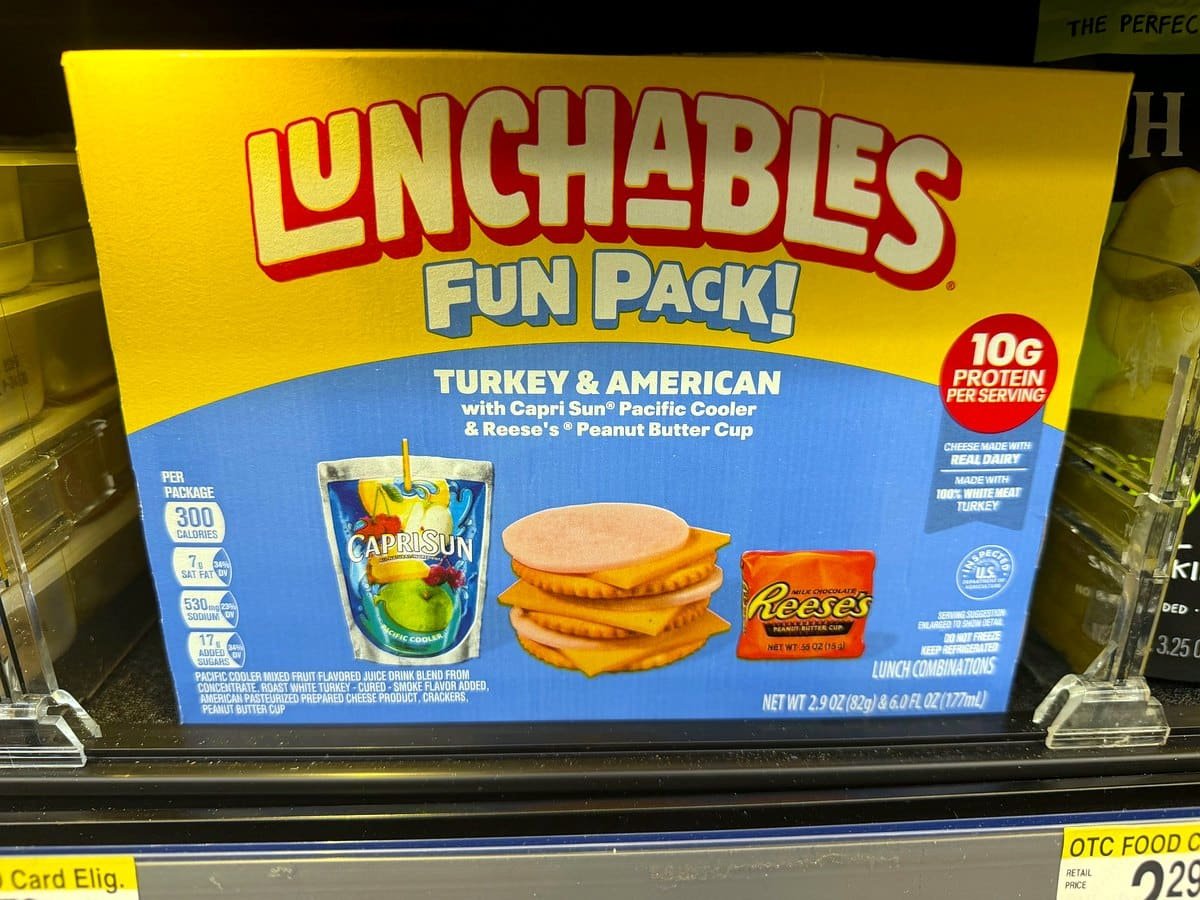
Last reviewed: November 2026. Reflects the U.S. Lunchables Fun Pack, Turkey & American with Capri Sun Pacific Cooler and a Reese’s Peanut Butter Cup (2.9 oz tray plus a 6 fl oz pouch), photographed November 2026. The plain Turkey & Cheddar Cracker Stackers tray is compared below; other varieties differ.
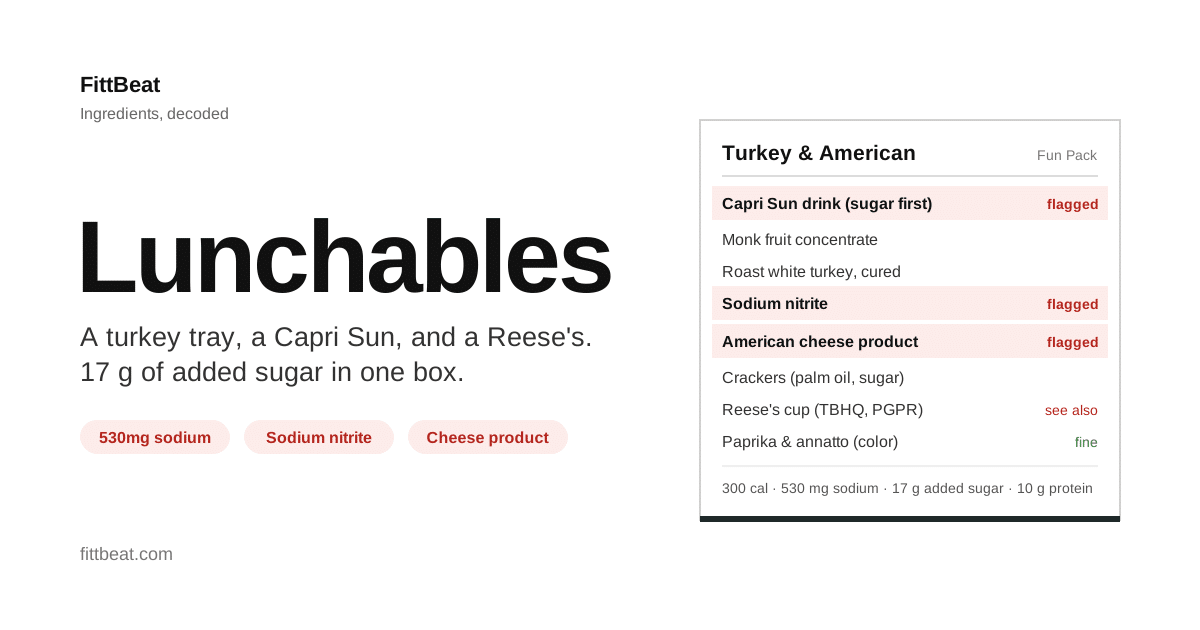
Lunchables is the lunch that thirty years of kids have assembled themselves, and the Fun Pack is the version that comes with dessert and a drink in the same box. Open it and you get four separate products: a nitrite-cured turkey, an “American pasteurized prepared cheese product” (the legal name for something that can’t be called cheese), a round butter cracker, a Capri Sun, and a Reese’s cup. The box calls out 10 grams of protein, “cheese made with real dairy,” and “100% white meat turkey.” The panel on the side says 530 mg of sodium and 17 grams of added sugar, about two-thirds of what the American Heart Association suggests a child have in a whole day. There are no synthetic dyes anywhere in it. Here’s all the lunchables ingredients, component by component, what the cheese actually is, what the Consumer Reports tests found, and what the same lunch looks like when you pack it yourself.
Quick answer: what’s in Lunchables?
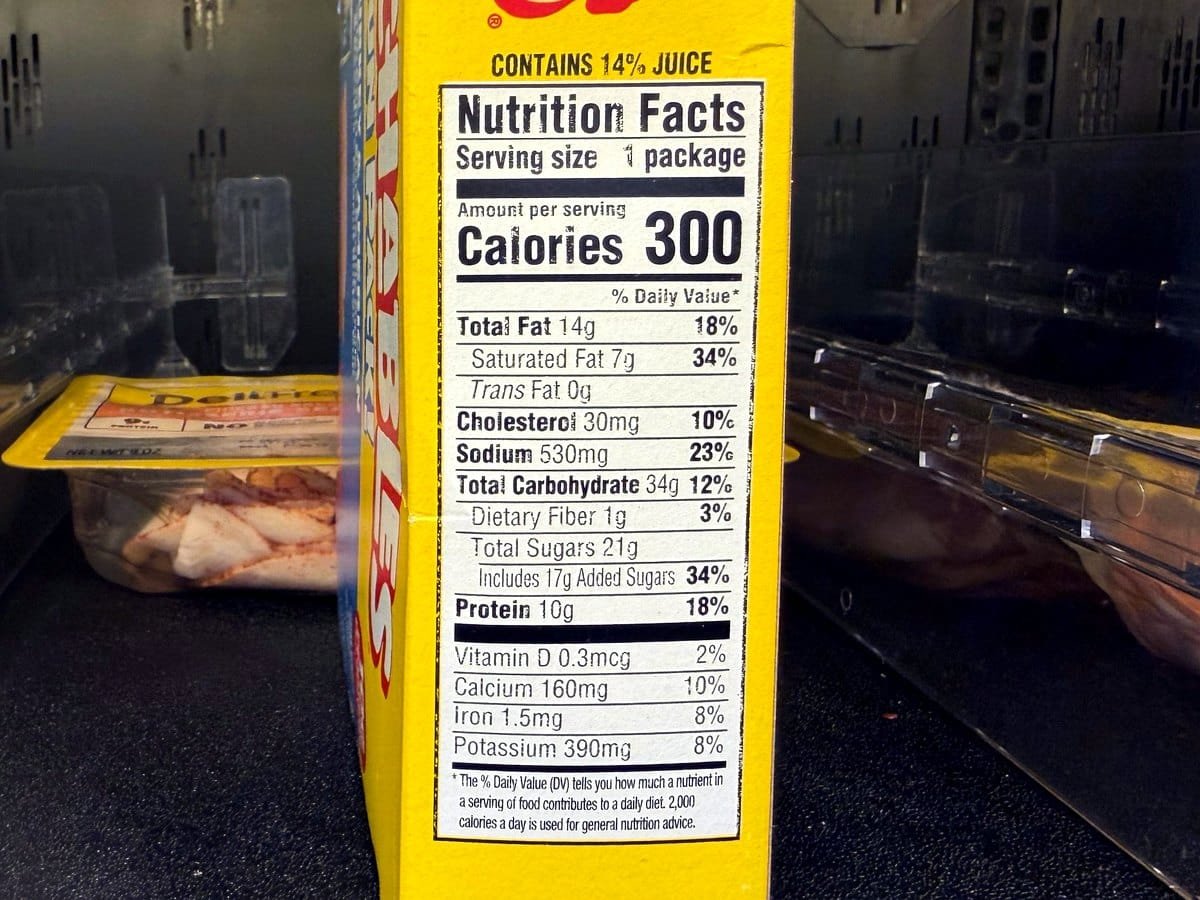
A Lunchables Fun Pack (Turkey & American) is five things. The Capri Sun is filtered water, sugar, pear, grape, orange, pineapple, and apple juice concentrates, monk fruit concentrate, citric acid, natural flavor, and mushroom extract. The turkey is white turkey and water with potassium lactate, modified cornstarch, dextrose, salt, carrageenan, sodium phosphates, potassium salts, sodium diacetate, sodium ascorbate, natural and artificial flavor, sodium nitrite, and smoke flavor. The “American” is a pasteurized prepared cheese product made from milk, water, milk protein concentrate, and milkfat with sodium citrate, salt, lactic acid, sorbic acid, enzymes, whey, cheese culture, paprika and annatto, and sunflower lecithin. The crackers are enriched flour, palm oil, sugar, vegetable oil, salt, leavening, soy lecithin, and natural flavors. The Reese’s cup is milk chocolate with PGPR, peanuts, sugar, dextrose, salt, and TBHQ. One box: 300 calories, 14 g of fat, 7 g of saturated fat, 530 mg of sodium, 21 g of sugar (17 g added), 1 g of fiber, and 10 g of protein. The sodium and the added sugar are each about a third of an adult’s daily value, and a larger share of a child’s. The turkey is processed meat. The cheese isn’t cheese. And the box contains peanuts.
Jump to: The label · Each ingredient · What “cheese product” means · Fun Pack vs. the plain tray · The Consumer Reports tests · Nutrition · Making it yourself · Verdict · FAQ
The full Lunchables Fun Pack ingredients list
Mixed Fruit Flavored Juice Drink Blend from Concentrate (Filtered Water; Sugar; Pear, Grape and Orange Juice Concentrates; Monk Fruit Concentrate; Citric Acid; Pineapple and Apple Juice Concentrates; Natural Flavor; Mushroom Extract [to Protect Quality]); Roast White Turkey – Cured – Smoke Flavor Added (White Turkey, Water, Potassium Lactate, Contains Less Than 2% of Modified Cornstarch, Dextrose, Salt, Carrageenan, Sodium Phosphates, Potassium Salts, Sodium Diacetate, Sodium Ascorbate, Natural and Artificial Flavor, Sodium Nitrite, Smoke Flavor); American Pasteurized Prepared Cheese Product (Milk, Water, Milk Protein Concentrate, Milkfat, Contains Less Than 2% of Sodium Citrate, Salt, Lactic Acid, Sorbic Acid [Preservative], Enzymes, Whey, Cheese Culture, Oleoresin Paprika and Annatto [Color], Sunflower Lecithin Added for Slice Separation); Crackers (Enriched Wheat Flour [Flour, Niacin, Reduced Iron, Thiamine Mononitrate, Riboflavin, Folic Acid], Palm Oil, Sugar, Vegetable Oil [Canola, and/or Soybean, and/or Palm Oil], Contains 2% or Less of Salt, Leavening [Baking Soda, Ammonium Bicarbonate, Monocalcium Phosphate], Soy Lecithin, Natural Flavors); Peanut Butter Cup (Milk Chocolate [Sugar, Cocoa Butter, Chocolate, Skim Milk, Milk Fat, Lactose, Soy Lecithin, PGPR], Peanuts, Sugar, Dextrose, Salt, TBHQ & Citric Acid to Maintain Freshness). Contains: milk, peanut, wheat, soy. Contains 14% juice.

Three things to notice. The Capri Sun is listed first because, at 6 ounces, it’s the heaviest thing in the box, and its second ingredient is sugar, ahead of every juice. The cheese is labeled “cheese product,” which falls outside the FDA’s standards for cheese and for process American cheese; “American” on the front describes the style, not the legal category. And sugar turns up in four of the five components (drink, crackers, chocolate, peanut filling, plus dextrose in the turkey), which is how a box built around a turkey tray reaches 17 g of added sugar.
Lunchables ingredients explained
Capri Sun: filtered water, sugar, juice concentrates Flagged, sugar first
The Pacific Cooler pouch is 14% juice, sweetened with added sugar listed ahead of the pear, grape, and orange concentrates. The label doesn’t split the box’s 17 g of added sugar by component, but the drink and the candy are where most of it lives. The monk fruit further down the list adds sweetness without adding sugar grams. Juice concentrate is still fruit sugar without the fiber. Our sugar and corn syrup breakdown covers why the body treats them about the same.
Monk fruit concentrate Fine
A fruit extract roughly 100 to 250 times sweeter than sugar, from compounds called mogrosides. It’s how a drink can taste as sweet as the original with less sugar. FDA has accepted it as generally recognized as safe; the long-term research base is thinner than for the older sweeteners, but nothing in it points to a problem at drink amounts.
Citric acid, natural flavor Fine
Tartness and the fruit-punch flavor. Citric acid is what makes juice drinks hard on teeth when they’re sipped slowly; with lunch and a straw, it’s minor.
Mushroom extract Undisclosed
Listed “to protect quality,” which means it’s doing a preservative’s job. Mushroom-derived ingredients are used as clean-label replacements for potassium sorbate in juice drinks; the label doesn’t say which compound it is. No safety concern is known, and it’s one of the newer ingredients in the kids’ aisle.
White turkey, water Real meat, diluted
Turkey breast, chopped and formed, with water added to keep it moist and the portion cheap. “100% white meat turkey” on the front is accurate, and it’s a real credit over the mechanically separated chicken in a Slim Jim. The water is why the slices are soft and why the protein per ounce is lower than a sliced roast.
Potassium lactate, sodium diacetate, potassium salts Fine (listeria control)
The modern deli-meat preservative system. Lactate and diacetate stop Listeria, the pathogen that actually makes ready-to-eat lunch meat dangerous; the potassium salts replace some of the sodium. These are the best-justified additives on the label, and they’re what makes a refrigerated kit safe for weeks.
Modified cornstarch, dextrose Fine
Starch to hold the water in the turkey and a trace of sugar for the cure and browning. Both minor.
Salt Flagged, 530 mg
Listed in the turkey, the cheese product, the crackers, and the peanut filling, with sodium phosphates, sodium diacetate, sodium citrate, sodium ascorbate, and sodium nitrite on top. The total is 530 mg per box, 23% of the adult daily value and about a third of the 1,500 mg daily limit for a four-to-eight-year-old. It’s lower than the plain Turkey & Cheddar tray because there’s less turkey, cheese, and cracker in the box, not because anything was reformulated.
Carrageenan Low concern, watched
A seaweed-derived thickener that binds water into the turkey. Approved in the U.S. and EU; EFSA re-reviewed it in 2018 and kept it approved while asking for more data, and the inflammation findings people cite come mostly from animal studies using degraded carrageenan, which isn’t the food-grade form. Not a reason to avoid the tray.
Sodium phosphates Fine in a serving
Keep the turkey moist and the slices intact. Phosphate additives are absorbed more completely than natural phosphorus and add up across processed foods; one serving is not a concern for healthy kidneys. Our phosphoric acid breakdown covers the same family in soda.
Sodium ascorbate Good — it’s vitamin C
Added alongside the nitrite specifically to block nitrosamine formation, the chemistry behind the processed-meat cancer link. This is the standard, responsible way to cure meat, and Lunchables does it where Slim Jim doesn’t.
Natural and artificial flavor, smoke flavor Undisclosed
The roasted-and-smoked taste. “Artificial flavor” on a children’s product is where the front-of-box “real” language stops matching the back; nothing on the label says what it is. Smoke flavor is condensed liquid smoke, which carries lower levels of the polycyclic compounds that actual smoking deposits.
Sodium nitrite Flagged, by the research
The cure. It prevents botulism and keeps the turkey pink. It’s also why this turkey is processed meat in the WHO’s Group 1 category, the one with the strongest evidence for a link to colorectal cancer, based on daily consumption over years. The ascorbate reduces the chemistry that drives that risk; it doesn’t take the product out of the category. One box is not a hazard. A box every school day for years is the pattern the research describes.
American pasteurized prepared cheese product Flagged, not cheese
Milk, water, milk protein concentrate, and milkfat, emulsified with sodium citrate and set with lactic acid and enzymes. “Cheese made with real dairy” on the front is true, and also exactly the phrase you’d use for something that isn’t cheese: it’s built from milk components rather than starting from cheese. It melts and slices cleanly, carries a good share of the box’s 7 g of saturated fat, and tastes like mild American. The full explanation is in its own section below.
Sorbic acid Fine
A mold inhibitor in the cheese, a cousin of the preservative in our sodium benzoate breakdown. Harmless at label amounts.
Oleoresin paprika, annatto Real color
Both from plants, both used for the cheese’s orange. Nothing in this box uses Yellow 5, Yellow 6, or Red 40, which is unusual for a kit with a drink and candy in it. Our synthetic dyes breakdown has the products that do.
Enriched wheat flour, palm oil, sugar, vegetable oil Ordinary crackers
A buttery round cracker: refined flour with iron and B vitamins added back, palm oil for the flaky texture and some of the saturated fat, and a little sugar. Nothing unusual, and the same cracker ingredient list as the plain Lunchables tray. Low in fiber, which is why the whole box has 1 g.
Leavening, soy lecithin, sunflower lecithin Fine
Baking soda, ammonium bicarbonate, and monocalcium phosphate puff the crackers; the lecithins keep the dough and the cheese slices from sticking. Trace amounts.
Reese’s Peanut Butter Cup: milk chocolate, peanuts, sugar, dextrose Candy
A 0.55 oz cup of milk chocolate and sweetened peanut filling. It’s a real candy bar, and peanuts are its second ingredient, which matters more than any additive in it: this box is a peanut product (see allergies below). The chocolate uses PGPR, an emulsifier made from castor oil that lets the chocolate flow with less cocoa butter; EFSA re-evaluated it in 2017 and found no safety concern.
TBHQ Preservative, low dose
A synthetic antioxidant that keeps the peanut oil from going rancid, limited by the FDA to 0.02% of the fat. Some animal studies at high doses have raised questions about immune effects, which is why it’s on many people’s avoid lists; at a candy-cup dose it’s well inside the limits. It’s the same preservative we flag in Cheez-It and Pop-Tarts.
What “pasteurized prepared cheese product” actually means
The FDA has standards of identity for cheese and for the processed versions of it. “Pasteurized process American cheese” has to be made from actual cheese, melted with emulsifying salts, with minimum fat and maximum moisture limits. “Pasteurized process cheese food” allows more milk ingredients and water, with at least 51% cheese. Anything that doesn’t meet those rules can’t use those names, so it’s called a “cheese product,” a term with no standard at all. The Lunchables slice starts from milk, milk protein concentrate, water, and milkfat and builds a cheese-like solid from them with citrate and enzymes; there’s a cheese culture in the list, so some fermentation happens, but the ingredient list doesn’t say “cheese” as an ingredient anywhere, because legally it couldn’t.
Is that bad for you? Not really. It’s dairy, with protein and calcium, and the saturated fat is similar to real American cheese. It’s a quality and honesty question: the front says American and “real dairy,” and the slice is a formulated dairy product engineered to behave like cheese at a lower cost. A slice of real cheese would have a shorter list and about the same nutrition. The difference is what you’re paying for, not what you’re risking.
The Fun Pack vs. the plain tray
The Fun Pack is the Turkey & Cheddar Cracker Stackers tray with less of the tray and two extras. The turkey and cracker ingredient lists are identical; the cheese is the American version of the same cheese product. What the Capri Sun and the Reese’s change is the shape of the nutrition: by Kraft Heinz’s listing, the 3.2 oz Turkey & Cheddar tray is 250 calories, 770 mg of sodium, 3 g of added sugar, and 12 g of protein. The Fun Pack is 300 calories, 530 mg, 17 g of added sugar, and 10 g of protein. So you trade about 240 mg of sodium for about 14 g of added sugar, and lose a little protein. Neither is the better lunch; they’re the same processed-meat-and-cheese-product lunch with a different problem on top.
The front of the box leads with “10g protein per serving.” The serving is the whole box, 300 calories of it, and 10 g is about what one hard-boiled egg and a slice of real cheese provide.
The Consumer Reports tests and the school-lunch exit
In April 2024, Consumer Reports tested twelve store-bought lunch kits, Lunchables and competitors, for lead, cadmium, phthalates, and sodium. CR tested the Turkey & Cheddar tray, not this Fun Pack, but the turkey and crackers in this box come from the same ingredient lists. Every kit had lead, cadmium, or both; none exceeded a federal limit, but CR measured against California’s stricter maximum allowable dose level, and the Turkey & Cheddar Lunchables came in at 74% of it for lead, the highest of anything tested. Most kits had at least one phthalate, a class of plasticizer that migrates from processing equipment and packaging and is linked to hormone disruption.
The sharper finding was about schools. Two Lunchables had been reformulated with whole-grain crackers and extra meat to qualify for the National School Lunch Program, and the school version of the turkey kit had 930 mg of sodium, more than the retail one. CR petitioned the USDA to remove them. In November 2024, Kraft Heinz pulled the school-lunch Lunchables itself, citing weak demand. The retail kits weren’t changed.
What to take from it: the heavy-metal numbers are real, but lead and cadmium come from soil and show up at low levels across the food supply, from cocoa to sweet potatoes, and “below the federal limit, above California’s” describes a long list of foods. The useful takeaways are that lunch kits as a category run high in sodium and processed meat, and that the brand’s own school formulation was saltier than the one in the grocery store.
Lunchables nutrition facts
| Per package | Lunchables Fun Pack, Turkey & American (2.9 oz + 6 fl oz) | Lunchables Turkey & Cheddar tray (3.2 oz) | Slim Jim Giant (0.97 oz) | Homemade: 2 oz deli turkey, 1 oz cheese, 6 whole-grain crackers, water (approx.) |
|---|---|---|---|---|
| Calories | 300 | 250 | 130 | ~290 |
| Fat | 14 g | 13 g | 10 g | ~11 g |
| Saturated fat | 7 g | 7 g | 3.5 g | ~6 g |
| Sodium | 530 mg | 770 mg | 450 mg | ~700 mg (less with low-sodium turkey) |
| Added sugar | 17 g | 3 g | <1 g | 0 g |
| Protein | 10 g | 12 g | 6 g | ~19 g |
| Fiber | 1 g | 0 g | 1 g | ~3 g |
| Processed meat (nitrite) | Yes, with ascorbate | Yes, with ascorbate | Yes, no ascorbate | Yes, unless you roast the turkey yourself |
| Real cheese | No (cheese product) | No (cheese product) | — | Yes |
| Contains peanut | Yes | No | No | No |
| Synthetic dyes | No | No | No | No |
Fun Pack figures are from the box we photographed. Turkey & Cheddar and Slim Jim figures are from the manufacturers’ current labels. The homemade column is an estimate from typical label values for sliced deli turkey, real cheese, and a whole-grain cracker; it’s there to show where the sodium comes from, which is the meat and cheese in any version of this lunch.
Lunchables vs. making it yourself
The honest comparison is less flattering to the homemade version on sodium than people expect, and much more flattering on everything else. Deli turkey is salty whatever the brand, and cheese is salty; two ounces of sliced turkey, an ounce of real cheese, and six crackers land near 700 mg unless you buy a lower-sodium turkey, which brings it to around 400. What changes decisively is the rest: roughly 19 g of protein instead of 10, real cheese instead of a cheese product, a few grams of fiber, and no added sugar unless you add it. If the point of the Fun Pack is the treat, a piece of fruit does the drink’s job and a single square of chocolate does the Reese’s, at a fraction of the sugar. One thing that doesn’t change as much as the package suggests: “uncured” or “no nitrites added” deli turkey is cured with celery powder, which supplies the same nitrite, so it’s still processed meat. The way out of that category is turkey you roast and slice yourself.
Are Lunchables bad for you?
FittBeat verdict
A processed-meat lunch with a juice drink and a candy bar packed in, responsibly cured, dye-free, and carrying both a salt problem and a sugar problem for the child it’s sold to. Credit where it’s due: white-meat turkey, ascorbate with the nitrite, plant colors, listeria-safe preservatives, ordinary crackers. The issues are the big ones. 530 mg of sodium is about a third of a young child’s daily limit, and 17 g of added sugar is about two-thirds of one, in a single 300-calorie box. The turkey is processed meat the research says to keep occasional, in a format designed to be eaten daily. The cheese product is a quality disappointment rather than a hazard, and the Consumer Reports findings are worth knowing and not worth panicking over. A Fun Pack is a fine treat lunch now and then. It’s a poor default, and the peanut cup rules it out of a lot of classrooms anyway.
The concerns, ranked by evidence:
- Added sugar. 17 g, 34% of the daily value, mostly from the drink and the candy; about two-thirds of the AHA’s daily limit for children.
- Sodium. 530 mg in a box aimed at children; the best-documented issue with lunch kits as a category.
- Processed meat as a daily lunch. Group 1 classification; the ascorbate helps, the pattern is what matters.
- Saturated fat. 7 g, 34% of the daily value, from the cheese product, the palm oil, and the chocolate.
- Low protein and fiber for the calories. 10 g and 1 g in 300 calories, despite the protein callout.
- Lead, cadmium, phthalates. Detected in CR’s tests of the plain tray, below federal limits, in line with the category.
- Cheese product, artificial flavor, TBHQ. Honesty and quality issues; low health relevance at these amounts.
Lunchables for kids, keto, and allergies
Kids: the whole audience. For a small child, this box is a third of the day’s sodium and most of the day’s added sugar before dinner. Treat it as a sometimes lunch, with fruit or vegetables alongside rather than in place of them.
Keto: no. 34 g of carbohydrate, most of it from the drink, crackers, and candy.
Allergies: contains milk, peanut, wheat, and soy. The peanut comes from the Reese’s cup, so this kit can’t go to a peanut-free classroom or table, unlike the plain turkey tray. Not gluten-free. The turkey contains no pork; the kit is not kosher or halal certified.
Cleaner alternatives
For the same format with better parts: a bento box with sliced real cheese, a lower-sodium deli turkey, and whole-grain crackers, plus fruit and water instead of the pouch and the candy. It costs about the same, has more protein and real cheese, and has no added sugar. Remember that “uncured” on the turkey package means celery powder did the curing, not that the turkey is nitrite-free. For a protein snack in the same aisle, Chomps and Jack Link’s are both still cured meat, but neither has a cheese substitute or a candy bar. For a lunch that isn’t processed meat at all: hard-boiled eggs with cheese and crackers, hummus with pita and cucumbers, or a cheese-and-apple box. And for the kid who wants the Fun Pack because it’s the Fun Pack: let it be the Friday one.
Frequently asked questions
What comes in a Lunchables Fun Pack?
The Turkey & American Fun Pack has cured turkey slices, American cheese product slices, and round crackers, plus a 6 fl oz Capri Sun Pacific Cooler and a 0.55 oz Reese’s Peanut Butter Cup. The whole box is one serving: 300 calories, 530 mg of sodium, 17 g of added sugar, and 10 g of protein.
Is the cheese in Lunchables real cheese?
No. It’s labeled “American pasteurized prepared cheese product,” a category for dairy products that don’t meet the FDA’s standards for cheese or process cheese. It’s made from milk, water, milk protein concentrate, and milkfat with emulsifying salts, colored with paprika and annatto. It’s dairy, with similar fat and calcium to cheese, but legally not cheese.
How much sugar is in a Lunchables Fun Pack?
21 g of total sugar, 17 g of it added: 34% of the adult daily value and about two-thirds of the American Heart Association’s 25 g daily limit for children. Most of it comes from the Capri Sun and the Reese’s cup. The plain Turkey & Cheddar tray has about 3 g of added sugar.
How much sodium is in a Lunchables?
The Turkey & American Fun Pack has 530 mg, 23% of the adult daily value and about a third of a young child’s limit. The plain 3.2 oz Turkey & Cheddar tray has 770 mg, because it has more turkey, cheese, and crackers.
Do Lunchables have nitrites?
Yes. The turkey is cured with sodium nitrite, which makes it processed meat. It’s cured with sodium ascorbate too, which reduces the formation of the compounds linked to cancer risk. Occasional servings aren’t the concern; daily servings over years are what the research describes.
Do Lunchables have peanuts?
The Fun Pack does: the Reese’s Peanut Butter Cup makes the whole kit a peanut product, and the box lists milk, peanut, wheat, and soy. The plain turkey trays don’t include peanuts. Check the allergen line on the specific box.
Do Lunchables have artificial dyes?
Not this one. The cheese product is colored with oleoresin paprika and annatto, both plant extracts, and the Capri Sun and Reese’s cup in this kit list no synthetic dyes. The turkey does contain artificial flavor.
Why were Lunchables removed from school lunches?
Consumer Reports petitioned the USDA in April 2024 after finding the school version of the turkey kit had 930 mg of sodium, more than the store version. Kraft Heinz withdrew the school-lunch Lunchables in November 2024, citing low demand. The retail kits are unchanged.
Sources
- Kraft Heinz. Nutrition facts and ingredients, Lunchables Fun Pack, Turkey & American with Capri Sun Pacific Cooler and Reese’s Peanut Butter Cup, 2.9 oz & 6.0 fl oz. Product label, photographed November 2026. Turkey & Cheddar Cracker Stackers 3.2 oz figures from lunchables.com, read October 2026.
- Consumer Reports. Should you pack Lunchables for your kids’ school lunch? April 2024 (updated November 2024). consumerreports.org
- Consumer Reports Advocacy. Consumer Reports urges USDA to remove Lunchables from National School Lunch Program. April 9, 2024. advocacy.consumerreports.org
- Bouvard V, et al., on behalf of the IARC Monograph Working Group. Carcinogenicity of consumption of red and processed meat. The Lancet Oncology, 2015. doi:10.1016/S1470-2045(15)00444-1
- U.S. FDA. 21 CFR 133.169–133.173, standards of identity for pasteurized process cheese, cheese food, and cheese spread. ecfr.gov
- EFSA Panel on Food Additives and Nutrient Sources. Re-evaluation of carrageenan (E 407) and processed Eucheuma seaweed (E 407a) as food additives. EFSA Journal, 2018. doi:10.2903/j.efsa.2018.5238
- EFSA Panel on Food Additives and Nutrient Sources. Re-evaluation of polyglycerol polyricinoleate (E 476) as a food additive. EFSA Journal, 2017. doi:10.2903/j.efsa.2017.4743
- Vos MB, et al. Added sugars and cardiovascular disease risk in children: a scientific statement from the American Heart Association. Circulation, 2017. doi:10.1161/CIR.0000000000000439
- USDA Food Safety and Inspection Service. Response to Petition 19-03 on “No Nitrate or Nitrite Added” and “Uncured” labeling. December 2020. fsis.usda.gov
- U.S. FDA. Sodium in your diet. fda.gov
Kraft Heinz’s November 2024 withdrawal of Lunchables from the National School Lunch Program, as reported in the company’s statements and general press. The homemade-lunch column in the nutrition table is an estimate from typical labels, not a measured product.
This article is for informational purposes and is not medical advice. Talk to a doctor or registered dietitian about your individual nutrition needs.
