
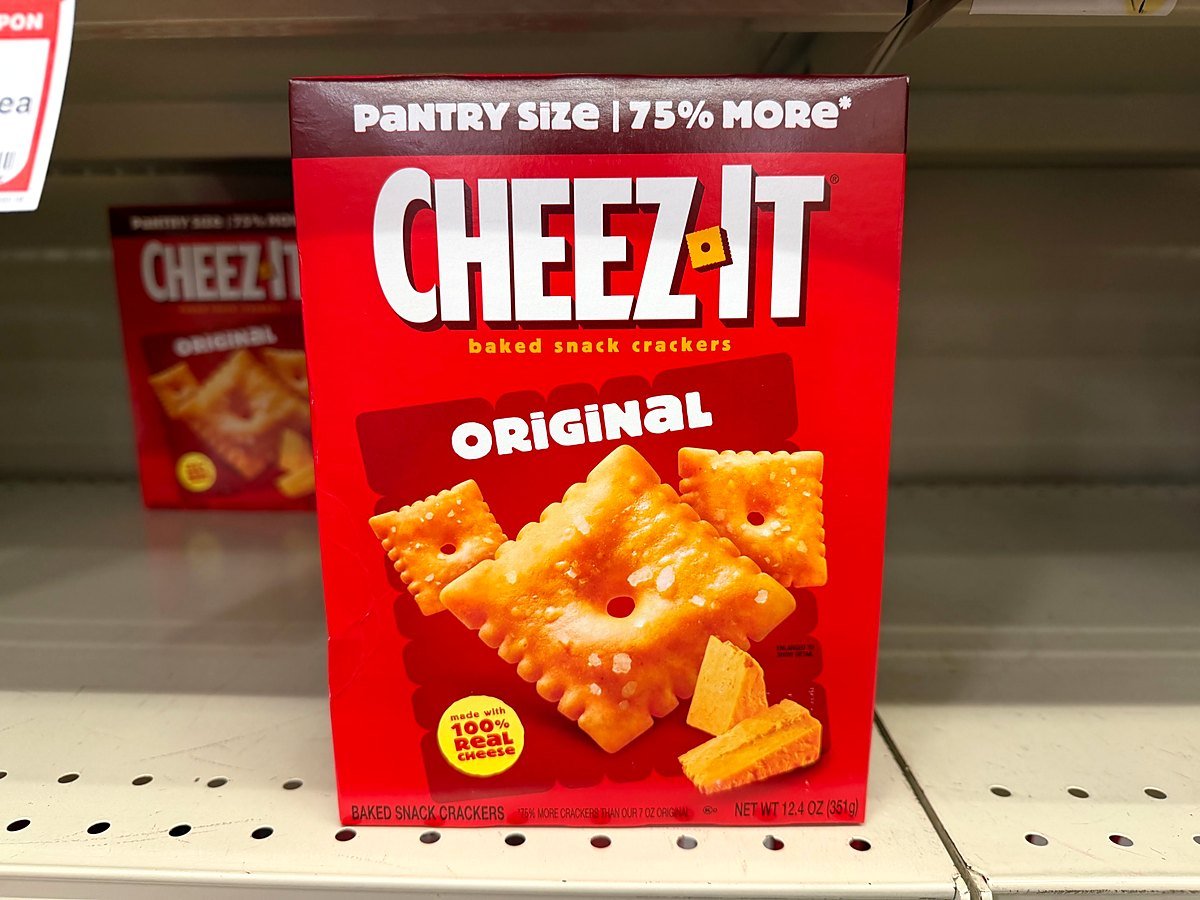
Last reviewed: October 2026. Reflects the U.S. Cheez-It Original Baked Snack Crackers, 12.4 oz (351 g) pantry-size box, photographed in store. Cheez-It has been owned by Mars since December 2025; the box still lists Kellogg Sales Co. as distributor. White Cheddar, Extra Toasty, Duoz, and Snap’d use different lists and are noted where relevant.
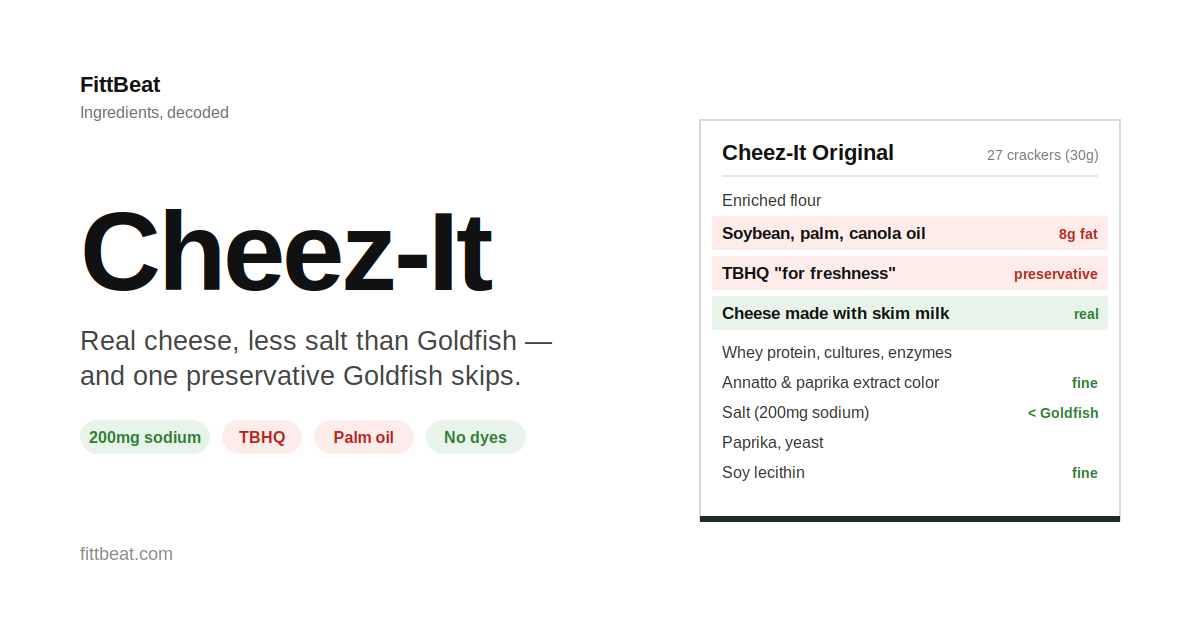
Cheez-It and Goldfish split the cheese-cracker aisle between them, and on the front of the box they make the same promises: baked, real cheese, no artificial colors. The back is where they part ways. Cheez-It’s cheese isn’t cheddar but “cheese made with skim milk,” and it comes after the oil rather than before it. The oil is a soybean-and-palm blend preserved with TBHQ, the synthetic antioxidant most people know from fast food. And the sodium is lower than Goldfish’s, which surprises people who think of Cheez-It as the saltier one. None of it is alarming. All of it is worth knowing if you’re choosing between the two. Here’s all the Cheez-It ingredients, what “made with skim milk” means, the TBHQ question, and the honest Goldfish comparison.
Quick answer: what’s in Cheez-It?
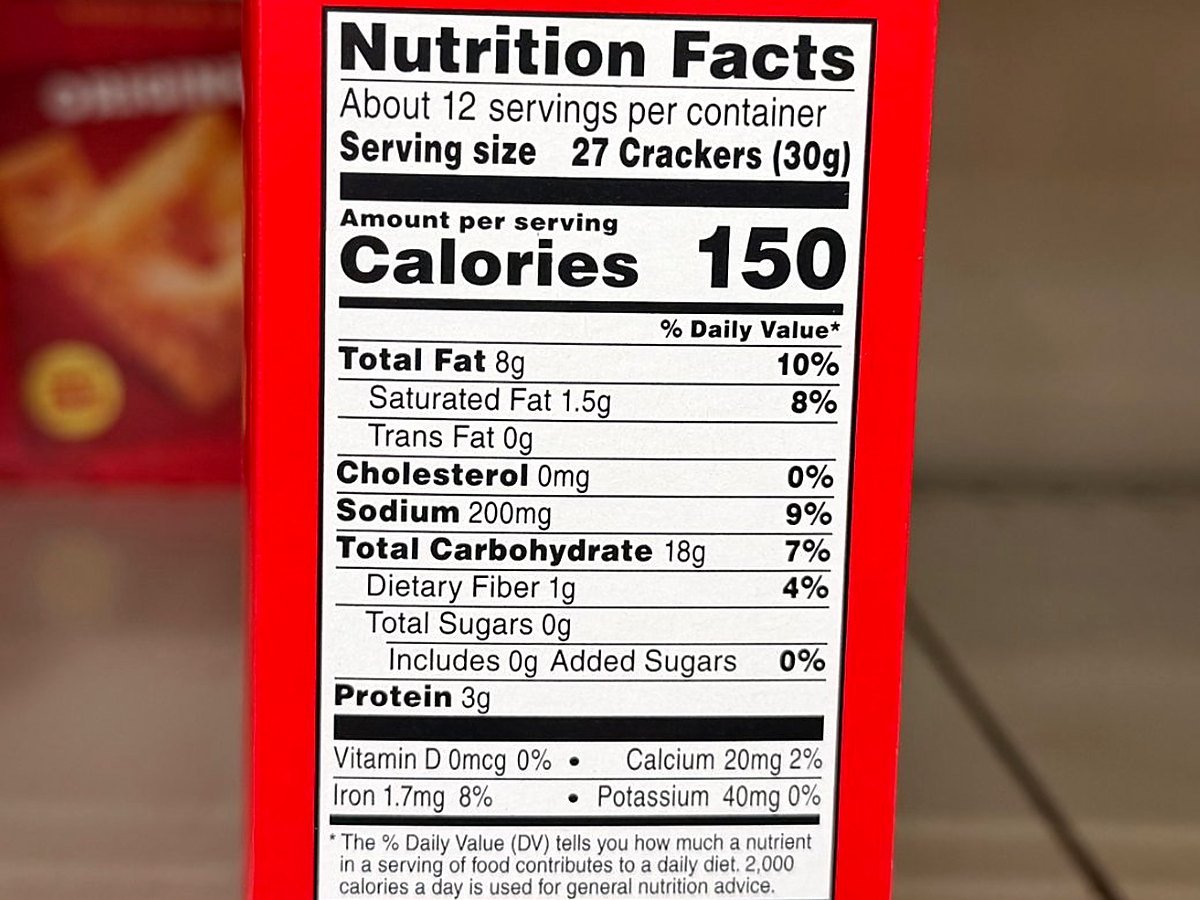
Cheez-It Original is enriched flour, vegetable oil (soybean, palm, canola, and/or sunflower with TBHQ for freshness), cheese made with skim milk (skim milk, whey protein, salt, cheese cultures, enzymes, annatto extract color), and 2% or less of salt, paprika, yeast, paprika extract color, and soy lecithin. A 27-cracker serving (30 g) has 150 calories, 8 g of fat, 1.5 g of saturated fat, 200 mg of sodium, 18 g of carbohydrate, 1 g of fiber, 0 g of sugar, and 3 g of protein. Real cheese, plant colors, no sugar, and less sodium than Goldfish are genuine credits. The trade-offs are more fat, a little palm oil, and TBHQ — a preservative that’s legal and used at tiny amounts, but one that Goldfish manages without.
Jump to: The label · Each ingredient · “Cheese made with skim milk” · TBHQ · Nutrition · Cheez-It vs. Goldfish · Verdict · FAQ
The full Cheez-It ingredients list
Enriched Flour (Wheat Flour, Niacin, Reduced Iron, Vitamin B1 [Thiamin Mononitrate], Vitamin B2 [Riboflavin], Folic Acid), Vegetable Oil (Soybean, Palm, Canola and/or Sunflower with TBHQ for Freshness), Cheese Made with Skim Milk (Skim Milk, Whey Protein, Salt, Cheese Cultures, Enzymes, Annatto Extract Color). Contains 2% or less of Salt, Paprika, Yeast, Paprika Extract Color, Soy Lecithin. Contains wheat, milk, and soy ingredients. Contains a bioengineered food ingredient.

Three things to notice. The oil is second and the cheese third — the reverse of Goldfish, where cheddar comes before the oil — so by weight Cheez-It has more fat than cheese. TBHQ isn’t listed as its own ingredient; it’s inside the oil’s parenthesis, “for freshness,” which is easy to read past. And the cheese is “cheese made with skim milk,” a lower-fat cheese with added whey protein, not cheddar. Everything else is short and recognizable: salt, paprika, yeast, and lecithin.
Cheez-It ingredients explained
Enriched flour Refined
White wheat flour with iron and four B vitamins added back, as U.S. law requires for enriched flour. It’s the base of the cracker and the reason the iron reads 8% on the panel. Refined, with about 1 g of fiber per serving — a touch more than Goldfish, still not much. Whole Grain Cheez-It swaps in whole wheat for more.
Vegetable oil (soybean, palm, canola and/or sunflower) Second ingredient
The fat, at 8 g per serving — more than Goldfish’s 5 g, and why Cheez-It tastes richer and flakier. The blend is mostly unsaturated, but palm oil adds saturated fat: 1.5 g per serving, 8% of the daily value. “And/or” means the mix varies with price and supply. No hydrogenated oil and 0 g trans fat.
TBHQ Flagged, by preference
Tertiary butylhydroquinone, a synthetic antioxidant added to the oil to keep it from going rancid on the shelf. It’s FDA-approved at up to 0.02% of the fat content, which works out to a trace amount per cracker. It’s the most debated ingredient on this label and gets its own section below. Short version: legal, used at tiny doses, with concerns that come mostly from animal and lab studies at far higher exposure — and it’s the one additive Cheez-It has that Goldfish doesn’t.
Cheese made with skim milk Real cheese, lower fat
Real cheese — skim milk, salt, cultures, and enzymes, the standard cheese recipe — with whey protein added and annatto for color. It’s what backs the “made with 100% real cheese” claim on the front, and the claim holds: this is cheese, not a “cheese product” or a cheese-flavored powder. It’s just not cheddar, and it isn’t the first thing after the flour. The section below explains the skim-milk choice.
Whey protein Fine
Milk protein added to the cheese, which firms up a low-fat cheese and helps it brown during baking. It contributes to the 3 g of protein per serving. Harmless; a milk allergen.
Annatto extract color and paprika extract color Real color
The orange, from annatto seed (in the cheese) and paprika. No synthetic dyes, so the “no artificial colors” banner on the side of the box is accurate. Annatto causes reactions in a very small number of people.
Salt 200 mg sodium
In the cheese and added to the dough and the surface (the visible salt crystals on the front of the box are real). 200 mg per 30 g, 9% of the daily value — less than Goldfish’s 250 mg for the same weight, more than Pringles’ 150 mg per ounce.
Paprika and yeast Fine
Paprika for flavor and warmth; yeast for a slight bready depth and lift. Unlike Goldfish, there’s no yeast extract or glutamate booster on this list — the savory flavor comes from the cheese and salt.
Soy lecithin Fine
An emulsifier that keeps the dough uniform and releases cleanly from the cutter. Trace amount; it’s why soy appears in the allergen line.
What “cheese made with skim milk” means
It means exactly what it says: real cheese, made from skim (fat-free) milk instead of whole milk. The FDA standards of identity cover named cheeses like cheddar, which have minimum milkfat requirements; a cheese made from skim milk doesn’t meet the cheddar standard, so it can’t be called cheddar and is labeled descriptively instead. Kraft Heinz’s Lunchables uses a “pasteurized prepared cheese product,” which is a step further from cheese; Cheez-It’s is a step closer — genuine cheese, cultured and aged, just lower in fat.
Why skim? Mostly function and cost. A lower-fat cheese bakes into a crisp cracker without leaking grease, and skim milk is cheaper than whole milk. The added whey protein restores some of the body that removing the fat takes out. For the eater, the practical effect is that Cheez-It’s cheese contributes protein and flavor but less fat than cheddar would — the fat on the panel comes mostly from the vegetable oil instead. The “100% real cheese” claim is accurate, and the cracker tastes like cheddar; the box just doesn’t say cheddar because it legally can’t.
TBHQ: what it is and whether it matters
TBHQ (tertiary butylhydroquinone) is a synthetic antioxidant derived from petroleum, used since the 1970s to keep oils and fats from oxidizing. It’s in many fried and shelf-stable foods — fast-food frying oil, crackers, microwave popcorn, some chips. The FDA permits it at no more than 0.02% of the oil or fat in a food; the EU allows it as E319 with similar limits. At those levels, a serving of Cheez-It contains a tiny fraction of a milligram.
The concerns come from three directions. High-dose animal studies have shown stomach tumors and other effects at exposures far above what food provides. A 2021 Environmental Working Group analysis of EPA screening data suggested TBHQ may affect immune cells in laboratory tests, and a few mouse studies have linked it to altered immune responses. And it’s simply unnecessary for many products — Goldfish keep on the shelf without it. What’s missing is human evidence of harm at dietary doses. Regulators still consider it safe at permitted levels, and the average American’s intake is well below the acceptable daily intake.
The fair reading: TBHQ is a reasonable thing to prefer to avoid, not a reason to panic about a box of crackers. If you’d rather skip it, the cheese crackers that do without it (Goldfish, Annie’s Cheddar Bunnies) are easy to find. Our Takis breakdown covers TBHQ in a chip that’s dropping it.
Cheez-It nutrition facts
| Cheez-It Original | Calories | Fat (sat) | Sodium | Carbs | Protein |
|---|---|---|---|---|---|
| 1 cracker (~1.1 g) | ~5.6 | ~0.3 g | ~7 mg | ~0.7 g | ~0.1 g |
| 27 crackers (30 g, label serving) | 150 | 8 g (1.5 g) | 200 mg | 18 g | 3 g |
| Whole 12.4 oz box (~12 servings) | ~1,750 | ~94 g (~18 g) | ~2,340 mg | ~210 g | ~35 g |
Calculated from the photographed label (351 g ÷ 30 g ≈ 11.7 servings). A pantry box holds about a day’s worth of sodium for an adult.
| Per 30 g | Cheez-It Original (27 crackers) | Goldfish Cheddar (55 pieces) | Pringles Original (~16 crisps) |
|---|---|---|---|
| Calories | 150 | 140 | ~161 |
| Fat (saturated) | 8 g (1.5 g) | 5 g (1 g) | ~9.6 g (~2.7 g) |
| Sodium | 200 mg | 250 mg | ~161 mg |
| Fiber | 1 g | <1 g | <1 g |
| Protein | 3 g | 3 g | ~1 g |
| Sugar | 0 g | 0 g | 0 g |
| Cheese | Skim-milk cheese, 3rd | Cheddar, 2nd | None |
| Preservative | TBHQ | None | None |
| Palm oil | Yes | No | No |
| Synthetic dyes | No | No | No |
All three from packages photographed for FittBeat in October 2026; Pringles scaled from its 28 g serving to 30 g.
Cheez-It vs. Goldfish
The two most-compared crackers in the aisle, and the labels make the comparison easy. Goldfish wins on ingredients: cheddar before the oil, no TBHQ, no palm oil, and 3 g less fat per serving. Cheez-It wins on sodium: 200 mg versus 250 for the same 30 grams, and a gram more fiber. Calories, protein, sugar, and color are a wash — both use real cheese, plant colors, and no added sugar. If the additive matters to you, Goldfish is the cleaner list. If sodium matters more (a child’s snack, a blood-pressure diet), Cheez-It is the lower number. Either way, the bigger difference is the one neither box controls: a 27-cracker or 55-piece serving is small, and both are designed to make the next handful easy.
Are Cheez-Its bad for you?
FittBeat verdict
Real cheese and less salt than you’d think — with one preservative and more oil than its rival. Cheez-It’s label holds up better than its reputation: real (skim-milk) cheese, no dyes, no sugar, 200 mg of sodium per serving, and a little fiber. The marks against it are specific: oil outweighs cheese, the oil includes palm, and TBHQ keeps it shelf-stable — legal and used in trace amounts, but avoidable, as Goldfish proves. It’s a reasonable snack in a measured serving, and a better choice than its rival if you’re counting sodium. Pour the 27 crackers into a bowl; the pantry box holds a day’s worth of salt.
The concerns, ranked by evidence:
- Portion and sodium. 200 mg per serving is moderate; a box is about 2,300 mg, and small crackers are easy to keep eating.
- Refined flour, mostly fat and starch. 18 g of carbohydrate and 8 g of fat, with 1 g of fiber.
- TBHQ. Trace amounts, FDA-approved; concerns come from high-dose and lab studies, not human dietary evidence. A reasonable preference to avoid.
- Palm oil and saturated fat. 1.5 g per serving; modest.
- Everything else. Cheese, whey, paprika, annatto, yeast, lecithin, salt: no meaningful concern.
Cheez-It for kids, allergies, and diets
Kids: no dyes, no sugar, and less sodium than Goldfish per serving make Cheez-It a reasonable kids’ cracker. Measure the serving; for a small child, half of the label’s 27 crackers is plenty. For toddlers, the same choking caution as any small, firm cracker applies.
Allergies: contains wheat, milk, and soy. Not gluten-free.
Vegetarian: the cheese uses “enzymes,” which can include animal-derived rennet; Cheez-It isn’t certified vegetarian. Strict vegetarians may want to check with the company.
Keto / low-carb: no — 18 g of carbohydrate per serving.
Cleaner alternatives
For the same snack without TBHQ or palm oil: Goldfish or Annie’s Cheddar Squares, both with real cheese and no preservative. For more fiber: Whole Grain Cheez-It. For less sodium per bite: Cheez-It Reduced Fat doesn’t help much, but a smaller handful paired with fruit or cut vegetables does. For actual cheese with real protein: a cheese stick or cheddar cubes on whole-grain crackers. And for the cracker fan: portion the pantry box into snack bags when you open it.
Frequently asked questions
What are the ingredients in Cheez-Its?
Enriched flour, vegetable oil (soybean, palm, canola, and/or sunflower with TBHQ for freshness), cheese made with skim milk (skim milk, whey protein, salt, cheese cultures, enzymes, annatto extract color), and 2% or less of salt, paprika, yeast, paprika extract color, and soy lecithin.
Do Cheez-Its have real cheese?
Yes. They’re made with real cheese — “cheese made with skim milk” — which is cultured and aged like any cheese but made from fat-free milk. It isn’t labeled cheddar because cheddar has a minimum milkfat standard.
What is TBHQ in Cheez-Its?
A synthetic antioxidant added to the oil to keep it from going rancid. It’s FDA-approved at up to 0.02% of the fat, so the amount per serving is tiny. Concerns come from high-dose animal and lab studies rather than evidence of harm at food levels.
How much sodium is in Cheez-Its?
200 mg per 27-cracker (30 g) serving, 9% of the daily value — less than Goldfish (250 mg for the same weight).
Are Cheez-Its healthier than Goldfish?
It depends what you’re counting. Cheez-It has less sodium and a bit more fiber; Goldfish has less fat, cheddar ahead of the oil, and no TBHQ or palm oil. Calories, protein, and sugar are about the same.
Do Cheez-Its have artificial colors?
No. The orange comes from annatto and paprika extract. The “no artificial colors” claim on the box is accurate.
Are Cheez-Its vegetarian?
The ingredients include no meat, but the cheese uses enzymes that may include animal rennet, and the product isn’t certified vegetarian.
How many calories are in Cheez-Its?
150 calories per 27 crackers (30 g), or about 5.6 calories per cracker.
Sources
- Kellogg Sales Co. / Kellanova (Mars). Nutrition facts and ingredients, Cheez-It Original Baked Snack Crackers, 12.4 oz (351 g). Product label, photographed October 2026.
- U.S. FDA. 21 CFR 172.185, TBHQ (tertiary butylhydroquinone): permitted use at not more than 0.02% of the oil or fat content. ecfr.gov
- EFSA Panel on Food Additives. Statement on the refined exposure assessment of tertiary-butyl hydroquinone (E 319). EFSA Journal, 2016. doi:10.2903/j.efsa.2016.4363
- Naidenko OV, et al. Investigating molecular mechanisms of immunotoxicity and the utility of ToxCast for immunotoxicity screening of chemicals added to food. International Journal of Environmental Research and Public Health, 2021. doi:10.3390/ijerph18073332
- U.S. FDA. 21 CFR 133.113, Cheddar cheese: standard of identity (milkfat requirements). ecfr.gov
- Mars, Incorporated. Mars completes acquisition of Kellanova. December 11, 2025.
- U.S. FDA. Sodium in your diet. fda.gov
Goldfish and Pringles figures are from packages photographed for FittBeat in October 2026. Whole-box totals are calculated from per-serving label values.
This article is for informational purposes and is not medical advice. Talk to a doctor or registered dietitian about your individual nutrition needs.
