
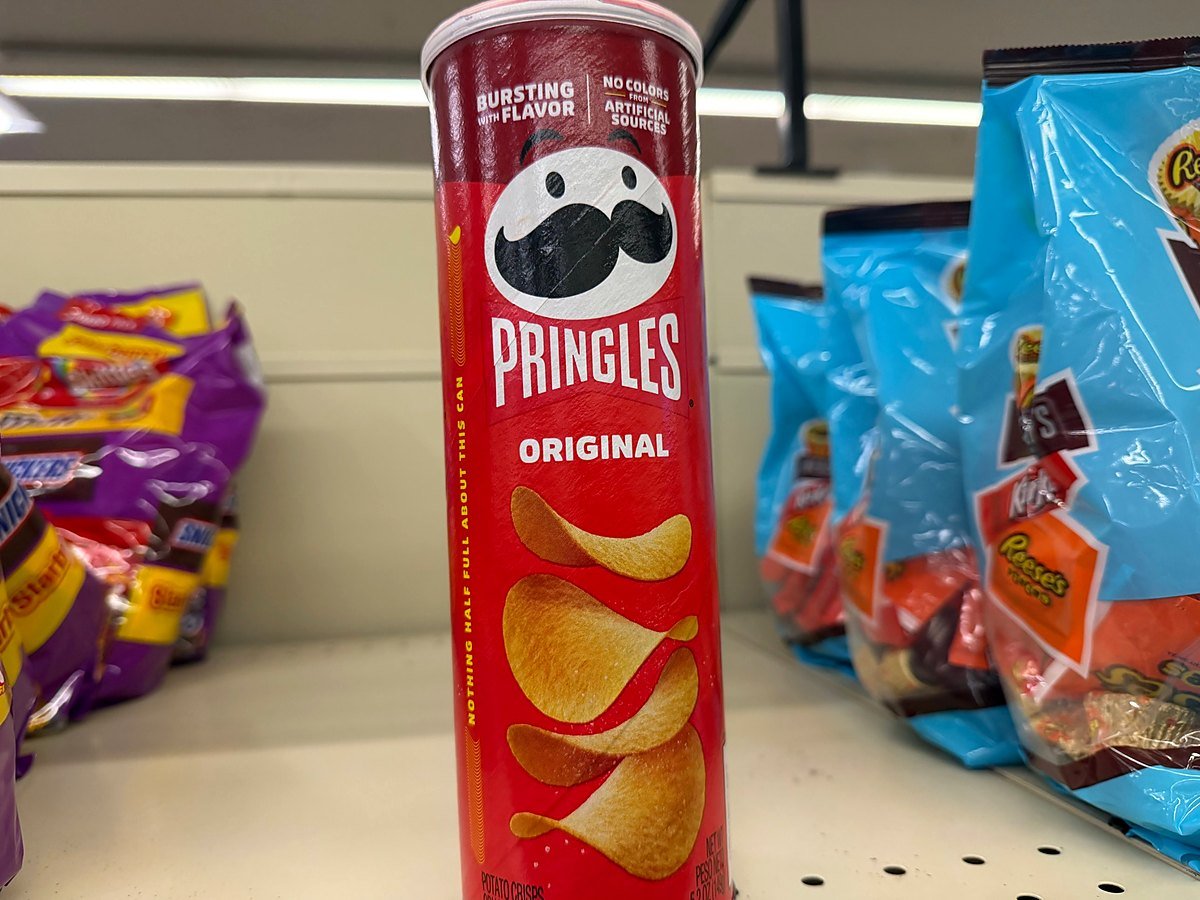
Last reviewed: October 2026. Reflects the U.S. Pringles Original, 5.2 oz (149 g) can, photographed in store. Flavored Pringles (Sour Cream & Onion, Cheddar Cheese, BBQ) add seasoning blends with dairy, sugar, and flavor enhancers and are noted where relevant. Pringles has been owned by Mars since December 2025.
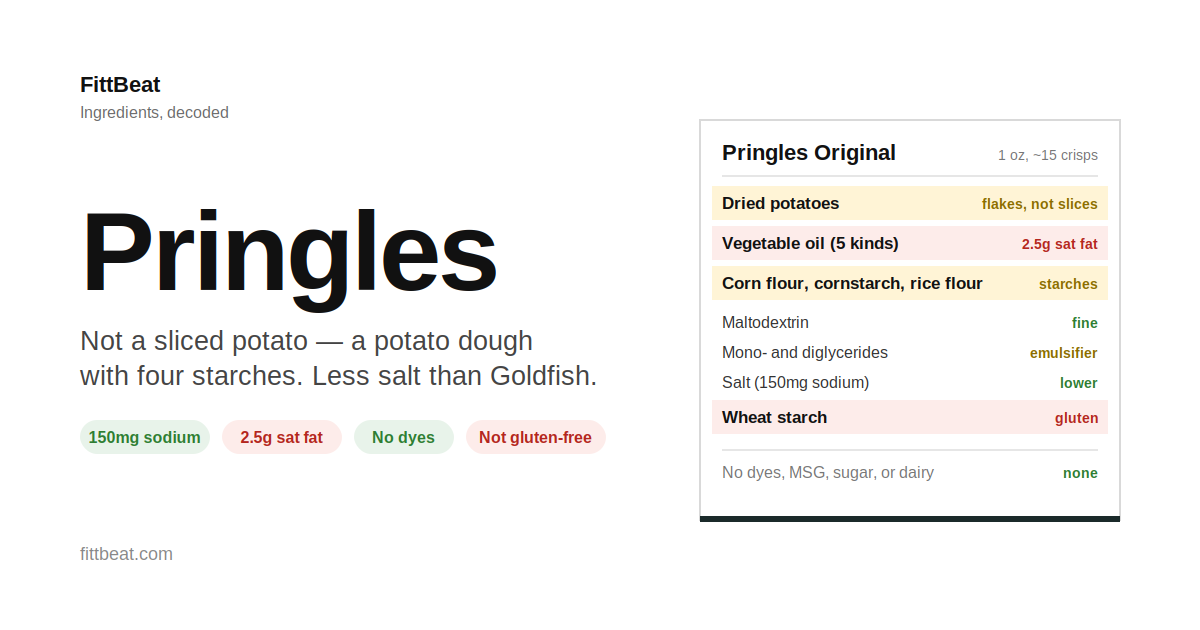
Pringles are the chip that isn’t quite a chip. There’s no sliced potato in the can: Pringles are made from a dough of dried potato flakes and starches, rolled into a sheet, pressed into a saddle shape, fried, salted, and stacked. That’s why every crisp is identical, why they fit in a tube, and why the British tax courts once had to rule on whether they count as potato crisps at all. The Original ingredient list is short and unalarming — potatoes, oil, four starches, an emulsifier, salt — and it’s actually lower in sodium than several snacks parents think of as gentler. The cost is in the format: a can that’s built to be eaten in one sitting. Here’s all the Pringles ingredients, what the “dried potatoes” really are, the acrylamide question, and what the whole can adds up to.
Quick answer: what’s in Pringles?
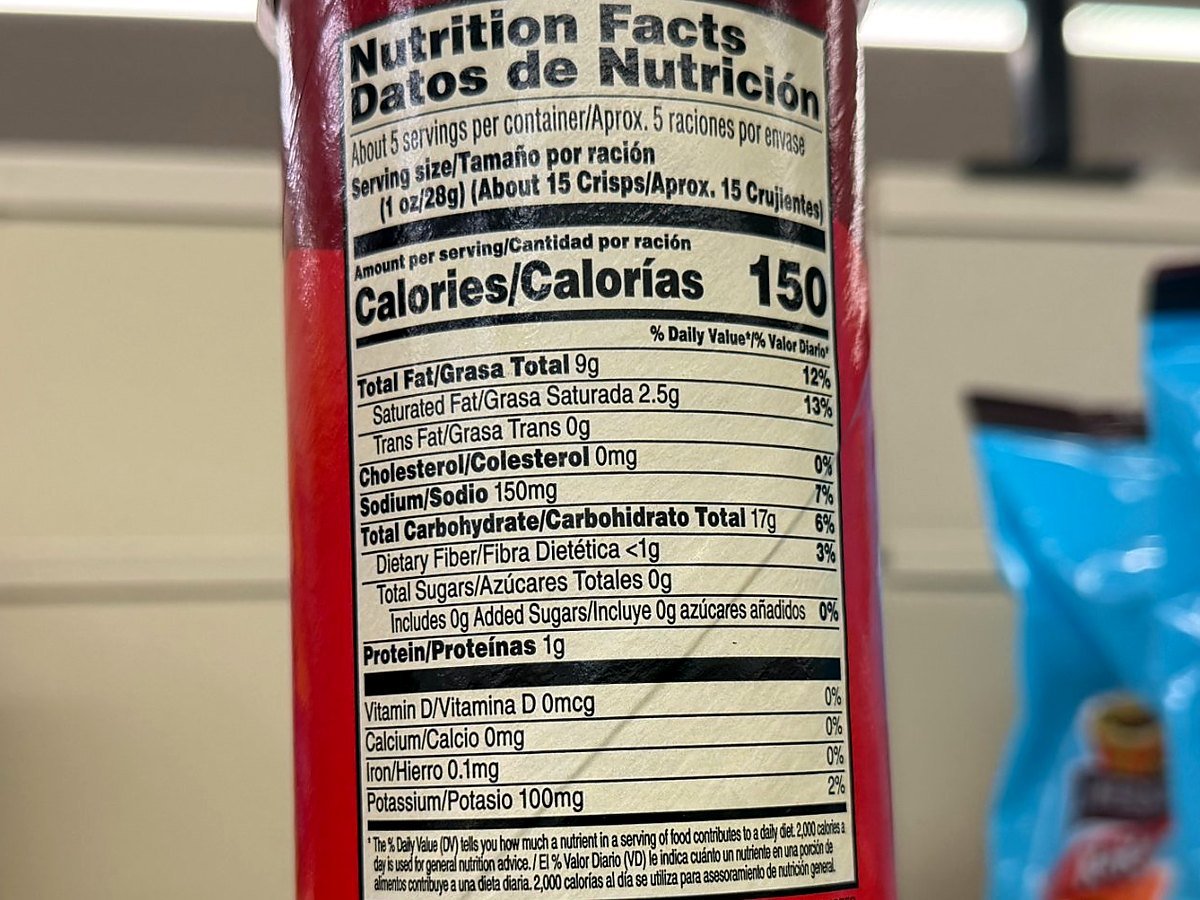
Pringles Original are dried potatoes, vegetable oil (corn, cottonseed, canola, high oleic soybean, and/or sunflower), degerminated yellow corn flour, cornstarch, rice flour, maltodextrin, mono- and diglycerides, salt, and wheat starch. A 1 oz (28 g) serving of about 15 crisps has 150 calories, 9 g of fat, 2.5 g of saturated fat, 150 mg of sodium, 17 g of carbohydrate, 0 g of sugar, less than 1 g of fiber, and 1 g of protein. No dyes, no preservatives, no MSG, no dairy, and less sodium per ounce than Doritos or Goldfish. The concerns are the ones that come with any fried starch: refined carbohydrate with almost no fiber, saturated fat a bit higher than a classic potato chip, acrylamide from frying, and a can that holds about five servings most people treat as one.
Jump to: The label · Each ingredient · Are Pringles real potato chips? · Acrylamide · Nutrition · Pringles vs. Lay’s · Verdict · FAQ
The full Pringles ingredients list
Dried Potatoes, Vegetable Oil (Corn, Cottonseed, Canola, High Oleic Soybean, and/or Sunflower), Degerminated Yellow Corn Flour, Cornstarch, Rice Flour, Maltodextrin, Mono- and Diglycerides, Salt, Wheat Starch. Contains wheat ingredients. Contains a bioengineered food ingredient.

Three things to notice. “Dried potatoes” is first, but it’s potato flakes, not slices — the crisp is a reconstituted dough. After the oil come four separate starches (corn flour, cornstarch, rice flour, wheat starch) plus maltodextrin, which is itself a starch derivative; together they’re what let the dough roll thin, hold its shape, and crisp evenly. And there’s no seasoning beyond salt in the Original — no MSG, no yeast extract, no sugar, no dairy — which makes it one of the shortest lists among the chips we’ve photographed.
Pringles ingredients explained
Dried potatoes Potato flakes
Potatoes cooked, mashed, and dehydrated into flakes, the same basic product as instant mashed potatoes. Rehydrated with water and blended with the starches, they form the dough every Pringle is cut from. It’s real potato, just processed twice — and drying and re-frying concentrates the starch, which matters for acrylamide (below). The “about 42% potato” figure often cited for Pringles comes from the UK tax case; the U.S. label doesn’t give a percentage, only that potato is the largest single ingredient.
Vegetable oil (corn, cottonseed, canola, high oleic soybean, and/or sunflower) The fat
The frying oil, a blend that varies with cost and supply — the “and/or” covers whichever oils are used in a given batch. No palm oil and no hydrogenated oil; trans fat is 0 g. The saturated fat (2.5 g per serving, 13% of the daily value) is higher than a typical potato chip fried in sunflower or canola, mostly because cottonseed and corn oil carry more saturated fat than high oleic oils. At 9 g, fat supplies more than half the calories.
Degerminated yellow corn flour Starch
Corn flour with the germ (the oily, nutrient-dense part) removed so it doesn’t go rancid. It adds body and a faint corn sweetness to the dough. Refined; almost no fiber.
Cornstarch and rice flour Fine
Two more starches that bind the dough and give Pringles their light, uniform crunch — rice flour in particular makes fried doughs crisper and less greasy. Functional, harmless, and the reason a Pringle shatters rather than bends.
Maltodextrin Fine
A quickly digested carbohydrate made by breaking down starch (usually corn). Here it helps the dough sheet and brown. It has a high glycemic index, but at this amount it’s one of several starches in a starchy snack; it doesn’t change the picture.
Mono- and diglycerides Emulsifier
Fats that help the oil and water in the dough mix evenly and keep the sheet from sticking to the machinery. They’re common in bread and baked goods and recognized as safe. One technical footnote: because they’re labeled as emulsifiers rather than fats, any trace trans fat they contain doesn’t count toward the “0 g trans fat” line. At this low level it’s not a meaningful concern, but it’s why some nutrition writers flag them.
Salt 150 mg sodium
The only seasoning in the Original — and less of it than you’d guess. 150 mg per ounce, 7% of the daily value, is lower than Doritos (170 mg), Flamin’ Hot Cheetos (210 mg), Goldfish (about 233 mg per ounce), and far below Takis (420 mg). Pringles taste salty because the salt sits on the surface where your tongue meets it first.
Wheat starch Gluten
The last starch, and the reason Pringles aren’t gluten-free. Wheat starch is mostly starch with some residual gluten, and the label’s “contains wheat ingredients” warning means people with celiac disease should skip Pringles. Several other chips (plain Lay’s, many tortilla chips) are gluten-free; Pringles aren’t.
What’s not here Worth saying
No dyes (the front’s “no colors from artificial sources” is accurate for every flavor; the Original has no added color at all). No preservatives, no MSG or yeast extract, no sugar, no dairy, no eggs. The flavored cans are a different story: Sour Cream & Onion and Cheddar Cheese add whey, milk, sugar, and flavor enhancers like MSG and disodium inosinate.
Are Pringles real potato chips?
Not in the way a Lay’s is. A potato chip is a slice of potato fried in oil; a Pringle is a fried cracker made from potato dough. In the U.S., the FDA objected to Pringles being called “potato chips” when they launched in 1968, and Procter & Gamble eventually settled on “potato crisps,” the term still on the can. In the UK the question went to court for a different reason: crisps made from potato are subject to VAT, and P&G argued in 2008 that Pringles weren’t potato crisps because potato made up only about 42% of the product. A tribunal agreed, and the Court of Appeal reversed it in 2009, ruling that Pringles have enough potato to count. So: legally, in Britain, they’re potato crisps. Technically, everywhere, they’re a potato-based snack shaped like a chip.
The shape has a name, too: a hyperbolic paraboloid, the saddle curve that lets them stack without breaking and gives each crisp the same crunch. Fredric Baur, the P&G chemist who designed the can, was so proud of it that part of his ashes were buried in one when he died in 2008.
Acrylamide: the fried-starch question
Acrylamide is a compound that forms when starchy foods are fried, baked, or roasted at high heat — the same browning reaction that makes chips, fries, toast, and coffee taste good. It’s classified as a probable human carcinogen based on animal studies at high doses; human studies at dietary levels haven’t shown a clear link to cancer. Potato chips and fries are among the biggest dietary sources, and in early FDA testing (2002–2004) Pringles were among the products with higher levels, likely because the dried potato flakes concentrate starch and sugars. California’s 2008 Proposition 65 settlement committed major chip makers, including Pringles’ then-owner Procter & Gamble, to cut acrylamide levels, and the industry has since reduced them through changes in processing.
The practical takeaway is the same as for every fried potato snack: acrylamide is a reason to treat chips as an occasional food, not a reason to fear a handful. The FDA’s advice is general — vary your diet, don’t over-brown starchy foods — rather than to avoid any specific product.
Pringles nutrition facts
| Pringles Original | Calories | Fat (sat) | Sodium | Carbs | Protein |
|---|---|---|---|---|---|
| 1 crisp (~1.9 g) | ~10 | ~0.6 g (~0.2 g) | ~10 mg | ~1.1 g | <0.1 g |
| 15 crisps (28 g, label serving) | 150 | 9 g (2.5 g) | 150 mg | 17 g | 1 g |
| Whole 5.2 oz can (~5 servings) | ~750–800 | ~45–48 g (~13 g) | ~750–800 mg | ~85–90 g | ~5 g |
Calculated from the photographed label. A whole can is about 5.3 servings by weight (149 g ÷ 28 g); the label rounds to “about 5,” hence the ranges. One can is roughly a third of a day’s calories for many adults and about a third of a day’s sodium.
| Per 1 oz (28 g) | Pringles Original | Lay’s Classic | Doritos Nacho Cheese | Flamin’ Hot Cheetos | Goldfish Cheddar | Takis Fuego |
|---|---|---|---|---|---|---|
| Calories | 150 | ~160 | 150 | 160 | ~131 | 140 |
| Saturated fat | 2.5 g | ~1.5 g | 1 g | ~1.5 g | ~0.9 g | ~2.5 g |
| Sodium | 150 mg | ~170 mg | 170 mg | 210 mg | ~233 mg | 420 mg |
| Sugar | 0 g | <1 g | <1 g | 0 g | 0 g | 1 g |
| Ingredients | 9 | 3 | 20+ | 20+ | 12 | 20+ |
| Synthetic dyes | No | No | Yes | Red 40 | No | Yes |
| Gluten-free | No | Yes | Not labeled | Not labeled | No | Not labeled |
Pringles and Goldfish figures are from packages photographed for these posts (Goldfish scaled from its 30 g serving); sodium for Doritos, Flamin’ Hot Cheetos, and Takis is from bags photographed for FittBeat, with their other cells from our breakdowns; Lay’s Classic is approximate from Frito-Lay’s current label. Dye status reflects the bags photographed; several are mid-reformulation.
Pringles vs. Lay’s
The cleanest comparison is a classic Lay’s, which is three ingredients: potatoes, oil, salt. Per ounce the two are close — Lay’s slightly higher in calories and sodium, Pringles slightly higher in saturated fat. The differences are structural. Lay’s is a sliced potato with no added starches, gluten-free, and a shorter list; Pringles is a starch dough with five refined starches and wheat, engineered for uniformity and a longer shelf life. Neither has meaningful fiber or protein. If you want the most “whole food” chip, Lay’s wins on ingredients. If you’re watching sodium, Pringles edges it. The bigger lever with both is portion: a Lay’s bag and a Pringles can both make a single ounce hard to stop at, and the can, with its stack, makes it especially easy to keep going.
Are Pringles bad for you?
FittBeat verdict
A short, dye-free list that’s less salty than its reputation — and a can designed to be finished. Nothing on the Pringles Original label is alarming: potato flakes, oil, four starches, an emulsifier, and salt, with no dyes, preservatives, MSG, sugar, or dairy, and less sodium per ounce than Doritos, Hot Cheetos, or Goldfish. What keeps them in the treat column is what they’re made of and how they’re sold: refined starch fried in oil, with almost no fiber or protein, a little more saturated fat than a classic chip, acrylamide like every fried potato snack, and a tube that holds five servings and empties easily. Pour 15 into a bowl and put the can away.
The concerns, ranked by evidence:
- Portion. A can is about 750–800 calories and 750–800 mg of sodium; the stack makes it unusually easy to eat several servings.
- Refined starch with no fiber or protein. 17 g of carbohydrate per ounce, under 1 g of fiber, 1 g of protein — calories that don’t fill you up.
- Saturated fat. 2.5 g per ounce, higher than many potato chips; modest per serving, significant per can.
- Acrylamide. Present in all fried starchy foods; historically higher in Pringles, reduced since 2008; a reason for moderation, not alarm.
- Everything else. Corn flour, cornstarch, rice flour, maltodextrin, mono- and diglycerides, salt: no meaningful concern at these amounts.
Pringles for kids, allergies, and diets
Kids: no dyes, no caffeine, and modest sodium per serving make Original Pringles one of the less concerning chips for kids. The issue is serving size — portion a small handful rather than handing over the can.
Gluten-free: no. Wheat starch is an ingredient; not safe for celiac disease.
Vegan / dairy-free: the Original has no animal ingredients, so it’s vegan and dairy-free by ingredients. Most flavored Pringles contain milk.
Allergies: contains wheat. No milk, egg, peanut, tree nut, or soy protein in the Original (soybean oil is highly refined and not considered an allergen source).
Keto / low-carb: no — 17 g of carbohydrate per ounce.
Cleaner alternatives
For the shortest possible chip list: Lay’s Classic or a kettle chip made with just potatoes, oil, and salt — and they’re gluten-free. For lower saturated fat: chips fried in avocado or high oleic sunflower oil. For more fiber and fewer refined starches: popcorn, which is a whole grain, or roasted chickpeas. And for Pringles fans: the snack-stack cans (0.67–0.74 oz) are a built-in portion, which is the single most useful swap here.
Frequently asked questions
What are Pringles made of?
Pringles Original are made from dried potatoes, vegetable oil (corn, cottonseed, canola, high oleic soybean, and/or sunflower), degerminated yellow corn flour, cornstarch, rice flour, maltodextrin, mono- and diglycerides, salt, and wheat starch. The potatoes are dried flakes formed into a dough, not slices.
Are Pringles real potato chips?
Not in the traditional sense. They’re made from a dough of potato flakes and starches pressed into shape and fried, which is why they’re labeled “potato crisps.” A UK court ruled in 2009 that they contain enough potato to count as potato crisps for tax purposes.
How much sodium is in Pringles?
150 mg per 1 oz (about 15 crisps), 7% of the daily value — less than Doritos, Flamin’ Hot Cheetos, or Goldfish per ounce. A whole 5.2 oz can is about 750–800 mg.
Are Pringles vegan?
The Original has no animal ingredients, so it’s vegan by ingredients. Most flavored Pringles, such as Sour Cream & Onion and Cheddar Cheese, contain milk.
Are Pringles gluten-free?
No. Pringles contain wheat starch, and the can says “contains wheat ingredients.”
Do Pringles have MSG?
Pringles Original don’t. Several flavored varieties add MSG or other flavor enhancers in their seasoning.
How many calories are in a can of Pringles?
A 5.2 oz (149 g) can of Original is about 750–800 calories — roughly five servings of 150 calories each.
Who owns Pringles?
Mars, since December 2025, when it completed its acquisition of Kellanova. Pringles were created by Procter & Gamble in 1968 and owned by Kellogg (later Kellanova) from 2012.
Sources
- Pringles Manufacturing Co. (Mars). Nutrition facts and ingredients, Pringles Original Potato Crisps, 5.2 oz (149 g). Product label, photographed October 2026.
- Mars, Incorporated. Mars completes acquisition of Kellanova. December 11, 2025.
- Revenue and Customs v. Procter & Gamble UK [2009] EWCA Civ 407 (Court of Appeal, England and Wales), on whether Pringles are “potato crisps” for VAT.
- U.S. FDA. Acrylamide and diet, food storage, and food preparation; survey data on acrylamide in food. fda.gov
- National Cancer Institute. Acrylamide and cancer risk. cancer.gov
- California Office of the Attorney General. Settlements with potato chip and French fry makers to reduce acrylamide under Proposition 65. 2008.
- U.S. FDA. Sodium in your diet. fda.gov
- U.S. Department of Agriculture. National Bioengineered Food Disclosure Standard. ams.usda.gov
Lay’s Classic figures are approximate from Frito-Lay’s current label. Whole-can totals are calculated from per-serving label values and shown as ranges because “about 5 servings” is rounded.
This article is for informational purposes and is not medical advice. Talk to a doctor or registered dietitian about your individual nutrition needs.
