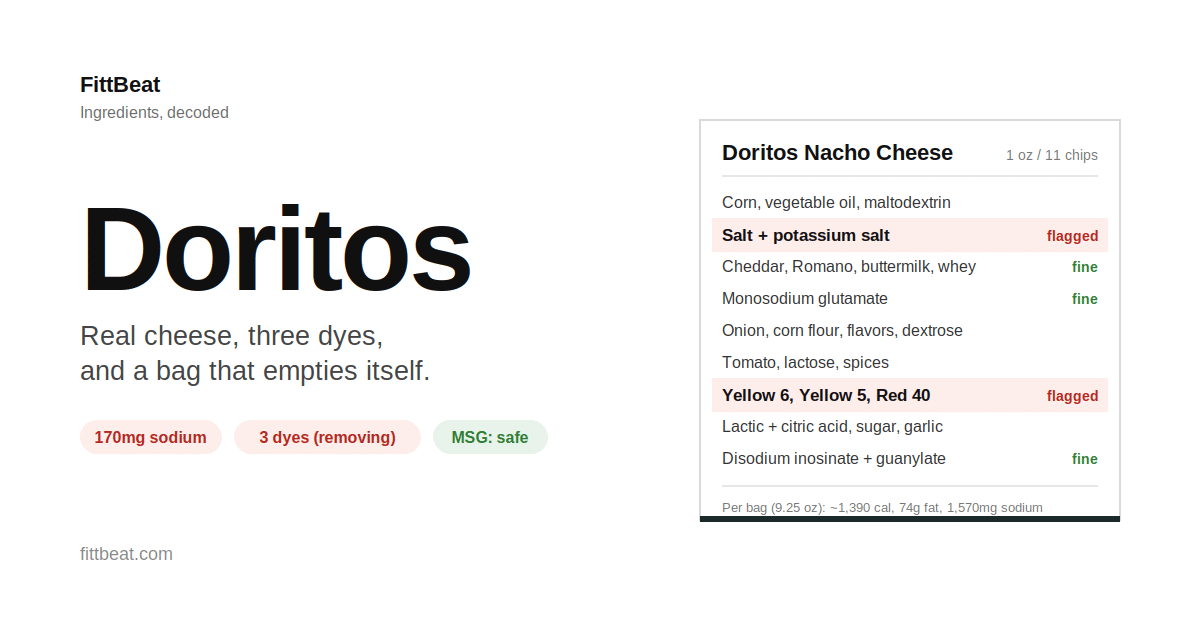

Last reviewed: October 2026. Reflects the current U.S. Doritos Nacho Cheese label, photographed in store. Regular Doritos still contain three synthetic dyes; PepsiCo’s dye-free version is a separate line, Doritos Simply NKD, launched December 2025. Both are covered below.
Doritos is a short ingredient list with a long tail. The chip is corn, oil, and salt; the orange dust is where the other 25 ingredients live — real cheese, three flavor enhancers, three synthetic dyes, and the sugars and acids that make it taste the way it does. That dust is also why one of the most-cited snacks in the research on “hyperpalatable” food is this one. PepsiCo said in 2025 it would move Doritos off synthetic dyes, then launched a colorless dye-free line instead of changing the regular bag — so the orange one in your hand still has all three. Here’s every Doritos ingredients, what each one does, which ones are changing, and what the research says about the ones that aren’t.
Quick answer: what’s in Doritos?
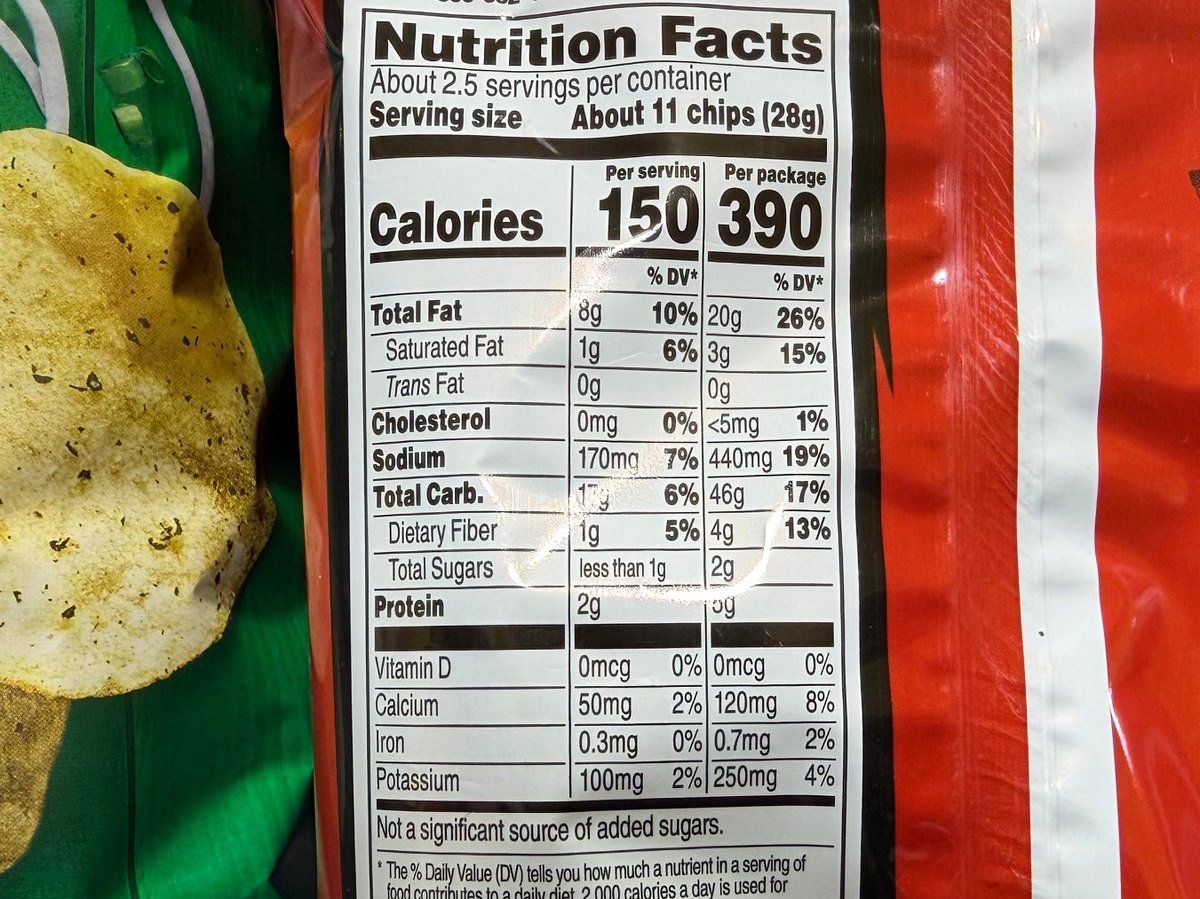
Doritos Nacho Cheese is corn, vegetable oil, maltodextrin, salt, cheddar cheese, whey, monosodium glutamate, buttermilk, Romano cheese, whey protein, onion powder, corn flour, natural and artificial flavor, dextrose, tomato powder, lactose, spices, three synthetic dyes (Yellow 6, Yellow 5, Red 40), lactic acid, citric acid, sugar, garlic powder, skim milk, bell pepper powder, disodium inosinate, and disodium guanylate. A 1 oz serving (about 11 chips) has 150 calories, 8 g of fat, 170 mg of sodium, and under 1 g of sugar. The three concerns are sodium and fat per bag rather than per serving, the three dyes (still on every regular bag; PepsiCo’s dye-free Doritos is a separate colorless line, Simply NKD), and a flavor system engineered to make stopping hard. MSG is safe. The cheese is real.
Jump to: The label · Each ingredient · The dye swap · MSG and the nucleotides · Nutrition · Verdict · FAQ
The full Doritos ingredients list
Corn, Vegetable Oil (Corn, Canola, Soybean, and/or Sunflower Oil), Corn Maltodextrin, and less than 2% of: Cheddar Cheese (Milk, Cheese Cultures, Salt, Enzymes), Salt, Whey, Monosodium Glutamate, Buttermilk, Romano Cheese (Milk, Cheese Cultures, Salt, Enzymes), Whey Protein Concentrate, Onion Powder, Potassium Salt, Corn Flour, Natural and Artificial Flavors, Dextrose, Tomato Powder, Lactose, Spices, Artificial Color (Yellow 6, Yellow 5, Red 40), Skim Milk, Lactic Acid, Citric Acid, Sugar, Garlic Powder, Red and Green Bell Peppers, Disodium Inosinate, Disodium Guanylate. Contains milk ingredients.
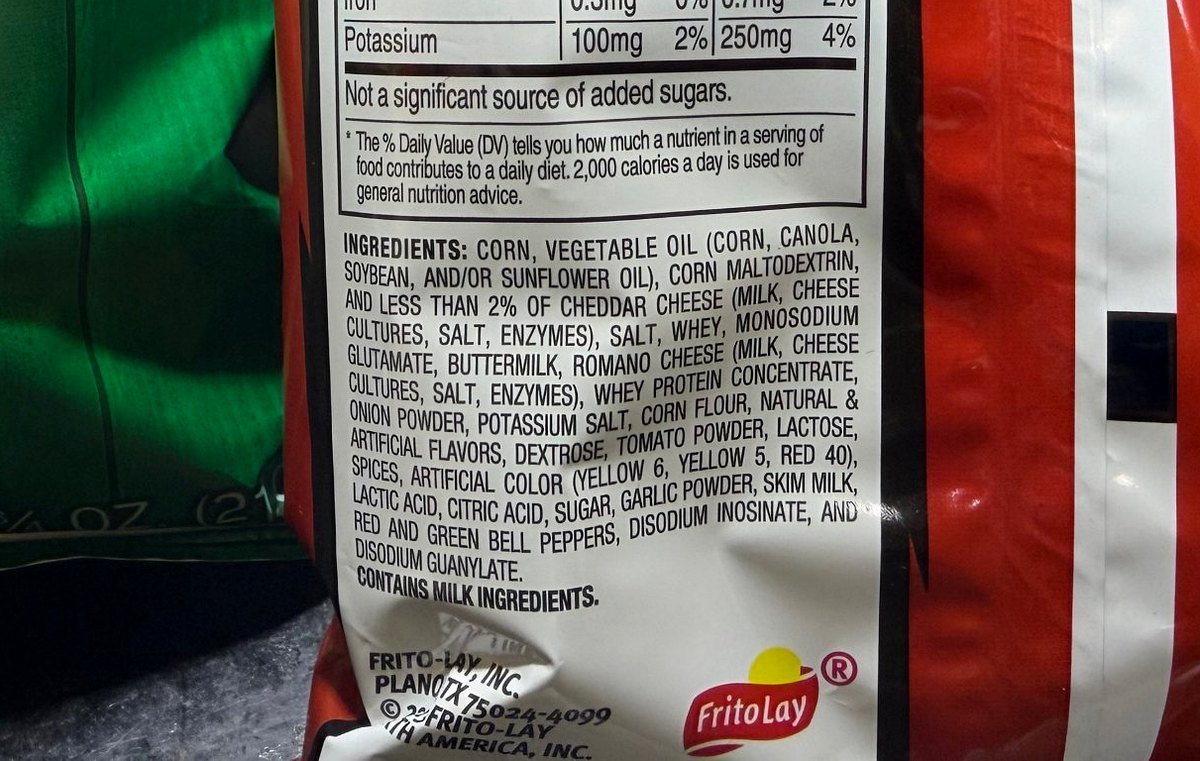
Three things to notice. Maltodextrin is third — ahead of salt and cheese — because it’s the carrier the seasoning is built on, not because Doritos are sweet; everything after it is under 2% of the bag. There are four real dairy ingredients (cheddar, Romano, buttermilk, whey), which is more cheese than most “cheese” snacks contain. And the flavor enhancers come as a trio: MSG in the middle of the list and two nucleotides at the very end, which is the combination that makes the “nacho” taste bigger than its parts.
Doritos ingredients explained
Corn Fine
Whole corn, cooked with lime (nixtamalized), ground into masa, sheeted, cut into triangles, and fried. The chip itself is a tortilla chip; everything else is applied afterward.
Vegetable oil (corn, canola, and/or sunflower) 8 g per serving
The frying oil, 8 g per ounce with 1 g saturated. These are mostly unsaturated oils and the saturated fat is low; the issue is quantity, not type — about half the calories in a Dorito are oil. “And/or” means the blend changes with commodity prices.
Maltodextrin Fine
A starch broken into short chains, used as the base the cheese powder and spices stick to. It’s a fast carbohydrate — higher glycemic index than sugar — but there’s little of it per serving. It’s the reason seasoning adheres to a chip.
Salt and potassium salt Flagged, by the bag
170 mg of sodium per ounce is moderate — lower than it used to be, because the current label adds potassium salt (potassium chloride) to replace part of the sodium chloride, a swap PepsiCo has been making across its chips. Potassium chloride is safe and tastes close enough to salt that you won’t notice. The problem is still that nobody eats an ounce: a 9.25 oz family bag is about 1,570 mg of sodium, two-thirds of a day’s recommended limit. The salt is also part of the flavor system that keeps you eating.
Cheddar cheese, Romano cheese, buttermilk, whey, whey protein, lactose, skim milk Real dairy
Doritos use actual aged cheddar and Romano, dried into powder, plus whey and buttermilk solids for tang and body. It’s more dairy than the ingredient list of most cheese-flavored snacks, and it’s why the “contains milk” allergen line is there. No concern unless you’re dairy-free.
Monosodium glutamate (MSG) Safe, doing a lot
The umami. MSG is the sodium salt of glutamate, an amino acid that’s abundant in cheese, tomatoes, and soy sauce, and it’s the single most studied flavor enhancer in food. The 1960s “Chinese restaurant syndrome” story has been tested in blinded trials repeatedly and doesn’t hold up; the FDA classifies MSG as generally recognized as safe, and the amount in a serving of Doritos is less than the natural glutamate in a serving of Parmesan. What it does is make the cheese taste more like cheese. Covered further below with the nucleotides.
Onion powder, garlic powder, tomato powder, bell pepper powder, spices Fine
The savory base. Dehydrated vegetables and undisclosed spices.
Natural and artificial flavor Undisclosed
The proprietary nacho profile beyond what the cheese and spices supply. “Artificial” means some molecules are synthesized; a labeling distinction, not a safety one. The Simply NKD line drops artificial flavors along with the colors; the regular bag keeps both.
Dextrose, sugar Under 1 g
Two sugars, in trace amounts, for browning and to round the sharp edges of the acid and salt. Less than a gram per serving. Not a sugar product.
Artificial color (Yellow 6, Yellow 5, Red 40) Flagged
The orange. Three synthetic dyes — the three with an EU child-behavior warning label and the three in the 2007 Southampton trial — in one chip. They’re on the FDA’s 2025 phase-out list, banned in West Virginia from 2028 and from California school food from 2027, and PepsiCo said in 2025 that Doritos would move to natural colors. What it did instead was launch a separate colorless line; as of a late-October 2026 bag (best by January 2027), every regular Doritos still lists all three. Covered in the next section; our synthetic food dyes breakdown has the research.
Lactic acid, citric acid Fine
The tang — lactic acid mimics the sourness of aged cheese, citric adds brightness. Both are mild and in small amounts.
Disodium inosinate, disodium guanylate Safe, the multiplier
Two nucleotides, always listed together and always with MSG, because that’s the point: they multiply the umami effect of glutamate several-fold at tiny doses. They occur naturally in meat and mushrooms. Safe, and the reason they’re at the end of the list is that almost none is needed. The one group that should note them is people with gout, since inosinate and guanylate are purines — though the amount in chips is far below what’s in a serving of sardines.
The dye “removal”: what PepsiCo actually did
In April 2025 PepsiCo said it would accelerate moving its portfolio to natural colors, and in October 2025 it said Doritos and Cheetos would be made without artificial colors or flavors. What arrived in December 2025 was not a reformulated Doritos but a new line: Doritos Simply NKD, with no color added at all — the chips are pale yellow, and the artificial flavors are gone too. It launched at Walmart first and expanded in 2026. The regular Nacho Cheese bag was not changed. The bag we photographed in late October 2026, best by January 2027, lists Yellow 6, Yellow 5, and Red 40 exactly as before, and PepsiCo has said publicly that it hasn’t committed to a full phase-out because dye-free versions of major brands have historically sold worse. Its stated goal is to offer a “natural color option” for every brand within a couple of years, which is what NKD is.
So there is no reformulated orange Doritos to look for. If you want the chip without the dyes, the choices are Simply NKD (colorless, same seasoning otherwise) or Doritos Simply (the older organic-style line, where stocked). The FDA’s request to industry is for synthetic dyes to be out by the end of 2026, and West Virginia’s statewide ban takes effect in 2028; if PepsiCo changes the regular bag, that’s when and why. We’ll update this post when a bag without “Artificial Color” on the label shows up in a store.
It’s worth being clear about what any of this changes. The three dyes are the ingredients with the best-documented child-behavior evidence and the weakest reason to exist; a Doritos without them is a real improvement for a snack marketed heavily to kids. It does nothing to the sodium, the fat, the MSG, or the engineering that makes a bag disappear. A dye-free Dorito is a less-dyed Dorito, not a healthier one.
MSG and the nucleotides: why you can’t stop
The honest health story of Doritos isn’t any single additive; it’s that the seasoning is a textbook hyperpalatable formula. Salt, fat, and glutamate hit three separate reward pathways at once; the nucleotides amplify the glutamate; the acids keep it from tasting flat; the cheese powder is dried so it dissolves instantly on the tongue, then vanishes — a property food scientists call “vanishing caloric density,” which keeps the brain from registering fullness. Frito-Lay’s own research into this is well documented, and the result is a product where the serving size (11 chips) bears no relation to how it’s eaten.
That’s not an argument that MSG is harmful — it isn’t — it’s an argument that the nutrition panel per ounce understates the product. Read Doritos by the bag: a “share size” 9.25 oz bag is about 1,390 calories, 74 g of fat, and 1,570 mg of sodium; even the small 2.75 oz bag photographed above is 390 calories and 440 mg.
Doritos nutrition facts
| Per 1 oz serving | Doritos Nacho Cheese | Takis Fuego | Cheetos Crunchy | Lay’s Classic | Tostitos Original |
|---|---|---|---|---|---|
| Calories | 150 | 150 | 160 | 160 | 140 |
| Fat | 8 g | 8 g | 10 g | 10 g | 7 g |
| Saturated fat | 1 g | 2.5 g | 1.5 g | 1.5 g | 1 g |
| Sodium | 170 mg | 420 mg | 250 mg | 170 mg | 115 mg |
| Sugar | <1 g | <1 g | <1 g | 0 g | 0 g |
| Synthetic dyes | 3 | 2 (Bimbo removing) | 1 | None | None |
| MSG | Yes | Yes | Yes | No | No |
| TBHQ / BHT | None | TBHQ (being removed) | None | None | None |
| Real cheese | Yes | No | Yes | — | — |
Are Doritos bad for you?
FittBeat verdict
A fried corn chip with real cheese and an engineered flavor system — and, for now, three dyes. The scary-sounding ingredients (MSG, the nucleotides, maltodextrin) are safe and doing exactly what they’re meant to. The genuinely questionable ones (the three dyes) are on their way out, and the bag without them is the one to buy. What that leaves is a snack whose only real problem is how much of it you eat: 150 calories and 170 mg of sodium per serving is fine, and nobody eats a serving. Reasonable as a measured handful; a bad idea as a bag.
The concerns, ranked by evidence:
- Portion. The flavor system is designed to override fullness, and the per-bag numbers are a meal’s worth of fat and sodium.
- Sodium. 170 mg per ounce, about 1,570 per family bag.
- The three dyes. Modest behavioral effect in some children per randomized trials; EU warning; still on every regular bag. The dye-free option is the colorless Simply NKD line.
- Fat. 8 g per serving, mostly unsaturated; the quantity is the issue, not the type.
- MSG, nucleotides, maltodextrin. Safe. The MSG fear is the most thoroughly debunked food myth of the last 50 years.
Doritos for kids, keto, and allergies
Kids: the dyes are the ingredient-level concern, and they’re still there on the regular bag. Simply NKD is the dye-free version if a kid will eat a pale chip; otherwise the remaining concern is the same as any chip: portion.
Keto: no — 17 g of carbs per serving, mostly from the corn.
Allergies: contains milk (four dairy ingredients). Yellow 5 is the one dye with documented sensitivity reactions in a small number of people; it’s on the old label and gone from the new one. No gluten ingredients, though Frito-Lay doesn’t certify Nacho Cheese as gluten-free.
Cleaner alternatives
For the same chip without dyes: Doritos Simply NKD (colorless, launched December 2025) or Doritos Simply where stocked. For nacho flavor with a shorter list: Late July Nacho Chipotle or Siete Nacho (grain-free, no dyes, no MSG). For the honest version: Tostitos or any plain tortilla chip with salsa — corn, oil, salt, and nothing engineered to keep your hand in the bag.
Frequently asked questions
Do Doritos have Red 40?
Yes — Red 40, Yellow 5, and Yellow 6 are on every regular Doritos Nacho Cheese bag as of late 2026. PepsiCo’s dye-free Doritos is a separate colorless line, Simply NKD, launched December 2025.
Do Doritos have MSG?
Yes, along with two related flavor enhancers (disodium inosinate and guanylate). MSG is classified as safe by the FDA, and the amount is less than the natural glutamate in a serving of Parmesan.
Are Doritos made with real cheese?
Yes — cheddar and Romano, plus buttermilk and whey. That’s why they contain milk.
How much sodium is in Doritos?
170 mg per 1 oz serving (about 11 chips), with potassium salt replacing part of the sodium on the current label. A 9.25 oz family bag has about 1,570 mg — two-thirds of a day’s recommended limit.
Are Doritos getting rid of artificial dyes?
Not on the regular bag yet. PepsiCo announced a move to natural colors in 2025 but launched a separate colorless line (Simply NKD) rather than reformulating Nacho Cheese, and says it hasn’t committed to a full phase-out. The FDA’s end-of-2026 target and West Virginia’s 2028 ban are the pressure points.
Are Doritos vegetarian?
The cheeses may use animal rennet (“enzymes”), which Frito-Lay doesn’t specify, so strict vegetarians often avoid them. Not vegan.
Are Doritos gluten-free?
No gluten ingredients, but Frito-Lay doesn’t certify Nacho Cheese as gluten-free due to shared equipment. Doritos Simply is certified.
Are Doritos worse than Takis?
Doritos have three dyes to Takis’ two, but Takis have more than double the sodium, more saturated fat, a preservative (TBHQ) Doritos don’t use, and no real cheese. Takis is the worse label.
Sources
- Frito-Lay / PepsiCo. Nutrition facts and ingredients, Doritos Nacho Cheese, 1 oz serving. Product label, photographed October 2026.
- PepsiCo. Third-quarter 2025 earnings remarks on artificial colors and flavors, October 2025; Simply NKD launch announcement, November 2025. fooddive.com
- U.S. FDA. Tracking food industry pledges to remove petroleum-based food dyes. fda.gov
- HHS and FDA. HHS, FDA to phase out petroleum-based synthetic dyes in nation’s food supply. April 22, 2025. fda.gov
- McCann D, et al. Food additives and hyperactive behaviour in 3-year-old and 8/9-year-old children in the community. The Lancet, 2007. doi:10.1016/S0140-6736(07)61306-3
- U.S. FDA. Questions and answers on monosodium glutamate (MSG). fda.gov
- Geha RS, et al. Review of alleged reaction to monosodium glutamate and outcome of a multicenter double-blind placebo-controlled study. Journal of Nutrition, 2000. doi:10.1093/jn/130.4.1058S
- Fazzino TL, et al. Hyper-palatable foods: development of a quantitative definition and application to the US food system database. Obesity, 2019. doi:10.1002/oby.22639
- U.S. FDA. Sodium in your diet. fda.gov
This article is for informational purposes and is not medical advice. Talk to a doctor or registered dietitian about your individual nutrition needs.
