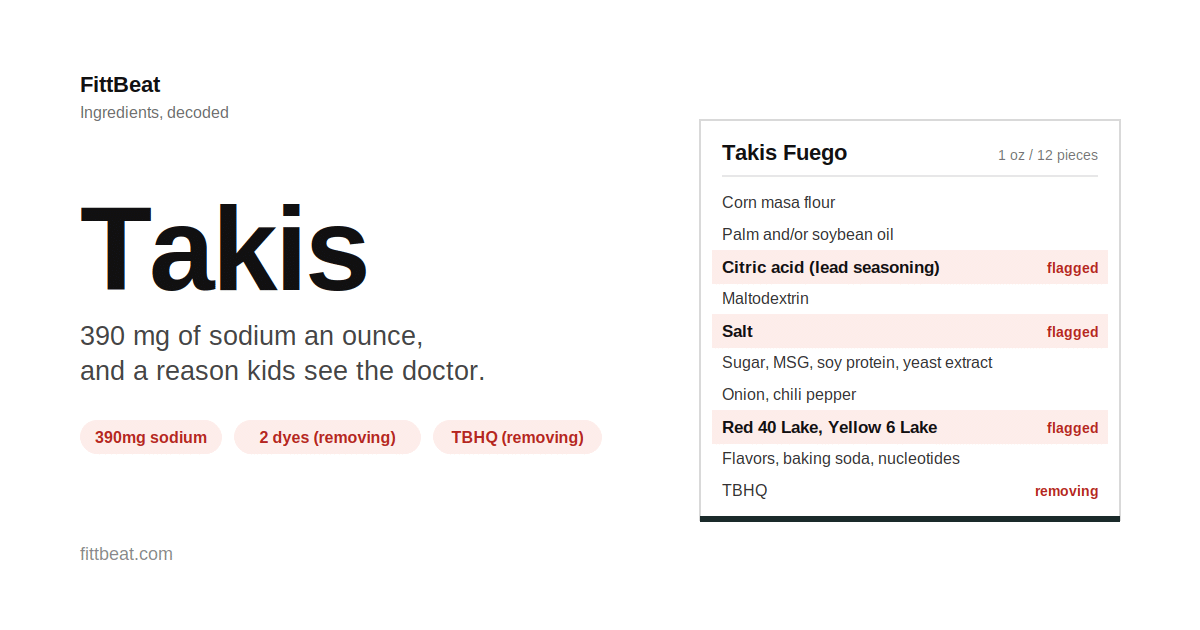

Last reviewed: October 2026. Reflects the U.S. Takis Fuego label. Grupo Bimbo has committed to removing synthetic dyes and TBHQ from the full Takis line by the end of 2026, and reformulated bags are already in some stores; as of this review both labels are in circulation. Check your bag.
Takis is the snack that pediatricians write about. Not because of any one ingredient, but because a rolled corn chip coated in citric acid, chili, salt, and MSG — eaten by the bag, by kids — produces a predictable set of stomach complaints that show up in emergency departments often enough to have been studied. The label is the most aggressive in the chip aisle: 420 mg of sodium per ounce, two and a half times Doritos; two synthetic dyes; three separate sources of glutamate; and TBHQ, a petroleum-derived preservative most competitors don’t use. Its owner is removing the dyes and the TBHQ by the end of this year. Here’s all the Takis ingredients, what the reformulation changes, and what the stomach research actually says.
Quick answer: what’s in Takis?
Takis Fuego is corn flour processed with lime, vegetable oil (palm, soybean, and/or canola), and a seasoning of salt, maltodextrin, citric acid, sugar, monosodium glutamate, hydrolyzed soy protein, onion powder, yeast extract, Red 40 Lake, Yellow 6 Lake, natural and artificial flavors, sodium bicarbonate, soybean oil, chili pepper, disodium inosinate, disodium guanylate, and TBHQ. A 1 oz serving (about 12 pieces) has 150 calories, 8 g of fat (2.5 g saturated, from palm oil), 420 mg of sodium, and 1 g of sugar. The sodium is the headline — 17% of the daily value in a dozen chips — followed by the acid-and-spice load that causes the stomach complaints, the two dyes, and TBHQ. The dyes and TBHQ are being removed by end of 2026; the salt, acid, and chili aren’t.
Jump to: The label · Each ingredient · The stomach problem · What’s changing · Nutrition · Verdict · FAQ
The full Takis ingredients list
Corn Flour (Processed with Lime), Vegetable Oil (Palm and/or Soybean and/or Canola Oil), Seasoning [Salt, Maltodextrin, Citric Acid, Sugar, Monosodium Glutamate, Hydrolyzed Soy Protein, Onion Powder, Yeast Extract, Red 40 Lake, Yellow 6 Lake, Natural and Artificial Flavors, Sodium Bicarbonate, Soybean Oil, Chili Pepper (Chile), Disodium Inosinate, Disodium Guanylate, TBHQ (Preservative)]. Contains soy. Made in a facility that may also use milk, egg, wheat, and peanuts.
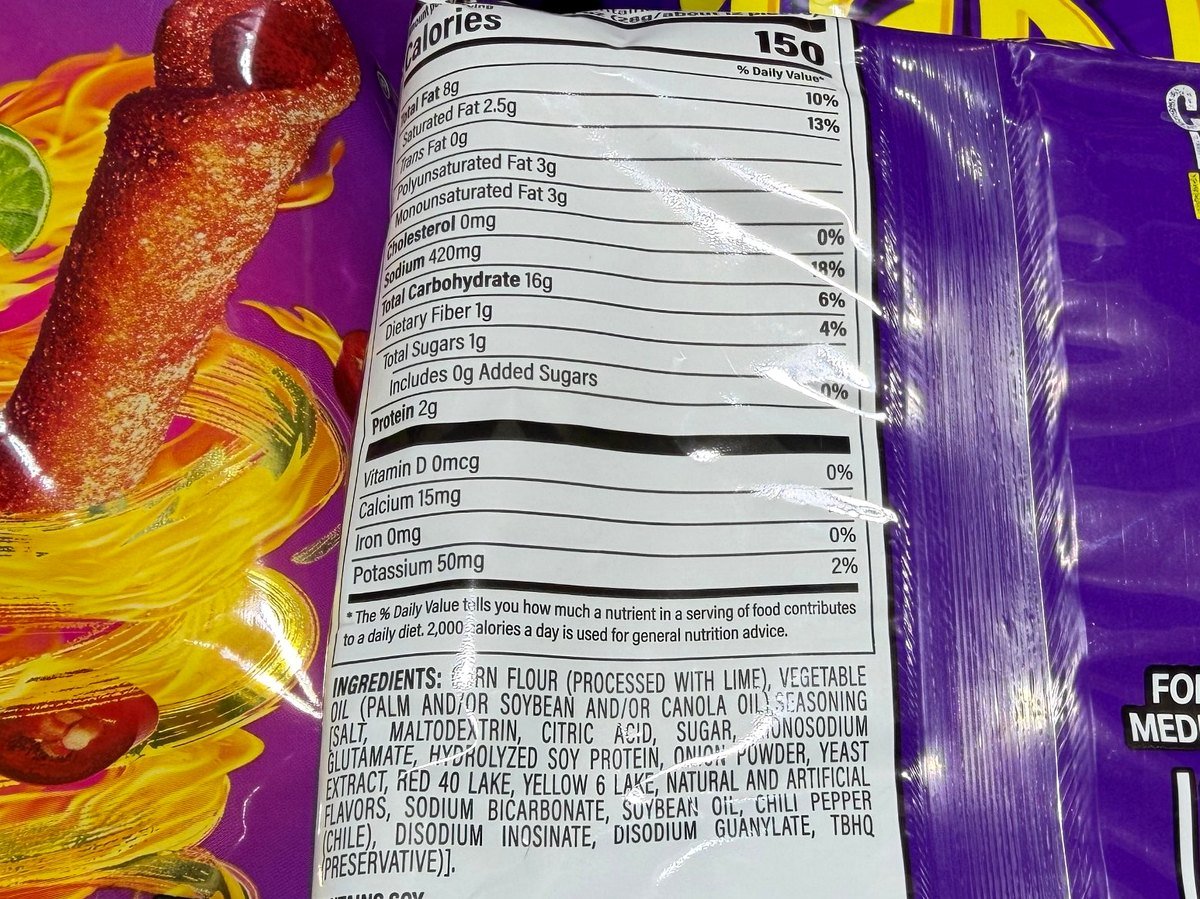
Three things to notice. Salt leads the seasoning and citric acid is third, ahead of the sugar and the chili — a lot of acid for a chip, and the source of the “hot lime” sourness and most of the stomach complaints. Glutamate shows up three times: as MSG, as hydrolyzed soy protein, and as yeast extract, the latter two being how manufacturers add glutamate without the letters M-S-G. And TBHQ is last, where antioxidants go; it’s a preservative for the oil, and it’s the ingredient that separates Takis from Doritos on a label.
Takis ingredients explained
Corn masa flour Fine
Nixtamalized corn flour, the same base as a tortilla. The chip is rolled into a tube before frying, which is why Takis are denser and crunchier than a flat chip and why they hold so much seasoning.
Vegetable oil (palm and/or soybean) Palm oil — 2.5 g saturated
The frying oil. Palm oil is the difference from Doritos: it’s solid at room temperature and about 50% saturated fat, which is why Takis have 2.5 g of saturated fat per ounce to Doritos’ 1 g. Palm oil also has the deforestation history the label doesn’t mention. “And/or” means the blend varies.
Citric acid Flagged, by the dose
The sour. In a soda, citric acid is a tartness agent at low concentration; on Takis it’s third in the seasoning — behind only salt and the maltodextrin carrier, ahead of the sugar and the chili pepper — applied as a powder directly to the chip, and it’s what makes the “Fuego” taste so sharp. The amount is undisclosed, but by position it’s one of the largest components of the coating. Citric acid is harmless in the body — it’s in every citrus fruit — but in this concentration, on an empty stomach, in quantity, it’s irritating to the stomach lining and the mouth. It’s also hard on enamel: acid powder sitting on teeth is worse than acid in a drink that gets swallowed.
Maltodextrin Fine
The starch carrier that makes seasoning stick. Fast carbohydrate in small amount.
Salt Flagged
420 mg of sodium per ounce — 18% of the daily value in 12 chips, two and a half times Doritos, and more than a serving of most fast-food fries. Salt is the first ingredient in the seasoning. A 3.25 oz bag is about 1,370 mg; a 9.9 oz bag is about 4,160 mg, nearly double a day’s limit. Takis are among the saltiest mainstream snacks sold, and the salt combines with the acid and capsaicin in the stomach effect below.
Sugar Under 1 g
Trace, for balance. Not a sugar product.
Monosodium glutamate, hydrolyzed soy protein, yeast extract Safe, three times
Three sources of free glutamate, which is the umami. MSG is the pure form; hydrolyzed soy protein and yeast extract are proteins broken down to release glutamate naturally, and they’re the standard way to add MSG’s effect without listing MSG (Takis lists both). The FDA classifies MSG as safe, and blinded trials have repeatedly failed to reproduce the reactions attributed to it. The triple source is a flavor decision — it makes the savory depth under the acid and heat — not a safety concern. The nucleotides at the end of the list multiply it.
Onion powder, chili pepper Fine
The heat. Chili pepper’s capsaicin is harmless in itself and is the third part of the stomach story: capsaicin stimulates acid secretion and gut motility, which is fine in a meal and uncomfortable in a bag eaten alone.
Artificial color (Red 40 Lake, Yellow 6 Lake) Flagged, being removed
The red. “Lake” forms are the dyes bonded to aluminum so they stay on a dry surface. Both carry the EU child-behavior warning, both are on the FDA’s 2025 phase-out list, and both are banned in West Virginia from 2028 and from California schools from 2027. Blue Heat uses Blue 1. Bimbo is replacing them with paprika extract and vegetable concentrates by the end of 2026 — the Dutch Takis has used that formula for years. Our Red 40 breakdown and synthetic food dyes hub cover the research.
Natural and artificial flavors Undisclosed
The lime and chili profile beyond the real chili and acid. Proprietary.
Baking soda Fine
Buffers the citric acid slightly and helps the seasoning disperse. Trace.
Disodium inosinate, disodium guanylate Safe
The nucleotide pair that multiplies glutamate’s effect several-fold at tiny doses. Safe; relevant only for people with gout, and even then the amount is small.
TBHQ Flagged, being removed
Tertiary butylhydroquinone — a synthetic antioxidant that keeps frying oil from going rancid, made from petroleum-derived butane. The FDA limits it to 0.02% of the fat content, and at that level the regulatory bodies consider it safe; EFSA set an acceptable daily intake of 0.7 mg/kg in 2004. The concerns: high doses caused tumors in rodent studies (far above human exposure), a 2022 EWG analysis linked it to immune-system effects in cell and animal studies, and it’s banned in Japan and restricted in the EU. The honest reading is that TBHQ is a low-concern preservative at food doses with enough unresolved questions that avoiding it is reasonable — and Bimbo is removing it, which few snack makers have done, so the point is becoming moot. Doritos and Cheetos don’t contain it.
The stomach problem
This is the Takis-specific issue, and it’s real. Since about 2012, pediatricians have reported a pattern of children — typically 8 to 16 — presenting with severe stomach pain, nausea, and sometimes vomiting after eating large amounts of spicy chips, with Takis and Flamin’ Hot Cheetos named most often. Some cases have been diagnosed as gastritis (inflamed stomach lining); a few have involved red stool that turned out to be dye, not blood, which caused its own ER visits. Hospitals in Illinois and Oregon publicly flagged the trend; some schools banned the chips.
The mechanism is the combination on the label: a heavy dose of citric acid powder, capsaicin, and salt, on an empty stomach, in a quantity nobody intended as a serving. None of the three is harmful at normal amounts; together, in a bag eaten alone at a desk, they irritate the stomach lining and stimulate acid secretion. It’s not poisoning and it’s not a permanent injury — the cases resolve — but it’s the reason a 12-piece serving size exists on the bag and the reason parents keep asking about Takis specifically. Eat them with food, not as food.
What’s changing in 2026
Grupo Bimbo, Takis’ owner, announced that the full U.S. Takis line — Fuego, Blue Heat, and the rest — will drop synthetic dyes and TBHQ by the end of 2026. The replacement colors are paprika extract with beet, radish, apple, and blackcurrant concentrates, which is what the European Takis already uses. Reformulated bags started appearing at major retailers in mid-2026; the ingredient list on a new bag reads “color (paprika extract, vegetable concentrates)” with no TBHQ at the end. Removing TBHQ is a step further than PepsiCo took with Doritos, and it’s worth crediting.
What it doesn’t change: the citric acid, the 420 mg of sodium, the palm oil, or the chili. The reformulated Takis is a cleaner label with the same stomach profile. The dyes were the ingredient a parent might reasonably worry about on behavioral grounds; the acid and salt are the ingredients that send a kid home from school.
Takis nutrition facts
| Per 1 oz serving | Takis Fuego | Doritos Nacho Cheese | Flamin’ Hot Cheetos | Lay’s Classic |
|---|---|---|---|---|
| Calories | 150 | 150 | 160 | 160 |
| Fat | 8 g | 8 g | 11 g | 10 g |
| Saturated fat | 2.5 g | 1 g | 1.5 g | 1.5 g |
| Sodium | 420 mg | 170 mg | 210 mg | 170 mg |
| Sugar | <1 g | <1 g | <1 g | 0 g |
| Synthetic dyes | 2 (being removed) | 3 (being removed) | 2 (being removed) | None |
| TBHQ | Yes (being removed) | No | No | No |
| Glutamate sources | 3 + nucleotides | 1 + nucleotides | 1 + nucleotides | 0 |
| Citric acid position | Third in seasoning | Minor | Mid-seasoning | — |
Are Takis bad for you?
FittBeat verdict
The hardest chip in the aisle on your stomach, your teeth, and your sodium — and getting a cleaner label without getting gentler. The dyes and TBHQ are the ingredients a label-reader worries about, and both are going by the end of 2026, which is more than most brands have done. What stays is the formula that matters: 420 mg of sodium an ounce, a coat of citric acid powder, palm oil, and chili, in a product kids eat by the bag. Fine as a handful with a meal for an adult who likes sour heat. As a solo snack for a child, it’s the one chip with a documented reason not to.
The concerns, ranked by evidence:
- Sodium. 420 mg per ounce; about 1,370 in the 3.25 oz bag, 4,160 in the 9.9 oz. Two and a half times Doritos and among the highest of any chip.
- Acid, salt, and capsaicin together. The stomach complaints are documented and the mechanism is the seasoning. Eat with food.
- Teeth. Citric acid powder on enamel, held in the mouth; worse than acidic drinks.
- The two dyes (old bags). Behavioral evidence in children; being removed. Buy the reformulated bag.
- TBHQ (old bags). Low concern at food doses, unresolved questions, being removed.
- Saturated fat. 2.5 g from palm oil; minor per serving, adds up per bag.
- MSG and friends. Safe. Three sources is a flavor choice, not a danger.
Takis for kids, keto, and allergies
Kids: this is the product the pediatric reports are about. Small amounts, with a meal, not on an empty stomach, and not as a lunch. The reformulated bag removes the dye concern; it doesn’t remove the stomach one.
Keto: no — 16 g of carbs per serving from the corn.
Allergies: contains soy (hydrolyzed soy protein, soybean oil). No dairy, no gluten ingredients (not certified). Yellow 6 has rare sensitivity reports.
Cleaner alternatives
For the same thing without the dyes and TBHQ: the reformulated Takis, once it’s in your store. For rolled spicy chips with a shorter list: Siete Fuego (grain-free, avocado oil, no dyes, no MSG, less sodium). For heat without the acid assault: Late July Jalapeño Lime, or plain tortilla chips with hot sauce — which is the Takis flavor without the powder on your teeth.
Frequently asked questions
Why do Takis hurt my stomach?
The seasoning is led by citric acid powder, with high salt and chili. Together, on an empty stomach and in quantity, they irritate the stomach lining and stimulate acid. Pediatricians have documented gastritis cases in children after large amounts. Eating them with food and in smaller amounts prevents most of it.
Do Takis have Red 40?
The original Fuego label has Red 40 Lake and Yellow 6 Lake. Grupo Bimbo is replacing them with paprika and vegetable extracts by the end of 2026, and reformulated bags are already in some stores.
What is TBHQ in Takis?
Tertiary butylhydroquinone, a petroleum-derived antioxidant that keeps the frying oil from going rancid. It’s FDA-approved at low limits, banned in Japan, and the subject of unresolved questions from high-dose animal and cell studies. Bimbo is removing it by the end of 2026. Doritos and Cheetos don’t contain it.
How much sodium is in Takis?
420 mg per 1 oz serving (about 12 pieces) — 18% of the daily value and two and a half times Doritos. A 3.25 oz bag has about 1,370 mg; a 9.9 oz bag about 4,160 mg.
Do Takis have MSG?
Yes, three ways: monosodium glutamate, hydrolyzed soy protein, and yeast extract, plus two nucleotide enhancers. All are classified as safe; the triple source is a flavor decision.
Are Takis worse than Doritos?
Yes, by most measures: two and a half times the sodium, more saturated fat (palm oil), a preservative (TBHQ) Doritos don’t use, and the acid load that causes stomach complaints. Doritos have one more dye.
Are Takis vegan?
Fuego contains no animal ingredients and is generally considered vegan. Some other flavors contain dairy.
Why is my stool red after Takis?
Red 40 in large amounts can pass through and color stool; it’s been mistaken for blood in ER visits. It’s the dye, not an injury — though the stomach pain that often accompanies it is from the acid and salt. The reformulated bags don’t do this.
Sources
- Barcel USA / Grupo Bimbo. Nutrition facts and ingredients, Takis Fuego, 3.25 oz bag (1 oz serving). Product label, photographed October 2026 (original formula).
- Grupo Bimbo. Announcement of synthetic dye and TBHQ removal from the Takis line by end of 2026, as reported in trade press, 2026.
- HHS and FDA. HHS, FDA to phase out petroleum-based synthetic dyes in nation’s food supply. April 22, 2025. fda.gov
- McCann D, et al. Food additives and hyperactive behaviour in 3-year-old and 8/9-year-old children in the community. The Lancet, 2007. doi:10.1016/S0140-6736(07)61306-3
- EFSA. Opinion of the Scientific Panel on Food Additives on tertiary-butylhydroquinone (TBHQ). EFSA Journal, 2004. doi:10.2903/j.efsa.2004.84
- U.S. FDA. Questions and answers on monosodium glutamate (MSG). fda.gov
- Geha RS, et al. Review of alleged reaction to monosodium glutamate and outcome of a multicenter double-blind placebo-controlled study. Journal of Nutrition, 2000. doi:10.1093/jn/130.4.1058S
- U.S. FDA. Sodium in your diet. fda.gov
Pediatric gastritis reports associated with spicy chips: case reports and hospital advisories from 2012 onward (including St. Louis Children’s Hospital and Illinois and Oregon health systems), as covered in medical and general press; no controlled trial exists.
This article is for informational purposes and is not medical advice. Talk to a doctor or registered dietitian about your individual nutrition needs.
