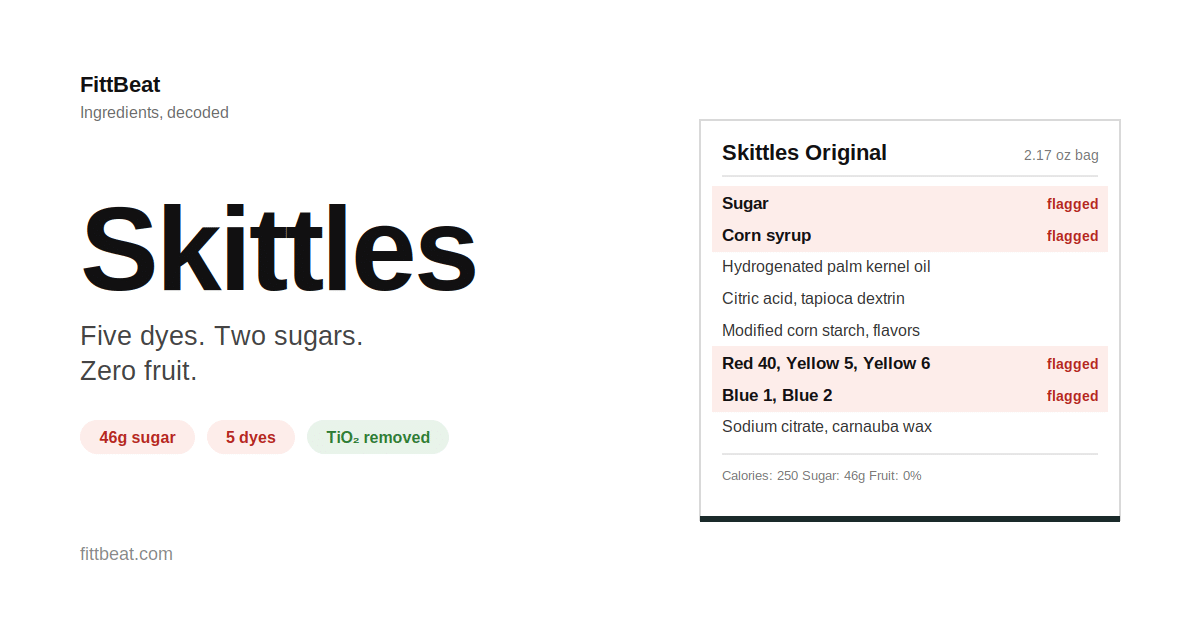

Last reviewed: October 2026. Reflects the current U.S. Skittles Original label; the bag photographed for this post is the 2.17 oz size. Titanium dioxide, which was on the label for years, has been removed from U.S. Skittles as of 2025; the dyes remain in the store bag. A version without synthetic dyes has been sold online since August 2026.
Skittles is the product that made “food dyes” a dinner-table topic. In 2022 a lawsuit over titanium dioxide produced the headline that Skittles were “unfit for human consumption”; in 2023 a California bill was misreported as a “Skittles ban”; in 2025 Mars quietly removed the titanium dioxide and kept everything else; and in 2026 it began selling a dye-free version online while the store bag stayed the same. Everything else is five synthetic dyes, two kinds of sugar, a hydrogenated oil, and a wax. Here’s all the Skittles ingredients, what each one does, what actually happened with the bans, and what the research says about the dyes.
Quick answer: what’s in Skittles?
Skittles are sugar, corn syrup, hydrogenated palm kernel oil, and less than 2% of citric acid, tapioca dextrin, modified corn starch, natural and artificial flavors, five synthetic dyes (Red 40, Yellow 5, Yellow 6, Blue 1, Blue 2, in both regular and “lake” forms), sodium citrate, and carnauba wax. A 2.17 oz bag has 250 calories, 45 g of sugar (about 11 teaspoons — more than a can of Coke), 2.5 g of saturated fat, and no fruit. The sugar is the main health issue; the dyes are the second, with the best-documented behavioral evidence in children. Titanium dioxide is gone. Skittles were never banned anywhere in the U.S.; the EU sells a version without synthetic dyes, and since August 2026 Mars has sold a dye-free U.S. version online — but the bag on store shelves still has all five.
Jump to: The label · Each ingredient · The five dyes · The “ban” and titanium dioxide · Nutrition · Verdict · FAQ
The full Skittles ingredients list
Sugar, Corn Syrup, Hydrogenated Palm Kernel Oil; Less Than 2% Of: Citric Acid, Tapioca Dextrin, Modified Corn Starch, Natural and Artificial Flavors, Colors (Includes Red 40 Lake, Yellow 5 Lake, Blue 2 Lake, Yellow 6 Lake, Blue 1 Lake, Yellow 6, Red 40, Yellow 5, Blue 1), Sodium Citrate, Carnauba Wax. Contains bioengineered food ingredients. Gluten-free, gelatin-free.
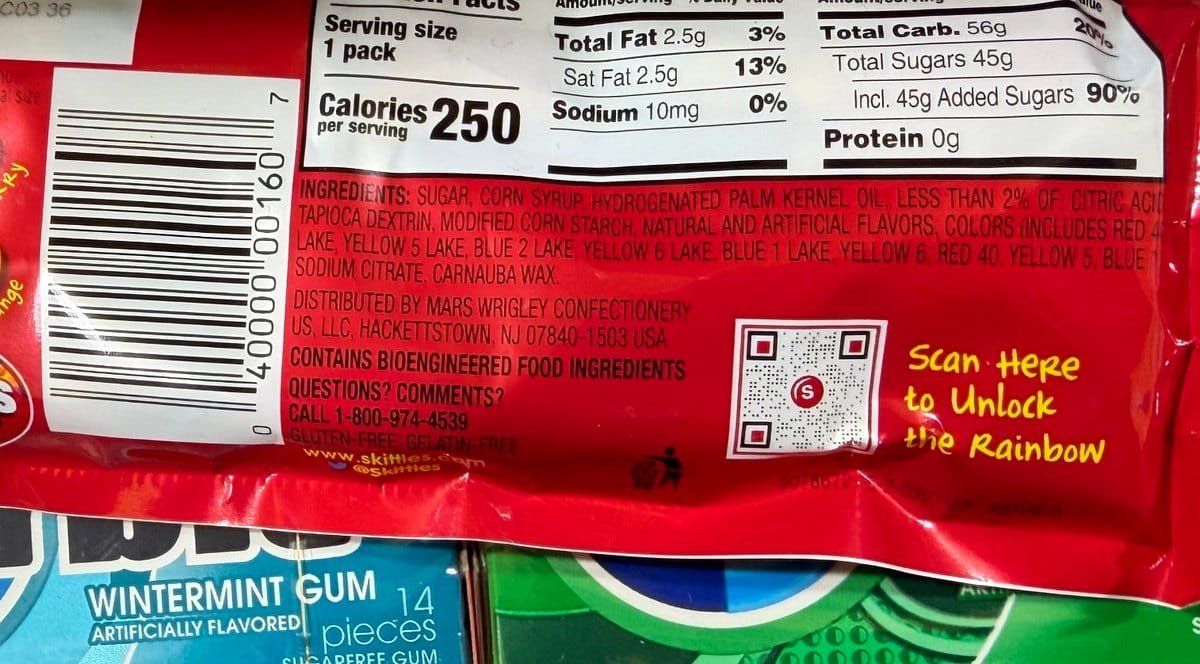
Three things to notice. The first three ingredients — two sugars and a hardened oil — are essentially the whole bag; everything after “less than 2%” is flavor, color, and shine. The dyes appear nine times because each one is listed in two forms: the water-soluble dye for the chewy center, and the “lake” (the dye bonded to aluminum) for the candy shell. And there’s no fruit anywhere on the label: the flavor is “natural and artificial flavors,” and the rainbow is five petroleum-derived colors.
Skittles ingredients explained
Sugar Flagged
Sucrose, the first ingredient by weight. Together with the corn syrup below it makes up 45 g per bag — all of it added sugar, 90% of the FDA’s daily value in one small bag and more than a 12 oz Coke. Candy sugar is absorbed slightly slower than liquid sugar because you chew it, but at this dose the distinction is thin. Daily intake at this level is linked to weight gain, type 2 diabetes, and tooth decay across the research. Our sugar and corn syrup breakdown covers the science.
Corn syrup Flagged
Regular corn syrup (mostly glucose), not high fructose corn syrup. In candy its job is texture: it prevents the sugar from crystallizing, which is what makes Skittles chewy rather than crunchy. Nutritionally it’s sugar; the two are counted together above.
Hydrogenated palm kernel oil Low concern, worth knowing
The fat that gives the shell its snap and keeps the center from going sticky. “Fully hydrogenated” oil is solid and contains essentially no trans fat (the partially hydrogenated kind, which did, was banned by the FDA in 2018). What it does contain is saturated fat: 2.5 g per bag, about 12% of the daily value. Minor for a treat; it’s the reason the bag has fat in it at all. Starburst, Skittles’ sister candy, uses the same oil.
Citric acid Fine
The sour note, and a mild preservative. Same molecule as in citrus fruit. It’s also part of why Skittles are hard on teeth: sugar plus acid, chewed, sticks to enamel longer than a drink does.
Tapioca dextrin and modified corn starch Fine
Starches that form the shell and bind the glaze. “Modified” means processed for a specific texture, not genetically modified. No concern.
Natural and artificial flavors Undisclosed
The fruit flavors — strawberry, orange, lemon, green apple (lime until 2013, back as a separate product since 2021), grape. All from flavor compounds, none from fruit. “Artificial” means some are synthesized; chemically that’s not a safety distinction. The reason every Skittle tastes like its color is the color; blindfolded tests consistently find people can’t tell the flavors apart.
Sodium citrate Fine
An acidity regulator balancing the citric acid. Trace amount.
Carnauba wax Fine
Palm-leaf wax from Brazil, the same thing in car polish and lipstick, used in a tiny amount to make the shell shiny. Indigestible, inert, and plant-based. It’s the one ingredient that sounds alarming and isn’t at all.
The five dyes
Red 40, Yellow 5, Yellow 6, Blue 1, and Blue 2 — five of the six synthetic dyes on the FDA’s 2025 phase-out list, in one bag. M&M’s carry the same five. Three of them (Red 40, Yellow 5, Yellow 6) were in the 2007 Southampton trial, the randomized study that found dye mixtures increased hyperactivity in children from the general population, and all three carry a child-behavior warning label in the EU. That warning is why Skittles sold in Europe are colored with paprika, spirulina, and black carrot extract instead — same brand, same shape, different label, because the company would rather reformulate than print the warning. The two blues weren’t in the Southampton study and have less evidence against them; they’re on the phase-out list by association.
Mars, which makes Skittles, has a long history with this. It pledged in 2016 to remove artificial colors from its products, walked that back in 2021, and through mid-2025 was the most prominent holdout as other big food companies signed on to the FDA’s phase-out. In July 2025 it changed course partway: it announced dye-free “options” for Skittles Original, M&M’s, Starburst Original, and Extra Spearmint, sold online in addition to — not instead of — the regular products. Those launched in August 2026. For M&M’s, Mars has said it aims to have every color natural by 2028; for Skittles it hasn’t announced a date to change the store bag, and the one photographed for this post, best by November 2027, still lists all five dyes. The state bans will force the issue regardless: California’s school-food ban takes effect December 31, 2027, and West Virginia’s statewide ban on January 1, 2028. Our Red 40 breakdown covers the behavioral research and the full timeline; the synthetic food dyes hub covers the other four.
The “Skittles ban” and titanium dioxide
Three things got tangled together in the headlines, and none of them was a ban on Skittles.
- The 2022 lawsuit. A California class action argued Skittles were “unfit for human consumption” because they contained titanium dioxide, a whitening pigment the EU banned in food in 2022 over unresolved questions about whether nanoparticles accumulate in the body. The suit was voluntarily dropped a few months later. Titanium dioxide remains FDA-approved.
- The 2023 “Skittles ban.” California’s AB 418, reported everywhere as the Skittles ban, originally included titanium dioxide — and then removed it before passage. The final law bans Red 3, brominated vegetable oil, potassium bromate, and propylparaben from 2027. Skittles contain none of them. Skittles were never banned in California or anywhere else in the U.S.
- The 2025 reformulation. Mars removed titanium dioxide from U.S. Skittles anyway, confirming it in May 2025. If your bag still lists it, it’s old stock. The five dyes are unchanged in the store bag.
The honest summary: the ingredient the lawsuit was about is gone, the ingredient the law was about was never in them, and the ingredients with the best evidence of harm — the sugar and the dyes — were never the subject of either.
Skittles nutrition facts
| Per package | Skittles (2.17 oz) | M&M’s (1.69 oz) | Starburst (2.07 oz) | Coca-Cola (12 oz) |
|---|---|---|---|---|
| Calories | 250 | 240 | ~240 | 140 |
| Total sugar | 45 g | 31 g | ~32 g | 39 g |
| Saturated fat | 2.5 g | 6 g | ~5 g | 0 g |
| Synthetic dyes | 5 | 5 | 4 | 0 (caramel) |
| Titanium dioxide | Removed 2025 | No | No | No |
| Gelatin | No | No | Yes | No |
| Fruit | 0% | — | Apple juice concentrate (under 2%) | — |
Starburst figures are scaled from its 6-piece (29 g) label to the 2.07 oz single pack. Gram for gram, Skittles are the most sugar of the three — about 73% sugar by weight — because there’s no chocolate or extra fat displacing it.
Are Skittles bad for you?
FittBeat verdict
Candy, with a dye problem on top. A bag of Skittles is 45 g of sugar — more than a can of Coke — and that’s the harm, same as any candy. What sets Skittles apart is five synthetic dyes in one serving, including the three with the strongest child-behavior evidence and an EU warning label, in a product marketed almost entirely to kids. The scary headlines were about the wrong ingredient; titanium dioxide is gone, and it was never the main issue. As an occasional treat for an adult, it’s a sugar hit. As a regular snack for a child, it’s one of the worst common choices — and the European bag and Mars’s own online dye-free version prove it doesn’t have to be.
The concerns, ranked by evidence:
- Sugar. 45 g per bag, 90% of the daily value, nearly double a child’s daily limit.
- Teeth. Sugar plus citric acid, chewed and stuck to enamel. Sticky candy is the dentist’s worst case.
- The dyes in children. Randomized-trial evidence of a modest hyperactivity effect in some kids; five dyes at once; being phased out by law in several states.
- Saturated fat. 2.5 g from the palm kernel oil; minor.
- Everything else. Dextrin, starch, wax, citrate: no meaningful evidence of harm.
Skittles for kids, vegans, and allergies
Kids: the product most of the dye research is effectively about. If a child seems to react to brightly colored foods, this is the first thing to cut, and there’s no nutritional cost to doing it.
Vegans: U.S. Skittles Original are vegan by ingredient since Mars dropped gelatin in 2010 and carmine earlier; the sugar may be processed with bone char, which some vegans count. Carnauba wax is plant-based. Starburst, by contrast, still contains gelatin in the U.S.
Allergies: no milk, egg, nuts, soy, wheat, or gelatin in Original; the bag is labeled gluten-free and gelatin-free, and “contains bioengineered food ingredients” (the corn syrup and starch). Yellow 5 is the one dye with documented sensitivity reactions (hives, asthma) in a small number of people, which is why it’s required to be named on labels.
Cleaner alternatives
For Skittles without the dyes: Mars’s own dye-free Skittles, sold online since August 2026, or the European version, which shows up in import shops. For fruit chews without synthetic dyes from other brands: YumEarth and Black Forest organic fruit snacks use fruit and vegetable colors; SmartSweets cuts the sugar as well (stevia and allulose, 3 g per bag). Welch’s Fruit Snacks have no dyes either, though most of their sugar is still added. Otherwise: a small bag, not a share size, and not every day.
Frequently asked questions
Are Skittles banned?
No. Skittles were never banned in the U.S. California’s 2023 food-additive law (reported as a “Skittles ban”) dropped titanium dioxide before passage and bans four other additives Skittles don’t contain. The EU sells Skittles with vegetable-based colors instead of synthetic dyes.
Do Skittles still have titanium dioxide?
No. Mars removed it from U.S. Skittles, confirmed in May 2025. Bags that still list it are old stock. The EU banned titanium dioxide in food in 2022.
What dyes are in Skittles?
Red 40, Yellow 5, Yellow 6, Blue 1, and Blue 2, each in both regular and “lake” form — five synthetic dyes, all on the FDA’s 2025 phase-out list.
How much sugar is in a bag of Skittles?
45 g in a 2.17 oz bag — about 11 teaspoons, 90% of the daily value, and more than a 12 oz Coca-Cola.
Are Skittles vegan?
By ingredient, yes — U.S. Skittles Original contain no gelatin, carmine, or dairy, and the bag is labeled gelatin-free. The sugar may be processed with bone char, which some vegans avoid.
Do Skittles have real fruit?
No. The flavors are natural and artificial flavorings and the colors are synthetic dyes. There is no fruit in Skittles.
Is Mars removing dyes from Skittles?
Partly. Since August 2026 Mars has sold a dye-free version of Skittles Original online, alongside dye-free M&M’s and Starburst, but the regular bag in stores is unchanged and Mars hasn’t set a date to switch it. State bans in California schools (December 31, 2027) and West Virginia (January 1, 2028) will apply regardless.
Why do all Skittles taste the same?
Because the flavor differences are small and the colors do most of the work. In blind tests most people can’t reliably tell the flavors apart.
Sources
- Mars Wrigley. Nutrition facts and ingredients, Skittles Original, 2.17 oz bag (best by November 2027), photographed October 2026.
- McCann D, et al. Food additives and hyperactive behaviour in 3-year-old and 8/9-year-old children in the community. The Lancet, 2007. doi:10.1016/S0140-6736(07)61306-3
- California OEHHA. Health effects assessment: potential neurobehavioral effects of synthetic food dyes in children, 2021. oehha.ca.gov
- HHS and FDA. HHS, FDA to phase out petroleum-based synthetic dyes in nation’s food supply. April 22, 2025. fda.gov
- NewsNation. M&M’s, Starburst without synthetic dyes coming in 2026, Mars says. August 2025. newsnationnow.com
- Fox Business. M&M’s set August launch for dye-free candies, with 2 colors absent. June 19, 2026. foxbusiness.com
- EFSA. Safety assessment of titanium dioxide (E171) as a food additive. EFSA Journal, 2021. doi:10.2903/j.efsa.2021.6585
- California AB 418 (California Food Safety Act), 2023, as enacted — bans Red 3, brominated vegetable oil, potassium bromate, and propylparaben effective 2027.
- Center for Science in the Public Interest. Synthetic dyes corporate commitment tracker. cspi.org
- U.S. FDA. Added sugars on the Nutrition Facts label. fda.gov
Titanium dioxide removal confirmed by Mars in May 2025, as reported by Bloomberg and trade press. M&M’s and Starburst figures are from our own breakdowns of each.
This article is for informational purposes and is not medical advice. Talk to a doctor or registered dietitian about your individual nutrition needs.
