

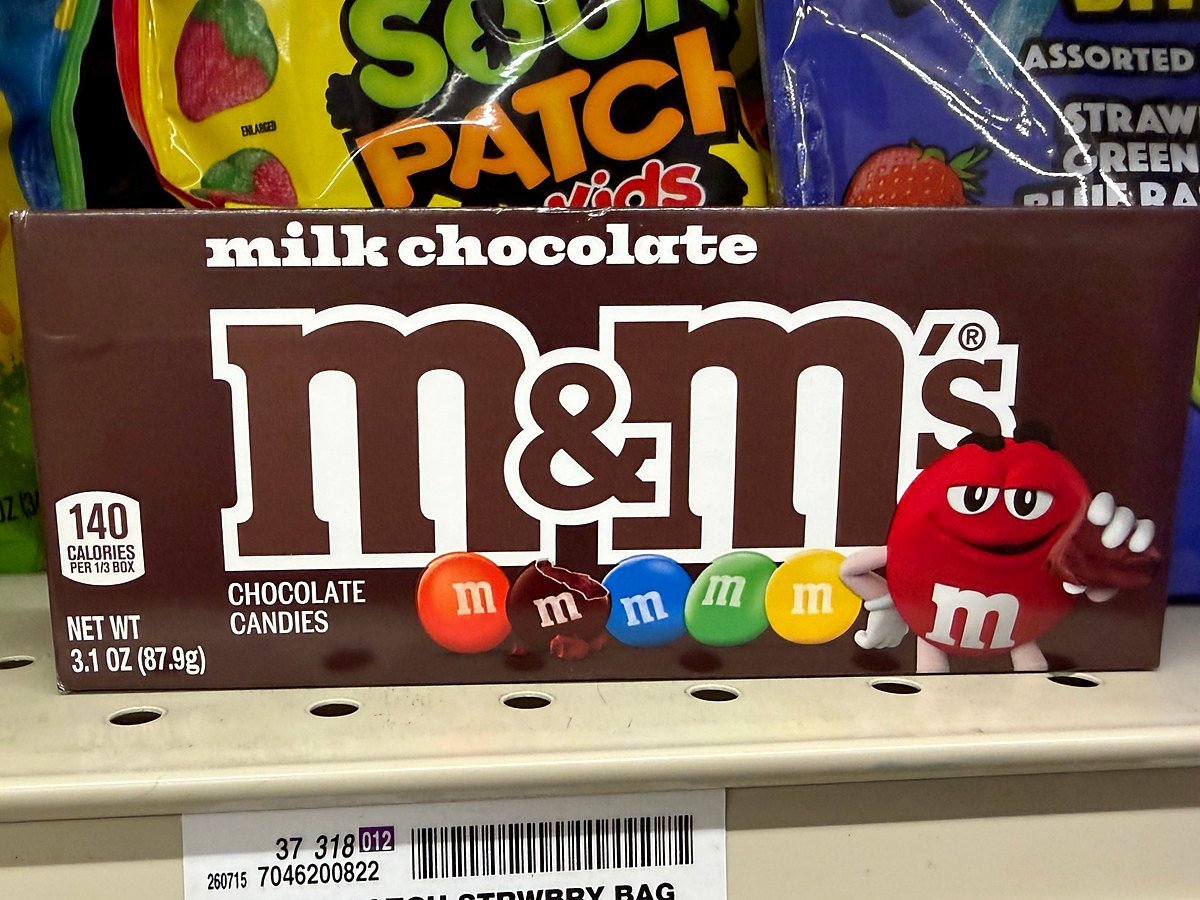
Last reviewed: October 2026. Reflects the U.S. M&M’s Milk Chocolate label; the box photographed for this post is the 3.1 oz (87.9 g) theater box, which is three servings. Peanut, Peanut Butter, Crispy, and the other varieties share the shell but have their own centers and are noted where they differ.
M&M’s are two products in one piece. The inside is real milk chocolate — sugar, chocolate, skim milk, cocoa butter, milkfat — that meets the FDA’s legal definition of the term, which is more than a lot of “chocolatey” candy can say. The outside is a sugar shell colored with five synthetic dyes that appear on the label in ten forms, in a year when the FDA has asked food makers to stop using every one of them. And the box prints “140 calories” on the front in large type for a package that holds 420 of them and a full day’s added sugar. Here’s all the M&M’s ingredients, what it’s doing, and where the dye-free version actually stands.
Quick answer: what’s in M&M’s?
M&M’s Milk Chocolate are milk chocolate (sugar, chocolate, skim milk, cocoa butter, lactose, milkfat, soy lecithin, salt, natural flavor), sugar, and cornstarch, with less than 1% corn syrup, dextrin, colors (Blue 1, Blue 2, Red 40, Yellow 5, and Yellow 6, each as a dye and as an aluminum lake), carnauba wax, and gum acacia. A 1/3-box serving (29 g, about 23 pieces) is 140 calories, 19 g of sugar (18 g added), 6 g of fat, and 20 mg of sodium. The whole 3.1 oz box is 420 calories, 57 g of sugar (53 g added, 106% of the daily value), 16 g of fat, and 10 g of saturated fat — half a day’s worth. There are no preservatives, no artificial flavors, no gelatin, and no hydrogenated oil. The chocolate is the honest part; the dyes are the problem, and a dye-free version exists but only online.
Jump to: Full label · Each ingredient · The dye situation · Nutrition facts · Verdict · FAQ
The full M&M’s ingredients list
Milk Chocolate (Sugar, Chocolate, Skim Milk, Cocoa Butter, Lactose, Milkfat, Soy Lecithin, Salt, Natural Flavor), Sugar, Cornstarch; Less than 1% of: Corn Syrup, Dextrin, Colors (includes Blue 1 Lake, Yellow 6, Red 40, Yellow 5, Blue 1, Yellow 6 Lake, Red 40 Lake, Yellow 5 Lake, Blue 2 Lake, Blue 2), Carnauba Wax, Gum Acacia. Contains milk and soy. May contain peanuts. Contains bioengineered food ingredients. “No artificial flavors.” Distributed by Mars Wrigley Confectionery US, LLC.

Three things to notice. Sugar is the first ingredient inside the milk chocolate and then the second ingredient of the candy as a whole, because the shell is almost entirely sugar — so it’s the lead ingredient twice. The color entry lists ten items but only five dyes: each one appears as the plain dye and again as a “lake,” which is the same dye bound to aluminum so it won’t bleed. And the box’s nutrition panel has a small error: potassium is listed as 0 mg per serving and 260 mg per pack, which can’t both be true (the real per-serving figure would be about 87 mg). It’s harmless, but it’s a reminder that labels are typed by people.
M&M’s ingredients explained
Milk chocolate Real chocolate
This is the part M&M’s gets right. To be called “milk chocolate” in the U.S., a product has to meet the FDA’s standard of identity: at least 10% chocolate liquor, 12% milk solids, and 3.39% milkfat, with cocoa butter as the fat. M&M’s center does — the sub-list is sugar, chocolate (the liquor), skim milk, cocoa butter, lactose, milkfat, soy lecithin, salt, and natural flavor, in that order. There’s no palm or shea substitute, which is why some competing coated candies have to call themselves “chocolatey” or “chocolate flavored.” Sugar comes first in the sub-list, as it does in nearly every milk chocolate; a Hershey’s bar is built the same way. Lactose is milk sugar added separately for texture and sweetness, and it’s why the box’s total sugars (57 g) run above its added sugars (53 g).
Sugar Flagged
Listed again as the second ingredient of the whole candy, because the crunchy shell is panned sugar — layer after layer of sucrose syrup dried onto the chocolate. Between the two listings, sugar is roughly two-thirds of the weight of an M&M. The box carries 53 g of added sugar, 106% of the FDA’s daily value, in a package that many people treat as a single sitting at the movies. Per 29 g serving it’s 18 g added, which is a reasonable dessert portion; the problem is that the serving is a third of the box and the front of the box only tells you about the third. The health picture for sugar at this dose is the same as for any candy or soda: large cohort studies tie regular intake to weight gain, type 2 diabetes, and cardiovascular risk. Our sugar and corn syrup breakdown covers the research; this is cane or beet sucrose, and the body treats it the same way.
Cornstarch Fine
The body of the shell, along with sugar. It gives the coating its matte, crisp structure before the color and glaze go on. Plain starch; the label’s “bioengineered” line most likely refers to this, the soy lecithin, and the sugar if it’s from beets.
Corn syrup and dextrin Trace
Both under 1%. Corn syrup (regular, not high-fructose) keeps the shell syrup from crystallizing wrong; dextrin, a partly broken-down starch, acts as the binder that holds the color layers on. Neither is meaningful at this amount.
Colors: Red 40, Yellow 5, Yellow 6, Blue 1, Blue 2 Flagged
The whole reason M&M’s look like M&M’s. Five of the six petroleum-derived FD&C dyes still permitted in the U.S. are on this label, each twice — once as the water-soluble dye that tints the sugar syrup, once as an aluminum lake, the insoluble form that gives the shell its opaque, even coat and keeps colors from bleeding onto your hands. Lakes are regulated as the same color additive and count the same way. Red 40 is the most-used dye in American food and the one most studied; the other four are covered in our synthetic dyes explainer. The honest summary of the evidence: these dyes are not carcinogens at food levels, but a 2007 randomized trial in The Lancet and a 2021 California state review both found that mixtures of them can worsen attention and activity in some children, and the effect doesn’t track with a prior ADHD diagnosis. Europe requires a warning label on foods with Yellow 5, Yellow 6, and Red 40. The U.S. does not, but in April 2025 the FDA asked manufacturers to phase out all six remaining synthetic dyes by the end of 2026 — which brings us to the next section.
Carnauba wax Fine
Wax from the leaves of a Brazilian palm, polished on last to give the shell its shine and keep pieces from sticking together. It’s the same wax on apples, in lip balm, and on cars. It isn’t digested and is harmless at the trace amount used.
Gum acacia Fine
Also called gum arabic, the dried sap of the acacia tree. Here it’s the glaze that seals the color layers under the wax. It’s a soluble fiber, used in far larger amounts in some sodas and fiber supplements, and raises no concerns at this level.
What isn’t on the label Credit where due
No preservatives — the shell and the low moisture do that job. No artificial flavors, as the box says. No hydrogenated or partially hydrogenated oil, no palm kernel oil, no gelatin, and no titanium dioxide, which many coated candies use for a white base layer (and which was briefly the center of the “Skittles ban” story). That’s a cleaner build than most of the candy aisle; the dyes are what keep it from being a clean one.
The dye situation: where the dye-free M&M’s stand
Mars has a history here. In 2016 it pledged to remove all artificial colors from its human foods within five years, then walked it back in 2021, saying U.S. consumers hadn’t asked for the change. Through mid-2025 it was the most prominent holdout as General Mills, PepsiCo, Kraft Heinz, Hershey, and others signed on to the FDA’s voluntary phase-out. That changed in late July 2025, when Mars Wrigley announced dye-free “options” for M&M’s, Skittles Original, Starburst Original, and Extra Spearmint for 2026.
The M&M’s version launched in August 2026 for the brand’s 85th anniversary, sold initially only on Amazon. Two colors are missing from the bag: blue and brown, because the natural replacement — spirulina extract — has been clogging spray equipment and costs far more than the dye it replaces. Mars says it aims to have every color in the bag natural by 2028. In the meantime, the box on every store shelf, including the one photographed for this post, is the unchanged formula with all five dyes. If you’re buying M&M’s to avoid synthetic colors, the only one that qualifies is the online product, and only until the shelves turn over — which, as of this writing, they haven’t begun to do.
Read next: Skittles ingredients — Mars’s other dye-heavy candy, the one the “ban” headlines were about, and how its label compares.
M&M’s nutrition facts
| Per package | M&M’s (1/3 box, 29 g) | M&M’s (full 3.1 oz box) | Skittles (2.17 oz bag) | Hershey’s Milk Chocolate (1.55 oz bar) | Oreo (3 cookies) |
|---|---|---|---|---|---|
| Calories | 140 | 420 | 250 | 210 | 160 |
| Total sugar | 19 g | 57 g | 45 g | 24 g | 14 g |
| Added sugar | 18 g | 53 g (106% DV) | 45 g | 24 g | 13 g |
| Total fat | 6 g | 16 g | 2.5 g | 13 g | 7 g |
| Saturated fat | 3.5 g | 10 g (50% DV) | 2.5 g | 8 g | 2 g |
| Sodium | 20 mg | 60 mg | 20 mg | 35 mg | 135 mg |
| Synthetic dyes | 5 | 5 | 5 | None | None |
| Preservatives | None | None | None | None | None |
Two things the table shows. Gram for gram, M&M’s are less sugar than Skittles — about 65% sugar by weight against Skittles’ roughly 90% — because a third of each piece is chocolate, which brings fat and a little protein with it. And the full box is a different food from the serving: 10 g of saturated fat is half the daily value, and nothing on the front of the package hints at it.
M&M’s vs. Skittles: which is the lesser evil?
Same company, same shell technology, same five dyes. The difference is the center. Skittles are sugar through and through — 45 g in a 2.17 oz bag, no fat, no protein. M&M’s trade some of that sugar for cocoa butter and milk: more calories per ounce, more saturated fat, less sugar. If sugar is what you’re watching, M&M’s win by weight; if calories are, Skittles do. If dyes are, neither does, and the only real move is the dye-free M&M’s bag or a plain chocolate bar. Our Skittles breakdown and Starburst breakdown cover the rest of Mars’s fruit-candy shelf.
Are M&M’s bad for you?
FittBeat verdict
Honest chocolate, dishonest packaging, and a shell that’s about to be redesigned. M&M’s are a real milk-chocolate candy with no preservatives, no fake flavors, and no hydrogenated fat — a better build than most of the aisle. The problems are the five synthetic dyes, which the FDA wants gone and Mars is slowly replacing, and the box, which advertises 140 calories for a package that holds 420 and more than a day’s added sugar. As an occasional treat in a fun-size or single serving, they’re fine. The theater box is a dessert for three. For kids who react to dyes, the store-shelf version is the wrong M&M; the dye-free bag is online.
The concerns, ranked by evidence:
- Sugar and the serving math. 53 g of added sugar per box is the clearest harm, and the front-of-box “140 calories” invites you to miss it. Portion is the whole game with this candy.
- Synthetic dyes. Five dyes, ten entries. Well-replicated evidence of behavioral effects in a subset of children; a federal phase-out request with a 2026 target; a company that has missed one pledge already.
- Saturated fat. 10 g per box from cocoa butter and milkfat. Real, but the same as any milk chocolate and not a reason to pick a candy without it.
- Teeth. A hard sugar shell that dissolves slowly is close to the ideal substrate for cavities. Less acidic than sour candy, though.
- Everything else. Cornstarch, dextrin, corn syrup, carnauba wax, gum acacia, soy lecithin — nothing here has credible evidence of harm at these amounts.
M&M’s for kids, allergies, keto, and vegetarians
Kids: the dyes are the question. The 2007 Southampton trial and California’s 2021 review found that mixtures of Red 40, Yellow 5, Yellow 6, and Blue 1 — four of the five here — can increase hyperactivity and reduce attention in some children, not only those with ADHD. If you’ve noticed a pattern, M&M’s are a high-dose source. The dye-free Amazon bag is the workaround until the regular product changes. On sugar, a fun-size pack (about 10 g) is a sane kid portion; the theater box is not.
Allergies: contains milk and soy; “may contain peanuts” because Peanut M&M’s run on shared lines, so this is not a safe candy for a peanut allergy despite having no peanuts in it. Milk Chocolate M&M’s have no gluten ingredients but aren’t certified gluten-free; the Pretzel and Crispy varieties contain wheat. The box carries the OU-D kosher dairy mark.
Keto and diabetes: no. 21 g of carbohydrate per serving, almost all sugar. There’s no sugar-free M&M; the closest is a square of 85% dark chocolate.
Vegetarian and vegan: vegetarian yes — no gelatin, unlike Starburst, and no carmine (the insect-derived red). Vegan no, because of the milk. The dyes are synthetic, not animal-derived.
Cleaner alternatives
If you want M&M’s without the dyes, the dye-free M&M’s bag on Amazon is the same chocolate under natural colors, minus blue and brown for now. If you want less sugar per ounce, Peanut M&M’s swap part of the chocolate for peanut and land around 25 g of sugar in a 1.74 oz single pack against about 31 g for the same size of Milk Chocolate — the peanut is doing real work. If you want the chocolate without the shell, a plain Hershey’s or Dove milk chocolate bar has no dyes and a shorter list, and a square or two of 70% dark chocolate has a third of the sugar and no color at all. And the simplest fix for the theater box is the one printed on it: it’s three servings, so share it or close it.
Frequently asked questions
What are M&M’s made of?
A milk chocolate center (sugar, chocolate, skim milk, cocoa butter, lactose, milkfat, soy lecithin, salt, natural flavor) inside a shell of sugar and cornstarch, colored with Red 40, Yellow 5, Yellow 6, Blue 1, and Blue 2, bound with dextrin and corn syrup, and glazed with gum acacia and carnauba wax.
Do M&M’s have artificial dyes?
Yes. The regular Milk Chocolate M&M’s sold in stores contain five synthetic dyes — Red 40, Yellow 5, Yellow 6, Blue 1, and Blue 2 — each listed as both a dye and an aluminum lake. A dye-free version launched in August 2026, sold initially only on Amazon and missing the blue and brown pieces.
Is the chocolate in M&M’s real chocolate?
Yes. It meets the FDA standard of identity for milk chocolate — chocolate liquor, cocoa butter, and milk solids with no vegetable-fat substitute — which is why the box can legally say “milk chocolate” rather than “chocolatey.”
How much sugar is in M&M’s?
19 g per 29 g serving (18 g added), and 57 g per 3.1 oz theater box (53 g added, 106% of the daily value). A fun-size pack has about 10 g.
How many calories are in a box of M&M’s?
The 3.1 oz theater box is 420 calories. The “140 calories” printed on the front is for one third of the box, which is the labeled serving.
Are M&M’s gluten-free?
Milk Chocolate M&M’s contain no gluten ingredients but aren’t certified gluten-free. Pretzel and Crispy M&M’s contain wheat.
Are M&M’s vegetarian or vegan?
Vegetarian, yes — there’s no gelatin or carmine. Vegan, no, because the chocolate contains skim milk, lactose, and milkfat.
Are M&M’s safe for a peanut allergy?
No. Milk Chocolate M&M’s contain no peanuts, but the label says “may contain peanuts” because they’re made on equipment shared with Peanut M&M’s.
Sources
- Mars Wrigley Confectionery US, LLC. Nutrition facts and ingredients, M&M’s Milk Chocolate, 3.1 oz (87.9 g) box, photographed October 2026.
- U.S. FDA. 21 CFR 163.130, Milk chocolate (standard of identity). ecfr.gov
- U.S. FDA / HHS. HHS, FDA to phase out petroleum-based synthetic dyes in nation’s food supply. Press announcement, April 22, 2025. fda.gov
- Fox Business. M&M’s set August launch for dye-free candies, with 2 colors absent. June 19, 2026. foxbusiness.com
- NewsNation. M&M’s, Starburst without synthetic dyes coming in 2026, Mars says. August 2025. newsnationnow.com
- McCann D, et al. Food additives and hyperactive behaviour in 3-year-old and 8/9-year-old children in the community: a randomised, double-blinded, placebo-controlled trial. The Lancet, 2007. doi:10.1016/S0140-6736(07)61306-3
- California OEHHA. Health effects assessment: potential neurobehavioral effects of synthetic food dyes in children. 2021. oehha.ca.gov
- Yang Q, et al. Added sugar intake and cardiovascular diseases mortality among US adults. JAMA Internal Medicine, 2014. doi:10.1001/jamainternmed.2013.13563
- Malik VS, et al. Sugar-sweetened beverages and risk of metabolic syndrome and type 2 diabetes. Diabetes Care, 2010. doi:10.2337/dc10-1079
Skittles, Hershey’s, and Oreo figures in the comparison table are from those products’ current U.S. labels; the Skittles and Oreo values are the ones in our own breakdowns of each.
This article is for informational purposes and is not medical advice. Talk to a doctor or registered dietitian about your individual nutrition needs.
