

Last reviewed: October 2026. Reflects the U.S. label on Jack Link’s Original Beef Jerky, 2.85 oz bag (about 3 servings), photographed in store. Teriyaki, Peppered, and the other flavors have different seasonings and sugar levels.
Jack Link’s is the biggest name in American jerky, and on the numbers that matter most to people who buy jerky, it delivers: 10 grams of protein and only 1.5 grams of fat in an ounce, from a label that starts with beef. It’s a genuinely lean snack. But sugar and brown sugar are ingredients three and four, an ounce carries 520 mg of sodium, and the two claims printed across the top of the bag — “no added nitrates or nitrites” and “no added MSG” — both have asterisks for a reason. Here’s all Jack Link’s beef jerky ingredients, what each one does, and what the front of the bag doesn’t say.
Quick answer: what’s in Jack Link’s beef jerky?
Jack Link’s Original Beef Jerky is beef, water, sugar, and brown sugar, with 2% or less of sea salt, salt, soy sauce (wheat, soybeans, salt), hydrolyzed corn protein, yeast extract, flavors, maltodextrin, cultured celery extract, beef stock, pineapple powder, and citric acid. A 1 oz serving has 80 calories, 1.5 g of fat (0.5 g saturated), 520 mg of sodium (23% of the daily value), 6 g of carbohydrate, 6 g of added sugar, and 10 g of protein. The 2.85 oz bag totals 230 calories, 1,490 mg of sodium (65% of a day), 16 g of added sugar, and 30 g of protein. It’s a lean, high-protein snack with a lot of salt and more sugar than most people expect in meat. The celery extract is a natural nitrite cure, and the hydrolyzed corn protein and yeast extract supply the same glutamate as MSG.
Jump to: Full label · Each ingredient · The two front-label claims · Nutrition facts · Jerky vs. meat sticks · Verdict · FAQ
The full Jack Link’s Beef Jerky ingredients list
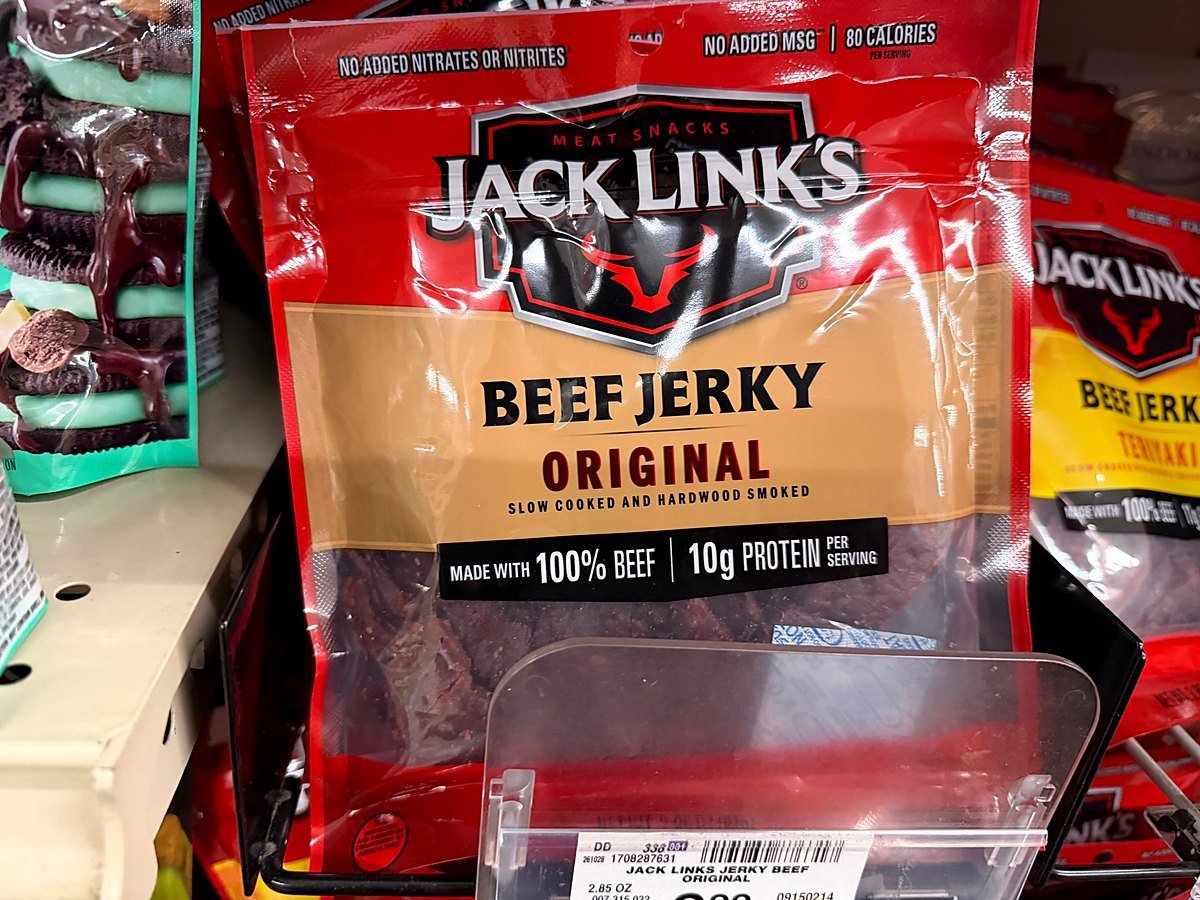
Beef, Water, Sugar, Brown Sugar, Contains 2% or less of: Sea Salt, Salt, Soy Sauce (Wheat, Soybeans, Salt), Hydrolyzed Corn Protein, Yeast Extract, Flavors, Maltodextrin, Cultured Celery Extract, Beef Stock, Pineapple Powder, Citric Acid. Contains: wheat, soy. Front of bag: “No added nitrates or nitrites*,” “No added MSG**,” “Made with 100% beef,” “10 g protein per serving.” Link Snacks, Inc., Minong, WI.
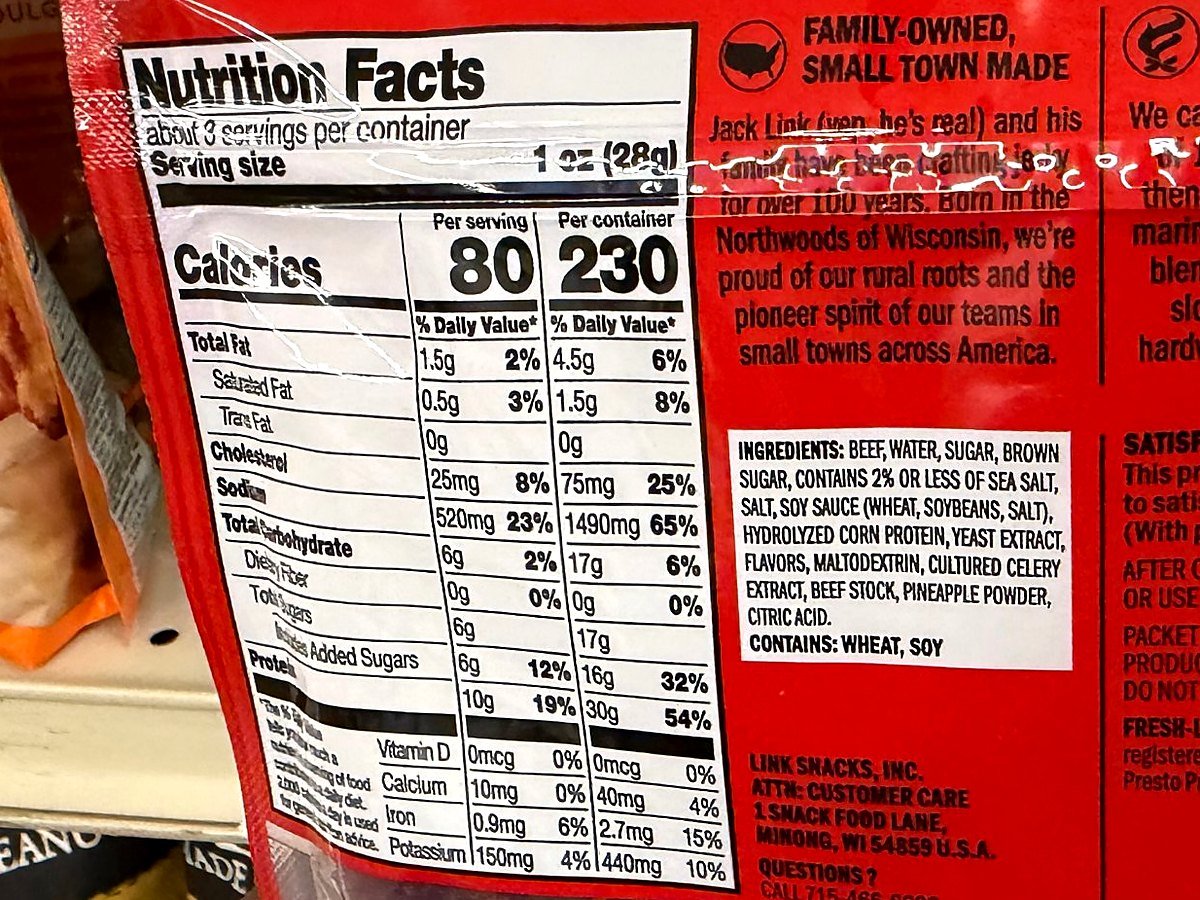
Three things to notice. Beef really is first, and “made with 100% beef” is true in the sense that it’s the only meat — no pork, no chicken, no soy filler. Sugar and brown sugar are third and fourth, ahead of every seasoning, which is why an ounce of dried beef has 6 g of added sugar. And the bag is printed with a per-container column for a reason: a 2.85 oz bag is easy to finish, and finishing it means 1,490 mg of sodium, two-thirds of a day’s limit, in a snack.
Jack Link’s ingredients explained
Beef Real meat
Whole-muscle beef, sliced and marinated, then slow-cooked and hardwood-smoked — not ground and re-formed like a meat stick. That’s why jerky is so lean: the fat is trimmed before drying, leaving 1.5 g per ounce against 7 g in a Chomps stick and 10 g in a Slim Jim. Half of the 80 calories come from protein. This bag makes no grass-fed or raised-without-antibiotics claim, so assume conventionally raised beef.
Water Fine
Part of the marinade, most of which dries off during cooking. It’s second because the marinade goes on before drying and ingredients are listed by weight at that point.
Sugar and brown sugar Flagged: 6 g added
The surprise on a meat label. Original jerky is sweet-savory by design, and the sugar balances the salt and helps the surface brown and form a glaze. Six grams of added sugar per ounce is 12% of the daily value — modest for a snack, but it’s 6 g more than a Chomps stick and 5 g more than a Slim Jim. It also means a bag is 16 g of added sugar, about four teaspoons, in a product most people buy precisely because they’re avoiding sugar. Brown sugar is white sugar with molasses; nutritionally it’s the same.
Sea salt and salt Flagged: 520 mg
Salt is what makes jerky shelf-stable — drying plus salt keeps bacteria from growing — and “sea salt” is nutritionally identical to table salt. Between the two salts, the soy sauce, and the flavor enhancers, an ounce carries 520 mg of sodium, 23% of the daily limit. That’s more sodium per ounce than a Slim Jim (about 465 mg) or Chomps (about 335 mg). Per gram of protein it’s better than a meat stick; per ounce it’s one of the saltier snacks we’ve broken down, close to Takis.
Soy sauce Contains wheat
Brewed from wheat, soybeans, and salt. It adds savory depth and more sodium, and it’s the reason the label says “Contains: wheat, soy.” That makes Jack Link’s Original unsuitable for celiac disease or a soy allergy, unlike Chomps, which is certified gluten-free.
Hydrolyzed corn protein and yeast extract Glutamate sources
Both are flavor enhancers that work the way MSG does. Hydrolyzing a protein breaks it down into free amino acids, including glutamate; yeast extract is rich in glutamate and the nucleotides that amplify it. The bag says “no added MSG,” which is literally true — monosodium glutamate isn’t on the list — but the savory compound MSG supplies is there by another route. That isn’t a safety problem: glutamate is safe whether it comes from MSG, yeast, cheese, or tomatoes. It’s a labeling problem, covered below.
Flavors and maltodextrin Undisclosed
“Flavors” covers smoke and spice notes beyond the hardwood smoking; the label doesn’t specify natural or artificial or say what they are. Maltodextrin is a starch carrier for the seasoning.
Cultured celery extract Flagged: it’s the cure
Celery is naturally high in nitrate; culturing it with bacteria converts that nitrate to nitrite, the same compound as sodium nitrite. In jerky it does what nitrite always does: keeps the meat red, adds cured flavor, and guards against bacteria. USDA rules require products cured this way to say “no added nitrates or nitrites” with a qualifier naming the source — which is exactly what this bag does. It’s the same system Chomps uses, and the same fine print. See below.
Beef stock Fine
Adds beefy flavor to the marinade. Harmless.
Pineapple powder Tenderizer and flavor
Pineapple contains bromelain, an enzyme that breaks down muscle protein, which is why pineapple juice is a classic meat tenderizer. In a jerky marinade, pineapple powder most likely does that job and adds a little fruity sweetness. Jack Link’s doesn’t say which. Either way it’s harmless.
Citric acid Fine
Adds tang and lowers pH slightly, which helps shelf stability and can speed the cure. Harmless.
The two front-label claims, and their asterisks
“No added nitrates or nitrites*.” The cure here comes from cultured celery extract, which supplies nitrite to the meat. Under current USDA labeling rules, a product cured with a natural nitrite source isn’t legally “cured,” so it’s required to carry the “no added nitrates or nitrites” wording along with a note naming the natural source. Consumer Reports testing has found nitrite and nitrate levels in celery-cured meats comparable to conventionally cured ones, and the USDA said in 2020 it would move to prohibit the claim on any product made with any nitrite source; as of the agency’s last update in 2024 that rule was still being drafted. The claim is legal and the asterisk is honest. It just doesn’t mean what most people read it to mean. Our Chomps breakdown covers the rule in detail.
“No added MSG**.” The FDA’s own guidance says foods containing ingredients that naturally contain free glutamate — it names yeast extract and hydrolyzed vegetable protein — cannot claim “no MSG” or “no added MSG.” Jerky is a meat product, so its label falls under the USDA rather than the FDA, and this bag carries the claim with a double asterisk. The chemistry is the same either way: hydrolyzed corn protein and yeast extract are there to supply glutamate. If you avoid MSG because you believe you react to it, this jerky isn’t a workaround. If you don’t, there’s nothing to worry about; MSG and glutamate are safe.
The bottom line on both: the front of the bag describes what wasn’t added in its named form, not what’s in the jerky. Read the ingredient list.
Jack Link’s nutrition facts
| Per serving | Jack Link’s Original Jerky (1 oz) | Chomps Original stick (1.15 oz) | Chomps Mini stick (0.5 oz) | Slim Jim Giant (0.97 oz) |
|---|---|---|---|---|
| Calories | 80 | 100 | 45 | 130 |
| Total fat | 1.5 g | 7 g | 3 g | 10 g |
| Saturated fat | 0.5 g | 3 g | 1.5 g | 3.5 g |
| Sodium | 520 mg | 380 mg | 170 mg | 450 mg |
| Sodium per ounce | ~525 mg | ~335 mg | ~340 mg | ~465 mg |
| Added sugar | 6 g | 0 g | 0 g | 1 g |
| Protein | 10 g | 10 g | 4 g | 6 g |
| Protein per ounce | ~10 g | ~9 g | ~8 g | ~6 g |
| Cure | Celery extract | Celery powder | Celery + cherry powder | Sodium nitrite |
| Gluten-free | No (soy sauce) | Certified | Certified | No (barley) |
Jerky wins on protein per calorie by a wide margin: Jack Link’s is half protein by calories, while meat sticks are mostly fat. It loses on sodium and sugar. Chomps figures are from its current labels (the mini from the bag photographed for our post); Slim Jim from its Giant stick label.
Jerky vs. meat sticks: which is the better snack?
They’re different foods. Jerky is whole-muscle beef with the fat trimmed and the marinade dried on, so it’s lean and high in protein but carries whatever salt and sugar the marinade had. A meat stick is ground meat and fat stuffed into a casing, so it’s fattier and lower in protein per ounce, but can be made with no sugar at all, as Chomps is. If you want the most protein for the fewest calories, Jack Link’s jerky is the better choice. If you’re limiting sugar or need gluten-free, Chomps is. Both are cured, salted processed meats, and the World Health Organization’s cancer agency classifies all processed meat in its highest-evidence group based on colorectal cancer risk with regular, daily intake — the risk rises about 18% per 50 g a day, a little under two ounces. Neither label changes that.
Is Jack Link’s beef jerky healthy?
FittBeat verdict
A lean, high-protein snack with a sugar-and-salt marinade and a front label that tells you what wasn’t added, not what’s in it. Jack Link’s Original is real whole-muscle beef with 10 g of protein and only 1.5 g of fat an ounce — a better protein-to-calorie ratio than any meat stick. The costs are 520 mg of sodium and 6 g of added sugar per ounce, and a bag that most people finish. “No added nitrates or nitrites” means the cure came from celery; “no added MSG” means the glutamate came from yeast extract and hydrolyzed corn protein. One serving is a good portable protein. A bag a day is a lot of salt and a daily processed meat.
The concerns, ranked by evidence:
- Processed meat, daily. The WHO Group 1 classification applies to cured, salted jerky as much as to sticks and bacon, celery cure or not. It’s about habitual intake.
- Sodium. 520 mg an ounce, 1,490 mg a bag. The single biggest number on the label.
- Added sugar. 6 g an ounce, 16 g a bag, in a product shoppers often pick to avoid sugar.
- The front-label claims. Not a health risk, but both lead people to think they’re avoiding something they aren’t.
- Everything else. Beef stock, pineapple powder, citric acid, maltodextrin, and the glutamate sources have no credible evidence of harm.
Jack Link’s for keto, gluten-free, kids, and allergies
Keto and low-carb: 6 g of carbohydrate per ounce, all from added sugar. It fits a moderate low-carb plan in a single serving; on strict keto, a zero-sugar stick or unsweetened jerky fits better.
Gluten and allergies: contains wheat and soy from the soy sauce. Not gluten-free. No milk, egg, or nut ingredients.
Kids: a decent protein snack in small amounts, but one ounce is about a third of a 4-to-8-year-old’s daily sodium limit of 1,500 mg. Tough, chewy jerky is also a choking risk for toddlers; tear it into small pieces for young children.
After opening: the bag says to refrigerate or eat within three days, and the oxygen-absorbing packet inside isn’t food.
Cleaner alternatives
For jerky with less sugar, look for “zero sugar” or “unsweetened” jerky lines, which are usually salted and spiced only; check the sodium, which often stays high. For no sugar and gluten-free in a stick, Chomps has 0 g of sugar and a third less sodium per ounce, at the cost of more fat. For protein without the cure or the salt, a hard-boiled egg, a pouch of tuna or chicken, Greek yogurt, or leftover roast beef beats any packaged meat snack. And with the bag, the easy fix is the one the label already prints: it’s three servings.
Frequently asked questions
What are the ingredients in Jack Link’s beef jerky?
Jack Link’s Original Beef Jerky contains beef, water, sugar, brown sugar, and 2% or less of sea salt, salt, soy sauce (wheat, soybeans, salt), hydrolyzed corn protein, yeast extract, flavors, maltodextrin, cultured celery extract, beef stock, pineapple powder, and citric acid.
Is Jack Link’s beef jerky healthy?
It’s a lean, high-protein snack — 80 calories, 1.5 g of fat, and 10 g of protein per ounce. It’s also high in sodium (520 mg an ounce) with 6 g of added sugar, and it’s a processed meat, so one serving is a good snack and a bag a day is too much.
Does Jack Link’s have nitrates or nitrites?
It’s cured with cultured celery extract, a natural source of nitrite. The bag says “no added nitrates or nitrites” because USDA rules require that wording for products cured with natural sources, with an asterisk naming the source.
Does Jack Link’s have MSG?
MSG isn’t added by name, but the jerky contains hydrolyzed corn protein and yeast extract, both sources of free glutamate — the same compound. The FDA says foods with those ingredients can’t claim “no added MSG”; jerky is regulated by the USDA. Glutamate from any source is safe.
How much sodium is in Jack Link’s beef jerky?
520 mg per 1 oz serving (23% of the daily value) and 1,490 mg per 2.85 oz bag (65%).
How much sugar is in Jack Link’s beef jerky?
6 g per ounce, all of it added (from sugar and brown sugar), and 16 g of added sugar in a 2.85 oz bag.
Is Jack Link’s beef jerky gluten-free?
No. The Original flavor contains soy sauce made with wheat, and the label lists wheat and soy as allergens.
Is jerky healthier than a meat stick?
Jerky is leaner and higher in protein per calorie because it’s whole-muscle beef with the fat trimmed. Meat sticks are fattier but can be sugar-free. Both are cured processed meats.
Sources
- Link Snacks, Inc. Nutrition facts and ingredients, Jack Link’s Original Beef Jerky, 2.85 oz bag, photographed October 2026.
- U.S. FDA. Questions and answers on monosodium glutamate (MSG). fda.gov
- USDA Food Safety and Inspection Service. Response to Petition 19-03 on “No Nitrate or Nitrite Added” and “Uncured” labeling. December 2020. fsis.usda.gov
- Center for Science in the Public Interest and Consumer Reports. Petition to USDA to end misleading “uncured” labels on processed meats. August 2019. cspi.org
- Bouvard V, et al., on behalf of the IARC Monograph Working Group. Carcinogenicity of consumption of red and processed meat. The Lancet Oncology, 2015. doi:10.1016/S1470-2045(15)00444-1
- National Academies of Sciences, Engineering, and Medicine. Dietary Reference Intakes for Sodium and Potassium. 2019. doi:10.17226/25353
- Geha RS, et al. Review of alleged reaction to monosodium glutamate and outcome of a multicenter double-blind placebo-controlled study. Journal of Nutrition, 2000. doi:10.1093/jn/130.4.1058S
Chomps figures are from its current labels and the mini-stick bag photographed for our Chomps post; Slim Jim figures are from the Giant 0.97 oz label used in our Slim Jim post.
This article is for informational purposes and is not medical advice. Talk to a doctor or registered dietitian about your individual nutrition needs.
