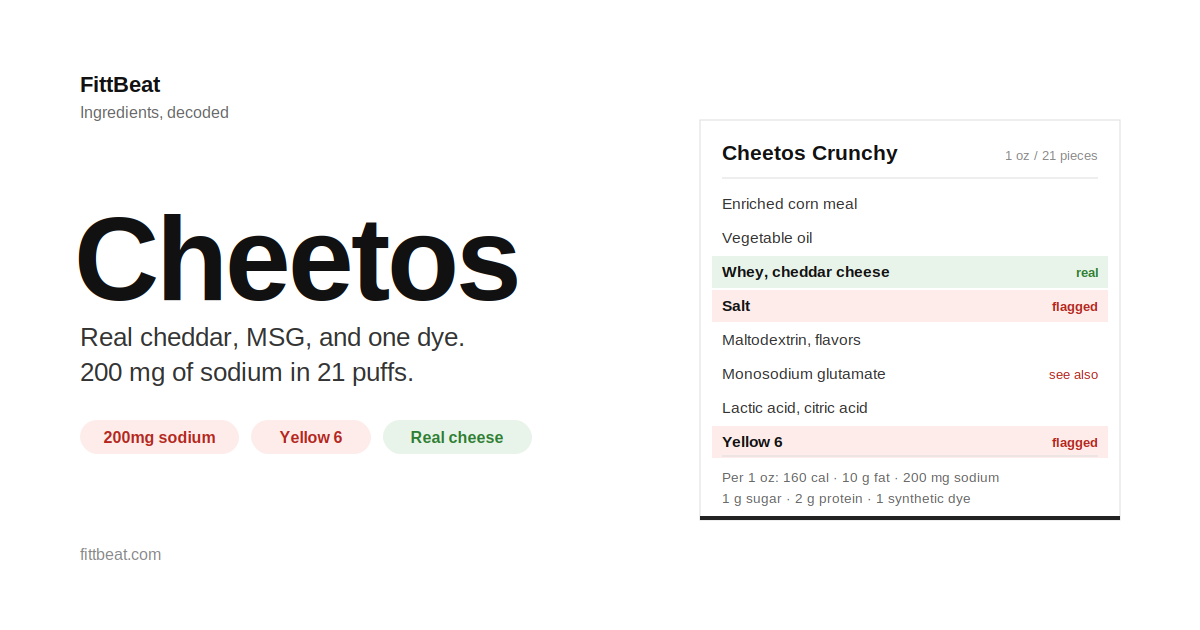

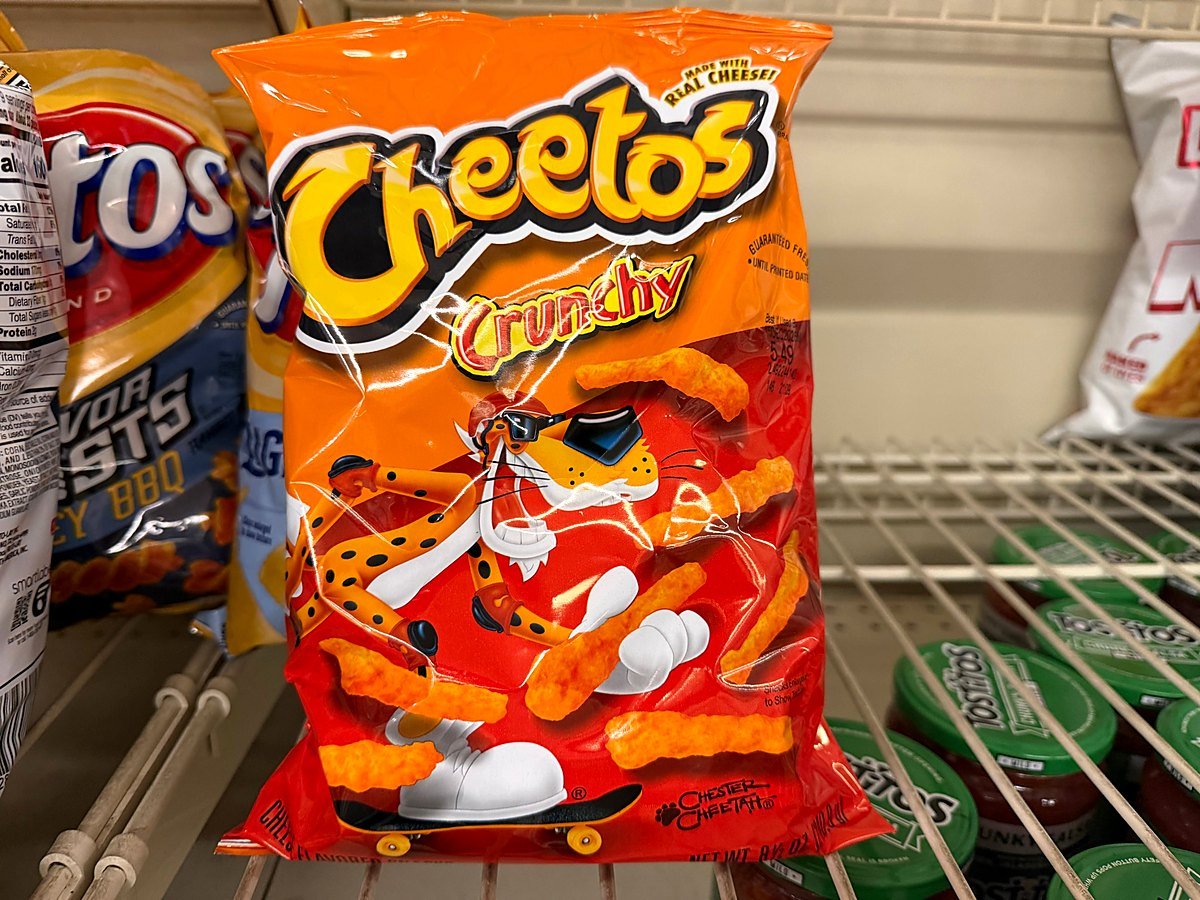
Last reviewed: October 2026. Reflects the U.S. Cheetos Crunchy label; the bag photographed for this post is the 8.5 oz size. Cheetos Puffs, Flamin’ Hot, and the other flavors have their own seasonings; Flamin’ Hot Cheetos has its own breakdown.
Cheetos Crunchy is a fried cornmeal stick coated in cheese powder, and the label is more honest than the orange dust suggests. There’s real cheddar in it — though less of it than whey, which comes first. There’s MSG, listed by name, which is safe. There’s no sugar to speak of. And the famous orange comes mostly from a single synthetic dye, Yellow 6, which makes the original a much simpler label than its Flamin’ Hot sibling with four dye entries. What it isn’t is a light snack: 21 pieces are 160 calories and 200 mg of sodium, and nobody stops at 21. Here’s every Cheetos ingredients, what it does, and how the bag compares to the rest of the chip aisle.
Quick answer: what’s in Cheetos?
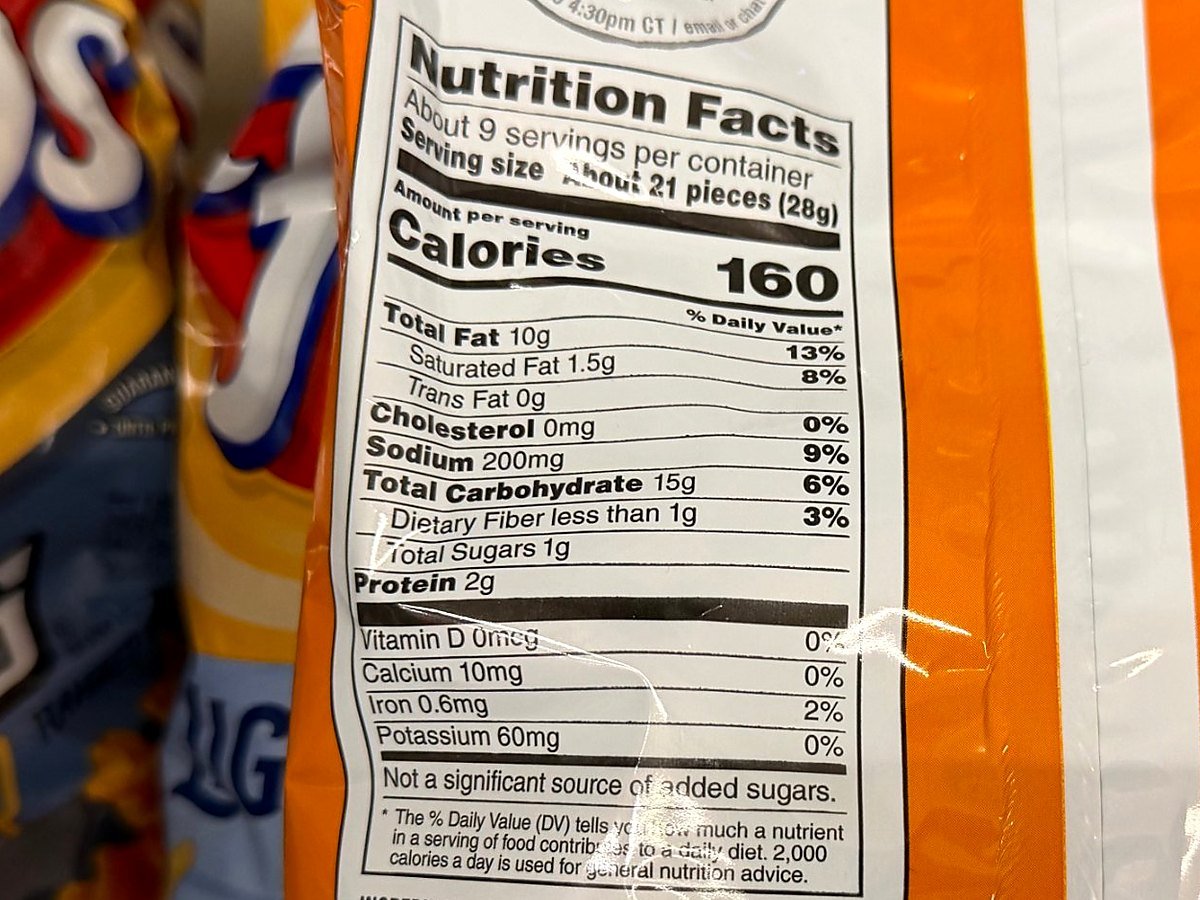
Cheetos Crunchy are enriched corn meal (corn meal, ferrous sulfate, niacin, thiamin mononitrate, riboflavin, folic acid), vegetable oil (corn, canola, and/or sunflower), whey, cheddar cheese (milk, cheese cultures, salt, enzymes), salt, corn maltodextrin, natural and artificial flavors, whey protein concentrate, monosodium glutamate, lactic acid, citric acid, and artificial color (Yellow 6). A 1 oz serving, about 21 pieces, has 160 calories, 10 g of fat (1.5 g saturated), 200 mg of sodium, 15 g of carbohydrate, 1 g of sugar, and 2 g of protein. The whole 8.5 oz bag is about 1,440 calories and 1,800 mg of sodium. The cheese is real, the MSG is safe, and there’s one synthetic dye. The fat and salt are the reason to keep it to a handful.
Jump to: Full label · Each ingredient · Why Cheetos are orange · Nutrition facts · Cheetos vs. Flamin’ Hot · Verdict · FAQ
The full Cheetos ingredients list
Enriched Corn Meal (Corn Meal, Ferrous Sulfate, Niacin, Thiamin Mononitrate, Riboflavin, Folic Acid), Vegetable Oil (Corn, Canola, and/or Sunflower Oil), Whey, Cheddar Cheese (Milk, Cheese Cultures, Salt, Enzymes), Salt, Corn Maltodextrin, Natural and Artificial Flavors, Whey Protein Concentrate, Monosodium Glutamate, Lactic Acid, Citric Acid, and Artificial Color (Yellow 6). Contains milk ingredients. Not a significant source of added sugars. Frito-Lay, Inc., Plano, TX.

Three things to notice. Whey is listed before cheddar cheese, which means there’s more of the cheaper dairy byproduct in the coating than actual cheese — “made with real cheese” on the front is true, but the cheese is the third ingredient, not the main one. The seasoning stacks three savory boosters: cheese, MSG, and whey protein concentrate, plus lactic and citric acid for the tang that makes the cheese taste sharper than it is. And there’s exactly one color, Yellow 6. Unlike Flamin’ Hot Cheetos and Doritos, this bag doesn’t list potassium salt, so its sodium hasn’t been trimmed the way theirs has.
Cheetos ingredients explained
Enriched corn meal Fine
The base: degerminated corn meal, extruded under pressure so it puffs into the knobbly Cheeto shape, then fried. “Enriched” means iron and four B vitamins (niacin, thiamin, riboflavin, folic acid) were added back after milling, which is why the panel shows 2% of the daily iron. Refined corn has almost no fiber — under 1 g per serving — so nutritionally this is starch.
Vegetable oil (corn, canola, and/or sunflower) 10 g fat
Crunchy Cheetos are fried, which is where 90 of the 160 calories come from. The oils are mostly unsaturated — saturated fat is only 1.5 g, 8% of the daily value — and there’s no hydrogenated oil or trans fat. “And/or” lets Frito-Lay switch among the three based on price; the fat profile is similar. The issue isn’t the type of oil, it’s the amount: a fried snack is energy-dense, and 10 g of fat in an ounce is more than a Dorito carries.
Whey Filler dairy
The liquid left over from cheesemaking, dried into powder. It’s safe and it’s real milk, but it’s the budget way to make a coating taste dairy, and its position ahead of cheddar tells you the seasoning is more whey than cheese. It’s also why Cheetos contain lactose and aren’t suitable for a milk allergy.
Cheddar cheese Real cheese
Actual cheddar — milk, cultures, salt, enzymes — dried and powdered. Credit where due: plenty of cheese-flavored snacks use cheese “product” or flavoring alone. The enzymes aren’t specified, so strict vegetarians who avoid animal rennet can’t confirm from the label whether this cheese qualifies.
Salt Flagged: 200 mg
200 mg per ounce, 9% of the daily limit — less than Goldfish (250 mg per 30 g) or Takis (420 mg), a little more than Doritos (170 mg). The ounce is reasonable. The bag isn’t: 8.5 oz is about 1,800 mg of sodium, close to the 2,300 mg daily limit, and Cheetos are designed to be eaten until the bag is gone. Salt also shows up inside the cheddar, and MSG contributes sodium too.
Corn maltodextrin Fine
A starch-derived powder that carries the seasoning and helps it stick. Nutritionally it’s a fast carbohydrate, but in seasoning amounts it adds little.
Natural and artificial flavors Undisclosed
Cheese, butter, and savory flavor compounds layered on top of the real cheese to make the taste bigger and more consistent from batch to batch. “Artificial” means some are synthesized; it isn’t a safety distinction. Details aren’t disclosed.
Whey protein concentrate Fine
A more concentrated whey that adds body and dairy flavor to the coating. It’s the same ingredient sold as a protein supplement, but here it’s a flavor carrier, not a protein source — the bag has 2 g of protein per serving.
Monosodium glutamate Safe
MSG is the sodium salt of glutamate, the amino acid that makes parmesan, tomatoes, and soy sauce taste savory. It’s listed by name, as the FDA requires when it’s added. Despite its reputation, double-blind trials have not been able to reproduce “MSG symptom complex” in people who believe they react to it, and the FDA classifies it as generally recognized as safe. It adds about a third of the sodium of the same amount of salt and lets the seasoning hit harder with less salt overall. This is the one ingredient on the label that’s more feared than it should be.
Lactic acid and citric acid Fine
The tang. Lactic acid is the same acid that makes cheese and yogurt sour; citric acid adds brightness. Together they make the powdered cheese taste sharper and more like aged cheddar. Both are harmless at seasoning levels.
Artificial color (Yellow 6) Flagged
The orange. Yellow 6 (Sunset Yellow) is a petroleum-derived azo dye, one of the three dyes in the 2007 Southampton trial that found dye mixtures modestly increased hyperactivity in some children, and it carries a child-behavior warning label in the EU. It’s on the FDA’s 2025 voluntary phase-out list, banned from California school food from December 31, 2027, and banned statewide in West Virginia from 2028. One dye is less than most orange snacks use, but it’s the only reason the color looks the way it does. Our synthetic food dyes breakdown covers the research.
Why Cheetos are orange — and the version that isn’t
Cheddar powder on its own is pale yellow-white; the bright orange is Yellow 6. That’s why the European and dye-free versions of cheese snacks look so washed out by comparison. PepsiCo hasn’t reformulated regular Cheetos: the bag on the shelf, including the one photographed for this post, still lists Yellow 6. Instead, in late 2025 it launched a separate line, Simply NKD, of Cheetos and Doritos made without artificial colors, sold first at Walmart. Those are pale. If you want Cheetos without the dye, that line is the option; the classic orange bag is unchanged, and PepsiCo hasn’t announced a date to change it.
Cheetos nutrition facts
| Per serving | Cheetos Crunchy (1 oz) | Flamin’ Hot Cheetos (1 oz) | Doritos Nacho Cheese (1 oz) | Goldfish Cheddar (30 g) |
|---|---|---|---|---|
| Calories | 160 | 160 | 150 | 140 |
| Total fat | 10 g | 11 g | 8 g | 5 g |
| Saturated fat | 1.5 g | 1.5 g | 1 g | 1 g |
| Sodium | 200 mg | 210 mg | 170 mg | 250 mg |
| Sugar | 1 g | 0 g | <1 g | 0 g |
| Protein | 2 g | 2 g | 2 g | 3 g |
| Synthetic dyes | 1 (Yellow 6) | 3 | 3 | None |
| MSG | Yes | Yes | Yes | No |
| Potassium salt | No | Yes | Yes | No |
| Real cheese | Yes | Yes | Yes | Yes |
The four cheese snacks are closer than their reputations. Cheetos and Flamin’ Hot are nearly identical on calories, fat, and sodium; the difference is the seasoning and the dye count. Doritos have less fat and sodium per ounce, Goldfish the least fat and the most sodium. None of them is a high-protein or high-fiber food. Flamin’ Hot, Doritos, and Goldfish figures are from the bags photographed for our posts on each.
Cheetos vs. Flamin’ Hot Cheetos
Same corn meal, same oil, same calories. The original has one dye; Flamin’ Hot has three (Red 40, Yellow 5, and Yellow 6, in four entries) plus sugar, yeast extract, two nucleotide flavor enhancers, and potassium salt standing in for some of the sodium — which is why its sodium is only 10 mg higher despite a much saltier taste. Flamin’ Hot also carries the acid-and-chili coating that pediatricians link to stomach complaints in kids who eat it daily; the original doesn’t. If you’re choosing between the two, the original is the simpler label, with fewer dyes and no capsaicin. Our Flamin’ Hot Cheetos breakdown goes line by line.
Are Cheetos bad for you?
FittBeat verdict
A fried corn snack with real cheese, safe MSG, and one dye — fine by the handful, a lot by the bag. Cheetos Crunchy have a more honest label than they get credit for: real cheddar, MSG named openly, almost no sugar, and a single synthetic color instead of the three or four in most orange snacks. The real costs are energy density and sodium: 10 g of fat and 200 mg of sodium in 21 pieces, and about 1,800 mg in a bag designed to disappear. If you’re avoiding dyes, Yellow 6 is the one to know about, and PepsiCo’s separate Simply NKD line is the version without it. Otherwise, pour a serving into a bowl and close the bag.
The concerns, ranked by evidence:
- Portion, fat, and calories. 160 calories an ounce from a food that doesn’t fill you up. A shared bag is 1,440 calories.
- Sodium. 200 mg per ounce is moderate; a bag is most of a day’s limit.
- Yellow 6. Modest behavioral evidence in some children, an EU warning label, and a federal phase-out request. One dye, but the only reason for the color.
- Refined starch. Under 1 g of fiber and 2 g of protein per serving: nothing in it slows you down.
- Everything else. MSG, whey, maltodextrin, and the acids have no credible evidence of harm at these amounts.
Cheetos for kids, allergies, and vegetarians
Kids: one ounce is a reasonable snack-size portion; the single-serve bags help. Yellow 6 is the ingredient to watch if a child seems sensitive to dyes, and the original is a better choice than Flamin’ Hot for kids, who are the group behind the Flamin’ Hot stomach complaints.
Allergies and gluten: contains milk (whey, cheddar, whey protein concentrate). No wheat, soy, egg, or nut ingredients are listed, but this bag doesn’t carry a gluten-free claim, so people with celiac disease should check Frito-Lay’s current gluten-free list or the package.
Vegetarians and vegans: not vegan (milk). For vegetarians, the cheese enzymes aren’t specified, so it isn’t possible to confirm from the label that no animal rennet was used.
Keto: no. 15 g of carbohydrate per ounce from corn.
Cleaner alternatives
For Cheetos without the dye, PepsiCo’s Simply NKD line is the same idea in a pale version. For less fat, a baked cheese puff typically cuts the fat roughly in half for similar calories; check for dyes, since many baked puffs still use them. For more protein and real cheese, a cheese crisp made from baked cheddar alone has no corn, no dye, and 7 g or more of protein per serving, though more saturated fat. And if it’s the cheese-and-crunch you want, Goldfish skip the dye and MSG entirely, at the cost of more sodium.
Frequently asked questions
What are Cheetos made of?
Cheetos Crunchy are enriched corn meal fried in corn, canola, or sunflower oil and coated in a seasoning of whey, cheddar cheese, salt, maltodextrin, natural and artificial flavors, whey protein concentrate, MSG, lactic acid, citric acid, and Yellow 6.
Are Cheetos made with real cheese?
Yes. The label lists cheddar cheese (milk, cultures, salt, enzymes). It comes after whey, though, so the coating contains more whey than cheese.
Do Cheetos have MSG?
Yes, listed by name as monosodium glutamate. Controlled studies have not confirmed MSG sensitivity reactions, and the FDA considers it safe.
What dye is in Cheetos?
Cheetos Crunchy list one synthetic dye, Yellow 6 (Sunset Yellow). Flamin’ Hot Cheetos use three: Red 40, Yellow 5, and Yellow 6. PepsiCo sells a separate Simply NKD line without artificial colors.
How much sodium is in Cheetos?
200 mg per 1 oz serving (about 21 pieces), 9% of the daily value. An 8.5 oz bag has about 1,800 mg.
Are Cheetos gluten-free?
Cheetos Crunchy contain no wheat, barley, or rye ingredients, but the bag we photographed doesn’t carry a gluten-free claim. Check the package or Frito-Lay’s current gluten-free list if you have celiac disease.
Are Cheetos vegetarian?
They contain milk, so they’re not vegan. The cheese enzymes aren’t specified on the label, so vegetarians who avoid animal rennet can’t confirm them from the bag.
Are Cheetos worse than Flamin’ Hot Cheetos?
They’re nearly identical in calories, fat, and sodium. The original has one dye instead of three and no chili-and-acid coating, so it’s the simpler label of the two.
Sources
- Frito-Lay, Inc. Nutrition facts and ingredients, Cheetos Crunchy, 8.5 oz bag, photographed October 2026.
- U.S. FDA. Questions and answers on monosodium glutamate (MSG). fda.gov
- Geha RS, et al. Review of alleged reaction to monosodium glutamate and outcome of a multicenter double-blind placebo-controlled study. Journal of Nutrition, 2000. doi:10.1093/jn/130.4.1058S
- McCann D, et al. Food additives and hyperactive behaviour in 3-year-old and 8/9-year-old children in the community. The Lancet, 2007. doi:10.1016/S0140-6736(07)61306-3
- HHS and FDA. HHS, FDA to phase out petroleum-based synthetic dyes in nation’s food supply. April 22, 2025. fda.gov
- California OEHHA. Health effects assessment: potential neurobehavioral effects of synthetic food dyes in children, 2021. oehha.ca.gov
Flamin’ Hot Cheetos, Doritos, and Goldfish figures are from the bags photographed for our breakdowns of each.
This article is for informational purposes and is not medical advice. Talk to a doctor or registered dietitian about your individual nutrition needs.
