
Last reviewed: October 2026. Reflects the current U.S. 12 fl oz Diet Coke formula.
Diet Coke is the best-selling diet soda in America and the one people ask about most, usually in the form of one question: is the aspartame going to hurt me? The short answer is no at any amount you’d actually drink, and the longer answer is more interesting than the headlines. Here’s every Diet Coke ingredient in order, what each one does, what the research says — including the 2023 WHO classification everyone heard about and almost nobody read — and how it compares to Coke Zero and regular Coke.
Quick answer: what’s in Diet Coke?
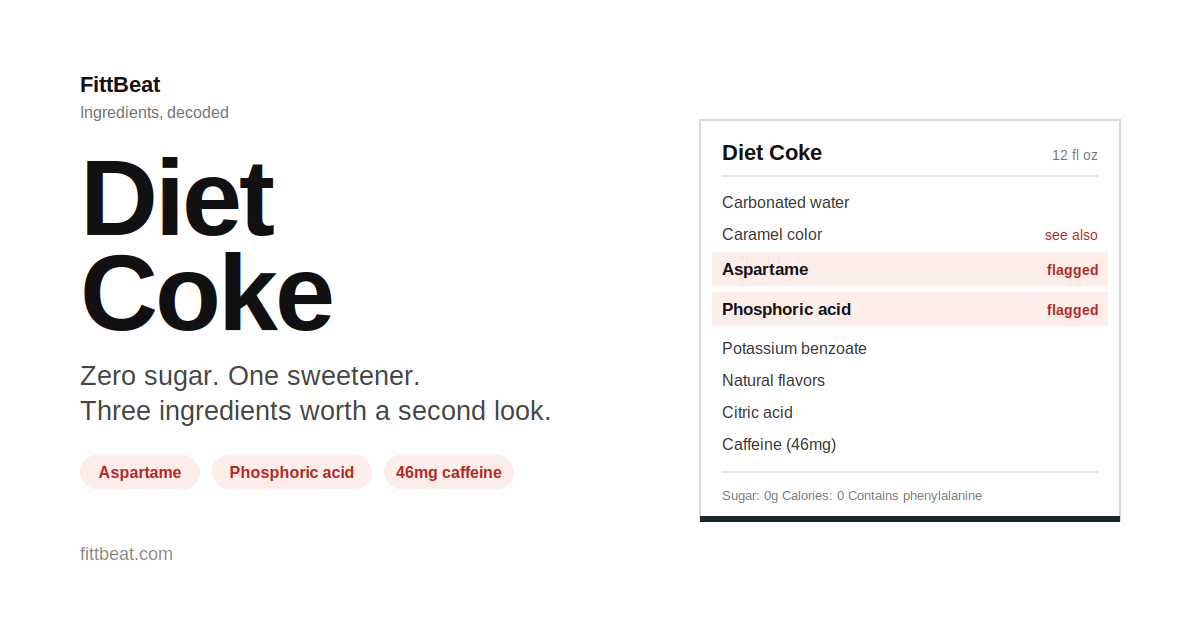
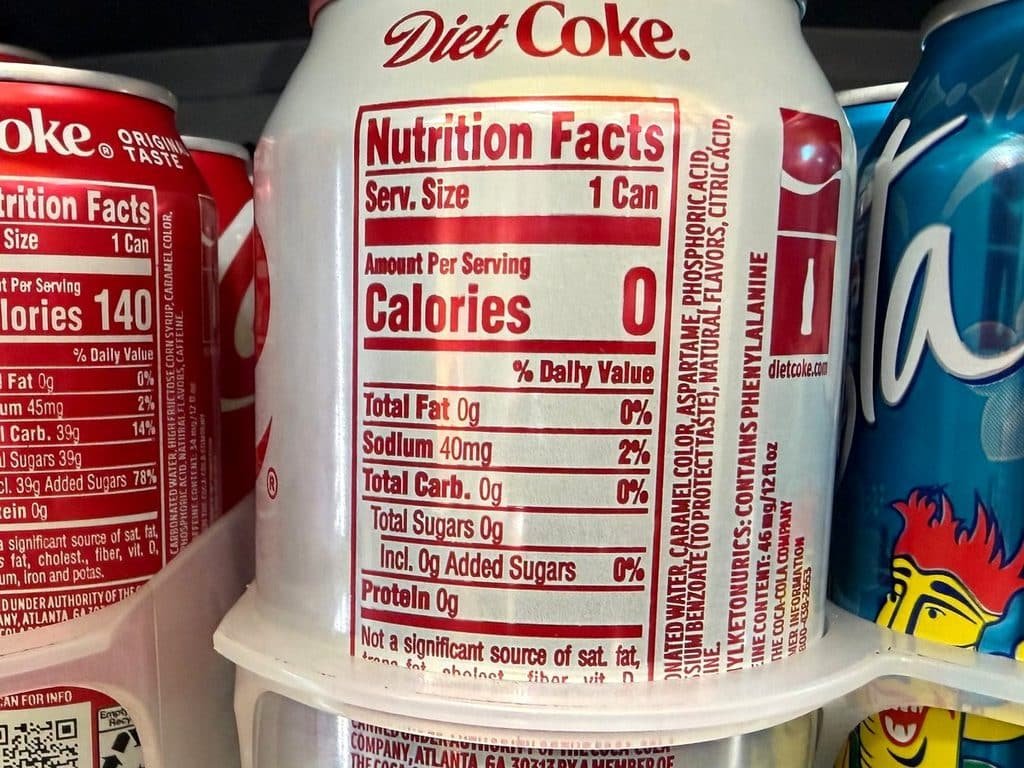
Diet Coke is carbonated water, caramel color, aspartame, phosphoric acid, potassium benzoate, natural flavors, citric acid, and caffeine. A 12 oz can has 0 calories, 0 g sugar, 40 mg sodium, and 46 mg caffeine — more caffeine than regular Coke or Coke Zero. The sweetener is aspartame alone, at roughly 180–200 mg per can; you’d need around 17 cans a day to reach the FDA’s acceptable daily intake. The three ingredients worth a second look are aspartame (safe for everyone except people with PKU, with a weak “possibly carcinogenic” label from the WHO), phosphoric acid (bad for enamel), and caramel color (the 4-MEI question). It is not a health drink, but it removes the single worst thing in regular Coke: 39 g of sugar.
Jump to: The label · Each ingredient · Aspartame and the WHO · Nutrition · Diet Coke vs. Coke Zero · Verdict · FAQ
The full Diet Coke ingredients list
Carbonated Water, Caramel Color, Aspartame, Phosphoric Acid, Potassium Benzoate (To Protect Taste), Natural Flavors, Citric Acid, Caffeine. Phenylketonurics: contains phenylalanine.
Eight ingredients to regular Coke’s six. Diet Coke drops sugar and adds three things: aspartame to replace it, potassium benzoate because without sugar the drink needs a preservative, and citric acid for a sharper taste. The “phenylketonurics” warning is required on every aspartame product and applies to roughly one in 15,000 people with the genetic disorder PKU; for everyone else it’s not relevant.
Diet Coke ingredients explained
Carbonated water Fine
Filtered water with dissolved CO₂. The carbonation forms a small amount of carbonic acid, but the acidity that matters comes from the phosphoric acid further down.
Caramel color Flagged
The brown. Diet Coke uses the same Class IV caramel color as regular Coke, made by heating sugars with ammonia and sulfite compounds, which produces a byproduct called 4-methylimidazole (4-MEI). 4-MEI caused tumors in mice at high doses, California listed it under Proposition 65 in 2011, and Coca-Cola reformulated in 2012 to stay under the 29 µg/day warning threshold rather than print a cancer warning on the can. Independent testing since then has found U.S. cans at a few micrograms. Cosmetic ingredient, low concern, no reason to exist except appearance. Our caramel color breakdown has the full 4-MEI story.
Aspartame Flagged
The sweetener, and the ingredient the whole conversation is about. Aspartame is two amino acids (aspartic acid and phenylalanine) joined with a methanol group; it’s 200 times sweeter than sugar, so a can needs only about 180–200 mg. Your body breaks it down into those three components — the same amino acids you get from any protein, and less methanol than a glass of tomato juice.
The regulatory picture: the FDA’s acceptable daily intake is 50 mg per kg of body weight — about 3,400 mg a day for a 150 lb adult, or roughly 17 cans. EFSA’s limit is 40 mg/kg, about 14 cans. Both agencies re-reviewed aspartame in the 2010s and kept it approved.
The headline you remember: in July 2023 the WHO’s cancer agency (IARC) classified aspartame as “possibly carcinogenic to humans,” Group 2B. What that means is limited evidence in humans and limited evidence in animals — the same group as aloe vera extract and pickled vegetables. IARC classifies hazard (could it cause cancer under any conditions?), not risk (does it, at real doses?). The risk assessment was done the same day by a different WHO committee (JECFA), which reviewed the same evidence and left the acceptable daily intake unchanged. The strongest human signal is a 2022 French cohort study that found a small increase in cancer risk among the highest aspartame consumers; it’s observational, and the effect was modest. Our aspartame breakdown goes through every study.
The honest summary: at one or two cans a day, aspartame is among the most-studied and least-concerning things you consume. The people who should avoid it entirely are those with PKU.
Phosphoric acid Flagged
The sharp bite, and the most direct, well-documented harm in the can. It drops the pH to around 3.2, which softens tooth enamel; the damage tracks how long you sip more than how much you drink. Observational studies have also linked daily cola — specifically cola, not other sodas, which points at phosphoric acid — to slightly lower bone density in women and higher kidney-disease risk at two or more cans a day. Diet and regular Coke both contain it. Our phosphoric acid breakdown covers the dental and bone research.
Potassium benzoate (to protect taste) Low concern
The preservative. Regular Coke doesn’t need one because 39 g of sugar in acid is already hostile to microbes; Diet Coke does. Benzoates are safe at these levels, with one known quirk: in the presence of vitamin C (ascorbic acid), heat, and light, they can form small amounts of benzene, a carcinogen. Diet Coke contains no ascorbic acid, so the main trigger is absent. This is why Coca-Cola uses potassium benzoate rather than sodium benzoate here — it keeps the sodium down — and the chemistry is the same. Our sodium benzoate breakdown explains the benzene reaction.
Natural flavors Undisclosed
Diet Coke’s flavor is its own, not a copy of Coke — it launched in 1982 with a separate recipe, which is why Coke Zero exists at all. The specific blend is proprietary; “natural” means plant- or animal-derived, not that it’s simple.
Citric acid Fine
A second acid, for brightness. Same molecule as in citrus fruit. It adds to the enamel issue but isn’t a concern on its own.
Caffeine 46 mg
46 mg per 12 oz — more than regular Coke (34 mg) and Coke Zero (34 mg), about half a cup of coffee. Modest for most adults against the FDA’s 400 mg daily guidance, but worth knowing if you drink several, and the reason Caffeine-Free Diet Coke exists.
Diet Coke nutrition facts
| Per 12 oz can | Diet Coke | Coke Zero Sugar | Diet Pepsi | Coca-Cola |
|---|---|---|---|---|
| Calories | 0 | 0 | 0 | 140 |
| Sugar | 0 g | 0 g | 0 g | 39 g |
| Sweetener | Aspartame | Aspartame + Ace-K | Sucralose + Ace-K | High fructose corn syrup |
| Caffeine | 46 mg | 34 mg | 35 mg | 34 mg |
| Sodium | 40 mg | 40 mg | 35 mg | 45 mg |
| Caramel color | Yes | Yes | Yes | Yes |
| Phosphoric acid | Yes | Yes | Yes | Yes |
| Preservative | Potassium benzoate | Potassium benzoate | Potassium benzoate | None |
| Phenylalanine warning | Yes | Yes | No | No |
Diet Coke vs. Coke Zero: what’s the difference?
They’re sold side by side and most people assume they’re the same drink with different cans. They aren’t. Diet Coke has its own flavor, developed in 1982, and uses aspartame alone. Coke Zero Sugar, launched in 2005, was built to taste like regular Coca-Cola, and it uses aspartame plus acesulfame potassium (Ace-K), because the two sweeteners together mimic sugar’s taste curve better than either alone. Coke Zero also has less caffeine (34 mg vs. 46 mg). Everything else — caramel color, phosphoric acid, potassium benzoate — is the same.
If you’re avoiding Ace-K, Diet Coke is the one with a single sweetener. If you want the drink that tastes like Coke, that’s Coke Zero. If you want less caffeine, Coke Zero. Our Coke Zero breakdown goes line by line.
Is Diet Coke bad for you?
FittBeat verdict
Not in the way people worry about. Still not something to drink all day. The aspartame fear is the least supported concern on the label; the acid is the best supported, and it’s about teeth. Diet Coke removes the 39 g of sugar that makes regular Coke a real health problem, and at a can a day the evidence doesn’t show harm for people without PKU. The cautions are the ones that apply to any cola: sip it less, not longer; don’t let it replace water; and if you’re drinking three or four a day, the phosphoric acid and the caffeine are the reasons to cut back, not the sweetener.
The concerns, ranked by evidence:
- Teeth. pH 3.2, sipped over hours. The one harm you can see. Drink with meals, rinse with water, wait before brushing.
- Bones and kidneys at heavy intake. Observational links at two-plus colas a day. Not proven causal; consistent enough to matter at that level.
- Caffeine. 46 mg is fine; four cans is 184 mg before coffee, and it’s often the hidden reason “I can’t sleep.”
- Aspartame. Group 2B is a hazard label, not a risk finding, and the risk assessment that day kept the limit unchanged. Avoid entirely with PKU; otherwise low concern at realistic intake.
- Caramel color and benzoate. Cosmetic and preservative; low concern at current levels.
Diet Coke for keto, diabetes, and pregnancy
Keto: zero carbs, zero sugar. Fine. Some people find diet soda increases cravings; that’s individual, not a ketosis issue.
Diabetes: no sugar, no glucose spike. Among the better soda choices for blood sugar. The research on whether artificial sweeteners affect insulin response over the long term is mixed and mostly focused on sucralose, not aspartame.
Pregnancy: aspartame is considered safe in pregnancy by the FDA and ACOG at normal intake; the 46 mg of caffeine counts toward the 200 mg daily guidance.
Cleaner alternatives
If you want cola without aspartame: Diet Pepsi uses sucralose and Ace-K instead — a different sweetener, not necessarily a better one. If you want cola without any artificial sweetener: Zevia Cola (stevia, no caramel color, clear) or Olipop Vintage Cola (stevia plus a few grams of cane sugar). If you want to keep the Diet Coke habit and cut the harm, the realistic changes are fewer cans, drunk faster, with food — not a different can.
Frequently asked questions
Does Diet Coke have sugar?
No. 0 g sugar and 0 calories per can. It’s sweetened with aspartame.
How much caffeine is in Diet Coke?
46 mg per 12 oz can — more than regular Coke (34 mg) and Coke Zero (34 mg), about half a cup of coffee.
Is aspartame in Diet Coke safe?
For people without PKU, yes at any realistic intake. The FDA’s daily limit works out to about 17 cans for a 150 lb adult. The WHO’s 2023 “possibly carcinogenic” classification is a hazard label based on limited evidence; the same day, the WHO’s risk committee kept the acceptable daily intake unchanged.
What’s the difference between Diet Coke and Coke Zero?
Different flavors and different sweeteners. Diet Coke has its own taste and uses aspartame alone with 46 mg caffeine. Coke Zero is designed to taste like regular Coke, uses aspartame plus acesulfame potassium, and has 34 mg caffeine.
Does Diet Coke have phosphoric acid?
Yes, the same as regular Coke. It’s the ingredient most responsible for enamel erosion and the one linked to bone and kidney effects at heavy intake.
Why does Diet Coke say “phenylketonurics: contains phenylalanine”?
Aspartame breaks down into phenylalanine, an amino acid that people with the rare genetic disorder PKU can’t metabolize. The warning is required on every aspartame product and doesn’t apply to anyone else.
Is Diet Coke keto?
Yes. Zero carbs, zero sugar.
Is Diet Coke bad for your teeth?
Yes, similarly to regular Coke: the phosphoric and citric acids soften enamel. No sugar means less fuel for bacteria, but the acid erosion is the same. Sip less, rinse with water, wait before brushing.
How many Diet Cokes a day is too many?
There’s no aspartame-based limit you’d realistically hit. The practical ceiling is set by the acid (teeth) and caffeine: one or two a day is unremarkable; three or more daily is where the bone, kidney, and sleep research starts to apply.
Sources
- Coca-Cola Company. Nutrition facts and ingredients, Diet Coke, 12 fl oz. Product label, photographed October 2026.
- World Health Organization. Aspartame hazard and risk assessment results released, July 14, 2023 (IARC Group 2B; JECFA ADI unchanged at 40 mg/kg). who.int
- U.S. FDA. Aspartame and other sweeteners in food. fda.gov
- EFSA. Scientific opinion on the re-evaluation of aspartame (E 951) as a food additive. EFSA Journal, 2013. doi:10.2903/j.efsa.2013.3496
- Debras C, et al. Artificial sweeteners and cancer risk: results from the NutriNet-Santé population-based cohort study. PLOS Medicine, 2022. doi:10.1371/journal.pmed.1003950
- Tucker KL, et al. Colas, but not other carbonated beverages, are associated with low bone mineral density in older women. American Journal of Clinical Nutrition, 2006. doi:10.1093/ajcn/84.4.936
- U.S. FDA. Data on benzene in soft drinks and other beverages. fda.gov
- California OEHHA. Proposition 65 listing: 4-methylimidazole (4-MEI). oehha.ca.gov
- U.S. FDA. Spilling the beans: how much caffeine is too much? fda.gov
This article is for informational purposes and is not medical advice. Talk to a doctor or registered dietitian about your individual nutrition needs.
