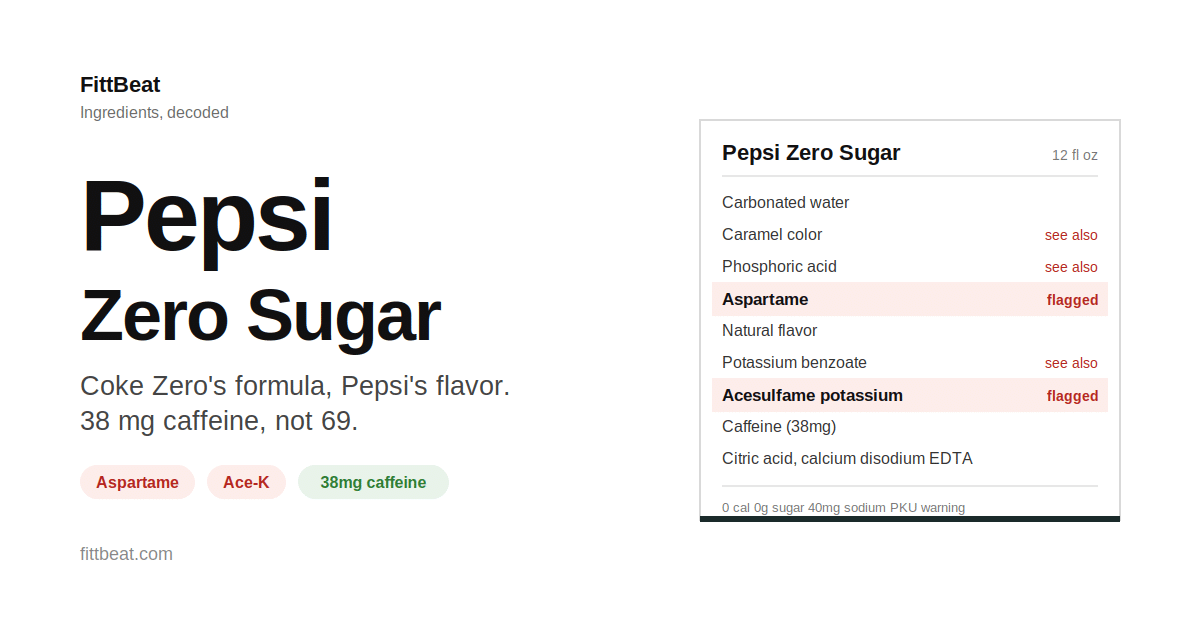

Last reviewed: October 2026. Reflects the current U.S. 12 fl oz Pepsi Zero Sugar label, photographed in store. Pepsi Zero Sugar was reformulated in early 2023; this post describes the current can.
Pepsi Zero Sugar is the black can that used to be Pepsi Max, and for most of its life it had a reputation for being the strong one: 69 mg of caffeine, nearly double a regular Pepsi, and a sweetener blend built to taste like the sugared original rather than like a diet soda. In 2023 PepsiCo quietly reformulated it, cut the caffeine almost in half, and changed the taste, and a lot of what’s written about Pepsi Zero online still describes the old can. Here’s all the Pepsi Zero Sugar ingredients on the current one, what changed, and how it stacks up against Diet Pepsi and Coke Zero.
Quick answer: what’s in Pepsi Zero Sugar?
Pepsi Zero Sugar is carbonated water, caramel color, phosphoric acid, aspartame, natural flavor, potassium benzoate, acesulfame potassium, caffeine, citric acid, and calcium disodium EDTA. A 12 oz can has 0 calories, 0 g sugar, 40 mg sodium, and 38 mg of caffeine — the same as regular Pepsi and a little more than Coke Zero’s 34. It’s sweetened with aspartame and Ace-K together, which is why it tastes closer to regular Pepsi than Diet Pepsi does. The ingredients worth knowing are the two sweeteners (safe by every regulator, with ongoing research on the gut), caramel color (the 4-MEI story), phosphoric acid (teeth), and the benzoate preservative. Not for anyone with PKU. The 69 mg caffeine figure you’ll see elsewhere is the pre-2023 can.
Jump to: The label · Each ingredient · The 2023 reformulation · Nutrition · Pepsi Zero vs. Diet Pepsi vs. Coke Zero · Verdict · FAQ
The full Pepsi Zero Sugar ingredients list
Carbonated Water, Caramel Color, Phosphoric Acid, Aspartame, Natural Flavor, Potassium Benzoate (Preserves Freshness), Acesulfame Potassium, Caffeine, Citric Acid, Calcium Disodium EDTA (To Protect Flavor). Phenylketonurics: contains phenylalanine. Caffeine content: 38 mg/12 fl oz.

Three things to notice. Aspartame is fourth, ahead of the flavor, which means it’s doing most of the sweetening; Ace-K comes after the preservative, as the supporting sweetener. The caffeine line on the can says 38 mg, not the 69 mg still quoted across most of the web. And unlike Diet Pepsi and Pepsi, there’s EDTA at the end — a chelator that stops the benzoate from reacting with trace metals and forming off-flavors, and that also happens to suppress the benzoate-benzene reaction.
Pepsi Zero Sugar ingredients explained
Carbonated water Fine
Water with dissolved CO₂. Mildly acidic on its own; the acids below do the real work on teeth.
Caramel color Flagged, low concern
The brown. Class IV caramel, made by heating sugars with ammonium and sulfite compounds, which creates a byproduct called 4-methylimidazole (4-MEI). California’s Prop 65 listed 4-MEI as a carcinogen in 2011 based on high-dose mouse studies, and the cola makers reformulated to stay under the warning threshold. The FDA’s position is that current levels pose no concern; a can is a fraction of the amount that caused tumors in mice. Our caramel color breakdown has the full story.
Phosphoric acid Flagged, for teeth
The cola tang, and the ingredient with the clearest harm on the list: it’s what makes cola acidic enough (pH around 3) to soften enamel. The bone and kidney research at heavy intake is mixed and covered in our phosphoric acid breakdown. Sip less, rinse after, don’t brush for 30 minutes.
Aspartame Flagged
The main sweetener, 200 times sweeter than sugar. The most-studied food additive in existence: approved by the FDA, EFSA, and every major regulator, with an acceptable daily intake you’d need about 15 cans to reach. The 2023 WHO/IARC classification as “possibly carcinogenic” (Group 2B — the same tier as pickled vegetables and aloe) was based on limited evidence and didn’t change the ADI. The one hard rule: people with phenylketonuria can’t metabolize the phenylalanine it breaks into, which is why the can carries the warning. Our aspartame breakdown covers each study.
Natural flavor Undisclosed
The Pepsi profile — citrus, spice, and vanilla notes, in a proprietary blend. Plant-derived; no detail on the label.
Potassium benzoate Flagged, low concern
The preservative, a potassium salt of benzoic acid; Pepsi uses it instead of the sodium benzoate in Dr Pepper to keep sodium down. Safe at this level by every regulator. The known quirk — benzoate plus vitamin C plus heat can form trace benzene — doesn’t apply here, because there’s no ascorbic acid on the label and the EDTA at the end suppresses the reaction anyway. Our sodium benzoate breakdown explains the chemistry.
Acesulfame potassium (Ace-K) Flagged
The second sweetener. Ace-K is almost always paired with another sweetener because it has a bitter aftertaste alone; with aspartame, the two cover each other’s edges and produce a rounder, more sugar-like curve. That pairing is the whole difference between Pepsi Zero (aspartame + Ace-K) and Diet Pepsi (aspartame alone). Not metabolized, approved everywhere, with thinner long-term human data than aspartame. Our Ace-K breakdown covers it.
Caffeine — 38 mg A third of a coffee
38 mg per 12 oz, the same as regular Pepsi, a little more than Coke Zero (34) and less than Diet Coke (46). About a third of a cup of coffee. This is the number that changed in 2023; see below.
Citric acid Fine, more acid
A second acid for brightness, which regular Pepsi also has and Coke doesn’t. Adds to the enamel load slightly.
Calcium disodium EDTA Fine
A chelating agent that binds trace metals so they don’t cause off-flavors or degrade the benzoate. Used in tiny amounts; safe by regulatory assessment, and the same ingredient in 7 Up and Powerade.
The 2023 reformulation: what changed
Pepsi Zero Sugar launched in the U.S. in 2007 as Pepsi Max, built as a “maximum taste, maximum caffeine” cola: 69 mg of caffeine, ginseng extract, and a sweetener blend tuned to the sugared original. It was renamed Pepsi Zero Sugar in 2016 and kept that formula. In early 2023 PepsiCo relaunched it with a new taste and a new caffeine number — 38 mg, matching regular Pepsi — and dropped the ginseng. The company said the change was about taste; it also brought the can in line with Coke Zero, which had always been in the 34 mg range.
The practical point: most of the “Pepsi Zero has 69 mg of caffeine” content online, including older versions of comparison charts and some retailer listings, describes a can that hasn’t been sold since 2023. The current label says 38, and that’s the number to use. If your can says 69, it’s old stock.
Pepsi Zero Sugar nutrition facts
| Per 12 oz can | Pepsi Zero Sugar | Diet Pepsi | Pepsi | Coke Zero Sugar | Diet Coke |
|---|---|---|---|---|---|
| Calories | 0 | 0 | 150 | 0 | 0 |
| Sugar | 0 g | 0 g | 41 g | 0 g | 0 g |
| Sweetener | Aspartame + Ace-K | Aspartame | HFCS + sugar | Aspartame + Ace-K | Aspartame |
| Caffeine | 38 mg | 35 mg | 38 mg | 34 mg | 46 mg |
| Sodium | 40 mg | 35 mg | 30 mg | 40 mg | 40 mg |
| Preservative | Potassium benzoate + EDTA | Potassium benzoate | None | Potassium benzoate | Potassium benzoate |
| Acids | Phosphoric + citric | Phosphoric + citric | Phosphoric + citric | Phosphoric | Phosphoric + citric |
| Caramel color | Yes | Yes | Yes | Yes | Yes |
Pepsi Zero vs. Diet Pepsi vs. Coke Zero
Pepsi Zero vs. Diet Pepsi: the difference is Ace-K. Diet Pepsi uses aspartame alone and tastes like a diet soda; Pepsi Zero adds Ace-K and tastes more like Pepsi. Caffeine is nearly identical (38 vs 35). If you’d rather have one sweetener than two, Diet Pepsi; if you want it to taste like the original, Zero. Neither is meaningfully healthier.
Pepsi Zero vs. Coke Zero: these are now the same product from two companies. Same two sweeteners, same preservative, same caramel color, 38 vs 34 mg of caffeine. The only label differences are that Pepsi adds citric acid and EDTA, and Coke adds potassium citrate. Pick by taste; there’s nothing on the ingredient panel to choose between. Our Coke Zero breakdown goes line by line.
Is Pepsi Zero Sugar bad for you?
FittBeat verdict
Coke Zero’s formula under a Pepsi flavor — and a lot less caffeine than the internet thinks. Zero sugar and zero calories are a real advantage over the 41 g in regular Pepsi; the two sweeteners are safe by every regulatory standard, with the gut and appetite research being the reason to keep it to a can or two rather than a six-pack a day. Phosphoric acid is the clearest harm (teeth), caramel color is a low-level question, and the benzoate is a non-issue thanks to the EDTA. If you’re switching from regular Pepsi, this is the better can by a wide margin. If you’re choosing between zero colas, taste is the only variable that matters.
The concerns, ranked by evidence:
- Teeth. Two acids; the one well-documented harm. Rinse, don’t sip all day.
- Aspartame and Ace-K. Safe at any realistic intake; ongoing research on gut bacteria and appetite is why moderation makes sense.
- Caramel color. 4-MEI at levels below the California threshold; low concern.
- PKU. Not a concern for most people; a hard no for anyone with phenylketonuria.
- Caffeine. 38 mg is a mild dose; a problem only if you’re stacking cans.
- Benzoate and EDTA. Non-issues at these amounts; no vitamin C to pair with.
Pepsi Zero Sugar for keto, pregnancy, and kids
Keto: yes — zero carbs, and the sweeteners don’t affect ketosis.
Pregnancy: aspartame and Ace-K are considered safe in pregnancy at normal intake by the FDA and ACOG; 38 mg of caffeine is well under the 200 mg daily guidance. One or two cans is fine; not a reason to avoid it.
Kids: no caffeinated soda is a good habit for children, and the AAP recommends against routine artificial sweeteners for kids pending better long-term data. The 38 mg of caffeine is the main reason to say no.
Cleaner alternatives
For a zero-sugar cola with one sweetener: Diet Pepsi (aspartame only) or Diet Coke. For no artificial sweeteners: Zevia Cola (stevia, no caramel color, no phosphoric acid). For a cola with real sugar you drink rarely: the regular Pepsi, which at least has no preservative. For your teeth: anything through a straw, and water after.
Frequently asked questions
How much caffeine is in Pepsi Zero Sugar?
38 mg per 12 oz can, the same as regular Pepsi. The 69 mg figure you’ll see online is the pre-2023 formula, which is no longer sold.
What sweetener is in Pepsi Zero Sugar?
Aspartame and acesulfame potassium (Ace-K) together. Diet Pepsi uses aspartame alone, which is the main difference between the two.
Is Pepsi Zero Sugar bad for you?
Not by the evidence at a can or two a day. The sweeteners are safe by every regulator; the phosphoric acid is hard on teeth; the caramel color is a low-level question. It’s far better than regular Pepsi’s 41 g of sugar.
What’s the difference between Pepsi Zero Sugar and Diet Pepsi?
Pepsi Zero adds Ace-K to the aspartame, which makes it taste closer to regular Pepsi, and it has slightly more caffeine (38 vs 35 mg). Otherwise the labels are nearly identical.
Is Pepsi Zero Sugar the same as Pepsi Max?
It was Pepsi Max in the U.S. from 2007 to 2016, then renamed. The 2023 reformulation cut the caffeine from 69 to 38 mg and removed the ginseng; the current can is a different formula from the old Max.
Does Pepsi Zero Sugar have caramel color?
Yes — Class IV caramel, the same as every cola. California’s 4-MEI threshold is the reason the levels were reduced in 2014.
Is Pepsi Zero Sugar keto?
Yes. Zero carbs, zero sugar, and the sweeteners don’t affect ketosis.
Why does Pepsi Zero Sugar have a phenylketonurics warning?
Because aspartame breaks down into phenylalanine, which people with PKU can’t metabolize. For everyone else it’s irrelevant.
Sources
- PepsiCo. Nutrition facts and ingredients, Pepsi Zero Sugar, 12 fl oz. Product label, photographed October 2026.
- PepsiCo. Pepsi Zero Sugar relaunch announcement, February 2023 (new formula, 38 mg caffeine).
- U.S. FDA. Aspartame and other sweeteners in food. fda.gov
- IARC / WHO. Aspartame hazard and risk assessment results released. July 14, 2023. who.int
- EFSA. Scientific opinion on the re-evaluation of aspartame (E 951) as a food additive. EFSA Journal, 2013. doi:10.2903/j.efsa.2013.3496
- Suez J, et al. Personalized microbiome-driven effects of non-nutritive sweeteners on human glucose tolerance. Cell, 2022. doi:10.1016/j.cell.2022.07.016
- California OEHHA. 4-Methylimidazole listed under Proposition 65. oehha.ca.gov
- U.S. FDA. Data on benzene in soft drinks and other beverages. fda.gov
- Baker SR, et al. The use of nonnutritive sweeteners in children (AAP policy statement). Pediatrics, 2019. doi:10.1542/peds.2019-3282
This article is for informational purposes and is not medical advice. Talk to a doctor or registered dietitian about your individual nutrition needs.
