
Last reviewed: November 2026. Reflects the U.S. Kellogg’s Froot Loops label (7.9 oz box, ©2025 WK Kellogg Co), photographed November 2026, which still lists four synthetic dyes. WK Kellogg says reformulated boxes colored from natural sources ship to retailers before the end of 2026; check the ingredient list on your box.
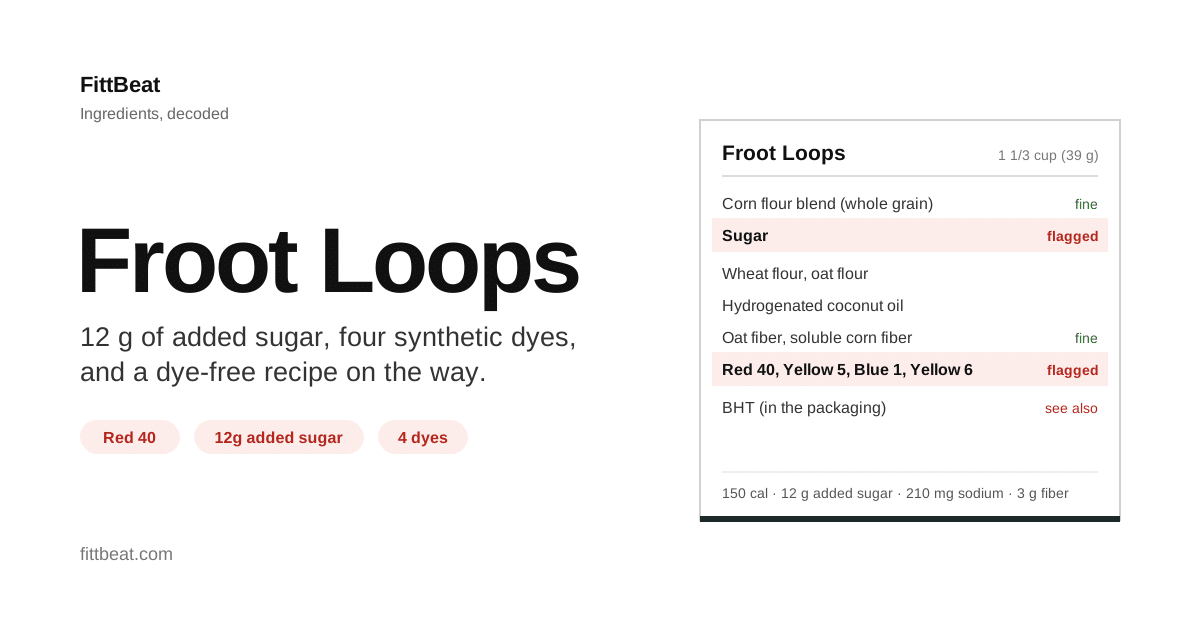
Froot Loops is a sweetened multigrain cereal, and the box tells you nearly everything about it in the first two ingredients and the last four. It starts with corn flour and sugar, adds wheat and oat flours, and ends with Red 40, Yellow 5, Blue 1, and Yellow 6, which makes it one of the last major U.S. cereals still colored with synthetic dyes. That’s about to change: in August 2026 WK Kellogg moved its dye-free deadline up a full year and says naturally colored Froot Loops ship to stores before the end of 2026. What won’t change is the 12 grams of added sugar in every bowl. The “natural fruit flavors” on the front are flavors, not fruit; there’s no fruit on the ingredient list. Here’s all the Froot Loops ingredients, what the dyes do and don’t do, and what the new box will and won’t fix.
Quick answer: what’s in Froot Loops?
Froot Loops is a corn flour blend (whole grain and degerminated yellow corn), sugar, wheat flour, whole grain oat flour, and modified food starch, with 2% or less of hydrogenated coconut, soybean, or cottonseed oil, oat fiber, maltodextrin, salt, soluble corn fiber, natural flavor, Red 40, Yellow 5, Blue 1, and Yellow 6, plus nine added vitamins and minerals. BHT is in the bag, not the cereal. A 1⅓-cup serving (39 g) has 150 calories, 12 g of sugar (all added), 210 mg of sodium, 3 g of fiber, and 2 g of protein. The sugar is about a quarter of an adult’s daily value and half a child’s. The four dyes are FDA-approved, have no nutritional purpose, and are linked to hyperactivity in some sensitive children; WK Kellogg is replacing them with colors from fruit and vegetable sources by the end of 2026. The fiber and whole grain claims on the front are real but modest.
Jump to: The label · Each ingredient · The dye-free Froot Loops · The front-of-box claims · Cereal comparison · Verdict · FAQ
The full Froot Loops ingredients list
Corn Flour Blend (Whole Grain Yellow Corn Flour, Degerminated Yellow Corn Flour), Sugar, Wheat Flour, Whole Grain Oat Flour, Modified Food Starch, Contains 2% or Less of Vegetable Oil (Hydrogenated Coconut, Soybean and/or Cottonseed), Oat Fiber, Maltodextrin, Salt, Soluble Corn Fiber, Natural Flavor, Red 40, Yellow 5, Blue 1, Yellow 6. Vitamins and Minerals: Vitamin C (Ascorbic Acid), Reduced Iron, Niacinamide, Vitamin B6 (Pyridoxine Hydrochloride), Vitamin B2 (Riboflavin), Vitamin B1 (Thiamin Hydrochloride), Folic Acid, Vitamin D3, Vitamin B12. BHT added to packaging for freshness. Contains wheat ingredients.

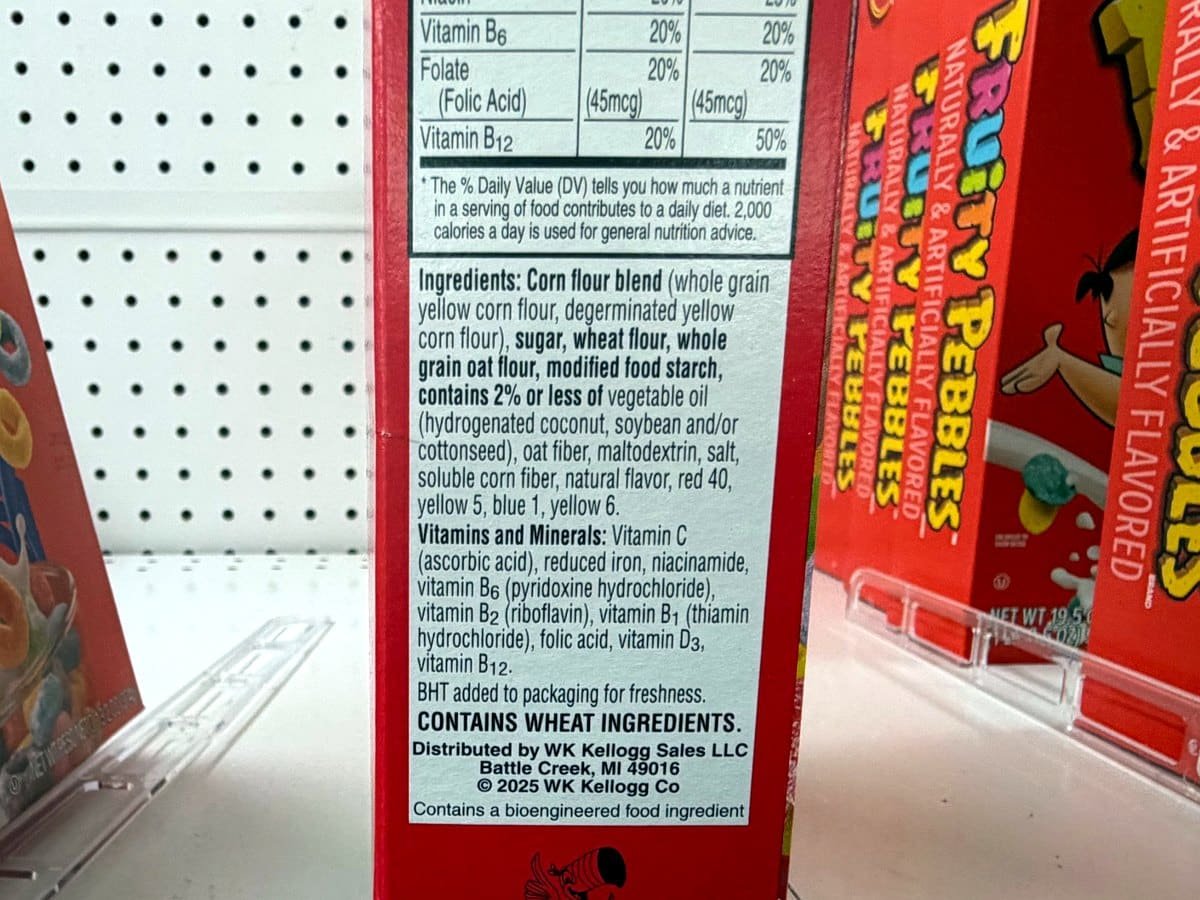
Three things to notice. Sugar is the second ingredient, ahead of the wheat and oat flours, so by weight there’s more sugar in a bowl than either of those grains. The four dyes are the last four ingredients, which tells you how little it takes to make cereal neon: under 2% of the box, doing all of the visual work. And the oil is hydrogenated coconut, soybean, or cottonseed; the label shows 0 g of trans fat, so this is the fully hydrogenated kind, which turns oil into saturated fat rather than the partially hydrogenated trans fat the FDA banned.
Froot Loops ingredients explained
Corn flour blend Fine, part whole grain
Whole grain yellow corn flour plus degerminated corn flour, which has had the germ and bran removed. The blend is why the box can say “multigrain” and count some whole grain; the degerminated half is refined starch.
Sugar Flagged, 12 g
About 3 teaspoons per serving, and the second ingredient. By weight, Froot Loops is roughly 31% added sugar. That’s the same 12 g as Lucky Charms and less than Cap’n Crunch (16 g). The American Heart Association suggests children have less than 25 g of added sugar a day, so one bowl is half of it before the day starts. Our sugar and corn syrup breakdown covers the research on added sugar.
Wheat flour, whole grain oat flour Fine
The other two grains in “multigrain.” The wheat is refined; the oat flour is whole grain. Together with the corn, the box claims 15 g of whole grain per serving.
Modified food starch, maltodextrin Fine
Starches that give the loops their light, puffed texture and help the coating stick. Maltodextrin is a fast-digesting carbohydrate; in a cereal already built on sugar and refined corn, it’s a footnote.
Hydrogenated coconut, soybean and/or cottonseed oil Small amount
Less than 2% of the box, used to coat the loops and keep them crisp in milk. Fully hydrogenated oil contains no trans fat but is saturated; at 0.5 g of saturated fat per serving, it’s not a meaningful amount.
Oat fiber, soluble corn fiber Fine, added fiber
The source of most of the 3 g of fiber that lets the box say “good source of fiber.” Oat fiber is the ground hull of the oat; soluble corn fiber is a processed starch that resists digestion. Both count as fiber on the label and are well tolerated. They’re isolated fibers added to a refined cereal, which is different from fiber that arrives in whole food, but they do count.
Salt 210 mg
9% of the daily value per serving. Moderate for a cereal: less than Cap’n Crunch (290 mg) or Cinnamon Toast Crunch (230 mg).
Natural flavor Undisclosed
The “natural fruit flavors” on the front. The label lists a single natural flavor and no fruit or juice; the different colors don’t come with different flavors in the ingredient list. “Froot” with two o’s is how the brand has always handled it.
Red 40 Flagged
The most-used synthetic dye in American food, and the one behind most of the dye debate. The FDA considers it safe at approved levels; a 2007 study in The Lancet found that mixtures including it increased hyperactivity in some children, which is why the EU requires a warning label on foods that contain it. California has banned it in school food starting December 31, 2027. Our Red 40 breakdown has the full research and the timelines.
Yellow 5, Blue 1, Yellow 6 Flagged
The other three colors. Yellow 5 (tartrazine) causes reactions in a small number of sensitive people and is the other dye most often named in the hyperactivity studies. Yellow 6 carries the same EU warning. Blue 1 has the least concerning record of the four and is mostly flagged because it’s part of the set being phased out. Together they make six loop colors from four dyes. Our synthetic food dyes breakdown covers all nine FD&C colors.
Vitamins and minerals Fine, fortified
Vitamin C, iron, niacin, B6, riboflavin, thiamin, folic acid, D3, and B12, mostly at 20–25% of the daily value. Fortification is genuinely useful, especially the folic acid and iron, and it’s the main nutritional argument for any fortified cereal. It’s also why “9 vitamins & minerals” sits on the front of a box that’s a third sugar.
BHT in the packaging Not in the food
Butylated hydroxytoluene, an antioxidant added to the liner to keep the cereal from going stale, not to the cereal itself. Small amounts can migrate into the food. EFSA reviewed BHT in 2012 and set an acceptable daily intake; animal research is mixed, and it’s on many avoid lists. WK Kellogg says it’s removing BHT from the cereal packaging that still has it, alongside the dyes.
The dye-free Froot Loops: what’s changing and when
WK Kellogg first committed in 2025 to remove FD&C colors from its cereals by the end of 2027, after a Texas Attorney General investigation ended with the company signing an assurance of voluntary compliance. In August 2026 it moved that up a year: production of the reformulated Froot Loops and Apple Jacks begins in late 2026, with boxes shipping to retailers before year-end and reaching most shelves in early 2027. The new colors come from fruit and vegetable juices and other plant sources, and the company says it tested the recipe to keep the same six-color look. Foods it sells to schools were reformulated first, starting January 2026.
The box we photographed in November 2026 is the old formula, and that will be true of much of what’s on shelves for a few months. Look for the dyes at the end of the ingredient list: if you see Red 40, Yellow 5, Blue 1, and Yellow 6, it’s the old box. Canadian Froot Loops have long been colored without synthetic dyes, which is part of why the U.S. version drew so much pressure.
What a dye-free box fixes is the dye question, and only that. The sugar, the refined starch, the sodium, and the 2 g of protein stay where they are. A dye-free Froot Loops is a better version of the same sweetened cereal, not a healthy one.
The front-of-box claims, checked
“Good source of fiber”: true. 3 g is 11% of the daily value, which meets the FDA’s 10% threshold, and it comes mostly from added oat fiber and soluble corn fiber. “15 g whole grains”: true, from the whole grain corn and oat flours; the dietary guidelines suggest at least 48 g a day. “9 vitamins & minerals”: true, all from fortification. “Natural fruit flavors”: the flavor is natural; there’s no fruit. None of these claims is false. Each is technically accurate on a box that’s 31% added sugar.
Froot Loops vs. other kids’ cereals
| Per label serving | Froot Loops | Cap’n Crunch | Cinnamon Toast Crunch |
|---|---|---|---|
| Serving | 1⅓ cup (39 g) | 1 cup (38 g) | 1 cup (41 g) |
| Calories | 150 | 150 | 170 |
| Added sugar | 12 g | 16 g | 12 g |
| Sugar by weight | 31% | 42% | 29% |
| Sodium | 210 mg | 290 mg | 230 mg |
| Fiber | 3 g | <1 g | 3 g |
| Saturated fat | 0.5 g | 1 g | 0 g |
| Protein | 2 g | 2 g | 2 g |
| First ingredient | Corn flour blend (part whole grain) | Corn flour | Whole grain wheat |
| Synthetic dyes | Red 40, Yellow 5, Blue 1, Yellow 6 | Yellow 5, Yellow 6 | None |
| BHT | In the packaging | In the cereal | In the cereal |
| Maker | WK Kellogg (Ferrero) | Quaker (PepsiCo) | General Mills |
All three from the boxes we photographed in November 2026. “Sugar by weight” is added sugar divided by serving weight, which evens out the different serving sizes. Our Lucky Charms breakdown has the same 12 g of added sugar per serving and switched to colors from natural sources in 2026.
Are Froot Loops bad for you?
FittBeat verdict
A fortified, sweetened corn cereal whose dyes are on their way out and whose sugar isn’t. Credit where it’s due: Froot Loops has real added fiber, some whole grain, useful fortification, modest sodium, and less sugar than Cap’n Crunch. The two issues are the obvious ones. Twelve grams of added sugar is half a child’s daily limit in one bowl, and four synthetic dyes do nothing but make the loops bright, at the cost of a small but real risk for sensitive kids. The dye-free recipe arriving now removes the second problem. It’s a fine weekend cereal. As a daily breakfast for a child, it’s a dessert with vitamins.
The concerns, ranked by evidence:
- Added sugar. 12 g per serving, about 31% of the cereal by weight; the most consistent long-term concern with sweetened cereals.
- Synthetic dyes (current box). Red 40, Yellow 5, Blue 1, Yellow 6; linked to hyperactivity in some sensitive children, being replaced by the end of 2026.
- Low protein and refined starch. 2 g of protein in 150 calories; it won’t hold a kid until lunch on its own.
- Sodium. 210 mg; moderate, adds up with the rest of the day.
- BHT in the liner. Low exposure, being removed.
Froot Loops for kids, allergies, and diets
Kids: the audience the box is designed for, and the reason the dye change matters. If your child is sensitive to dyes, either wait for the new box or read the ingredient list before buying. A smaller bowl with milk and fruit is the better pattern than a full serving on its own.
Allergies: contains wheat, and that is the only allergen statement on the box we read. Not gluten-free.
Vegan: the ingredient list has no animal ingredients. Vitamin D3 is often animal-derived, and the box doesn’t say which source, so strict vegans may want to check with the company.
Cleaner alternatives
For the same bowl with less sugar: plain Cheerios or another low-sugar O-shaped cereal, sweetened with sliced strawberries or blueberries, which also gives real fruit color. For a kid who wants the bright loops: a mix of half Froot Loops and half plain O’s cuts the sugar and dyes in half without a fight. For dye-free now: Cinnamon Toast Crunch has never used synthetic dyes and has whole wheat first, though it has the same 12 g of added sugar. And once the new boxes reach your store, the dye-free Froot Loops is the straightforward swap for this one.

Frequently asked questions
What are the ingredients in Froot Loops?
A corn flour blend, sugar, wheat flour, whole grain oat flour, and modified food starch, with small amounts of hydrogenated vegetable oil, oat fiber, maltodextrin, salt, soluble corn fiber, natural flavor, and four dyes: Red 40, Yellow 5, Blue 1, and Yellow 6. Nine vitamins and minerals are added.
Do Froot Loops have Red 40?
The box we photographed in November 2026 does, along with Yellow 5, Blue 1, and Yellow 6. WK Kellogg says reformulated Froot Loops colored from fruit and vegetable sources ship to retailers before the end of 2026, so check the ingredient list on your box.
When will Froot Loops be dye-free?
WK Kellogg announced in August 2026 that production of dye-free Froot Loops begins in late 2026, with boxes shipping to retailers before year-end and reaching shelves in early 2027. That’s a year earlier than its original end-of-2027 pledge.
How much sugar is in Froot Loops?
12 g per 1⅓-cup serving, all of it added sugar, about 3 teaspoons. That’s 24% of the adult daily value and roughly half the American Heart Association’s daily limit for children.
Are Froot Loops healthy?
Not as a daily breakfast. They’re fortified and have some fiber and whole grain, but they’re about 31% added sugar by weight with 2 g of protein. As an occasional cereal, alongside fruit and milk, they’re fine.
Do Froot Loops have real fruit?
No. “Natural fruit flavors” refers to flavoring; the ingredient list contains no fruit or fruit juice.
Are Froot Loops different in Canada?
Yes. Canadian Froot Loops have long been colored with plant-based sources instead of synthetic dyes. The U.S. version is switching to natural colors starting with boxes shipped in late 2026.
Are Froot Loops gluten-free?
No. They contain wheat flour and are labeled as containing wheat ingredients.
Sources
- WK Kellogg Co. Nutrition facts and ingredients, Kellogg’s Froot Loops, 7.9 oz box, ©2025. Product label, photographed November 2026.
- Food Business News. WK Kellogg: artificial colors to be out this year. August 2026. foodbusinessnews.net
- Associated Press. Kellogg says it will remove artificial dyes from cereals by the end of 2027. August 2025. ksl.com
- McCann D, et al. Food additives and hyperactive behaviour in 3-year-old and 8/9-year-old children in the community: a randomised, double-blinded, placebo-controlled trial. The Lancet, 2007. doi:10.1016/S0140-6736(07)61306-3
- EFSA Panel on Food Additives and Nutrient Sources. Scientific opinion on the re-evaluation of butylated hydroxytoluene (BHT, E 321) as a food additive. EFSA Journal, 2012. doi:10.2903/j.efsa.2012.2588
- Vos MB, et al. Added sugars and cardiovascular disease risk in children: a scientific statement from the American Heart Association. Circulation, 2017. doi:10.1161/CIR.0000000000000439
- U.S. FDA. Color additives: questions and answers for consumers. fda.gov
WK Kellogg became a subsidiary of the Ferrero Group in September 2025. The Texas Attorney General’s 2025 assurance of voluntary compliance with WK Kellogg was reported by the Associated Press.
This article is for informational purposes and is not medical advice. Talk to a doctor or registered dietitian about your individual nutrition needs.
