
Last reviewed: November 2026. Which drinks list citric acid is from the U.S. labels we photographed in October and November 2026. Regulatory status is from the FDA and EFSA documents linked in the sources.
Citric acid in soda is so common that it’s easier to list the drinks without it. It’s the third ingredient in Sprite and 7 Up, it’s in every orange and citrus soda, and it’s in most sports and energy drinks too. People notice it on the label for two reasons. The name sounds like fruit, and the internet says it’s made from black mold. The first is misleading and the second is true, though it matters much less than it sounds. Here’s what citric acid in soda is, why it’s there, which drinks use it, and what the evidence says about your teeth, your stomach, and the mold.
Quick answer: is citric acid in soda bad for you?
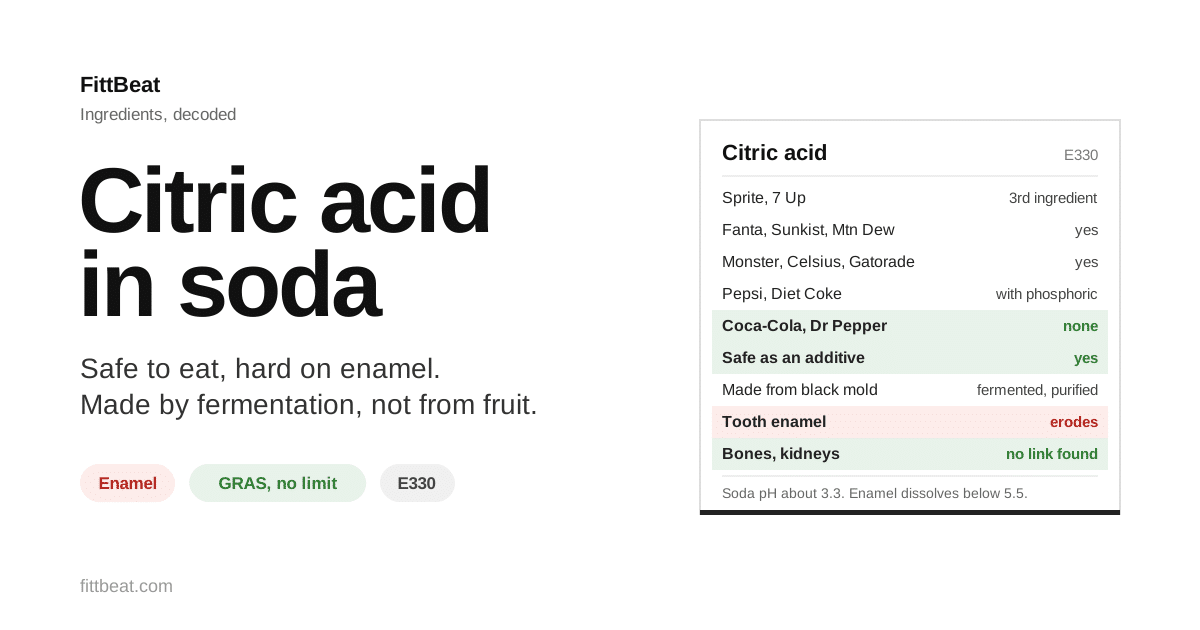
For your body, no. For your teeth, somewhat. Citric acid is a natural part of human metabolism, the FDA lists it as generally recognized as safe with no set limit, and no regulator has found a health risk from eating it. In soda it does three jobs: it adds tartness, it lowers the pH so preservatives work, and it protects flavor. The citric acid in your can wasn’t squeezed from fruit. It was made by fermenting sugar with a mold called Aspergillus niger and then purified, which is how nearly all of the world’s supply has been made for about a century. The one documented harm is dental: citric acid erodes tooth enamel about as much as the phosphoric acid in cola. The sugar sharing the can with it is a bigger concern than the acid.
Jump to: What it is · Why it’s in soda · Which drinks have it · The research · The mold question · Citric vs. phosphoric · Verdict · FAQ
What citric acid is, and where it comes from
Citric acid is a weak organic acid. It occurs naturally in citrus fruit, and lemon juice is about 5% citric acid by weight. Your own cells make and break it down constantly, because it’s a step in the cycle that turns food into energy. That cycle is named after it: the citric acid cycle.
The citric acid in soda doesn’t come from lemons, though. Since the 1920s it has been produced by feeding sugar, usually from corn, to the mold Aspergillus niger, which excretes citric acid as it grows. The liquid is filtered, and the acid is purified and crystallized into a white powder. The result is the same molecule that’s in a lemon. On a label it may appear as citric acid or, in Europe, E330.
Two common mix-ups are worth clearing up. Citric acid is not vitamin C, which is ascorbic acid, a different compound. And it’s not the same as the citrate salts you’ll see next to it, such as sodium citrate and potassium citrate. Those are its buffered forms, added to keep the tartness steady.
What citric acid in soda is for
Tartness. A can of soda with 38 g of sugar and no acid would taste flat and syrupy. Citric acid supplies the sour note that balances it, with a bright, fruity character that suits lemon-lime, orange, and berry flavors.
Preservation. Lowering the pH to around 3 makes the drink hostile to most bacteria. It also switches on the preservative: sodium benzoate only works in acidic drinks.
Flavor protection. Citric acid binds trace metals that would otherwise make flavors and colors break down on the shelf.
Colas use phosphoric acid for the first two jobs, because its sharper, drier bite fits cola flavor. Almost everything else uses citric.
Which sodas and drinks have citric acid?
| Drink | Citric acid | Where on the label | Other acid |
|---|---|---|---|
| Sprite and Sprite Zero Sugar | Yes | 3rd | None |
| 7 Up | Yes | 3rd | None |
| Fanta and Sunkist | Yes | 3rd | None |
| Mountain Dew | Yes | Near the top | None |
| Pepsi | Yes | Near the end | Phosphoric |
| Diet Coke | Yes | 7th of 8 | Phosphoric |
| Monster | Yes | 4th | None |
| Celsius | Yes | 2nd | None |
| Gatorade, Powerade, Prime | Yes | 3rd or 4th | None |
| Coca-Cola | No | — | Phosphoric |
| Coke Zero Sugar | No (potassium citrate) | — | Phosphoric |
| Dr Pepper | No | — | Phosphoric |
Three things to notice. Citric acid sits high on the label in every non-cola, usually right after the water and the sweetener, so it’s a main ingredient and not a trace one. Pepsi and Diet Coke use both acids. And the only drinks without it are colas, which swap it for phosphoric acid. If you want a soda with no added acid of either kind, you’re looking at root beer or plain sparkling water.
How much is in a can? Makers don’t print it. Soft drinks are typically formulated with a fraction of a percent of citric acid, which works out to roughly a gram per 12 oz can. For scale, one ounce of lemon juice has about 1.4 g.
What the research says about citric acid in soda
Safety as a food additive Safe
Citric acid is on the FDA’s list of substances generally recognized as safe, with no limit beyond good manufacturing practice. International food-safety committees haven’t set a maximum daily intake either, because they saw no need for one. Your body handles far more citric acid from its own metabolism each day than any soda supplies.
Tooth enamel Documented
This is the real finding. Enamel starts to dissolve below a pH of about 5.5, and lemon-lime sodas measure around 3.3. Citric acid adds a second problem, because it binds calcium and pulls it out of the tooth surface. In lab studies that soak teeth in soft drinks, citrus sodas erode enamel as much as colas do, and sometimes more. Sugar-free versions are no gentler, since the acid does this without any help from sugar. The damage depends on contact time, so sipping one can over an hour does more than drinking it with a meal.
Stomach and acid reflux Individual
Acidic, carbonated drinks can aggravate reflux or an irritated stomach in people who are prone to it. That comes from the acidity and the carbonation together, and it applies to colas as well. For most people the stomach, which is far more acidic than any soda, doesn’t notice.
Kidney stones Mixed
Citrate itself works against the most common kind of kidney stone, and doctors prescribe potassium citrate for that reason. That doesn’t make soda protective. In a large cohort study, people who drank sugar-sweetened non-cola sodas had a higher stone risk, which points at the sugar.
Benzene Not this acid
The benzene issue in soft drinks involves benzoate preservatives reacting with ascorbic acid, which is vitamin C. Citric acid isn’t part of that reaction. Our sodium benzoate breakdown explains it.
Is the citric acid in soda made from black mold?
Yes, in the sense that a mold makes it. Aspergillus niger is the black mold you might see on an old onion, and industrial strains of it produce nearly all commercial citric acid. This is ordinary food fermentation, the same idea as yeast making alcohol or bacteria making yogurt. The mold is filtered out and the acid is purified, so the powder that goes into soda is citric acid and not mold.
The concern you’ll see online traces to a 2018 paper describing four people who reported joint pain, muscle pain, and digestive symptoms after eating foods with manufactured citric acid, and not after eating citrus. The authors suggested that trace residues from the mold might trigger inflammation in sensitive people. It’s a hypothesis built on four case reports. It hasn’t been tested in a controlled study, and regulators haven’t changed their position. If you’ve noticed a consistent reaction of your own, it’s reasonable to avoid it and mention it to a doctor. For everyone else, there’s no evidence of a problem.
Read next: Sodas without phosphoric acid — the full list of sodas that use citric acid instead, and what that switch changes.
Citric acid vs. phosphoric acid
| Citric acid | Phosphoric acid | |
|---|---|---|
| Found in | Clear, fruit, and citrus sodas; sports and energy drinks | Colas and Dr Pepper |
| Source | Fermentation of sugar | Phosphate rock |
| Typical soda pH | About 3.3 | About 2.5 |
| Tooth enamel | Erodes it | Erodes it |
| Bone density research | No link found | Linked to daily cola in women |
| Kidney disease research | No link found | Linked to 2+ colas a day |
| Adds phosphorus | No | About 50 mg a can |
On the evidence, citric acid is the milder of the two. The bone and kidney findings that follow cola don’t show up for citric-acid sodas, and it adds no phosphorus, which matters to people on a kidney diet. For teeth, the two are about even.
Is citric acid in soda bad for you? The verdict
FittBeat verdict
One of the safest ingredients on the label, with a real cost for teeth. Citric acid is a normal part of your own metabolism, it’s been reviewed and cleared without a limit, and the mold it’s made with doesn’t end up in your drink. The inflammation claims rest on four case reports. What is documented is enamel erosion, and that applies to every acidic drink, sugared or not. If citric acid in soda is the ingredient you’re worried about, look one line up at the sweetener.
The concerns, ranked by evidence:
- Enamel erosion. Well documented, and worse with slow sipping. It’s the same in diet versions.
- Reflux or stomach irritation. Real for people prone to it, and shared with all acidic, carbonated drinks.
- Sensitivity to manufactured citric acid. Four case reports and a hypothesis. Possible in rare individuals and unproven.
- Everything else. No evidence of harm to bones, kidneys, or anything systemic.
Citric acid in soda for kids, pregnancy, and sensitive teeth
Kids: citric acid isn’t a concern for children in itself. Their enamel is, and sour candies and sipped sodas are the main sources of acid wear in kids’ teeth.
Pregnancy: there’s no restriction on citric acid. If reflux is a problem, which is common later in pregnancy, acidic sodas can make it worse.
Sensitive teeth or erosion: have acidic drinks with meals, use a straw, rinse with water afterward, and wait about half an hour before brushing so you don’t scrub softened enamel.
How to avoid it, if you want to
Plain sparkling water and club soda have no added acid, though carbonation alone makes water mildly acidic. Flavored seltzers usually list citric acid, in small amounts. Among sodas, root beers are the least acidic. Milk, plain tea, and still water avoid the question entirely. Colas avoid citric acid only by using phosphoric acid, which is the worse trade.
Frequently asked questions
Is citric acid in soda bad for you?
Not for your general health. Citric acid is a normal part of human metabolism and is classified as safe with no set limit. It does erode tooth enamel, like any acid in a drink.
What is the citric acid in soda made from?
Commercial citric acid is made by fermenting sugar, usually from corn, with the mold Aspergillus niger, then purifying the acid. It’s the same molecule found in lemons, but it isn’t extracted from fruit.
Is citric acid made from black mold?
A black mold, Aspergillus niger, produces it during fermentation. The mold is filtered out and the citric acid is purified, so the finished ingredient is not mold.
Is citric acid the same as vitamin C?
No. Vitamin C is ascorbic acid, a different compound. Citric acid has no vitamin activity.
Does Coke have citric acid?
Regular Coca-Cola doesn’t. It uses phosphoric acid. Diet Coke lists both phosphoric and citric acid, and Coke Zero Sugar uses potassium citrate.
Is citric acid in soda bad for your teeth?
Yes, with frequent exposure. Sodas with citric acid have a pH around 3.3, well below the 5.5 at which enamel begins to dissolve, and sugar-free versions are just as acidic.
Is citric acid or phosphoric acid worse?
Phosphoric acid, on current evidence. Both erode enamel, but only cola intake has been linked to lower bone density and kidney disease, and phosphoric acid adds phosphorus.
Can citric acid cause inflammation?
A 2018 paper described four people who reported inflammatory symptoms after eating manufactured citric acid. It’s a hypothesis that hasn’t been confirmed in controlled studies.
Sources
- Labels photographed October and November 2026: Sprite, 7 Up, Fanta Orange, Sunkist, Mountain Dew, Pepsi, Diet Coke, Coca-Cola, Coke Zero Sugar, Dr Pepper, Monster Energy, Celsius, Gatorade, Powerade, Prime Hydration.
- U.S. FDA. 21 CFR 184.1033, citric acid. ecfr.gov
- Reddy A, et al. The pH of beverages in the United States. Journal of the American Dental Association, 2016. doi:10.1016/j.adaj.2015.10.019
- Sweis IE, Cressey BC. Potential role of the common food additive manufactured citric acid in eliciting significant inflammatory reactions contributing to serious disease states: a series of four case reports. Toxicology Reports, 2018. doi:10.1016/j.toxrep.2018.08.002
- Penniston KL, et al. Quantitative assessment of citric acid in lemon juice, lime juice, and commercially-available fruit juice products. Journal of Endourology, 2008. doi:10.1089/end.2007.0304
- Ferraro PM, et al. Soda and other beverages and the risk of kidney stones. Clinical Journal of the American Society of Nephrology, 2013. doi:10.2215/CJN.11661112
- Tucker KL, et al. Colas, but not other carbonated beverages, are associated with low bone mineral density in older women. American Journal of Clinical Nutrition, 2006. doi:10.1093/ajcn/84.4.936
The amount of citric acid per can is an estimate from typical soft-drink formulation ranges. Manufacturers don’t publish it.
This article is for informational purposes and is not medical advice. Talk to a doctor or dentist about your individual needs.
