Author: FittBeat

  • Powerade Ingredients: What’s Really in the Bottle (2026)

    Powerade Ingredients: What’s Really in the Bottle (2026)

    Last reviewed: October 2026. Ingredient lists reflect the current U.S. formula sold in 28 fl oz bottles. Coca-Cola occasionally reformulates, so always check your bottle.

    Powerade sells itself on electrolytes and “more power.” Flip the bottle around, though, and the first two ingredients are water and high fructose corn syrup — the same opening line as a can of Sprite. This breakdown goes through every Powerade ingredient, what it does, which ones are worth paying attention to, and how the regular, Zero, and Sour versions differ.

    Quick answer: what is in Powerade?

    Regular Powerade is a sugar-sweetened electrolyte drink. A 12 oz serving has about 80 calories and 21 g of added sugar, plus 250 mg sodium and 80 mg potassium. Its ingredients are water, high fructose corn syrup, citric acid, a four-mineral electrolyte blend, vitamins B12 and C, natural flavors, a few texture and color-stabilizing additives, and one or two artificial dyes depending on flavor. Powerade Zero swaps the corn syrup for sucralose and acesulfame potassium.

    The full Powerade ingredients list

    Here is the label from the most popular flavor, Mountain Berry Blast, in order of quantity:

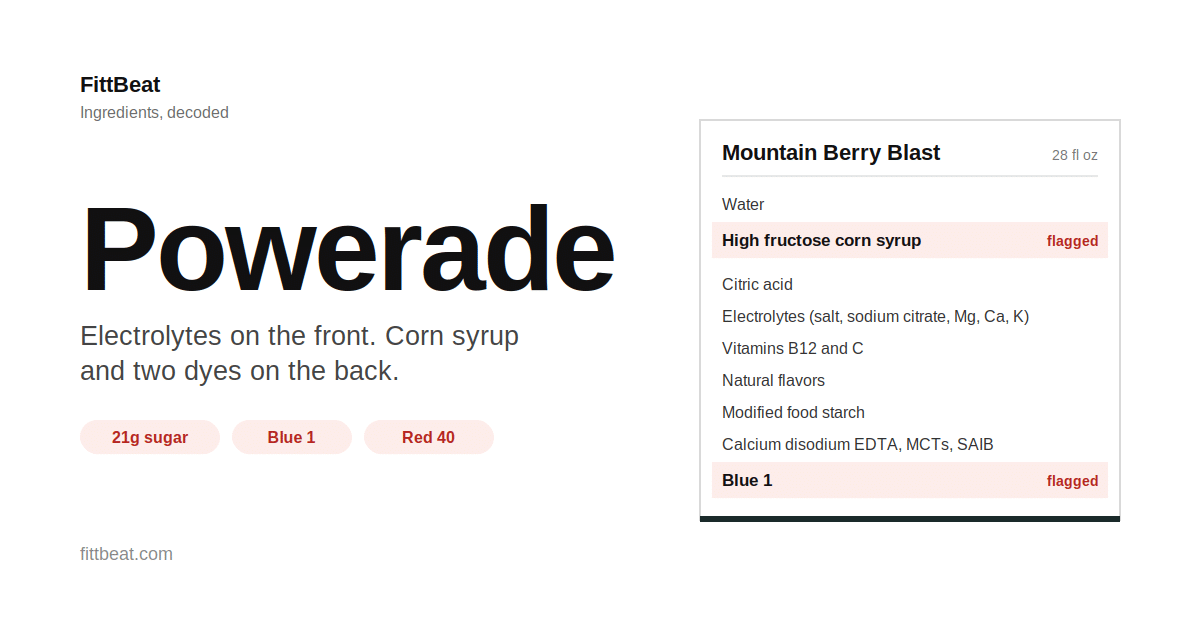
    Water, High Fructose Corn Syrup, Less Than 0.5% of: Citric Acid, Electrolytes (Salt, Sodium Citrate, Magnesium and Calcium Chlorides, Mono-Potassium Phosphate), Vitamins B12 and C (Cyanocobalamin and Ascorbic Acid), Natural Flavors, Modified Food Starch, Calcium Disodium EDTA (To Protect Color), Medium Chain Triglycerides, Sucrose Acetate Isobutyrate, Blue 1. Contains: Corn.

    Fruit Punch is nearly identical but uses Red 40 instead of Blue 1 and adds glycerol ester of rosin. Grape and the Sour line use both Red 40 and Blue 1 together.

    Notice the phrase “less than 0.5% of.” Everything after water and corn syrup — electrolytes, vitamins, additives, dyes — combined makes up under half a percent of the bottle. Powerade is, by weight, almost entirely sugar water.

    Powerade ingredients explained, one by one

    Water

    The base. Nothing to flag here.

    High fructose corn syrup

    This is Powerade’s sugar source and the ingredient that matters most. HFCS is a blend of glucose and fructose made from corn starch, and in a sports drink it does a real job: it provides fast carbohydrates that working muscles can use. Powerade is roughly a 6% carbohydrate solution, which is the range sports-science research generally supports for endurance exercise over about an hour.

    The problem is dosage. A full 28 oz bottle delivers around 50 g of added sugar — the entire daily added-sugar limit the American Heart Association recommends for men, and well over it for women. If you’re drinking Powerade at your desk rather than at mile eight, that sugar isn’t fueling anything. High fructose corn syrup in depth post covers the broader research on corn syrup.

    Citric acid

    Provides the tart edge, balances the sweetness, and lowers the pH enough to help preserve the drink. It’s the same acid found naturally in citrus, though commercial citric acid is made by fermentation. The main downside of acidic drinks is dental erosion with frequent sipping, which applies to Powerade just as it does to soda.

    The electrolyte blend

    Powerade’s “ION4” marketing refers to four minerals lost in sweat:

    • Salt and sodium citrate — sodium, the electrolyte you lose most of when you sweat. 250 mg per 12 oz is meaningful; it’s about 50% more than Gatorade.
    • Mono-potassium phosphate — potassium, at 80 mg per serving. Useful, though a banana has about five times as much.
    • Magnesium chloride and calcium chloride — present in amounts small enough that they don’t register as a percentage of daily value on the label. They’re there, but they’re not doing much.

    Bottom line: the sodium is legitimate. The other three are more marketing than nutrition.

    Vitamins B12 and C

    Cyanocobalamin (B12) and ascorbic acid (vitamin C) were added in the current formula, replacing the older B3/B6/B12 trio. A serving gives about 35% of your daily B12 and 20% of vitamin C. These are harmless, but they’re also the kind of additions that let a brand put “with vitamins” on the front of the bottle. Most people eating a normal diet aren’t short on either.

    Natural flavors

    A catch-all term the FDA allows for flavor compounds derived from plant or animal sources. The exact blend is proprietary, so you can’t know what’s in it. Blue raspberry, the flavor profile of Mountain Berry Blast, doesn’t exist in nature — “natural” here means the source molecules came from natural materials, not that the flavor resembles any real fruit.

    Modified food starch

    A thickener and emulsifier that keeps the flavor oils evenly suspended so the drink doesn’t separate or look watery. Derived from corn (hence the “Contains: Corn” allergen note). Considered safe; it’s in thousands of products.

    Calcium disodium EDTA

    Labeled “to protect color.” EDTA is a chelating agent — it binds trace metals that would otherwise react with the dyes and vitamins and cause the drink to fade or discolor. The FDA permits it in small amounts and it’s not absorbed well by the body. It’s a cosmetic additive, not a nutritional one.

    Medium chain triglycerides (MCTs)

    Surprising to see fat in a sports drink, but MCTs here aren’t a nutritional dose — they’re a carrier for flavor oils. The amount is far too small to appear on the nutrition facts panel (total fat: 0 g).

    Sucrose acetate isobutyrate (SAIB)

    A “weighting agent.” Flavor oils are lighter than water and would float to the top; SAIB increases their density so they stay mixed. It’s been used in citrus-flavored beverages for decades and is FDA-approved, though it’s the kind of ingredient most people would never choose to drink if it were listed on the front.

    Glycerol ester of rosin (Fruit Punch only)

    Another weighting agent, this one derived from pine tree resin. Same job as SAIB — keeps the cloudy flavor emulsion stable. FDA-approved; replaced brominated vegetable oil (BVO) in many drinks after BVO was banned in 2024.

    Blue 1 and Red 40

    These synthetic, petroleum-derived dyes give Powerade its neon color and nothing else. Both are the subject of the FDA’s 2025 announcement that it intends to phase synthetic food dyes out of the U.S. food supply by the end of 2026, following decades of debate about hyperactivity in sensitive children. Red 40 in particular is among the most heavily consumed dyes in the American diet. Our Red 40 post goes into the research in detail.

    If dye-free matters to you, note that Powerade currently has no dye-free flavor in the U.S. lineup. BodyArmor (also Coca-Cola owned) uses fruit and vegetable juice for color instead.

    Powerade nutrition facts

    Per 12 fl oz serving (a 28 oz bottle is about 2.3 servings):

    NutrientPer 12 ozPer 28 oz bottle (approx.)
    Calories80190
    Total carbohydrates21 g49 g
    Added sugars21 g (41% DV)49 g
    Sodium250 mg (11% DV)585 mg
    Potassium80 mg (2% DV)185 mg
    Vitamin C20% DV~47% DV
    Vitamin B1235% DV~82% DV
    Fat / Protein0 g0 g
    Caffeine0 mg0 mg

    Does Powerade have caffeine? No. Regular Powerade, Powerade Zero, and Powerade Sour are all caffeine-free in the U.S.

    Powerade Zero ingredients: what changes

    Powerade Zero removes the corn syrup and replaces it with two artificial sweeteners. Here’s the Mixed Berry Zero label:

    Water, Less Than 0.5% of: Citric Acid, Electrolytes (Salt, Sodium Citrate, Magnesium and Calcium Chlorides, Mono-Potassium Phosphate), Vitamins B12 and C (Cyanocobalamin and Ascorbic Acid), Natural Flavors, Sucralose, Acesulfame Potassium, Calcium Disodium EDTA (To Protect Color), Red 40, Blue 1.

    Key differences:

    • Sucralose (Splenda) and acesulfame potassium (Ace-K) provide the sweetness. Both are FDA-approved and have been studied extensively; both also show up in ongoing research on gut bacteria and insulin response that hasn’t reached consensus. Zero calories, zero sugar, zero carbs — it won’t break a keto diet or spike blood sugar.
    • No MCTs, SAIB, or modified starch, since there’s no sugar-heavy flavor system to stabilize.
    • Same electrolytes, same dyes, same sodium (240–250 mg).
    • Some Zero flavors list “natural and artificial flavors” rather than just natural.

    Powerade Zero is the better choice if you want electrolytes without sugar — but you’re trading one set of debated additives for another, and you lose the fast carbs that are the actual reason to drink a sports drink during hard exercise.

    Powerade vs. Gatorade: ingredient comparison

    The two brands are closer than their marketing suggests. The headline differences per 12 oz:

    PoweradeGatorade Thirst QuencherPowerade Zero
    SweetenerHigh fructose corn syrupSugar and dextroseSucralose, Ace-K
    Calories80800
    Sugar21 g21 g0 g
    Sodium250 mg160 mg240–250 mg
    Potassium80 mg50 mg80 mg
    Magnesium / calciumTrace amountsNoneTrace amounts
    Added vitaminsB12, CNoneB12, C
    Artificial dyesYesYesYes

    Powerade wins on sodium and potassium. Gatorade uses sucrose and dextrose instead of HFCS, which some people prefer, though metabolically the difference is small. Both use synthetic dyes. Neither is a health drink.

    Is Powerade bad for you?

    It depends entirely on when you drink it.

    During or after hard exercise lasting over an hour, in heat, or when you’re sweating heavily, Powerade does what it’s designed to do: it replaces sodium and delivers quick carbohydrates in a form that’s absorbed faster than plain water with food. The sugar isn’t a bug in that context — it’s the point.

    As an everyday drink, it’s a 190-calorie bottle of corn syrup with a few minerals and two synthetic dyes. The electrolytes don’t offset the sugar, and the vitamins are negligible. If you’re sick with a stomach bug and can’t keep food down, the sugar-and-sodium combination can help — that’s a legitimate use. For everything else, water is better.

    Ingredients worth watching, ranked by how much they should influence your decision:

    1. High fructose corn syrup — the dose is the problem, not the molecule. Half a bottle at your desk is a lot of sugar for nothing.
    2. Blue 1 / Red 40 — purely cosmetic, under regulatory pressure, and avoidable in competing products.
    3. Sucralose and Ace-K (Zero only) — approved and widely used, but the long-term research is still evolving.
    4. SAIB, EDTA, MCTs, modified starch — stabilizers in tiny amounts. Low concern, but they’re the reason the label reads like a chemistry set.

    Cleaner alternatives

    If you want electrolytes without the sugar or dyes, options that beat Powerade on ingredients include coconut water (naturally high in potassium, low in sodium — add a pinch of salt), electrolyte powders like LMNT or Liquid I.V. Sugar-Free, or simply water with a quarter teaspoon of salt and a squeeze of citrus for a hard workout. BodyArmor Lyte is the closest mainstream bottled option without synthetic dyes.

    Browse our full ingredients index for breakdowns of Gatorade, Diet Coke, Sprite, and more.

    Frequently asked questions

    What are the main ingredients in Powerade?

    Water, high fructose corn syrup, citric acid, an electrolyte blend (sodium, potassium, magnesium, calcium), vitamins B12 and C, natural flavors, stabilizers (modified food starch, EDTA, MCTs, SAIB), and artificial dyes such as Blue 1 or Red 40.

    Does Powerade have high fructose corn syrup?

    Yes. HFCS is the second ingredient in regular Powerade and its only sugar source. Powerade Zero contains no corn syrup.

    Does Powerade contain caffeine?

    No. All U.S. Powerade products — regular, Zero, and Sour — are caffeine-free.

    What sweeteners are in Powerade Zero?

    Sucralose and acesulfame potassium (Ace-K). It has zero calories and zero sugar.

    Is Powerade healthier than Gatorade?

    Powerade has more sodium and potassium per serving and adds vitamins B12 and C. Gatorade uses sugar and dextrose instead of corn syrup. Calories and sugar are identical. Neither is meaningfully healthier; both are best reserved for intense exercise.

    Does Powerade have red dye 40?

    Fruit Punch, Grape, Strawberry Lemonade, and most Zero flavors contain Red 40. Mountain Berry Blast uses Blue 1 only. There is currently no dye-free Powerade.

    Is Powerade good when you’re sick?

    It can help if you’re losing fluids from vomiting or diarrhea and can’t eat, since it supplies sodium and simple sugar together. Diluting it half-and-half with water lowers the sugar concentration, which some people tolerate better.

    This article is for informational purposes and is not medical advice. Talk to a doctor or registered dietitian about your individual nutrition needs.
  • Sodium Benzoate: The Preservative That Can Turn Into Benzene

    Sodium Benzoate: The Preservative That Can Turn Into Benzene

    Sodium benzoate is in a lot of drinks for a boring reason: sugar water left at room temperature grows mold and yeast, and benzoate stops that. The interesting part is what happens when it meets vitamin C.

    What it is

    Sodium benzoate is the salt of benzoic acid, which occurs naturally in cranberries, prunes, and cinnamon. The food-grade version is made synthetically. It works best in acidic foods, which is why it shows up in soda, pickles, and salad dressing rather than in bread. Potassium benzoate, used in Diet Coke, does the same job.

    Where you’ll find it

    • Sprite, Sunkist, Mountain Dew, and many fruit-flavored sodas
    • Diet Coke (as potassium benzoate)
    • Pickles, olives, sauerkraut
    • Salad dressings, condiments, jams
    • Fruit juices and juice drinks
    • Some mouthwashes and liquid medications

    Coca-Cola Classic doesn’t need it; its phosphoric acid and low pH do the preserving.

    What the evidence says

    Benzene. When sodium benzoate is combined with ascorbic acid (vitamin C) and exposed to heat or light, it can form benzene, a known carcinogen. The FDA found this in some soft drinks in 2006, a few above the 5 parts-per-billion limit for drinking water. Manufacturers reformulated, and follow-up testing found most products well under the limit. The combination to watch for on a label is “sodium benzoate” plus “ascorbic acid” or “citric acid” in a drink that sits on a warm shelf.

    Hyperactivity. The same 2007 British study that implicated synthetic dyes also used sodium benzoate in its test mixtures. Researchers couldn’t fully separate the preservative’s effect from the dyes, but it’s part of why the EU requires a warning on dyed foods.

    Everything else. At normal intake, sodium benzoate is excreted quickly and the body handles it without trouble. The acceptable daily intake is 5 mg per kilogram of body weight, which is a lot of pickles.

    Our verdict

    By itself, sodium benzoate is one of the more benign additives in soda. The benzene issue is real but mostly fixed, and you can sidestep it by not buying vitamin-C-fortified drinks that also contain benzoate, and by not leaving soda in a hot car. If you’ve got a kid who’s sensitive to dyes, it’s reasonable to watch benzoate too.

    Common questions

    Is sodium benzoate natural? Benzoic acid is found in nature; the additive is made in a lab. Same molecule either way.

    Is it in Coke? Regular Coke, no. Diet Coke uses potassium benzoate, a close relative.

    Does it cause cancer? Not on its own. The risk comes from benzene formation under specific conditions, which modern formulations are designed to prevent.

    Check any drink for preservatives in seconds with the free FittBeat app.

    This article is for general information and isn’t medical advice.

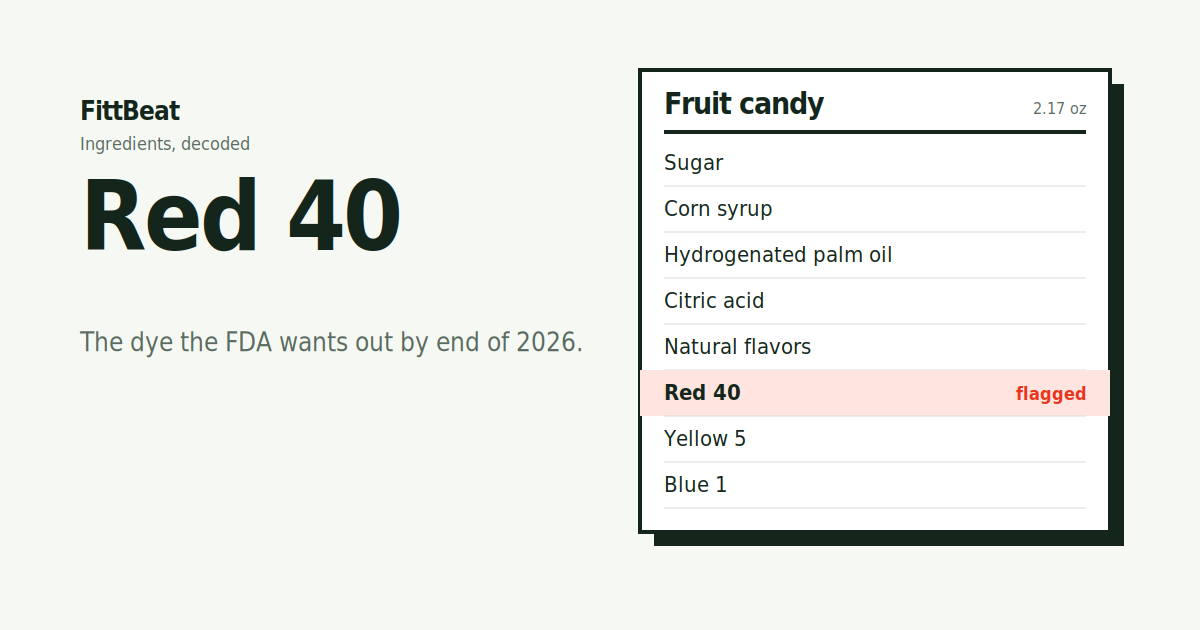
  • Red 40: The Dye the FDA Wants Out of Your Food by the End of 2026

    Red 40: The Dye the FDA Wants Out of Your Food by the End of 2026

    Last reviewed: October 2026. Regulatory status changes frequently; the timeline table below reflects announcements through this date.

    Red 40 is the most-used food dye in America — it’s in roughly one in five packaged products with any color added, from sports drinks to cereal to the coating on your vitamins. It’s also the dye at the center of the FDA’s 2025 plan to get petroleum-based colors out of the food supply, the subject of a warning label across the EU, and the one parents ask about most. Here’s where it stands right now, what the research says, and what still contains it.

    Quick answer: is Red 40 banned?

    No — Red 40 is still legal in the United States as of October 2026. The FDA asked food companies in April 2025 to voluntarily remove it (along with five other synthetic dyes) by the end of 2026, and later guidance has pointed toward the end of 2027; it is a request, not a ban. The dye that is banned is Red 3, revoked in January 2025 with a January 2027 deadline for food. Several states have gone further on their own: West Virginia bans Red 40 statewide starting 2028, and California bans it in school food from 2028. In the EU, Red 40 is legal but must carry a warning that it “may have an adverse effect on activity and attention in children.” That warning comes from a 2007 randomized trial, and it’s the one health finding on Red 40 that’s held up: a modest, real increase in hyperactivity in some children. There is no credible evidence it causes cancer.

    Red 40 ban timeline: what’s actually happened

    DateActionStatus
    2007University of Southampton randomized trial links dye-plus-benzoate mixtures to increased hyperactivity in childrenBasis for all later action
    2010EU requires a child-behavior warning on any product containing Red 40 and five other dyesIn effect
    2011FDA advisory committee reviews the evidence; finds a link in sensitive children but votes against a warning labelNo change
    2021California’s environmental health agency (OEHHA) concludes synthetic dyes can affect behavior in some childrenReport
    Oct 2023California bans Red 3 statewide (effective Jan 2027) — first state ban on a federally approved dyeRed 3 only
    Sept 2024California School Food Safety Act bans Red 40 and five other dyes from public school food (effective Dec 31, 2027)Red 40, schools
    Jan 15, 2025FDA revokes Red 3 authorization; food deadline Jan 15, 2027Red 3 only
    Mar 2025West Virginia bans Red 40 and six other dyes: school food Aug 2025, statewide Jan 1, 2028Red 40, statewide
    Apr 22, 2025FDA/HHS announce plan to phase out Red 40, Yellow 5, Yellow 6, Blue 1, Blue 2, Green 3 by end of 2026 — voluntary, no ruleRequest
    2025–2026Kraft Heinz, General Mills, PepsiCo, Nestlé, Tyson, J.M. Smucker, Hershey and others commit to removing synthetic dyes from U.S. products, mostly by end of 2027In progress
    Dec 31, 2026Original FDA target for voluntary removal of Red 40Likely to slip to 2027
    Dec 31, 2027California school ban takes effect; most corporate commitments come dueUpcoming
    Jan 1, 2028West Virginia statewide ban takes effectUpcoming

    The short version: Red 40 is being pushed out by state law and corporate commitments faster than by the FDA itself. The FDA’s “phase-out” has no enforcement mechanism, so the real deadlines are the state ones and the companies’ own promises. Expect to keep seeing Red 40 on labels through 2027, with candy and beverages last to reformulate.

    What is Red 40?

    Red 40 — Allura Red AC, E129 in Europe — is a synthetic azo dye made from petroleum-derived chemicals. It was approved by the FDA in 1971 as a replacement for Red 2, which was banned in 1976 over cancer concerns, and it has since become the single most-used color additive in the country by volume. It’s cheap, stable in heat and acid, and produces a bright, consistent red that natural colors (beet, paprika, carmine) struggle to match in beverages.

    Its job is cosmetic. It adds no flavor, no nutrition, and no preservation — it exists so that fruit punch looks like fruit, cherry candy looks like cherry, and strawberry yogurt looks pink. Every argument about Red 40 is really an argument about whether that’s worth any risk at all, which is why the EU landed on “legal with a warning” and the U.S. is landing on “please stop.”

    What the research actually says

    Hyperactivity in children Real, modest effect

    This is the finding that matters. The 2007 Southampton study gave about 300 children drinks containing mixtures of synthetic dyes (including Red 40 in one mix) plus sodium benzoate, or a placebo, in a randomized, double-blind crossover design. Both dye mixtures increased hyperactive behavior, measured by parents, teachers, and a computer test — in children from the general population, not just those diagnosed with ADHD. The effect was small on average and varied a lot between kids: some showed nothing, some showed a clear response. The EU acted on it in 2010. The FDA’s 2011 review agreed a link existed in “certain susceptible children” but concluded the evidence didn’t support a label. California’s 2021 OEHHA review, covering 27 trials, found the same pattern and said the FDA’s acceptable-intake levels were based on decades-old studies that never looked at behavior.

    The honest summary: Red 40 doesn’t cause ADHD, but in some children it can make attention and activity measurably worse, and no one can tell you in advance which children. That’s enough for a reasonable parent to limit it.

    Cancer No credible evidence

    Red 40 is often confused with Red 3, which was banned because it caused thyroid tumors in rats, and with Red 2, banned in 1976. Red 40 itself has not shown carcinogenic effects in the FDA’s or EFSA’s reviews. Two things do get cited: trace contaminants from manufacturing (benzidine and related aromatic amines) that are regulated to very low limits, and a 2022 mouse study where Red 40 in a high-dose diet worsened colitis and DNA damage in the gut over many months. That’s a real study, but a mouse at a dose far above human intake. EFSA opened a fresh genotoxicity review in 2024; as of this writing it hasn’t changed Red 40’s status.

    Allergy and sensitivity Rare

    True allergic reactions to Red 40 are documented but uncommon — hives and, rarely, more serious reactions. It’s more often an issue for people who react to multiple azo dyes. Migraine triggers are reported anecdotally without strong trial evidence.

    Daily intake Context

    The FDA’s acceptable daily intake is 7 mg per kg of body weight — about 490 mg a day for a 150 lb adult. A typical serving of a brightly colored drink or candy delivers somewhere between 5 and 30 mg. Adults don’t come close to the limit; children, who eat more dyed food per pound of body weight, get much nearer, and the OEHHA report noted that the FDA’s limits were never designed around behavioral effects at all.

    What foods and drinks contain Red 40?

    Almost anything red, orange, pink, or purple that isn’t colored by actual fruit — and a surprising number of things that aren’t red at all, where it’s blended with yellow or blue. Common categories:

    • Sports and fruit drinks: red and orange Gatorade flavors, Powerade, Hawaiian Punch, Kool-Aid, red-flavored Capri Sun
    • Soda: Fanta Orange (with Yellow 6), Sunkist, Mountain Dew Code Red, Big Red, cherry and strawberry sodas. Colas don’t use it — their color is caramel.
    • Candy: Skittles, M&M’s, Starburst, Swedish Fish, Twizzlers, Nerds, most gummies
    • Cereal and snacks: Froot Loops, Trix, Lucky Charms marshmallows, Doritos, Flamin’ Hot Cheetos, Takis, Cheez-It (some flavors)
    • Dairy and dessert: strawberry milk, flavored yogurt, Jell-O, popsicles, cake mix and frosting, maraschino cherries
    • Medicine and vitamins: children’s liquid medicines, chewable vitamins, pill coatings — Red 40 in drugs is also covered by the FDA’s 2025 phase-out guidance

    On a label it appears as “Red 40,” “FD&C Red No. 40,” “Red 40 Lake” (the insoluble form used in coatings and candy shells), or “Allura Red.” Products reformulating under the 2025–2027 commitments typically replace it with beet juice, paprika extract, carmine (from insects), or anthocyanins from purple carrot and black currant.

    Is Red 40 bad for you?

    FittBeat verdict

    Not dangerous for most adults. Worth avoiding for kids. The cancer fears belong to other red dyes; Red 40’s documented harm is behavioral, modest, and concentrated in children — which is precisely the group eating the most of it. It does nothing but color food, so there’s no benefit to weigh against the risk. For adults, it’s low on the list of things to worry about on a label. For a child who seems to react to brightly colored foods, it’s the first thing to cut, and the EU warning label and the FDA phase-out both say you’d be right to.

    How to avoid Red 40

    1. Read the color line. It’s at the end of the ingredient list. “Color added” or “artificial color” without a name is rare now; look for Red 40, Red 40 Lake, or Allura Red.
    2. Be suspicious of red, orange, and purple drinks. If it’s that color and lists no fruit juice, it’s almost certainly dyed. Clear and brown sodas don’t use it.
    3. Check kids’ medicine. Many liquid fever reducers and allergy meds are dyed; dye-free versions of most exist.
    4. Watch for the swap. Through 2027, products are quietly reformulating. The same brand can be dyed in one package and dye-free in the next; the label, not the brand, tells you which.

    Red 40 is one of the two dyes in most dyed foods; its usual partner is Yellow 6, and the two together are covered in our Fanta breakdown. See the full ingredients index for every product we’ve checked for dyes.

    Frequently asked questions

    Is Red 40 banned in the United States?

    No. As of October 2026 it’s still FDA-approved. The FDA asked companies in April 2025 to voluntarily stop using it by the end of 2026 (later guidance points to 2027), and West Virginia and California have passed their own bans taking effect in 2027–2028. Red 3 is the dye that was actually banned.

    Is Red 40 banned in Europe?

    No, but products containing it must carry a warning that it may affect activity and attention in children. Most European manufacturers reformulated rather than print the warning, so it’s much less common there in practice.

    Does Red 40 cause ADHD?

    It doesn’t cause ADHD. Randomized trials show it can modestly increase hyperactivity and reduce attention in some children — including kids without any diagnosis — for hours after eating it. The effect varies widely between children.

    Does Red 40 cause cancer?

    There’s no credible evidence that it does. It’s often confused with Red 3 (banned over thyroid tumors in rats) and Red 2 (banned in 1976). A 2022 mouse study linked very high doses to gut inflammation, which EFSA is reviewing.

    What is the difference between Red 40 and Red 3?

    Different molecules. Red 3 (erythrosine) is a pink-red iodine-based dye that was banned in January 2025 because it caused cancer in lab rats. Red 40 (Allura Red) is an orange-red azo dye with a behavioral — not cancer — concern. Red 40 is far more widely used.

    What foods have Red 40?

    Red and orange sports drinks, fruit punch, Fanta, Sunkist, Skittles, M&M’s, Starburst, Froot Loops, Doritos, Flamin’ Hot Cheetos, strawberry yogurt and milk, Jell-O, and many children’s liquid medicines. It appears on labels as Red 40, Red 40 Lake, or Allura Red.

    What is replacing Red 40?

    Beet juice, paprika and annatto extracts, carmine (from cochineal insects), lycopene, and anthocyanins from purple carrot, black currant, or red cabbage. These are less heat- and acid-stable and often less vivid, which is why candy and soda are reformulating last.

    How much Red 40 is safe?

    The FDA’s acceptable daily intake is 7 mg per kg of body weight — roughly 490 mg a day for a 150 lb adult. A serving of dyed candy or drink has about 5–30 mg. Children are more likely to approach meaningful intakes relative to body weight.

    This article is for informational purposes and is not medical advice. Talk to a doctor or registered dietitian about your individual nutrition needs.
  • Phosphoric Acid: The Ingredient That Gives Cola Its Bite

    Phosphoric Acid: The Ingredient That Gives Cola Its Bite

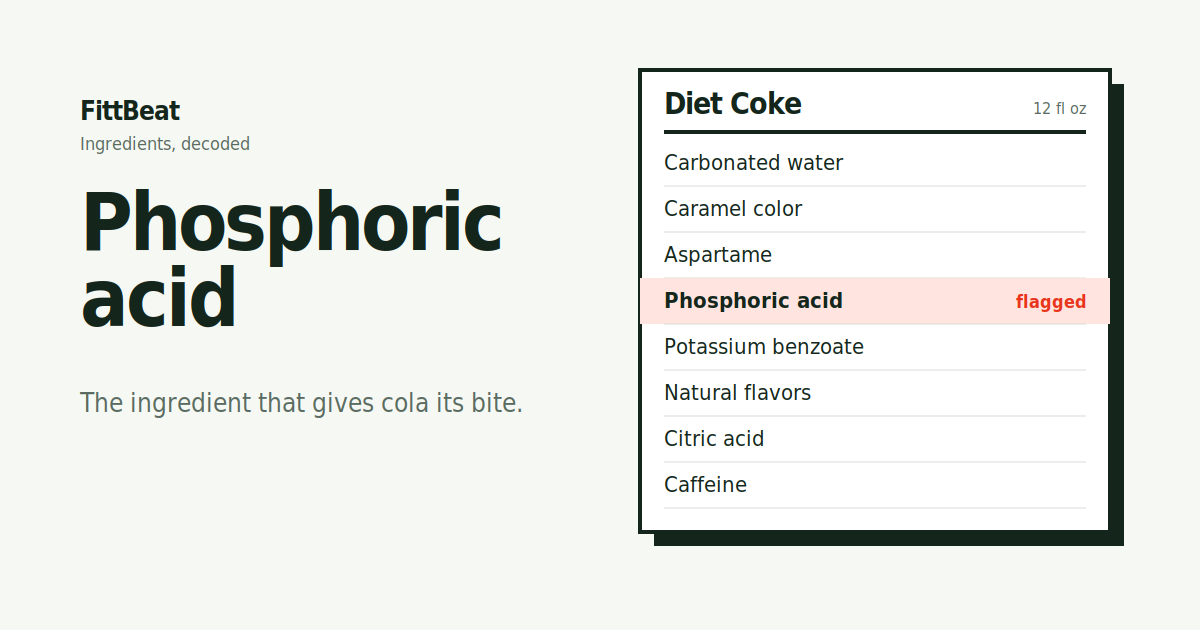
    Ever notice that cola tastes sharper than orange soda? That’s phosphoric acid. It’s the fourth ingredient in Coke, Diet Coke, and Pepsi, and it does two jobs: it adds tang and it keeps bacteria from growing in a bottle full of sugar water.

    What it is

    Phosphoric acid is a mineral acid made from phosphate rock. Food-grade versions are highly purified. It’s the same compound used in fertilizer and rust removal at industrial concentrations, which is where the “it can dissolve a nail” stories come from. In soda, it’s heavily diluted, but still enough to give cola a pH around 2.5. For comparison, lemon juice is about 2.0 and black coffee about 5.0.

    Where you’ll find it

    • Coca-Cola, Diet Coke, Pepsi, Dr Pepper
    • Some iced teas and energy drinks
    • Processed cheese, where it’s used as an emulsifier
    • Some jams and processed meats

    Clear sodas like Sprite and 7 Up use citric acid instead, which is gentler on enamel but still acidic.

    What the evidence says

    Teeth. This is the clearest risk. Acidic drinks soften tooth enamel, and the damage is about frequency, not quantity. Sipping one soda over two hours is worse than drinking it in ten minutes. Lab studies have shown measurable enamel erosion from cola, and dentists see it in patients who drink soda regularly, diet or not.

    Bones. Several studies found that women who drink cola regularly have slightly lower bone density, with no similar effect from non-cola sodas. One explanation is that phosphorus without matching calcium throws off the balance your bones need; another is that cola drinkers simply drink less milk. The effect is small and only shows up with daily consumption.

    Kidneys. Two or more colas a day has been associated with higher risk of chronic kidney disease in observational studies. Again, cause isn’t proven, but the pattern is consistent enough that it shows up in kidney-health guidance.

    Our verdict

    Phosphoric acid is one of the few soda ingredients with a well-documented, direct effect: it’s hard on your teeth. If you’re going to drink cola, drink it with a meal, don’t nurse it all afternoon, and rinse with water after. If you’re drinking two or more a day, cutting back is one of the more clearly justified changes you can make.

    Common questions

    Is phosphoric acid in diet soda too? Yes. Diet Coke has the same acid as regular Coke, so “diet” doesn’t protect your teeth.

    Does brushing right after soda help? No. Brushing softened enamel wears it away faster. Rinse with water and wait 30 to 60 minutes.

    Is phosphorus bad for you? You need it. The issue is getting a lot of it from soda while skipping calcium-rich foods.

    The free FittBeat app shows you what’s in any drink before you crack it open.

    This article is for general information and isn’t medical advice.

  • Caramel Color: Why There’s a Cancer Warning on Your Cola

    Caramel Color: Why There’s a Cancer Warning on Your Cola

    Last reviewed: October 2026.

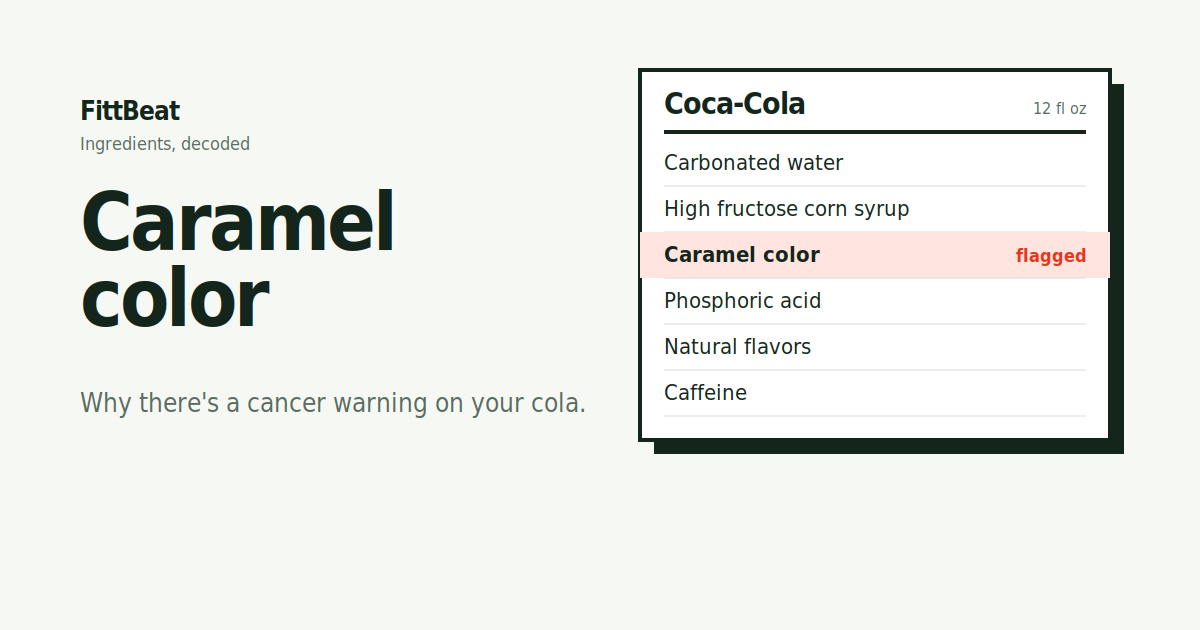
    Coke isn’t naturally brown. Neither is Pepsi, Dr Pepper, or root beer. The color comes from an additive called caramel color, and one version of it carries a chemical that California requires a cancer warning for. Here’s why that’s both true and less scary than it sounds.

    Quick answer: is caramel color bad for you?

    Caramel color is a brown food dye made by heating sugar. The type in colas (Class IV) is made with ammonia and sulfite compounds, which creates a byproduct called 4-MEI that caused lung tumors in mice at high doses. California requires a cancer warning above 29 micrograms a day, so Coca-Cola and Pepsi reformulated in 2012 to get under it — a can of U.S. cola today typically has a few micrograms. The FDA considers current levels safe; the WHO calls 4-MEI “possibly carcinogenic,” the same tier as aspartame. It’s a cosmetic ingredient with no benefit, a small risk, and the sugar in the same can is the bigger problem.

    What it is

    Caramel color is made by heating sugars, usually corn syrup, under controlled conditions. There are four classes. Class I is basically burnt sugar. Classes III and IV are made with ammonia compounds, which is what gives colas their deep, stable brown. Class IV is the one in most sodas.

    ClassE numberMade withContains 4-MEI?Typical use
    Class I (plain)E150aHeat onlyNoSpirits, some desserts
    Class II (sulfite)E150bSulfite compoundsNoSome liqueurs, cognac
    Class III (ammonia)E150cAmmonia compoundsYesBeer, soy sauce, gravy
    Class IV (sulfite ammonia)E150dAmmonia + sulfiteYesColas, most dark sodas

    The ammonia process creates a byproduct called 4-methylimidazole, or 4-MEI. That’s the chemical the warnings are about.

    Where you’ll find it

    • Coca-Cola, Diet Coke, Coke Zero, Pepsi, Dr Pepper, root beer
    • Soy sauce, Worcestershire sauce, gravy mixes
    • Some beers, whiskeys, and dark breads
    • Many “brown” flavored foods: caramel-flavored coffee drinks, some cereals

    Clear sodas like Sprite and 7 Up don’t use it, and orange sodas like Fanta use synthetic dyes (Red 40, Yellow 6) instead — a different set of concerns.

    What the evidence says

    In a two-year study, mice given high doses of 4-MEI developed lung tumors. Based on that, California added it to its Proposition 65 list in 2011 and set a daily exposure threshold of 29 micrograms. Above that, a product needs a warning label.

    Rather than put cancer warnings on cola, Coca-Cola and Pepsi reformulated their caramel color to cut 4-MEI, first for California and then nationally. Independent testing since then has found U.S. cans well under the threshold, though levels vary by brand and bottling plant.

    The FDA’s position is that current intake levels don’t pose a health concern. The World Health Organization’s cancer agency classifies 4-MEI as “possibly carcinogenic,” the same low-certainty tier as aspartame.

    Our verdict

    FittBeat verdict

    Caramel color is a cosmetic ingredient. It does nothing for taste and nothing for you. The 4-MEI risk at today’s levels is small, but it’s a reasonable example of an additive that only exists so a product looks the way marketing decided it should. If you drink a lot of dark soda, the sugar or sweetener is still the bigger issue.

    Common questions

    Is caramel color the same as caramel?

    No. Caramel you eat is sugar cooked with butter or cream. Caramel color is an industrial dye and has no caramel flavor in the amounts used.

    Is it in clear sodas?

    No. Sprite, 7 Up, and ginger ale don’t need it.

    How can I avoid 4-MEI?

    Choose clear or naturally colored drinks. Class I caramel (listed as “plain caramel” in some countries) doesn’t contain it.

    4-MEI questions

    What is 4-MEI?

    4-methylimidazole — a chemical that forms when sugars are heated with ammonia compounds. It’s not added on purpose; it’s a byproduct of making Class III and IV caramel color. It also forms naturally in roasted coffee, grilled meat, and soy sauce.

    How much 4-MEI is in a can of Coke?

    Since the 2012 reformulation, independent tests of U.S. Coca-Cola have generally found around 4 micrograms or less per 12 oz can — under California’s 29-microgram daily threshold. Pre-2012 cans tested at over 100 micrograms. Levels in other brands and in cola from other countries have tested higher, which is why the “varies by brand and bottling plant” caveat matters.

    Does caramel color cause cancer?

    Not at the levels in food, based on current evidence. The cancer finding comes from mice fed high doses of 4-MEI for two years. The FDA and EFSA both concluded that typical human intake doesn’t pose a health concern; the WHO’s cancer agency lists 4-MEI as “possibly carcinogenic” (Group 2B), which means limited evidence in animals and inadequate evidence in humans.

    Why doesn’t my Coke have a cancer warning?

    Because Coca-Cola reformulated to stay under California’s threshold. Proposition 65 only requires a warning if a product would expose someone to more than 29 micrograms of 4-MEI a day; a reformulated can comes in well below that. The warning never appeared because the company changed the recipe instead.

    Is caramel color banned anywhere?

    No. It’s permitted in the U.S., EU, Canada, and essentially everywhere, with limits on 4-MEI content. The EU set a maximum of 250 mg of 4-MEI per kg of caramel color in 2012; California’s Prop 65 listing is a warning requirement, not a ban.

    Is caramel color natural?

    It starts from sugar, but Class III and IV are made with ammonia and sulfite compounds under heat and pressure, so it’s an industrial product. Labels call it “caramel color” or “E150d”; it can’t be labeled “natural color” in most markets. Class I is the closest to what you’d make in a pan.

    Does Diet Coke have the same caramel color as regular Coke?

    Yes — Diet Coke, Coke Zero, and Coca-Cola all use Class IV caramel. Switching to diet removes the sugar but not the color.

    Scan a can with the free FittBeat app to see every additive in it before you buy.

    See the full ingredients index for every ingredient and soda we’ve broken down.

    This article is for general information and isn’t medical advice.

  • High Fructose Corn Syrup: Is It Really Worse Than Sugar?

    Flip over a can of Coke in the U.S. and the second ingredient is high fructose corn syrup. In Mexico, it’s cane sugar. People swear they can taste the difference. The bigger question is whether your body can tell. Mostly, it can’t.

    What it is

    High fructose corn syrup (HFCS) is corn starch that’s been broken down into glucose, then partly converted to fructose using enzymes. The common version in soda, HFCS-55, is about 55% fructose and 45% glucose. Table sugar is 50/50. That’s the entire difference in composition.

    Food companies use it because it’s cheaper than sugar in the U.S. (thanks to corn subsidies and sugar tariffs), it’s a liquid that mixes easily, and it keeps baked goods moist longer.

    Where you’ll find it

    • Coca-Cola, Sprite, Dr Pepper, Sunkist, and nearly every full-sugar U.S. soda
    • Ketchup, barbecue sauce, salad dressings
    • Bread, cereal, granola bars, yogurt
    • Juice drinks and sports drinks

    What the evidence says

    Studies comparing HFCS directly to sugar at matched doses have found no meaningful difference in blood sugar, insulin, appetite hormones, or weight gain. Your body handles 55% fructose almost identically to 50%.

    Where HFCS does deserve blame is quantity. Because it’s cheap, it ended up in everything, and sugar intake in the U.S. climbed alongside it. Excess fructose from any source is processed mostly by the liver, and chronic overload is linked to fatty liver, insulin resistance, and weight gain. A 12-ounce Coke has 39 grams of sugar. The American Heart Association suggests capping added sugar at 25 grams a day for women and 36 for men. One can blows past it.

    Our verdict

    HFCS is not a special poison. It’s sugar with a cheaper name. The problem is that it’s everywhere, including in foods that don’t taste sweet. If you want one rule: added sugar is added sugar, and the number on the nutrition label matters a lot more than which syrup produced it.

    Common questions

    Is Mexican Coke healthier? No. Same calories, same sugar. Some people prefer the taste of cane sugar, and that’s a fine reason to buy it, but it’s not a health upgrade.

    Does HFCS cause diabetes? No single ingredient does. Consistently high intake of added sugar from any source raises the risk.

    Does HFCS contain mercury? A 2009 study found trace amounts in some samples from an older manufacturing process. Modern production doesn’t use that process.

    The free FittBeat app shows you added sugar per serving the moment you scan a barcode.

    This article is for general information and isn’t medical advice.

  • Aspartame Side Effects: What the Research Really Shows (2026)

    Aspartame Side Effects: What the Research Really Shows (2026)

    Last reviewed: October 2026. This article summarizes published research and regulatory positions current as of that date. The science on non-sugar sweeteners is active; we update as findings change.

    Aspartame is the oldest, most studied, and most argued-about artificial sweetener on the market. It’s what makes Diet Coke taste like Diet Coke, it’s in roughly 6,000 products, and in 2023 the World Health Organization’s cancer agency put it on the same “possibly carcinogenic” list as aloe vera and pickled vegetables — a ruling the FDA publicly disagreed with the same week. This article covers what aspartame is, where it hides, which aspartame side effects have real evidence behind them, and what to make of the cancer question.

    Quick answer: is aspartame bad for you?

    For most people drinking a diet soda or two a day, major regulators — the FDA, EFSA, and the WHO’s own food-safety committee — say no. The 2023 IARC classification was a hazard label (“could this ever cause cancer?”) based on limited evidence, not a risk finding at normal doses, and the acceptable daily intake was left unchanged. The clearest real concern is for people with phenylketonuria (PKU), who can’t process one of its breakdown products. Beyond that, research since 2022 has linked heavy intake to modest increases in cancer and cardiovascular risk in observational data, a 2025 animal study tied it to artery plaque via insulin spikes, and the WHO advises against using any non-sugar sweetener for weight control. Not dangerous at normal intake; not the inert “free” sweetener it was sold as either.

    What is aspartame?

    Aspartame is a compound built from two amino acids, aspartic acid and phenylalanine, joined with a methyl ester. It was discovered by accident in 1965 by a chemist working on an ulcer drug who licked his finger. It’s about 200 times sweeter than sugar, so a can of diet soda needs only about 180–200 mg of it — which is why “zero calories” is accurate even though aspartame technically has 4 calories per gram like any protein.

    Unlike sucralose, which mostly passes through unabsorbed, aspartame is fully broken down in the gut into its three components: phenylalanine (about 50%), aspartic acid (40%), and methanol (10%). All three also occur naturally in food — a glass of tomato juice has more methanol than a can of diet soda, and a glass of milk has more phenylalanine — which is the main argument for its safety. The counterargument is that aspartame delivers them without the protein and fiber that normally come along, and that it’s consumed by some people in very large daily amounts over decades.

    On labels it appears as aspartame, E951, or under brand names NutraSweet and Equal (blue packets). Because it breaks down when heated, it’s rarely in baked goods — which is why sucralose and Ace-K dominate there.

    Where aspartame hides

    Diet Coke12 fl oz

    Carbonated Water, Caramel Color, Aspartame, Phosphoric Acid, Potassium Benzoate (To Protect Taste), Natural Flavors, Citric Acid, Caffeine. Phenylketonurics: Contains Phenylalanine.

    That last line — “Phenylketonurics: Contains Phenylalanine” — is the legal tell. Any U.S. product containing aspartame must carry it, so it’s the fastest way to spot aspartame on a label. Common sources:

    • Diet Coke post — aspartame is the only sweetener
    • Coke Zero Sugar — aspartame plus acesulfame potassium (Ace-K)
    • Diet Dr Pepper, Diet Mountain Dew, Diet A&W, Diet Sprite (Sprite Zero)
    • Most sugar-free gum (Extra, Orbit, Trident, 5)
    • Equal and NutraSweet packets; many “sugar-free” syrups and drink mixes
    • Sugar-free Jell-O, pudding, and many “light” yogurts
    • Some children’s chewable medicines and vitamins

    Worth knowing: Diet Pepsi in the U.S. has been aspartame-free since 2020 and uses sucralose and Ace-K instead, after PepsiCo removed aspartame in 2015, brought it back by customer demand in 2016, and then quietly dropped it again. Pepsi Zero Sugar also reformulated in 2023. If you want to avoid aspartame but keep a diet cola, Pepsi’s lineup is the mainstream option; Zevia uses stevia.

    Aspartame side effects: what the evidence actually shows

    Ranked from strongest evidence to weakest.

    1. Phenylketonuria (PKU) Proven — specific group

    This is the one undisputed harm. About 1 in 10,000–15,000 babies is born with PKU, a genetic condition where the body can’t break down phenylalanine. For them, it builds up in the blood and damages the brain, and aspartame is a concentrated source. Every U.S. newborn is screened for PKU at birth, and people with it manage a lifelong low-phenylalanine diet in which aspartame is strictly off-limits. This is why the warning label exists. It does not apply to anyone without PKU; carriers of one gene copy are fine.

    2. Cancer: the IARC classification Limited evidence

    In July 2023 the International Agency for Research on Cancer (IARC) classified aspartame as Group 2B, “possibly carcinogenic to humans,” citing limited evidence for liver cancer from three observational studies, limited evidence in animals, and limited mechanistic evidence. Headlines treated this as “aspartame causes cancer.” It isn’t.

    IARC’s job is hazard identification — whether something could cause cancer under any circumstances — not whether it does at the doses people consume. Group 2B is its second-weakest category and includes aloe vera extract, pickled vegetables, and working as a dry cleaner. The same day, the WHO/FAO Joint Expert Committee on Food Additives (JECFA), which does assess real-world risk, reviewed the same evidence and kept the acceptable daily intake at 40 mg/kg, concluding there was no convincing evidence of harm at normal consumption. The FDA went further and said it disagreed with IARC outright, pointing to flaws in the key animal study (including infections in the test animals).

    The strongest human evidence IARC cited was the French NutriNet-Santé cohort (2022, ~100,000 adults), which found that the highest consumers of artificial sweeteners — aspartame in particular — had about 13% higher overall cancer risk and higher breast and obesity-related cancer risk than non-consumers. That’s a real signal, but observational: heavy diet-soda drinkers differ from non-drinkers in many ways that are hard to fully adjust for. A June 2025 commentary from independent cancer-assessment experts noted the field is still divided on how much weight the 2B label deserves. The honest summary: there’s a reason to study it more, and no demonstrated cancer risk at ordinary intake.

    3. Cardiovascular effects Emerging evidence

    Two findings here. The same NutriNet-Santé cohort reported in 2022 that higher artificial sweetener intake, especially aspartame, was associated with a 9% higher risk of cardiovascular disease and 18% higher risk of stroke. Then in February 2025, a Karolinska Institute study in Cell Metabolism showed how that might happen: mice fed the equivalent of about three cans of diet soda daily for 12 weeks developed larger, more inflamed arterial plaques. The mechanism was unexpected — aspartame triggered an insulin spike (the sweet taste primes the body for sugar that never arrives), and chronic insulin surges drove inflammation in blood vessel walls. One mouse study isn’t proof, but it’s a plausible mechanism for the human observational data, and it matches the sucralose findings on insulin and hunger.

    4. It may not help with weight Strong evidence it doesn’t help

    The World Health Organization issued guidance in May 2023, after reviewing 283 studies, recommending against using non-sugar sweeteners — aspartame included — for weight control. Short-term trials show a small benefit when sweeteners replace sugar; longer observational studies show no benefit and some association with higher body weight and type 2 diabetes risk. The likely explanations are the insulin/hunger effect above and compensation (people eat more elsewhere). The direct trade of a sugar soda for a diet soda is still a calorie win. The trap is assuming diet soda is “free” and letting it displace water indefinitely.

    5. Headaches and migraines Mixed, individual

    The most common self-reported aspartame side effect. A few small controlled trials have found that some migraine-prone people react to aspartame; others found no effect versus placebo. The mechanism, if real, is probably phenylalanine’s effect on neurotransmitter balance. You don’t need a trial to justify an elimination test on yourself — cut it for two weeks and see.

    6. Gut microbiome Animal data mostly

    Rodent studies show aspartame alters gut bacteria and can impair glucose tolerance through that route. Human data is thin and mixed. This is a more active research area for sucralose and saccharin than for aspartame, since aspartame is broken down before it reaches most gut bacteria.

    7. Mood, memory, and anxiety Animal data

    A 2022 Florida State study found that mice given aspartame at roughly 15% of the FDA’s daily limit showed increased anxiety-like behavior that persisted into their offspring; a 2023 follow-up reported spatial memory deficits. Human studies are limited to small trials and self-reports. Interesting, unproven in people.

    8. Methanol and formaldehyde Not a real concern

    Aspartame’s methanol fraction is metabolized to formaldehyde, which sounds alarming. The amounts are tiny: a can of diet soda yields about 20 mg of methanol, versus roughly 50–100 mg from a glass of fruit juice and far more from fermented foods. The body handles these quantities routinely. This argument circulates widely online and doesn’t hold up to the numbers.

    How much aspartame is too much?

    The FDA’s acceptable daily intake is 50 mg per kilogram of body weight; EFSA and JECFA use 40 mg/kg. A 12 oz can of Diet Coke has roughly 180–200 mg.

    Body weightFDA limit (50 mg/kg)Cans of Diet Coke to reach itEFSA limit (40 mg/kg)
    60 lb child1,360 mg~7 cans~5–6 cans
    130 lb adult2,950 mg~15 cans~12 cans
    180 lb adult4,080 mg~20 cans~16 cans

    Almost nobody hits the ADI. But note two things: the ADI only addresses toxicity, not the insulin, hunger, or cardiovascular effects that showed up at ordinary intake; and a child’s limit is a fraction of an adult’s. A kid drinking two or three diet sodas plus sugar-free gum and a “light” yogurt is at a meaningfully higher fraction of the ADI than a parent having the same.

    Aspartame vs. sucralose vs. Ace-K vs. stevia

    AspartameSucraloseAcesulfame KStevia
    What it isTwo amino acidsChlorinated sugarSyntheticPlant extract
    Sweetness vs sugar200×600×200×200–300×
    Heat stableNoTo ~250°FYesYes
    Cancer classificationIARC 2BNoneNoneNone
    Main concernPKU, IARC 2B, heart dataHunger, gut, S-6-AUnder-studiedAftertaste, fewer studies
    Found inDiet Coke, Coke Zero, gumZero-sugar sports and energy drinksPaired with bothZevia, Olipop

    The two most common sweeteners in your diet are almost certainly aspartame (if you drink Coca-Cola diet products) or sucralose (if you drink zero-sugar sports and energy drinks). Our sucralose breakdown covers the other one in the same depth.

    Should you avoid aspartame?

    FittBeat verdict

    Safe at normal intake for people without PKU. Not a reason to drink more diet soda. The cancer label is a research flag, not a finding. The better-supported concerns — insulin spikes, no weight benefit, modest cardiovascular associations — all point the same direction: a diet soda is a better choice than a sugar soda, and water is a better choice than both.

    • You have PKU: avoid completely. This is settled.
    • Occasional diet soda: no meaningful concern.
    • Several diet sodas a day, every day: this is the group where the observational cancer and heart signals showed up. Cutting back is reasonable even without a definitive verdict.
    • Pregnancy: approved at normal intake; EFSA’s 2013 review found no developmental concern below the ADI. Moderation is the sensible default.
    • Kids: the ADI is weight-based, so children reach it far faster. Several states have restricted artificial sweeteners in school meals since 2025.
    • Trying to lose weight: don’t count on it helping beyond the direct sugar swap. Watch whether it increases your sweet cravings.
    • Migraines: try a two-week elimination and judge for yourself.

    See the full ingredients index for every drink we’ve broken down, including which ones use aspartame.

    Frequently asked questions

    Does aspartame cause cancer?

    No study has shown that it does at normal intake. In 2023 the WHO’s cancer agency classified it “possibly carcinogenic” (Group 2B) based on limited evidence; the WHO’s food-safety committee and the FDA both concluded the same day that it remains safe within the acceptable daily intake.

    What does “phenylketonurics: contains phenylalanine” mean?

    It’s the mandatory U.S. warning on any product with aspartame, for people with the genetic condition PKU who cannot process phenylalanine. If you don’t have PKU, the warning doesn’t apply to you.

    Is aspartame in Diet Coke?

    Yes — it’s the only sweetener in Diet Coke, at about 180–200 mg per 12 oz can. Coke Zero Sugar uses aspartame plus acesulfame potassium.

    Is aspartame in Diet Pepsi?

    Not in the U.S. Diet Pepsi switched to sucralose and acesulfame potassium in 2020.

    How much aspartame is safe per day?

    The FDA limit is 50 mg per kilogram of body weight, roughly 15 cans of diet soda for a 130-pound adult. The European limit is 40 mg/kg.

    Aspartame vs. sucralose — which is worse?

    Different concerns. Aspartame carries the IARC 2B label and is dangerous for people with PKU; sucralose has stronger evidence on hunger and gut effects and breaks down when baked. Neither has been shown to cause harm at ordinary intake.

    Does aspartame break down into formaldehyde?

    Technically yes, via methanol, but in amounts smaller than you get from a glass of fruit juice. The body processes it routinely. This is not a credible health concern.

    Does aspartame raise blood sugar or insulin?

    It contains no carbohydrate and doesn’t raise blood sugar directly. A 2025 animal study found it triggers insulin release through the sweet-taste response, which may matter with heavy long-term use; human evidence is still limited.

    This article is for informational purposes and is not medical advice. Talk to a doctor or registered dietitian about your individual nutrition needs.
  • 7-Up Ingredients: The Negative Hidden Dangers of These Sodas!!

    7-Up Ingredients: The Negative Hidden Dangers of These Sodas!!

    The 7-Up ingredients list has a unique claim to fame – it launched in 1929 as “Lithiated Lemon-Lime Soda” containing lithium citrate, a mood-stabilizing drug! Today, though far removed from its medicinal origins, 7-Up markets itself as having one of the cleanest formulas in the soda industry. Let’s uncover what actually goes into this famous “Uncola.”

    Core 7-Up Ingredients: The Clean Formula

    Let’s have a look at 7-Up ingredients, the classic soda everyone know and love. We’ll peek into each one to see how they come together to create that iconic refreshment without any frills or fuss.

    7-Up Ingredients: Filtered Carbonated Water Base

    The main star here is filtered carbonated water. It’s just water with a bit of bubbly magic, courtesy of carbon dioxide. That bubbly goodness comes from adding carbon dioxide to water under pressure, giving the drink its lively fizz. When you open the bottle, the gas pops out, bringing those famous bubbles—the soul of any good soda. Many fizzy drinks call this their humble beginning.

    7-Up Ingredients: High Fructose Corn Syrup

    Now, onto the sweetness that defines 7-Up. The usual suspect is high fructose corn syrup (HFCS), a sweet staple in sodas. In some places, you might find 7-Up sweetened with real sugar. HFCS adds an extra sugary punch and helps keep the drink fresh for longer.

    Sweetener TypeCalories (per 12 oz)
    High Fructose Corn Syrup150
    Real Sugar140

    7-Up Ingredients: Citric Acid

    Next up is citric acid, a crucial player giving 7-Up its tasty zest. It brings a bit of tang that complements the sweetness, jazzing up the citrusy flavor. Plus, citric acid lends a hand in keeping the soda around longer by acting as a natural preservative.

    7-Up Ingredients: Natural Flavors Composition

    Then we have the natural flavors—the real secret sauce. While the exact recipe is kept under wraps, these flavors mostly come from citrus fruits, which make 7-Up taste like, well, 7-Up. These fruity notes fuse with citric acid for a burst of freshness in every sip.

    Discussion of Preservative Choices

    Preservatives might not sound exciting, but they’re key in keeping the soda in tip-top shape. 7-Up uses potassium citrate and calcium disodium EDTA to stay fresh. The latter guards the taste by fending off oxidation, ensuring that the drink remains tasty from the first pop to the last drop.

    By looking at these ingredients, we can see how 7-Up’s blend stays so fresh and clean. Curious about other sodas? Check out the ingredient lists for Pepsi, Coca-Cola, Diet Coke, Fanta, and Sunkist.

    Pros and Cons of 7-Up Ingredients:

    When we size up what makes 7-Up bubbly and refreshing, there’s a mix of good and not-so-great points worth chatting about. Knowing these can help us sip smartly.

    7-Up Ingredients: Pros

    No caffeine means sweet dreams for the caffeine-sensitive

    A big plus with 7-Up is its total lack of caffeine. For those of us who get a bit jittery from caffeine or are just not fans of it, this is a thumbs-up.

    Sticks to simpler stuff, unlike some flavor party sodas

    It’s nice that 7-Up keeps it straightforward with its ingredients. It avoids the mountain of complex chemicals and weird additives you find in plenty of other sodas.

    No funky colors or phosphoric acid

    You’ll notice 7-Up is free of the usual artificial colors and phosphoric acid seen in lots of drinks. This can be a win if we’re trying to sidestep extra chemicals.

    Lower sodium hit compared to soda rivals

    For the sodium-wary among us, 7-Up often has less salt than many other fizzy options, making it a bit kinder on our hydration plans.

    Some places offer the real sugar taste

    In parts of the world, you might find 7-Up sweetened with real sugar. This can be a treat for those looking for a more down-to-earth sweet taste.

    7-Up Ingredients: Cons

    Sugary punch with 38g per 12 oz can

    7-Up does pack a sugary punch. A typical can has around 38g of sugar, which can add to health woes if we’re not careful about how much we drink.

    Includes preservatives like potassium benzoate

    There’s potassium benzoate in 7-Up, an artificial gunk that might make some of us squirm. While it’s generally tagged as safe, some would rather sip on stuff without it.

    Citric acid might not be so sweet to your teeth

    Citric acid is in the mix here, and it can nibble away at our enamel over time. So, sipping 7-Up might need some tooth care bragging later.

    Sugar rush could spike blood sugar levels

    The sugar surge in 7-Up can shoot up our blood sugar levels, which isn’t ideal if we’re juggling sugar management.

    Some cans use high fructose corn syrup over sugar

    Certain versions of 7-Up opt for high fructose corn syrup instead of real sugar. This sugary stuff has a bit of a reputation for health worries like weight gain and diabetes.

    Balancing the good and the not-so-great can help us sip wisely when it comes to 7-Up and its fizzy friends. If you’re curious about what goes into other popular sodas, check out what’s inside with Pepsi ingredients, Coca Cola ingredients, Diet Coke ingredients, Fanta ingredients, and Sunkist ingredients.

    Natural Flavors and Citrus Components

    Let’s break down what makes 7-Up tick, starting with the flavors. If you’ve ever wondered why this soda keeps bringing folks back for more, we’re here to decode the magic of lemons and limes. So, grab a can, sip along, and get cozy as we see what sets 7-Up apart from your regular bubbly drink.

    Where’s That Lemony Goodness Coming From?

    The secret to 7-Up’s lemon zing lies in natural sources. Think of it as Mother Nature lending a hand, with lemon oil and juicy extracts from ripely zested lemons tossing a party in every sip. These flavor kickers show up from the peel and flesh, gifting a pop of zestiness. No fake tang here—natural lemon’s the name of the game for that straight-up taste everyone loves in their fizzy fix.

    What Puts the Lime in the Coconut?

    Alright, maybe it’s not in a coconut, but the lime flavor in 7-Up comes from nature’s pantry too. Picture real lime juice or oil, just tart enough to tango with the soda’s sweetness. This dynamic duo whips up a taste balance that keeps you coming back. By steering into natural lime town, 7-Up stands out in the citrus soda crowd, wooing fans of all things fruity.

    How Do They Keep It Fresh?

    Flavor’s gotta stick around, right? That’s where 7-Up pulls out some cool tricks. Calcium disodium EDTA swoops in as a guardian, keeping flavors from getting all oxidized and gross. It’s like the superhero of preservatives, making sure your soda’s just as tasty on day one as it is down the line.

    Trick Up Their SleevesWhat It Does
    Calcium disodium EDTAStops flavors from losing their oomph
    Cool bottling spotsKeeps the light and heat at bay

    Standing Out Among the Fizz Crowd

    When it comes to clear sodas, they’re not all cut from the same citrus cloth. Take Sprite or Sierra Mist. Sprite leans heavier into its lemon-lime notes, while Sierra Mist tosses in real sugar for kicks. These little tweaks can sway folks one way or the other. It’s all about what tickles your taste buds the right way.

    So, What’s ‘Natural’ Anyway?

    When you see ‘natural’ on a label, it means the flavors hail from plants or critters, processed just enough to jazz up your drink. But let’s be real, “natural” doesn’t mean untouched by human hands or processes. It’s a bit like taking an apple, and turning it into apple flavor without straying too far from its roots.

    So, to wrap it up, the fresh flavors and citrusy splash in 7-Up give it the edge, especially for those who like a peek at the ingredient list without a chemistry degree handy. Want more soda scoop? Dive into our articles on pepsi ingredients and coca cola ingredients.

    Long-Term Health Risks Consuming 7-Up

    Scientific Research Studies on Consuming Soda

    Let’s chat about the health issues tied to guzzling 7-Up. It’s not just about enjoying that refreshing fizz—there’s more lurking under the surface of those bubbles. What say we dig into the research around regularly indulging in sugary drinks like 7-Up?

    Health RisksStudies / Findings
    Weight GainIt ain’t rocket science: sugary sodas and weight gain are like peanut butter and jelly—they just hang together. Those extra calories from all that sugar add up big-time.
    Metabolic SyndromeHaving a soda habit could jack up your chances of getting metabolic syndrome. That means trouble with blood sugar and cholesterol, according to Healthline.
    Dental HealthThere’s acid content here—think citric acid—which can erode tooth enamel and send you running to the dentist with cavities.
    Blood Sugar SpikesSip a 7-Up, and your blood sugar might just go whooop! Constant peaks like this can lead your body towards a dodgy insulin turn, as pointed out by UC Davis Health.
    Heart Health RisksMore sugar might mean more heart trouble, with some studies hinting that it’s tied to higher blood pressure and heart disease risks.

    Now, about all those additives in your soda can, like potassium benzoate. They’re there mainly to keep the product stable, but having too much over time can make folks raise an eyebrow. Playing it safe with moderation is usually the way to go.

    So, while 7-Up may not give you caffeine jitters, it’s worth thinkin’ ’bout how these sweet drinks fit into the bigger picture of your diet and health. It’s cool to enjoy a can now and then, but keep it balanced, folks. Curious about what’s in other sodas? Feel free to check out our write-ups on Pepsi ingredients, Coca-Cola ingredients, Diet Coke ingredients, Fanta ingredients, and Sunkist ingredients.

    Wrapping It Up

    Take a Sip of Insight

    We’ve had an up-close look at 7-Up and its fizzy secrets, and let’s face it, this bubbly charmer draws us in with its crisp ingredients and refreshing kick. Still, we can’t ignore the sugary side of things—the impact on your health is something to think about. So let’s sip wisely and keep our bodies happy.

    For all you soda fans out there, you should take a peek at what’s really inside your favorites—not just 7-Up. Knowing what’s in your drink arsenal means you can choose a little smarter. If you’re thirsty for more soda scoop, dip into our articles on Pepsi ingredients, Coca Cola ingredients, Diet Coke ingredients, Fanta ingredients, and Sunkist ingredients.

    Checking out this info lets us all sip with a little more smarts, mixing good times with a dash of caution. Let’s pour ourselves into better choices, one can at a time!

  • Sunkist Ingredients: Honest Findings From Our Investigation

    Sunkist Ingredients: Honest Findings From Our Investigation

    Primary Sunkist Ingredients: The Foundation

    So, if we’re gonna really dig into what’s in Sunkist, we gotta start with the basics – the stuff that gives this soda its unique kick. Let’s break it down, one ingredient at a time.

    Sunkist Ingredients: Carbonated Water

    The big star of Sunkist’s show is carbonated water. This bubbly goodness is what makes the drink fizzy and refreshing, acting as a stage for all the other flavors to shine. Essentially, it’s water jazzed up with some carbon dioxide gas. The best part? It brings no calories or sugars to the party, so it’s pretty much guilt-free.

    Sunkist Ingredients: High Fructose Corn Syrup

    Now, let’s chat about high fructose corn syrup (HFCS), the sweet talker of the bunch. It’s cheaper than regular sugar and boosts the sweetness, which manufacturers love. HFCS is what makes Sunkist taste like a treat that even candy would be jealous of. It’s a hefty contributor to the sugar tally in your can of fizz.

    IngredientAmount per Serving
    High Fructose Corn SyrupAround a whopping 12 teaspoons of added sugar per serving (EWG Food Scores)

    Sunkist Ingredients: Yellow 6 and Red 40 dyes

    Here’s where things get a bit colorful and kinda controversial. Sunkist gets its sunny hue from Yellow 6, while Red 40 jazzes up the visual appeal. These colorful companions have stirred up quite a conversation due to potential health risks, though they’re green-lighted by the FDA.

    Sunkist Ingredients: Citric Acid

    Citric acid is like the multitasker of the bunch. It adds that tangy citrus zing that keeps the sweetness from being overwhelming and helps keep the soda fresh. Since it’s naturally found in citrus fruits, it’s a familiar face in the soda world.

    Sunkist Ingredients: Sodium Benzoate

    Sodium benzoate’s like the security guard of the soda world, keeping unwanted bacteria and mold at bay. Even though it’s generally considered safe by the FDA, folks who worry about health sometimes give it the side-eye, especially when it teams up with stuff like vitamin C.

    Understanding these main players in Sunkist—like bubble-producing carbonated water to shelf-life-prolonging sodium benzoate—gives us a peek into why Sunkist remains a fizzy favorite, despite a few raised eyebrows. Curious how it stacks up next to others? Check out how ingredients compare in drinks like Pepsi and Coca-Cola.

    Artificial Colors and Flavors Decoded

    Let’s break down what’s really going on with the ingredients that give Sunkist its signature zing. We’re diving into what these artificial colors and flavors are made of, how they’re cooked up, and the rules around using them.

    The Lowdown on Fake Orange Flavor

    Sunkist’s orange flavor tries its best to taste like picking oranges right off a tree. It’s a mix of natural and man-made stuff, where ethyl butyrate plays a starring role with its fruity scent. Plus, other compounds reel in those sweet and tangy vibes we love in orange drinks. These ingredients are mixed just right to make sure every bottle tastes the same and lasts long enough to enjoy.

    What’s Going On With Yellow 6 and Red 40?

    Yellow 6 and Red 40 bring the color to Sunkist but also bring along some worries. These dyes, sourced from petroleum, are churned out with some heavy chemical processes. This kind of production raises flags due to its potential ties to allergies and attention hiccups in kids. It’s like putting a splash of caution along with the color.

    Checking Out Natural Color Alternatives

    Sunkist may stick with artificial hues, but there are natural ways to brighten things up. Beet juice and annatto are options that steer clear of the risks synthetic colors can have. More brands are leaning towards Mother Nature’s palette, spurred by consumers itching for simplicity and transparency. However, natural dyes might not hold up as well or pop as vividly as the synthetic ones do.

    ColorantSourceHealth Concerns
    Yellow 6Synthetic (petroleum)Allergies, possible hyperactivity
    Red 40Synthetic (petroleum)Allergies, attention troubles
    Beet JuiceNaturalFewer worries, shades can vary
    AnnattoNaturalGenerally safe with minimal concerns

    The Secret to Long-Lasting Flavor

    Keeping the taste fresh for a long time is crucial in the soda biz. Sunkist opts for preservatives like sodium benzoate to fend off mold and bacteria, keeping the fizz tasting just right. Antioxidants are like flavor bodyguards, stopping any funny business like oxidation from messing with the taste.

    A Peek at Color Rules Around the Globe

    Colors like Yellow 6 and Red 40 aren’t just thrown into the mix without rules. The United States says okay to these additives within certain limits, but in places like the European Union, the rules tighten up. Some countries kick out these artificial colors for good, pushing brands to tweak recipes for compliance. Knowing these rules can be an eye-opener when choosing your fizzy drink companion.

    Want more ingredient info on other sodas? Check out the ingredients in Pepsi, Coca-Cola, Diet Coke, Fanta, and 7-Up.

    Sweetener System and Sugar Content

    Getting to know the sweeteners and sugar levels in Sunkist soda is a pretty big deal. We’re diving into the types of sweeteners that go into Sunkist, how much sugar is packed in each can, and how it stacks up against other fizzy orange drinks.

    Sweeteners Doing the Heavy Lifting

    Sunkist mainly rolls with high fructose corn syrup as its go-to sweetener. It’s super common in sodas because it pumps up the flavor without emptying wallets. In Sunkist, this type of sugar is the headliner (EWG Food Scores).

    Sugar Load Per Serving

    Crack open a 12-ounce can and you’re looking at around 44 grams of sugar—about 11 teaspoons worth! This sugar hit goes way over the American Heart Association’s daily limit, which suggests keeping it under 36 grams for dudes and 25 grams for the ladies (Is It Bad For You).

    Serving SizeSugar Content (g)Teaspoons of Sugar
    12 oz (Sunkist)4411

    How Sunkist Stands with Its Orange Buddies

    Line Sunkist up with its orange-tinted pals, and you’ll see it’s got quite a sugar jackpot. Here’s the breakdown:

    Soda TypeSugar Content (g per 12 oz)
    Sunkist44
    Fanta40
    Crush48
    Diet Orange Soda0

    See? Sunkist is definitely on the sugar-strong side among the orange fizzy drinks.

    Diet Sodas: The “Sugar-Free” Players

    If you’re sugar-watching, diet sodas like Diet Sunkist or Diet Fanta are more your speed. They swap sugar for artificial sweeteners, letting you enjoy the taste without the calorie and sugar pile-up. Curious about what goes into a diet soda fix? Check our article on diet coke ingredients.

    Local Flavors and Sweetener Swaps

    The sweet stuff can change depending on where you are. Some places might use cane sugar instead of high fructose corn syrup because of different local rules and what’s trending with taste. This could tweak the flavor and sweetness, so scanning those labels can be eye-opening.

    All this chat about sweeteners in Sunkist shows that knowing your sugar really matters if you’re serious about what you sip. Want to compare more sips? Take a peek at our deep dives on pepsi ingredients and coca cola ingredients.

    Global Variations and Regional Recipes

    When we take a trip through the world of Sunkist, it’s clear that flavors and ingredients aren’t one-size-fits-all—they change depending on where you are, thanks to local tastes and rules.

    Comparison of US vs. European Formulations

    Let’s break it down: Sunkist in the U.S. and Europe isn’t concocted quite the same way. Across the pond, Europe tends to go easy on the artificial colors, choosing more natural hues instead, while the U.S. version loves that high fructose corn syrup punch. Want more details? Check out Is It Bad For You.

    DetailU.S. MixEuro Version
    Sweet StuffHigh fructose corn syrupSucrose, natural sweeteners
    Colors All AroundArtificial (Yellow 6, Red 40)More natural tones
    PreservativesSodium benzoateTight rules on some preservatives

    Analysis of International Ingredient Restrictions

    International rules about what’s allowed in a can of Sunkist can be a real game-changer. Ingredients that fly in the U.S. might be frowned upon elsewhere. Some countries are really cracking down on artificial stuff, saying nope to preservatives and colors they find sketchy. For the nitty-gritty on what’s allowed and what’s not, visit Open Food Facts.

    Investigation of Regional Taste Preferences

    Who knew that taste buds vary so much? The level of sweetness in Sunkist gets a tweak depending on where you sip it. Different places have different ideas about what tastes best, and that’s tied up with local culture and the environment. Dive into those taste tidbits over at EWG Food Scores.

    Breakdown of Country-Specific Regulations

    When it comes to what goes into your Sunkist, it’s all about regulations. Every country has its own set of rules on what’s safe to eat and drink, shaping the way our favorite orange soda is whipped up and served. This isn’t just about taste, it’s about safety, consumer preferences, and health policies. Explore the topic more at Sunkist Growers Inc..

    Overview of Global Manufacturing Standards

    Global standards are like the secret recipe for consistency and safety in our fizzy friend. Companies gotta play by the rules, which could mean switching up their ingredients or processes. Knowing these standards helps us appreciate just how complex the Sunkist formula is. For a behind-the-scenes look at food production, Chick-fil-A spills the beans.

    By diving into how Sunkist’s ingredients change around the globe, we get a better picture of what goes into making that iconic orange soda. From tweaks in recipes to who checks the ingredient list, Sunkist’s story reveals a lot about tastes and production across regions.

    Health and Safety Considerations

    We all love kicking back with a fizzy can of Sunkist soda, but let’s face it, we gotta know what’s really inside. It’s time to take a hard look at what those artificial colors, preservatives, and sugars might be doing to us, not to mention the opinions of the folks at the FDA.

    Analysis of Artificial Color Safety Studies

    Some might say Sunkist is a rainbow in a can, thanks to colors like Red 40 and Yellow 6. According to the EWG Food Scores, these colors make the top list for causing a bit of a stir. Some research hints that artificial colors might tweak the behaviors of kiddos, though the jury’s still out. The FDA thinks these colors are okay in the amounts used—so long as you’re not chugging barrels of the stuff!

    Investigation of Preservative Research Findings

    Look closer at what keeps Sunkist fresh: sodium benzoate. This guy’s a preservative powerhouse, but it’s also wearing a question mark hat. Under certain conditions, sodium benzoate can transform into benzene, a troublemaker linked to cancer. But, rest easy, because the soda’s levels usually play it way under the danger zone, according to the FDA.

    Examination of Sugar Impact on Health

    Pour some sugar—44 grams, to be exact—into a 12-ounce can of Sunkist. That’s what Is It Bad For You says you’re swallowing. That’s a sugar bomb way over what the American Heart Association would hang out with. Sugar’s the usual suspect behind obesity, type 2 diabetes, and heart disease. You don’t want to make a habit out of this sweetness, folks.

    IngredientAmount Per ServingHealth Concerns
    Sugar44 gramsObesity, Diabetes
    Sodium BenzoatePresentPotential carcinogen risk

    Discussion of Dental Health Concerns

    Our chompers take a beating with every sip of sugary sodas like Sunkist. Sugar gets cozy with mouth bacteria and they start a party that ruins your enamel and ups your risk of cavities and gum disease. Keeping up with good oral hygiene is pretty much your best bet after indulging in these bubbly drinks.

    Overview of FDA Stance on Ingredients

    The FDA gives a thumbs up to the ingredients in Sunkist—like artificial colors and preservatives—if they’re sipped responsibly and in moderation. Still, more and more folks are wondering if a steady diet of these processed goodies is all that wise. Advocacy groups say, be smart about sipping and read those labels.

    Let’s not forget, enjoying Sunkist is all about balance. Knowing what’s inside can help us make better calls on when to crack open that next can.

    Pros and Cons

    When we think about what’s inside a can of Sunkist, it’s good to weigh both the upsides and downsides of drinking it.

    Long-Term Health Risks

    Sunkist Soda packs a punch with around 190 calories per can, most of it coming from sugar. This kind of “empty calorie” doesn’t give us any real nutritional punch. Downing these sodas regularly can send the scale up and bring along unwanted baggage like obesity and other health hiccups. Research shows Sunkist sits high on the sugar scale compared to better choices like a no-sugar iced tea or just plain water (Is It Bad For You).

    Sunkist also throws in some extras like artificial colors, sweeteners such as aspartame, and preservatives like sodium benzoate. Even though the FDA gives these the nod, folks still argue about what they might do to us in the long run. Sometimes, folks can even have allergies or bad reactions to these add-ins.

    Let’s put it simply with a quick look at what goes into Sunkist and what it might mean for us:

    IngredientWhat It Might Do
    High Fructose Corn SyrupWeight creep, metabolic woes
    Artificial ColorsAllergy alarms, long-term question marks
    Sodium BenzoateBehavior bumps in kids, cancer concerns when mixed with vitamin C
    AspartameCan trigger headaches, other possible reactions in some

    Scientific Research Studies

    Loads of science folks have looked into how soda ingredients mess with our health over time. For instance, studies show regular soda sippers, like fans of Sunkist, flirt with higher odds of Type 2 diabetes and heart diseases. Folks throwing back sodas regularly often see the scale tipping further into obesity-related troubles.

    Artificial sweeteners—those little lifesavers or troublemakers, depending on who you ask—also face scrutiny. Some studies say they can slim down calorie intake, yet others claim they fuel the want for sweeter, heftier foods.

    Knowing what these studies say can steer us toward smarter drink choices. We can see how Sunkist stacks up against the ingredients in Pepsi, Coca Cola, and Fanta if we’re curious. It’s up to us to know what’s swimming in our drinks and how that affects the bigger picture of our health.

    Conclusion

    What You Can Do

    Well, there you go! We’ve taken a close look at what makes up Sunkist soda and why it matters for our health. With about 190 calories in each can, we’re looking at what’s often called “empty calories.” Translation? Zero nutrients but could lead to extra weight. If getting the good stuff from what you eat and drink is a goal, Sunkist ain’t your wingman (Is It Bad For You).

    Also worth noting are the artificial add-ons in Sunkist like fake colors and sweeteners. Let’s not forget aspartame and preservatives like sodium benzoate. Yep, they’re FDA-approved, but they still have red flags tied to ’em. Specifically, we’re talking about Red 40 and Yellow 6, top additives of concern according to EWG (EWG Food Scores).

    If you’re curious about what else is lurking in sodas, feel free to check out Pepsi, Coca-Cola, Diet Coke, Fanta, and 7-Up. Compare the facts, and see where Sunkist stands in the health game.

    So, what do we do with all this info? Browsing those ingredient labels is a good start. Keeping an eye on what goes into our bodies goes a long way toward being healthier. Let’s stick together and stay smart about what we’re sipping on. Knowledge and awareness, folks—that’s the backbone of good choices. Cheers to smarter, healthier habits with every drink!

  • Fanta Ingredients: What’s Really in Orange Fanta (2026

    Fanta Ingredients: What’s Really in Orange Fanta (2026

    Last reviewed: October 2026. Reflects the current U.S. 12 fl oz Fanta Orange formula sold by Coca-Cola. European Fanta is a different recipe (less sugar, colored with carrot and pumpkin extract) and is covered below.

    Fanta Orange contains no orange. It’s the best-selling orange soda in the U.S., and the orange is a performance: color from two petroleum-derived dyes, cloudiness from a starch and a tree-resin ester, and 44 grams of corn syrup carrying it all. None of that is a secret — it’s on the can — but the label is written to be skimmed. Here’s all the Fanta ingredients in order, what it does, and what the research actually says, including why the same two dyes come with a warning label in Europe and not here.

    Quick answer: what’s in Fanta?

    Fanta Orange is carbonated water, high fructose corn syrup, citric acid, sodium benzoate, natural flavors, modified food starch, sodium polyphosphates, glycerol ester of rosin, Yellow 6, and Red 40. A 12 oz can has 160 calories, 44 g of sugar (about 11 teaspoons — more than Coke), and no caffeine. There is no fruit juice. The sugar is the main health issue; the two synthetic dyes are the second, and they’re the reason Fanta tastes the same but looks different in Europe, where Coca-Cola colors it with vegetable extracts instead.

    The full Fanta ingredients list

    Fanta Orange12 fl oz

    Carbonated Water, High Fructose Corn Syrup, Citric Acid, Sodium Benzoate (To Protect Taste), Natural Flavors, Modified Food Starch, Sodium Polyphosphates, Glycerol Ester of Rosin, Yellow 6, Red 40.

    Ten ingredients to Coca-Cola’s six. The four extras exist to make a clear, flavorless sugar-water look and feel like orange juice: a starch and a resin to make it cloudy, two dyes to make it orange. “100% natural flavors” on the front of the can is true and refers only to the flavor line — the color is not natural, and the can doesn’t claim it is.

    Fanta ingredients explained

    Carbonated water Fine

    Filtered water with dissolved CO₂. Nothing to flag on its own.

    High fructose corn syrup Flagged

    The sweetener, and the ingredient that matters most. 44 g per 12 oz can — about 11 teaspoons, and 5 g more than Coke. A 20 oz bottle is 73 g. That’s past the American Heart Association’s entire daily added-sugar limit for men (36 g) in one can, and nearly double the limit for women (25 g). Your body treats HFCS and table sugar almost identically; the problem isn’t that it’s corn syrup, it’s that it’s liquid sugar with nothing to slow absorption. Daily sugar-sweetened soda is one of the most consistent dietary predictors of weight gain, type 2 diabetes, and fatty liver disease in large studies, and fruit-flavored sodas like Fanta tend to carry more sugar than colas because there’s no bitterness to balance it. Our high fructose corn syrup breakdown covers the research.

    Citric acid Fine

    Provides the tartness and does the acidity work that phosphoric acid does in cola. Same molecule as in citrus fruit, made commercially by fermenting sugar with a mold. Harmless as an ingredient; it does make Fanta acidic enough (pH around 2.9–3.0) to soften tooth enamel, and the frequency-of-sipping rule applies here as it does with any soda.

    Sodium benzoate (to protect taste) Flagged

    The preservative. Benzoates are safe at the levels used, with one well-documented exception: in the presence of vitamin C (ascorbic acid), heat, and light, sodium benzoate can form small amounts of benzene, a known carcinogen. U.S. Fanta Orange does not list ascorbic acid, which removes the main trigger — but this reaction is exactly why the FDA tested fruit-flavored sodas in 2006 and several brands reformulated. Sodium benzoate was also one of the additives in the 2007 Southampton study that linked a benzoate-plus-dyes mixture to increased hyperactivity in children. Our sodium benzoate breakdown explains the benzene chemistry.

    Natural flavors Undisclosed

    The orange taste — likely citrus oils and flavor compounds derived from orange peel and other plant sources. “Natural” means the molecules came from a plant or animal source; it says nothing about how many there are or whether any orange was involved. It’s the only thing in Fanta that has any connection to an actual orange, and it’s the fifth ingredient.

    Modified food starch Low concern

    Corn starch chemically treated to work as an emulsifier. Its job is to keep the flavor oils evenly suspended so the soda looks cloudy like juice instead of separating into a clear drink with an oil slick on top. “Modified” sounds worse than it is — it means processed, not genetically modified. No health concern at these amounts.

    Sodium polyphosphates Low concern

    A sequestrant: it binds trace metals from the water that would otherwise dull the color and flavor over time. Phosphates in general are a minor concern for people with kidney disease, who are told to limit phosphate additives; at the trace level here it’s not meaningful for everyone else.

    Glycerol ester of rosin Low concern

    The strangest-sounding ingredient, and the one people screenshot. It’s made from pine tree resin (rosin) reacted with glycerol, and it’s a weighting agent: it makes the citrus flavor oils the same density as the sugar water so they stay suspended instead of floating. It replaced brominated vegetable oil (BVO), which the FDA finally banned in 2024, in most citrus sodas. The FDA considers ester gum safe, the EU allows it (E445), and there’s no meaningful evidence of harm at the tiny amounts used. Unusual, not dangerous.

    Yellow 6 (Sunset Yellow) Flagged

    The primary color — a synthetic azo dye made from petroleum that gives Fanta its yellow-orange base. It’s FDA-approved and used in enormous quantities across orange and yellow foods. The concern is behavioral, not cancer: Yellow 6 was one of six dyes in the 2007 University of Southampton trial, which found that mixtures of these dyes plus sodium benzoate increased hyperactive behavior in children from the general population, not just kids with ADHD. The EU responded in 2010 by requiring every product containing Yellow 6 (and five other dyes) to carry the warning “may have an adverse effect on activity and attention in children.” Coca-Cola’s answer was to reformulate European Fanta with carrot and pumpkin extract rather than print that label. U.S. Fanta still uses Yellow 6. In 2025 the FDA announced a plan to phase synthetic dyes out of the U.S. food supply through voluntary industry commitments by the end of 2026; as of this review, Fanta Orange’s U.S. label is unchanged.

    Red 40 (Allura Red) Flagged

    Added in a small amount to shift the yellow toward a deeper orange. Same dye family, same Southampton findings, same EU warning label. Red 40 is the most-used food dye in the U.S., and it’s the one getting the most attention in the current FDA phase-out. Our Red 40 breakdown covers the behavioral research, the FDA timeline, and the state laws (California’s school ban among them) in detail.

    Fanta nutrition facts

    Per 12 oz canFanta OrangeCoca-ColaSunkist OrangeFanta Zero Sugar
    Calories1601401600
    Total sugar44 g39 g43 g0 g
    SweetenerHigh fructose corn syrupHigh fructose corn syrupHigh fructose corn syrupAspartame + Ace-K
    Caffeine0 mg34 mg41 mg0 mg
    Synthetic dyesYellow 6, Red 40NoneYellow 6, Red 40Yellow 6, Red 40
    PreservativeSodium benzoateNoneSodium benzoatePotassium benzoate
    Fruit juice0%—0%0%

    Two things stand out. Fanta has more sugar than Coke — fruit sodas usually do, because there’s no cola bitterness to cut the sweetness. And Fanta Zero drops the sugar but keeps both dyes; going sugar-free doesn’t get you a dye-free orange soda.

    Why Fanta is a different drink in Europe

    This is the part most “Fanta ingredients” articles skip, and it’s the most useful comparison on the label. The UK Fanta Orange recipe is roughly 3.7 g of sugar per 100 ml (about 13 g per 12 oz, less than a third of the U.S. version), contains 3.7% actual orange juice, and gets its color from carrot and pumpkin concentrates. Three forces made that happen: the UK sugar levy on soft drinks, the EU warning-label rule for synthetic dyes, and consumer pressure after the Southampton study. None of those apply in the U.S., so the U.S. recipe never changed.

    The takeaway isn’t that American Fanta is uniquely dangerous — it’s that the same company makes an orange soda with a third of the sugar, some real juice, and no synthetic dyes, and sells it to a market that demanded it. The U.S. version is the one where nobody asked.

    Is Fanta bad for you?

    FittBeat verdict

    Worse than Coke, for two reasons. More sugar — 44 g a can — and two synthetic dyes that carry a child-behavior warning label in Europe. There’s no caffeine, which is the one thing it has over cola, and the scary-sounding ingredients (rosin ester, polyphosphates) are the ones that don’t matter. As a rare treat, fine. As a regular drink for kids, it’s one of the worst common choices: the most sugar, the dyes with the best-documented behavioral evidence, and marketing built on fruit it doesn’t contain.

    The concerns, ranked by evidence:

    1. Sugar. 44 g per can is the strongest, best-established harm on the label. A 20 oz bottle (73 g) is nearly three days of the AHA’s limit for a child.
    2. Yellow 6 and Red 40 in kids. The Southampton trial is a randomized controlled study, the EU acted on it, and the FDA has acknowledged the behavioral evidence since 2011. The effect is modest and varies by child, but it’s real enough that avoiding dyes is a reasonable call for parents.
    3. Teeth. Citric acid plus sugar is a worse combination for enamel than either alone. Drink with meals, rinse after, wait before brushing.
    4. Sodium benzoate. Low concern in this specific product because there’s no added vitamin C to trigger benzene formation. Worth watching in other fruit drinks that pair the two.
    5. Everything else. Starch, polyphosphates, and rosin ester are texture and stability ingredients with no meaningful evidence of harm at these doses. They sound industrial because they are; that’s not the same as unsafe.

    Fanta for kids, keto, and diabetes

    Kids: this is where Fanta matters most, because it’s marketed and flavored for them. The AAP recommends under 25 g of added sugar a day for children; one can is nearly double. Add the dye evidence and it’s a drink to keep for occasions, not the fridge.

    Keto: no — 44 g of carbs. Fanta Zero Sugar is zero-carb but keeps the dyes and uses aspartame and acesulfame potassium.

    Diabetes: fast liquid sugar with zero fiber or protein. Among the worst common drinks for glucose control.

    Cleaner alternatives

    For orange soda without dyes: Izze Sparkling Clementine or Spindrift Orange Mango (real juice, no dyes, less sugar — Spindrift is nearly sugar-free), Olipop Orange Squeeze or Poppi Orange (a few grams of cane sugar, stevia, no dyes), or Zevia Orange (stevia, clear, no color at all). If you want a mainstream soda with no dyes, Sprite is the same company’s clear lemon-lime with the same corn syrup and no color. If you’re specifically comparing orange sodas, Sunkist has the same dyes and adds caffeine. And the honest option: sparkling water with a squeeze of actual orange, which is more orange than Fanta has ever had.

    See the full ingredients index for every soda we’ve broken down, including Coca-Cola, Dr Pepper, and 7 Up.

    Frequently asked questions

    Does Fanta have real orange juice in it?

    No. U.S. Fanta Orange contains 0% juice. The orange flavor comes from “natural flavors” and the color from Yellow 6 and Red 40. UK and EU Fanta contains a small amount of real juice and is colored with carrot and pumpkin extract.

    How much sugar is in a can of Fanta?

    44 grams per 12 oz can — about 11 teaspoons, and 5 g more than Coca-Cola. A 20 oz bottle has 73 grams.

    Does Fanta have caffeine?

    No. Fanta Orange is caffeine-free. Sunkist Orange, by contrast, has 41 mg per 12 oz.

    What dyes are in Fanta?

    Yellow 6 (Sunset Yellow) and Red 40 (Allura Red), both synthetic azo dyes. In the EU, products containing these dyes must carry a warning about effects on children’s activity and attention, which is why European Fanta uses vegetable extracts instead.

    Is Fanta banned in Europe?

    No — but the U.S. recipe isn’t sold there. European Fanta is reformulated with less sugar, some real juice, and no synthetic dyes to avoid the EU’s dye warning label and the UK’s sugar levy.

    What is glycerol ester of rosin?

    A food-grade emulsifier made from pine resin and glycerol. It keeps citrus flavor oils suspended so the soda stays cloudy. It replaced brominated vegetable oil (BVO) and is considered safe by the FDA and EU.

    Is Fanta worse than Coke?

    By ingredients, yes: more sugar (44 g vs 39 g), two synthetic dyes Coke doesn’t have, and a preservative Coke doesn’t need. Fanta’s only advantage is zero caffeine.

    Is Fanta Zero Sugar healthier?

    It removes the 44 g of sugar, which is the biggest issue, but keeps both dyes and adds aspartame and acesulfame potassium. Better than regular Fanta; not dye-free.

    This article is for informational purposes and is not medical advice. Talk to a doctor or registered dietitian about your individual nutrition needs.