
Last reviewed: October 2026.
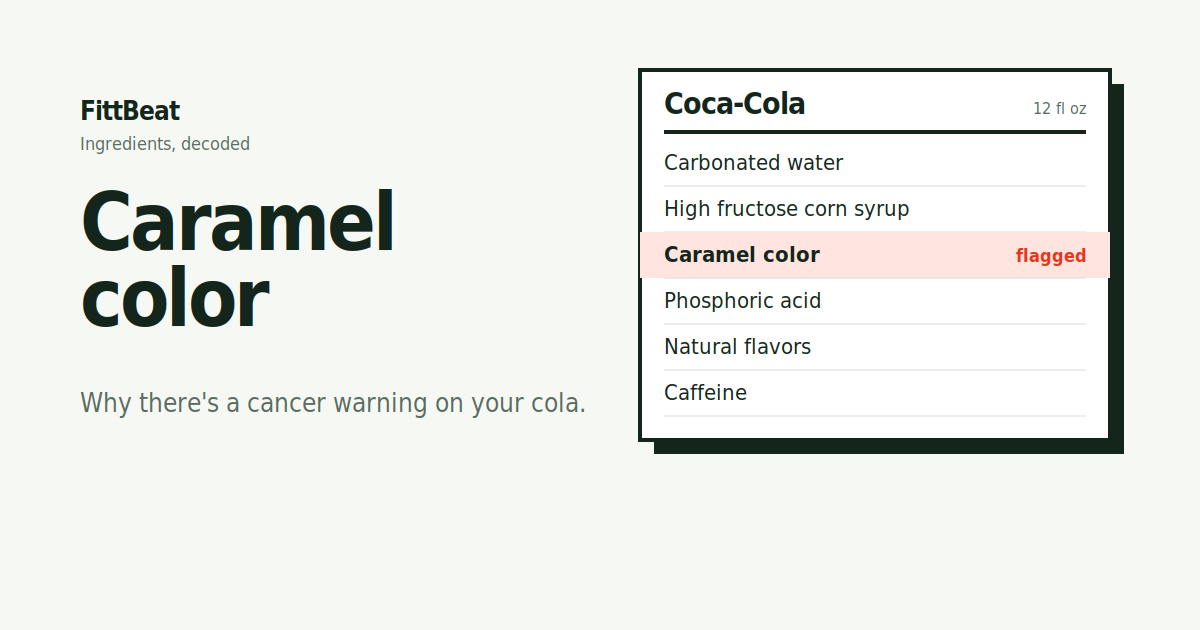
Coke isn’t naturally brown. Neither is Pepsi, Dr Pepper, or root beer. The color comes from an additive called caramel color, and one version of it carries a chemical that California requires a cancer warning for. Here’s why that’s both true and less scary than it sounds.
Quick answer: is caramel color bad for you?
Caramel color is a brown food dye made by heating sugar. The type in colas (Class IV) is made with ammonia and sulfite compounds, which creates a byproduct called 4-MEI that caused lung tumors in mice at high doses. California requires a cancer warning above 29 micrograms a day, so Coca-Cola and Pepsi reformulated in 2012 to get under it — a can of U.S. cola today typically has a few micrograms. The FDA considers current levels safe; the WHO calls 4-MEI “possibly carcinogenic,” the same tier as aspartame. It’s a cosmetic ingredient with no benefit, a small risk, and the sugar in the same can is the bigger problem.
What it is
Caramel color is made by heating sugars, usually corn syrup, under controlled conditions. There are four classes. Class I is basically burnt sugar. Classes III and IV are made with ammonia compounds, which is what gives colas their deep, stable brown. Class IV is the one in most sodas.
| Class | E number | Made with | Contains 4-MEI? | Typical use |
|---|---|---|---|---|
| Class I (plain) | E150a | Heat only | No | Spirits, some desserts |
| Class II (sulfite) | E150b | Sulfite compounds | No | Some liqueurs, cognac |
| Class III (ammonia) | E150c | Ammonia compounds | Yes | Beer, soy sauce, gravy |
| Class IV (sulfite ammonia) | E150d | Ammonia + sulfite | Yes | Colas, most dark sodas |
The ammonia process creates a byproduct called 4-methylimidazole, or 4-MEI. That’s the chemical the warnings are about.
Where you’ll find it
- Coca-Cola, Diet Coke, Coke Zero, Pepsi, Dr Pepper, root beer
- Soy sauce, Worcestershire sauce, gravy mixes
- Some beers, whiskeys, and dark breads
- Many “brown” flavored foods: caramel-flavored coffee drinks, some cereals
Clear sodas like Sprite and 7 Up don’t use it, and orange sodas like Fanta use synthetic dyes (Red 40, Yellow 6) instead — a different set of concerns.
What the evidence says
In a two-year study, mice given high doses of 4-MEI developed lung tumors. Based on that, California added it to its Proposition 65 list in 2011 and set a daily exposure threshold of 29 micrograms. Above that, a product needs a warning label.
Rather than put cancer warnings on cola, Coca-Cola and Pepsi reformulated their caramel color to cut 4-MEI, first for California and then nationally. Independent testing since then has found U.S. cans well under the threshold, though levels vary by brand and bottling plant.
The FDA’s position is that current intake levels don’t pose a health concern. The World Health Organization’s cancer agency classifies 4-MEI as “possibly carcinogenic,” the same low-certainty tier as aspartame.
Our verdict
FittBeat verdict
Caramel color is a cosmetic ingredient. It does nothing for taste and nothing for you. The 4-MEI risk at today’s levels is small, but it’s a reasonable example of an additive that only exists so a product looks the way marketing decided it should. If you drink a lot of dark soda, the sugar or sweetener is still the bigger issue.
Common questions
Is caramel color the same as caramel?
No. Caramel you eat is sugar cooked with butter or cream. Caramel color is an industrial dye and has no caramel flavor in the amounts used.
Is it in clear sodas?
No. Sprite, 7 Up, and ginger ale don’t need it.
How can I avoid 4-MEI?
Choose clear or naturally colored drinks. Class I caramel (listed as “plain caramel” in some countries) doesn’t contain it.
4-MEI questions
What is 4-MEI?
4-methylimidazole — a chemical that forms when sugars are heated with ammonia compounds. It’s not added on purpose; it’s a byproduct of making Class III and IV caramel color. It also forms naturally in roasted coffee, grilled meat, and soy sauce.
How much 4-MEI is in a can of Coke?
Since the 2012 reformulation, independent tests of U.S. Coca-Cola have generally found around 4 micrograms or less per 12 oz can — under California’s 29-microgram daily threshold. Pre-2012 cans tested at over 100 micrograms. Levels in other brands and in cola from other countries have tested higher, which is why the “varies by brand and bottling plant” caveat matters.
Does caramel color cause cancer?
Not at the levels in food, based on current evidence. The cancer finding comes from mice fed high doses of 4-MEI for two years. The FDA and EFSA both concluded that typical human intake doesn’t pose a health concern; the WHO’s cancer agency lists 4-MEI as “possibly carcinogenic” (Group 2B), which means limited evidence in animals and inadequate evidence in humans.
Why doesn’t my Coke have a cancer warning?
Because Coca-Cola reformulated to stay under California’s threshold. Proposition 65 only requires a warning if a product would expose someone to more than 29 micrograms of 4-MEI a day; a reformulated can comes in well below that. The warning never appeared because the company changed the recipe instead.
Is caramel color banned anywhere?
No. It’s permitted in the U.S., EU, Canada, and essentially everywhere, with limits on 4-MEI content. The EU set a maximum of 250 mg of 4-MEI per kg of caramel color in 2012; California’s Prop 65 listing is a warning requirement, not a ban.
Is caramel color natural?
It starts from sugar, but Class III and IV are made with ammonia and sulfite compounds under heat and pressure, so it’s an industrial product. Labels call it “caramel color” or “E150d”; it can’t be labeled “natural color” in most markets. Class I is the closest to what you’d make in a pan.
Does Diet Coke have the same caramel color as regular Coke?
Yes — Diet Coke, Coke Zero, and Coca-Cola all use Class IV caramel. Switching to diet removes the sugar but not the color.
Scan a can with the free FittBeat app to see every additive in it before you buy.
See the full ingredients index for every ingredient and soda we’ve broken down.
Sources
- California OEHHA. Proposition 65 listing: 4-methylimidazole (4-MEI), 2011, with the 29 µg/day No Significant Risk Level. oehha.ca.gov
- National Toxicology Program. Toxicology and carcinogenesis studies of 4-methylimidazole in F344/N rats and B6C3F1 mice. NTP Technical Report 535, 2007. ntp.niehs.nih.gov
- IARC. 4-Methylimidazole. IARC Monographs on the Evaluation of Carcinogenic Risks to Humans, Volume 101, 2013 (Group 2B).
- EFSA. Scientific opinion on the re-evaluation of caramel colours (E 150 a,b,c,d) as food additives. EFSA Journal, 2011. doi:10.2903/j.efsa.2011.2004
- U.S. FDA. Questions and answers on caramel coloring and 4-MEI. fda.gov
- Smith TJS, et al. Caramel color in soft drinks and exposure to 4-methylimidazole: a quantitative risk assessment. PLOS ONE, 2015 (the Johns Hopkins / Consumer Reports testing). doi:10.1371/journal.pone.0118138
This article is for general information and isn’t medical advice.

Leave a Reply