
Last reviewed: October 2026. This article summarizes published research and regulatory positions current as of that date. The science on non-sugar sweeteners is active; we update as findings change.
Aspartame is the oldest, most studied, and most argued-about artificial sweetener on the market. It’s what makes Diet Coke taste like Diet Coke, it’s in roughly 6,000 products, and in 2023 the World Health Organization’s cancer agency put it on the same “possibly carcinogenic” list as aloe vera and pickled vegetables — a ruling the FDA publicly disagreed with the same week. This article covers what aspartame is, where it hides, which aspartame side effects have real evidence behind them, and what to make of the cancer question.
Quick answer: is aspartame bad for you?
For most people drinking a diet soda or two a day, major regulators — the FDA, EFSA, and the WHO’s own food-safety committee — say no. The 2023 IARC classification was a hazard label (“could this ever cause cancer?”) based on limited evidence, not a risk finding at normal doses, and the acceptable daily intake was left unchanged. The clearest real concern is for people with phenylketonuria (PKU), who can’t process one of its breakdown products. Beyond that, research since 2022 has linked heavy intake to modest increases in cancer and cardiovascular risk in observational data, a 2025 animal study tied it to artery plaque via insulin spikes, and the WHO advises against using any non-sugar sweetener for weight control. Not dangerous at normal intake; not the inert “free” sweetener it was sold as either.
What is aspartame?
Aspartame is a compound built from two amino acids, aspartic acid and phenylalanine, joined with a methyl ester. It was discovered by accident in 1965 by a chemist working on an ulcer drug who licked his finger. It’s about 200 times sweeter than sugar, so a can of diet soda needs only about 180–200 mg of it — which is why “zero calories” is accurate even though aspartame technically has 4 calories per gram like any protein.
Unlike sucralose, which mostly passes through unabsorbed, aspartame is fully broken down in the gut into its three components: phenylalanine (about 50%), aspartic acid (40%), and methanol (10%). All three also occur naturally in food — a glass of tomato juice has more methanol than a can of diet soda, and a glass of milk has more phenylalanine — which is the main argument for its safety. The counterargument is that aspartame delivers them without the protein and fiber that normally come along, and that it’s consumed by some people in very large daily amounts over decades.
On labels it appears as aspartame, E951, or under brand names NutraSweet and Equal (blue packets). Because it breaks down when heated, it’s rarely in baked goods — which is why sucralose and Ace-K dominate there.
Where aspartame hides
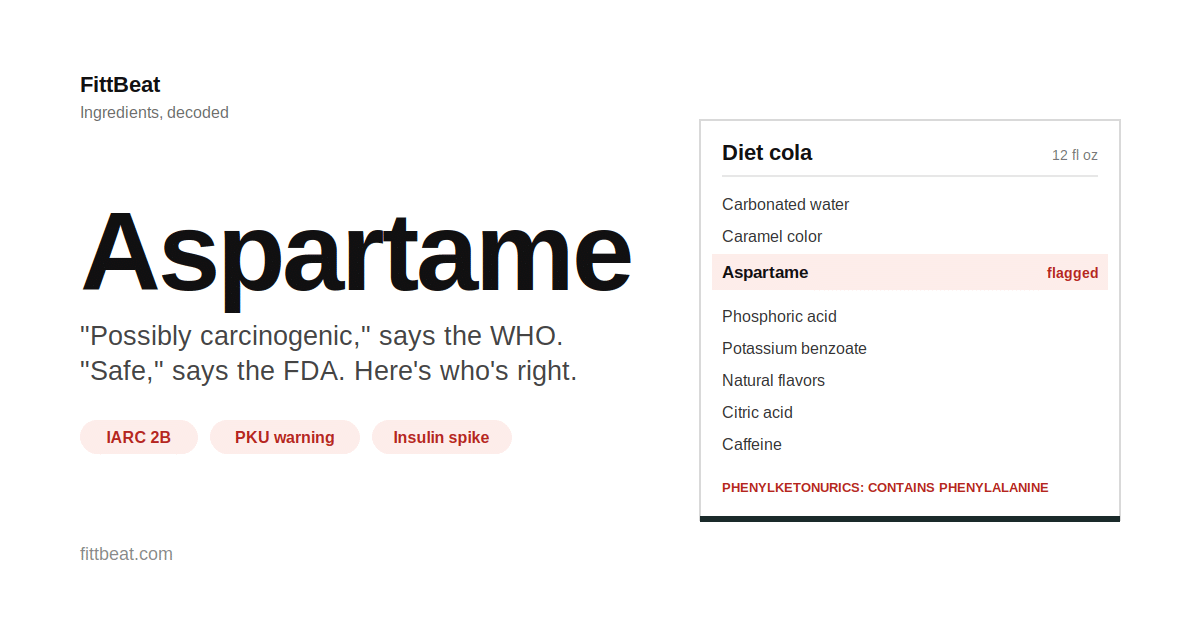
Carbonated Water, Caramel Color, Aspartame, Phosphoric Acid, Potassium Benzoate (To Protect Taste), Natural Flavors, Citric Acid, Caffeine. Phenylketonurics: Contains Phenylalanine.
That last line — “Phenylketonurics: Contains Phenylalanine” — is the legal tell. Any U.S. product containing aspartame must carry it, so it’s the fastest way to spot aspartame on a label. Common sources:
- Diet Coke post — aspartame is the only sweetener
- Coke Zero Sugar — aspartame plus acesulfame potassium (Ace-K)
- Diet Dr Pepper, Diet Mountain Dew, Diet A&W, Diet Sprite (Sprite Zero)
- Most sugar-free gum (Extra, Orbit, Trident, 5)
- Equal and NutraSweet packets; many “sugar-free” syrups and drink mixes
- Sugar-free Jell-O, pudding, and many “light” yogurts
- Some children’s chewable medicines and vitamins
Worth knowing: Diet Pepsi in the U.S. has been aspartame-free since 2020 and uses sucralose and Ace-K instead, after PepsiCo removed aspartame in 2015, brought it back by customer demand in 2016, and then quietly dropped it again. Pepsi Zero Sugar also reformulated in 2023. If you want to avoid aspartame but keep a diet cola, Pepsi’s lineup is the mainstream option; Zevia uses stevia.
Aspartame side effects: what the evidence actually shows
Ranked from strongest evidence to weakest.
1. Phenylketonuria (PKU) Proven — specific group
This is the one undisputed harm. About 1 in 10,000–15,000 babies is born with PKU, a genetic condition where the body can’t break down phenylalanine. For them, it builds up in the blood and damages the brain, and aspartame is a concentrated source. Every U.S. newborn is screened for PKU at birth, and people with it manage a lifelong low-phenylalanine diet in which aspartame is strictly off-limits. This is why the warning label exists. It does not apply to anyone without PKU; carriers of one gene copy are fine.
2. Cancer: the IARC classification Limited evidence
In July 2023 the International Agency for Research on Cancer (IARC) classified aspartame as Group 2B, “possibly carcinogenic to humans,” citing limited evidence for liver cancer from three observational studies, limited evidence in animals, and limited mechanistic evidence. Headlines treated this as “aspartame causes cancer.” It isn’t.
IARC’s job is hazard identification — whether something could cause cancer under any circumstances — not whether it does at the doses people consume. Group 2B is its second-weakest category and includes aloe vera extract, pickled vegetables, and working as a dry cleaner. The same day, the WHO/FAO Joint Expert Committee on Food Additives (JECFA), which does assess real-world risk, reviewed the same evidence and kept the acceptable daily intake at 40 mg/kg, concluding there was no convincing evidence of harm at normal consumption. The FDA went further and said it disagreed with IARC outright, pointing to flaws in the key animal study (including infections in the test animals).
The strongest human evidence IARC cited was the French NutriNet-Santé cohort (2022, ~100,000 adults), which found that the highest consumers of artificial sweeteners — aspartame in particular — had about 13% higher overall cancer risk and higher breast and obesity-related cancer risk than non-consumers. That’s a real signal, but observational: heavy diet-soda drinkers differ from non-drinkers in many ways that are hard to fully adjust for. A June 2025 commentary from independent cancer-assessment experts noted the field is still divided on how much weight the 2B label deserves. The honest summary: there’s a reason to study it more, and no demonstrated cancer risk at ordinary intake.
3. Cardiovascular effects Emerging evidence
Two findings here. The same NutriNet-Santé cohort reported in 2022 that higher artificial sweetener intake, especially aspartame, was associated with a 9% higher risk of cardiovascular disease and 18% higher risk of stroke. Then in February 2025, a Karolinska Institute study in Cell Metabolism showed how that might happen: mice fed the equivalent of about three cans of diet soda daily for 12 weeks developed larger, more inflamed arterial plaques. The mechanism was unexpected — aspartame triggered an insulin spike (the sweet taste primes the body for sugar that never arrives), and chronic insulin surges drove inflammation in blood vessel walls. One mouse study isn’t proof, but it’s a plausible mechanism for the human observational data, and it matches the sucralose findings on insulin and hunger.
4. It may not help with weight Strong evidence it doesn’t help
The World Health Organization issued guidance in May 2023, after reviewing 283 studies, recommending against using non-sugar sweeteners — aspartame included — for weight control. Short-term trials show a small benefit when sweeteners replace sugar; longer observational studies show no benefit and some association with higher body weight and type 2 diabetes risk. The likely explanations are the insulin/hunger effect above and compensation (people eat more elsewhere). The direct trade of a sugar soda for a diet soda is still a calorie win. The trap is assuming diet soda is “free” and letting it displace water indefinitely.
5. Headaches and migraines Mixed, individual
The most common self-reported aspartame side effect. A few small controlled trials have found that some migraine-prone people react to aspartame; others found no effect versus placebo. The mechanism, if real, is probably phenylalanine’s effect on neurotransmitter balance. You don’t need a trial to justify an elimination test on yourself — cut it for two weeks and see.
6. Gut microbiome Animal data mostly
Rodent studies show aspartame alters gut bacteria and can impair glucose tolerance through that route. Human data is thin and mixed. This is a more active research area for sucralose and saccharin than for aspartame, since aspartame is broken down before it reaches most gut bacteria.
7. Mood, memory, and anxiety Animal data
A 2022 Florida State study found that mice given aspartame at roughly 15% of the FDA’s daily limit showed increased anxiety-like behavior that persisted into their offspring; a 2023 follow-up reported spatial memory deficits. Human studies are limited to small trials and self-reports. Interesting, unproven in people.
8. Methanol and formaldehyde Not a real concern
Aspartame’s methanol fraction is metabolized to formaldehyde, which sounds alarming. The amounts are tiny: a can of diet soda yields about 20 mg of methanol, versus roughly 50–100 mg from a glass of fruit juice and far more from fermented foods. The body handles these quantities routinely. This argument circulates widely online and doesn’t hold up to the numbers.
How much aspartame is too much?
The FDA’s acceptable daily intake is 50 mg per kilogram of body weight; EFSA and JECFA use 40 mg/kg. A 12 oz can of Diet Coke has roughly 180–200 mg.
| Body weight | FDA limit (50 mg/kg) | Cans of Diet Coke to reach it | EFSA limit (40 mg/kg) |
|---|---|---|---|
| 60 lb child | 1,360 mg | ~7 cans | ~5–6 cans |
| 130 lb adult | 2,950 mg | ~15 cans | ~12 cans |
| 180 lb adult | 4,080 mg | ~20 cans | ~16 cans |
Almost nobody hits the ADI. But note two things: the ADI only addresses toxicity, not the insulin, hunger, or cardiovascular effects that showed up at ordinary intake; and a child’s limit is a fraction of an adult’s. A kid drinking two or three diet sodas plus sugar-free gum and a “light” yogurt is at a meaningfully higher fraction of the ADI than a parent having the same.
Aspartame vs. sucralose vs. Ace-K vs. stevia
| Aspartame | Sucralose | Acesulfame K | Stevia | |
|---|---|---|---|---|
| What it is | Two amino acids | Chlorinated sugar | Synthetic | Plant extract |
| Sweetness vs sugar | 200× | 600× | 200× | 200–300× |
| Heat stable | No | To ~250°F | Yes | Yes |
| Cancer classification | IARC 2B | None | None | None |
| Main concern | PKU, IARC 2B, heart data | Hunger, gut, S-6-A | Under-studied | Aftertaste, fewer studies |
| Found in | Diet Coke, Coke Zero, gum | Zero-sugar sports and energy drinks | Paired with both | Zevia, Olipop |
The two most common sweeteners in your diet are almost certainly aspartame (if you drink Coca-Cola diet products) or sucralose (if you drink zero-sugar sports and energy drinks). Our sucralose breakdown covers the other one in the same depth.
Should you avoid aspartame?
FittBeat verdict
Safe at normal intake for people without PKU. Not a reason to drink more diet soda. The cancer label is a research flag, not a finding. The better-supported concerns — insulin spikes, no weight benefit, modest cardiovascular associations — all point the same direction: a diet soda is a better choice than a sugar soda, and water is a better choice than both.
- You have PKU: avoid completely. This is settled.
- Occasional diet soda: no meaningful concern.
- Several diet sodas a day, every day: this is the group where the observational cancer and heart signals showed up. Cutting back is reasonable even without a definitive verdict.
- Pregnancy: approved at normal intake; EFSA’s 2013 review found no developmental concern below the ADI. Moderation is the sensible default.
- Kids: the ADI is weight-based, so children reach it far faster. Several states have restricted artificial sweeteners in school meals since 2025.
- Trying to lose weight: don’t count on it helping beyond the direct sugar swap. Watch whether it increases your sweet cravings.
- Migraines: try a two-week elimination and judge for yourself.
See the full ingredients index for every drink we’ve broken down, including which ones use aspartame.
Frequently asked questions
Does aspartame cause cancer?
No study has shown that it does at normal intake. In 2023 the WHO’s cancer agency classified it “possibly carcinogenic” (Group 2B) based on limited evidence; the WHO’s food-safety committee and the FDA both concluded the same day that it remains safe within the acceptable daily intake.
What does “phenylketonurics: contains phenylalanine” mean?
It’s the mandatory U.S. warning on any product with aspartame, for people with the genetic condition PKU who cannot process phenylalanine. If you don’t have PKU, the warning doesn’t apply to you.
Is aspartame in Diet Coke?
Yes — it’s the only sweetener in Diet Coke, at about 180–200 mg per 12 oz can. Coke Zero Sugar uses aspartame plus acesulfame potassium.
Is aspartame in Diet Pepsi?
Not in the U.S. Diet Pepsi switched to sucralose and acesulfame potassium in 2020.
How much aspartame is safe per day?
The FDA limit is 50 mg per kilogram of body weight, roughly 15 cans of diet soda for a 130-pound adult. The European limit is 40 mg/kg.
Aspartame vs. sucralose — which is worse?
Different concerns. Aspartame carries the IARC 2B label and is dangerous for people with PKU; sucralose has stronger evidence on hunger and gut effects and breaks down when baked. Neither has been shown to cause harm at ordinary intake.
Does aspartame break down into formaldehyde?
Technically yes, via methanol, but in amounts smaller than you get from a glass of fruit juice. The body processes it routinely. This is not a credible health concern.
Does aspartame raise blood sugar or insulin?
It contains no carbohydrate and doesn’t raise blood sugar directly. A 2025 animal study found it triggers insulin release through the sweet-taste response, which may matter with heavy long-term use; human evidence is still limited.
Sources
- World Health Organization. Aspartame hazard and risk assessment results released, July 14, 2023 (IARC Group 2B; JECFA ADI of 40 mg/kg reaffirmed). who.int
- U.S. FDA. Aspartame and other sweeteners in food (FDA response to the IARC classification; ADI of 50 mg/kg). fda.gov
- EFSA. Scientific opinion on the re-evaluation of aspartame (E 951) as a food additive. EFSA Journal, 2013. doi:10.2903/j.efsa.2013.3496
- Magnuson BA, et al. Aspartame: a safety evaluation based on current use levels, regulations, and toxicological and epidemiological studies. Critical Reviews in Toxicology, 2007. doi:10.1080/10408440701516184
- Soffritti M, et al. First experimental demonstration of the multipotential carcinogenic effects of aspartame administered in the feed to Sprague-Dawley rats. Environmental Health Perspectives, 2006 (the Ramazzini study and its criticisms). doi:10.1289/ehp.8711
- Debras C, et al. Artificial sweeteners and cancer risk: results from the NutriNet-Santé population-based cohort study. PLOS Medicine, 2022. doi:10.1371/journal.pmed.1003950
- MedlinePlus (NIH). Phenylketonuria (PKU). medlineplus.gov
- Suez J, et al. Personalized microbiome-driven effects of non-nutritive sweeteners on human glucose tolerance. Cell, 2022 (aspartame arm). doi:10.1016/j.cell.2022.07.016
This article is for informational purposes and is not medical advice. Talk to a doctor or registered dietitian about your individual nutrition needs.

Leave a Reply