
Last reviewed: October 2026. Ingredient lists reflect the current U.S. formula sold in 28 fl oz bottles. Coca-Cola occasionally reformulates, so always check your bottle.
Powerade sells itself on electrolytes and “more power.” Flip the bottle around, though, and the first two ingredients are water and high fructose corn syrup — the same opening line as a can of Sprite. This breakdown goes through every Powerade ingredient, what it does, which ones are worth paying attention to, and how the regular, Zero, and Sour versions differ.
Quick answer: what is in Powerade?
Regular Powerade is a sugar-sweetened electrolyte drink. A 12 oz serving has about 80 calories and 21 g of added sugar, plus 250 mg sodium and 80 mg potassium. Its ingredients are water, high fructose corn syrup, citric acid, a four-mineral electrolyte blend, vitamins B12 and C, natural flavors, a few texture and color-stabilizing additives, and one or two artificial dyes depending on flavor. Powerade Zero swaps the corn syrup for sucralose and acesulfame potassium.
The full Powerade ingredients list
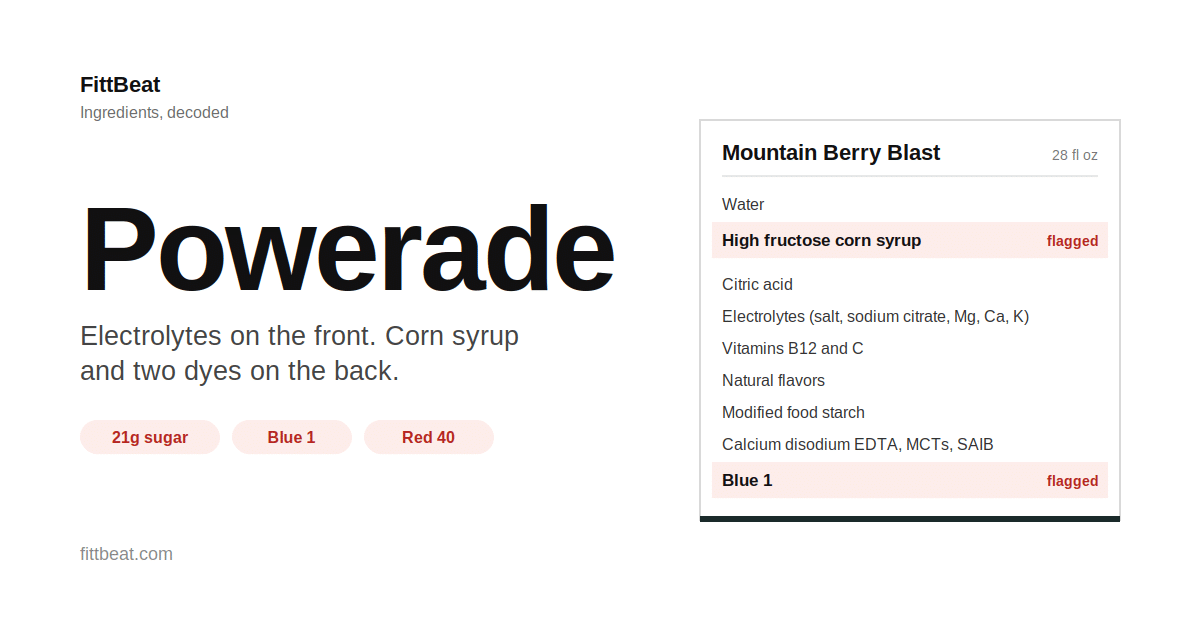
Here is the label from the most popular flavor, Mountain Berry Blast, in order of quantity:
Water, High Fructose Corn Syrup, Less Than 0.5% of: Citric Acid, Electrolytes (Salt, Sodium Citrate, Magnesium and Calcium Chlorides, Mono-Potassium Phosphate), Vitamins B12 and C (Cyanocobalamin and Ascorbic Acid), Natural Flavors, Modified Food Starch, Calcium Disodium EDTA (To Protect Color), Medium Chain Triglycerides, Sucrose Acetate Isobutyrate, Blue 1. Contains: Corn.
Fruit Punch is nearly identical but uses Red 40 instead of Blue 1 and adds glycerol ester of rosin. Grape and the Sour line use both Red 40 and Blue 1 together.
Notice the phrase “less than 0.5% of.” Everything after water and corn syrup — electrolytes, vitamins, additives, dyes — combined makes up under half a percent of the bottle. Powerade is, by weight, almost entirely sugar water.
Powerade ingredients explained, one by one
Water
The base. Nothing to flag here.
High fructose corn syrup
This is Powerade’s sugar source and the ingredient that matters most. HFCS is a blend of glucose and fructose made from corn starch, and in a sports drink it does a real job: it provides fast carbohydrates that working muscles can use. Powerade is roughly a 6% carbohydrate solution, which is the range sports-science research generally supports for endurance exercise over about an hour.
The problem is dosage. A full 28 oz bottle delivers around 50 g of added sugar — the entire daily added-sugar limit the American Heart Association recommends for men, and well over it for women. If you’re drinking Powerade at your desk rather than at mile eight, that sugar isn’t fueling anything. High fructose corn syrup in depth post covers the broader research on corn syrup.
Citric acid
Provides the tart edge, balances the sweetness, and lowers the pH enough to help preserve the drink. It’s the same acid found naturally in citrus, though commercial citric acid is made by fermentation. The main downside of acidic drinks is dental erosion with frequent sipping, which applies to Powerade just as it does to soda.
The electrolyte blend
Powerade’s “ION4” marketing refers to four minerals lost in sweat:
- Salt and sodium citrate — sodium, the electrolyte you lose most of when you sweat. 250 mg per 12 oz is meaningful; it’s about 50% more than Gatorade.
- Mono-potassium phosphate — potassium, at 80 mg per serving. Useful, though a banana has about five times as much.
- Magnesium chloride and calcium chloride — present in amounts small enough that they don’t register as a percentage of daily value on the label. They’re there, but they’re not doing much.
Bottom line: the sodium is legitimate. The other three are more marketing than nutrition.
Vitamins B12 and C
Cyanocobalamin (B12) and ascorbic acid (vitamin C) were added in the current formula, replacing the older B3/B6/B12 trio. A serving gives about 35% of your daily B12 and 20% of vitamin C. These are harmless, but they’re also the kind of additions that let a brand put “with vitamins” on the front of the bottle. Most people eating a normal diet aren’t short on either.
Natural flavors
A catch-all term the FDA allows for flavor compounds derived from plant or animal sources. The exact blend is proprietary, so you can’t know what’s in it. Blue raspberry, the flavor profile of Mountain Berry Blast, doesn’t exist in nature — “natural” here means the source molecules came from natural materials, not that the flavor resembles any real fruit.
Modified food starch
A thickener and emulsifier that keeps the flavor oils evenly suspended so the drink doesn’t separate or look watery. Derived from corn (hence the “Contains: Corn” allergen note). Considered safe; it’s in thousands of products.
Calcium disodium EDTA
Labeled “to protect color.” EDTA is a chelating agent — it binds trace metals that would otherwise react with the dyes and vitamins and cause the drink to fade or discolor. The FDA permits it in small amounts and it’s not absorbed well by the body. It’s a cosmetic additive, not a nutritional one.
Medium chain triglycerides (MCTs)
Surprising to see fat in a sports drink, but MCTs here aren’t a nutritional dose — they’re a carrier for flavor oils. The amount is far too small to appear on the nutrition facts panel (total fat: 0 g).
Sucrose acetate isobutyrate (SAIB)
A “weighting agent.” Flavor oils are lighter than water and would float to the top; SAIB increases their density so they stay mixed. It’s been used in citrus-flavored beverages for decades and is FDA-approved, though it’s the kind of ingredient most people would never choose to drink if it were listed on the front.
Glycerol ester of rosin (Fruit Punch only)
Another weighting agent, this one derived from pine tree resin. Same job as SAIB — keeps the cloudy flavor emulsion stable. FDA-approved; replaced brominated vegetable oil (BVO) in many drinks after BVO was banned in 2024.
Blue 1 and Red 40
These synthetic, petroleum-derived dyes give Powerade its neon color and nothing else. Both are the subject of the FDA’s 2025 announcement that it intends to phase synthetic food dyes out of the U.S. food supply by the end of 2026, following decades of debate about hyperactivity in sensitive children. Red 40 in particular is among the most heavily consumed dyes in the American diet. Our Red 40 post goes into the research in detail.
If dye-free matters to you, note that Powerade currently has no dye-free flavor in the U.S. lineup. BodyArmor (also Coca-Cola owned) uses fruit and vegetable juice for color instead.
Powerade nutrition facts
Per 12 fl oz serving (a 28 oz bottle is about 2.3 servings):
| Nutrient | Per 12 oz | Per 28 oz bottle (approx.) |
|---|---|---|
| Calories | 80 | 190 |
| Total carbohydrates | 21 g | 49 g |
| Added sugars | 21 g (41% DV) | 49 g |
| Sodium | 250 mg (11% DV) | 585 mg |
| Potassium | 80 mg (2% DV) | 185 mg |
| Vitamin C | 20% DV | ~47% DV |
| Vitamin B12 | 35% DV | ~82% DV |
| Fat / Protein | 0 g | 0 g |
| Caffeine | 0 mg | 0 mg |
Does Powerade have caffeine? No. Regular Powerade, Powerade Zero, and Powerade Sour are all caffeine-free in the U.S.
Powerade Zero ingredients: what changes
Powerade Zero removes the corn syrup and replaces it with two artificial sweeteners. Here’s the Mixed Berry Zero label:
Water, Less Than 0.5% of: Citric Acid, Electrolytes (Salt, Sodium Citrate, Magnesium and Calcium Chlorides, Mono-Potassium Phosphate), Vitamins B12 and C (Cyanocobalamin and Ascorbic Acid), Natural Flavors, Sucralose, Acesulfame Potassium, Calcium Disodium EDTA (To Protect Color), Red 40, Blue 1.
Key differences:
- Sucralose (Splenda) and acesulfame potassium (Ace-K) provide the sweetness. Both are FDA-approved and have been studied extensively; both also show up in ongoing research on gut bacteria and insulin response that hasn’t reached consensus. Zero calories, zero sugar, zero carbs — it won’t break a keto diet or spike blood sugar.
- No MCTs, SAIB, or modified starch, since there’s no sugar-heavy flavor system to stabilize.
- Same electrolytes, same dyes, same sodium (240–250 mg).
- Some Zero flavors list “natural and artificial flavors” rather than just natural.
Powerade Zero is the better choice if you want electrolytes without sugar — but you’re trading one set of debated additives for another, and you lose the fast carbs that are the actual reason to drink a sports drink during hard exercise.
Powerade vs. Gatorade: ingredient comparison
The two brands are closer than their marketing suggests. The headline differences per 12 oz:
| Powerade | Gatorade Thirst Quencher | Powerade Zero | |
|---|---|---|---|
| Sweetener | High fructose corn syrup | Sugar and dextrose | Sucralose, Ace-K |
| Calories | 80 | 80 | 0 |
| Sugar | 21 g | 21 g | 0 g |
| Sodium | 250 mg | 160 mg | 240–250 mg |
| Potassium | 80 mg | 50 mg | 80 mg |
| Magnesium / calcium | Trace amounts | None | Trace amounts |
| Added vitamins | B12, C | None | B12, C |
| Artificial dyes | Yes | Yes | Yes |
Powerade wins on sodium and potassium. Gatorade uses sucrose and dextrose instead of HFCS, which some people prefer, though metabolically the difference is small. Both use synthetic dyes. Neither is a health drink.
Is Powerade bad for you?
It depends entirely on when you drink it.
During or after hard exercise lasting over an hour, in heat, or when you’re sweating heavily, Powerade does what it’s designed to do: it replaces sodium and delivers quick carbohydrates in a form that’s absorbed faster than plain water with food. The sugar isn’t a bug in that context — it’s the point.
As an everyday drink, it’s a 190-calorie bottle of corn syrup with a few minerals and two synthetic dyes. The electrolytes don’t offset the sugar, and the vitamins are negligible. If you’re sick with a stomach bug and can’t keep food down, the sugar-and-sodium combination can help — that’s a legitimate use. For everything else, water is better.
Ingredients worth watching, ranked by how much they should influence your decision:
- High fructose corn syrup — the dose is the problem, not the molecule. Half a bottle at your desk is a lot of sugar for nothing.
- Blue 1 / Red 40 — purely cosmetic, under regulatory pressure, and avoidable in competing products.
- Sucralose and Ace-K (Zero only) — approved and widely used, but the long-term research is still evolving.
- SAIB, EDTA, MCTs, modified starch — stabilizers in tiny amounts. Low concern, but they’re the reason the label reads like a chemistry set.
Cleaner alternatives
If you want electrolytes without the sugar or dyes, options that beat Powerade on ingredients include coconut water (naturally high in potassium, low in sodium — add a pinch of salt), electrolyte powders like LMNT or Liquid I.V. Sugar-Free, or simply water with a quarter teaspoon of salt and a squeeze of citrus for a hard workout. BodyArmor Lyte is the closest mainstream bottled option without synthetic dyes.
Browse our full ingredients index for breakdowns of Gatorade, Diet Coke, Sprite, and more.
Frequently asked questions
What are the main ingredients in Powerade?
Water, high fructose corn syrup, citric acid, an electrolyte blend (sodium, potassium, magnesium, calcium), vitamins B12 and C, natural flavors, stabilizers (modified food starch, EDTA, MCTs, SAIB), and artificial dyes such as Blue 1 or Red 40.
Does Powerade have high fructose corn syrup?
Yes. HFCS is the second ingredient in regular Powerade and its only sugar source. Powerade Zero contains no corn syrup.
Does Powerade contain caffeine?
No. All U.S. Powerade products — regular, Zero, and Sour — are caffeine-free.
What sweeteners are in Powerade Zero?
Sucralose and acesulfame potassium (Ace-K). It has zero calories and zero sugar.
Is Powerade healthier than Gatorade?
Powerade has more sodium and potassium per serving and adds vitamins B12 and C. Gatorade uses sugar and dextrose instead of corn syrup. Calories and sugar are identical. Neither is meaningfully healthier; both are best reserved for intense exercise.
Does Powerade have red dye 40?
Fruit Punch, Grape, Strawberry Lemonade, and most Zero flavors contain Red 40. Mountain Berry Blast uses Blue 1 only. There is currently no dye-free Powerade.
Is Powerade good when you’re sick?
It can help if you’re losing fluids from vomiting or diarrhea and can’t eat, since it supplies sodium and simple sugar together. Diluting it half-and-half with water lowers the sugar concentration, which some people tolerate better.
This article is for informational purposes and is not medical advice. Talk to a doctor or registered dietitian about your individual nutrition needs.
Leave a Reply