
Last reviewed: November 2026. Definitions are from the current U.S. and EU regulations linked in the sources. Product examples are from the labels we photographed in October and November 2026.
The natural flavors meaning on an ingredient label is narrower than the words suggest. It doesn’t mean fresh, simple, or healthy, and it doesn’t mean the flavor came from the food on the front of the package. It’s a legal term from the FDA’s labeling rules, and it covers a blend of flavor chemicals that can number in the dozens. “Natural flavors” appears on almost every product we’ve broken down, from Coca-Cola to Doritos, and it’s the one line on the label where the maker is allowed to tell you almost nothing. Here’s the natural flavors meaning in full: what the rule requires, what it lets companies leave out, and the few situations where that gap matters.
Quick answer: the natural flavors meaning, in plain terms
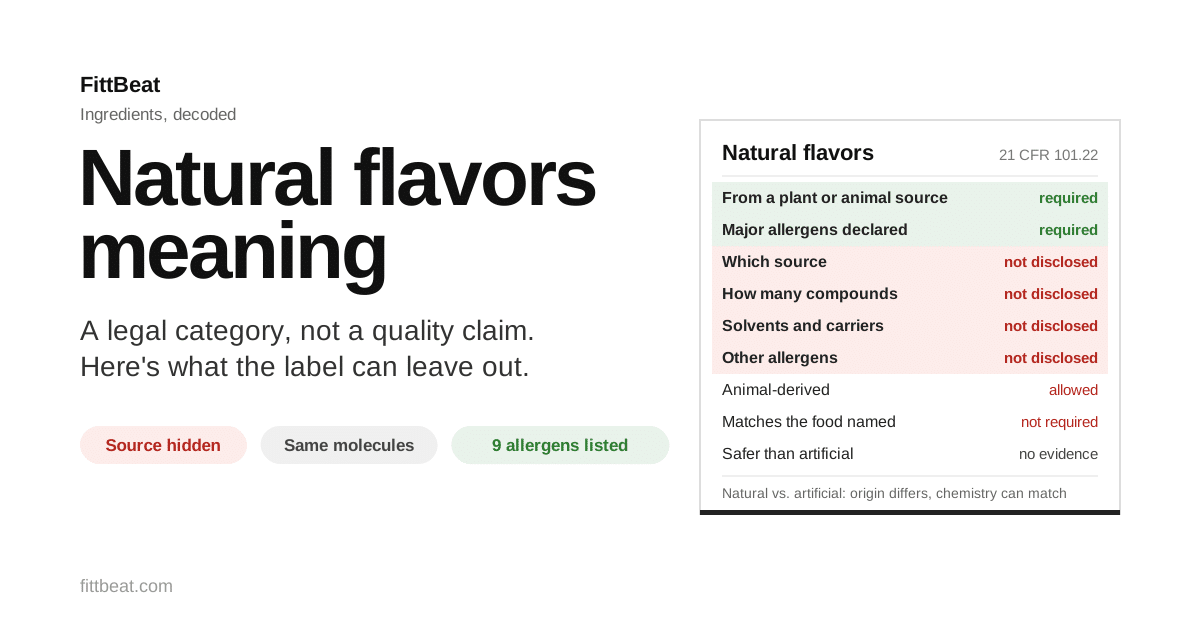
It means the flavoring compounds were derived from a plant, animal, or fermentation source. Under the FDA’s definition, a natural flavor is an extract, oil, distillate, or similar product taken from a spice, fruit, vegetable, herb, bark, root, yeast, meat, seafood, poultry, egg, or dairy product, and used for flavor and not nutrition. That’s all the term promises. It doesn’t name the source, it doesn’t have to match the food pictured on the package, and the solvents and preservatives that carry the flavor don’t have to be listed. A natural flavor and an artificial flavor can contain the identical molecule, and there’s no evidence that one is safer than the other. The term matters most for people with uncommon allergies and for vegetarians and vegans. For everyone else, it’s the least informative line on the label and rarely the one to worry about.
Jump to: The definition · What’s inside · Natural vs. artificial · What isn’t disclosed · On real labels · Safety · Verdict · FAQ
Natural flavors meaning: the legal definition
The natural flavors meaning comes from a single FDA rule, which defines a natural flavor by where the flavoring constituents come from. They have to be derived from a spice, fruit or fruit juice, vegetable or vegetable juice, edible yeast, herb, bark, bud, root, leaf or similar plant material, meat, seafood, poultry, eggs, dairy products, or fermentation products of any of those. The flavor can be extracted, distilled, roasted, heated, or produced with enzymes. Its job in the food has to be flavoring, not nutrition.
Three points follow from that wording.
The source can be anything on the list. A “natural flavor” in a strawberry drink doesn’t have to come from strawberries. If it comes only from the named fruit, the label can say “natural strawberry flavor.” If other natural sources are blended in, the rules call for “with other natural flavors.”
Animal sources count. Meat, seafood, dairy, and egg derivatives are all natural flavors under the rule.
Processing isn’t limited. The starting material must be natural. What happens to it in the lab afterward can be extensive.
What’s actually inside a natural flavor
A flavor is a formula built by a flavor chemist, usually at a specialist company that supplies the food maker. It has two parts. The first is the flavoring compounds themselves, the molecules you taste and smell. A single flavor can blend dozens of them. The second part is everything that carries and stabilizes those compounds: solvents such as propylene glycol or alcohol, emulsifiers, and preservatives. By weight, the carriers often make up most of the mixture.
These carriers are treated as incidental additives, which means they don’t have to appear on the label when they have no function in the finished food. The whole formula is a trade secret. That’s why the 23 flavors of Dr Pepper and the recipe behind Coca-Cola can sit behind two words.
Natural flavors vs. artificial flavors
| Natural flavor | Artificial flavor | |
|---|---|---|
| Starting material | Plant, animal, or fermentation source | Anything else, usually petroleum- or wood-derived chemicals |
| Can the final molecule be identical? | Yes | Yes |
| Made in a lab? | Yes | Yes |
| Formula disclosed? | No | No |
| Carriers and solvents listed? | No | No |
| Evidence it’s safer? | None | None |
| Typical cost | Higher | Lower |
The difference is origin, not chemistry. Vanillin is the standard example. Extracted from vanilla beans, it’s natural. Made by fermenting a plant compound, it can also be labeled natural. Synthesized from wood pulp or petrochemicals, it’s artificial. Your body can’t tell the three apart, because they’re the same molecule. Artificial flavors are often simpler mixtures than natural ones, since chemists add only the compounds they need. So “natural” on this line tells you about the supply chain and nothing about your health. That’s the part of the natural flavors meaning most people get wrong.
What the label doesn’t have to tell you
The source Undisclosed
Plant or animal, fruit or bark. The label doesn’t say. Companies will often answer if you ask them directly.
Uncommon allergens Matters for some
U.S. law requires the nine major allergens to be declared even when they’re inside a flavor: milk, eggs, fish, shellfish, tree nuts, peanuts, wheat, soy, and sesame. Anything outside that list doesn’t have to be named. If you react to celery, mustard, garlic, or a particular fruit or spice, “natural flavors” can contain it without saying so. This is the group for whom the term is a real problem, and contacting the manufacturer is the only way to know.
Animal-derived ingredients Matters for some
Natural flavors can come from meat, dairy, or seafood. Milk has to be declared as an allergen, but meat and poultry derivatives don’t unless the product falls under USDA rules. If you’re vegetarian or vegan, look for a certified vegan mark or ask the maker. The famous example is castoreum, a beaver secretion that’s legally a natural flavor. It’s real, and it’s also so scarce and expensive that it’s almost never used in food today.
Carriers and preservatives Undisclosed
Propylene glycol, alcohol, and similar solvents in tiny amounts. They’re approved additives, and none is a known concern at these levels.
How many compounds Undisclosed
One or fifty. The label reads the same.
One way to narrow all of this: flavors in USDA certified organic foods can’t be made with synthetic solvents, synthetic carriers, or artificial preservatives. And in the European Union the rules are tighter on naming. A label there can say “natural strawberry flavouring” only if at least 95% of the flavoring comes from strawberries.
The natural flavors meaning on real labels
| Product | What the label says | What it tells you |
|---|---|---|
| Coca-Cola | Natural flavors | The entire cola recipe is in these two words |
| Dr Pepper | Natural and artificial flavors | Some of the 23 flavors are synthetic |
| Sprite | Natural flavors | The lemon-lime taste; the can contains no juice |
| Fanta Orange | Natural flavors | Orange flavor in a drink labeled “contains no juice” |
| Monster | Natural flavors | The proprietary taste, fifth of 24 ingredients |
| Lunchables turkey | Natural and artificial flavor | A roasted-and-smoked taste, source not stated |
Three things to notice. Natural flavors can be the main event, as in a cola, and not a finishing touch. “Natural” fruit flavor shows up in drinks with no fruit in them, which the rule allows. And “natural and artificial” is at least more specific than either word alone, because it tells you a synthetic compound is present.
Flavored sparkling waters are the purest case. A can of LaCroix lists carbonated water and natural flavor, and nothing else. A 2018 lawsuit claimed those flavors were synthetic, and the plaintiff withdrew the claims in 2020. The episode showed how little anyone outside the company can check.
Read next: Citric acid in soda — the other ingredient on almost every label, and the one fact about it that matters.
Are natural flavors bad for you?
Safety review Reviewed, mostly by industry
Flavoring substances are permitted either as FDA-approved additives or as “generally recognized as safe.” Most reach the second category through an expert panel run by the flavor industry’s own trade association, which has cleared a few thousand substances since 1960. The panel publishes its findings, and the amounts used are tiny, typically parts per million. The criticism is about independence. The FDA doesn’t review most of these decisions itself.
Withdrawn flavorings Synthetic ones
In 2018 the FDA removed seven flavoring substances from its approved list after a petition citing cancer findings in animals at high doses. All seven were synthetic. The agency said they posed no risk at the levels used in food and that the law required their removal anyway. Natural extracts that contain the same compounds weren’t affected, which shows again that the natural label is about origin and not risk.
Effects on appetite Plausible, unproven
Flavors are engineered to make food more appealing, and some researchers argue that this pushes people to eat more of the foods that carry them. That’s an argument about ultra-processed food as a whole. No study has isolated natural flavors as a cause.
Direct harm No evidence
There’s no credible evidence that natural flavors at food levels cause disease. The documented risks are the two disclosure gaps above: uncommon allergens and animal sources.
Natural flavors meaning: the verdict
FittBeat verdict
A legal category, not a quality claim. “Natural flavors” tells you the flavor chemicals began in a plant, animal, or fermentation source and tells you nothing else. It isn’t healthier than artificial flavor, it isn’t a sign of real fruit, and it isn’t a hidden danger either. Treat it as a blank line on the label. If you have an allergy outside the major nine, or you avoid animal products, that blank matters and the fix is to ask the manufacturer. If you don’t, spend your attention on the sugar, the sodium, and the sweeteners, which the label does spell out.
The concerns, ranked by evidence:
- Undeclared uncommon allergens. A real risk for a small group of people.
- Undeclared animal sources. A real issue for vegetarians, vegans, and some religious diets.
- Limited independent oversight. A fair criticism of the system, with no specific harm shown.
- Carriers and solvents. Approved additives in trace amounts.
- The flavor compounds themselves. No evidence of harm at food levels.
Natural flavors for allergies, vegans, and kids
Allergies: the nine major allergens must be declared. For anything else, call or email the manufacturer and ask about the specific product.
Vegan and vegetarian: natural flavors can be animal-derived. A certified vegan mark is the reliable signal.
Kosher and halal: certification covers the flavor’s sources, so the symbol answers the question the ingredient list doesn’t.
Kids: there’s no specific concern. The products that lean hardest on added flavor tend to be the sugary ones, and the sugar is the reason to limit them.
How to see past the term
Once you know the natural flavors meaning, read the rest of the label for what the flavor is standing in for. A drink with “natural flavors” and no juice gets its fruit taste from the flavor alone. Choose products that name their flavor sources, such as “vanilla extract” or “lemon juice,” when that matters to you. Look for USDA organic if you want limits on solvents and carriers. And for a short list, plain foods and unflavored drinks don’t need the line at all.
Frequently asked questions
What does natural flavors mean on a label?
The natural flavors meaning is legal, not nutritional. The flavoring compounds were derived from a plant, animal, or fermentation source, such as a fruit, spice, herb, meat, or dairy product. The term doesn’t identify the source or the number of compounds in the blend.
What are natural flavors made of?
Flavor compounds extracted or produced from natural starting materials, plus carriers such as propylene glycol or alcohol and sometimes preservatives. The carriers usually don’t appear on the label.
Are natural flavors bad for you?
There’s no evidence they cause harm at the amounts used in food. The real issues are undisclosed uncommon allergens and animal-derived sources, which matter to specific groups of people.
What is the difference between natural and artificial flavors?
Only the starting material. Natural flavors begin with a plant, animal, or fermentation source; artificial flavors begin with anything else. The final molecule can be identical, and neither is shown to be safer.
Are natural flavors vegan?
Not always. The definition includes meat, seafood, poultry, egg, and dairy sources. Check for a certified vegan mark or ask the manufacturer.
Can natural flavors contain allergens?
Yes. The nine major allergens must be declared on the label even when they’re part of a flavor. Other allergens, such as celery or mustard, don’t have to be named.
Do natural flavors contain MSG?
MSG added as an ingredient has to be listed by name and can’t be hidden under “natural flavors.” Flavorings such as yeast extract do contain naturally occurring glutamate.
Does “natural strawberry flavor” come from strawberries?
In the U.S., a flavor named for one food should be derived from it, and blends are labeled “with other natural flavors.” Plain “natural flavors” can come from any natural source.
Sources
- Labels photographed October and November 2026: Coca-Cola, Dr Pepper, Sprite, Fanta Orange, Monster Energy, Lunchables Fun Pack.
- U.S. FDA. 21 CFR 101.22, foods; labeling of spices, flavorings, colorings and chemical preservatives. ecfr.gov
- U.S. FDA. 21 CFR 101.100, food; exemptions from labeling (incidental additives). ecfr.gov
- U.S. FDA. Food allergies. fda.gov
- USDA National Organic Program. 7 CFR 205.605, nonagricultural substances allowed in organic processed products. ecfr.gov
- European Parliament and Council. Regulation (EC) No 1334/2008 on flavourings. eur-lex.europa.eu
- U.S. FDA. Food additive regulations; synthetic flavoring agents and adjuvants. Final rule, Federal Register, October 9, 2018.
The LaCroix lawsuit (Rice v. National Beverage Corp., filed 2018, claims withdrawn 2020) is as reported in court filings and general press.
This article is for informational purposes and is not medical advice. If you have a food allergy, confirm ingredients with the manufacturer.
