
Last reviewed: November 2026. Safety limits are from the FDA, EFSA, and WHO documents linked in the sources. Product examples from Coke Zero Sugar and Poppi are from the U.S. labels we photographed in October 2026; others are from manufacturers’ published ingredient lists.
Stevia side effects are one of the most searched questions about any sweetener, mostly because stevia is the one people switch to when they’ve decided to avoid the others. The short version is reassuring. Purified stevia has a clean safety review, it doesn’t raise blood sugar, and the side effects most people notice are a bitter aftertaste and some bloating. The bloating usually isn’t caused by the stevia. It comes from the sugar alcohol that most stevia products are blended with. Here’s what the research says about stevia side effects, which ones are documented, which are rare or theoretical, and who should talk to a doctor first.
Quick answer: what are the side effects of stevia?
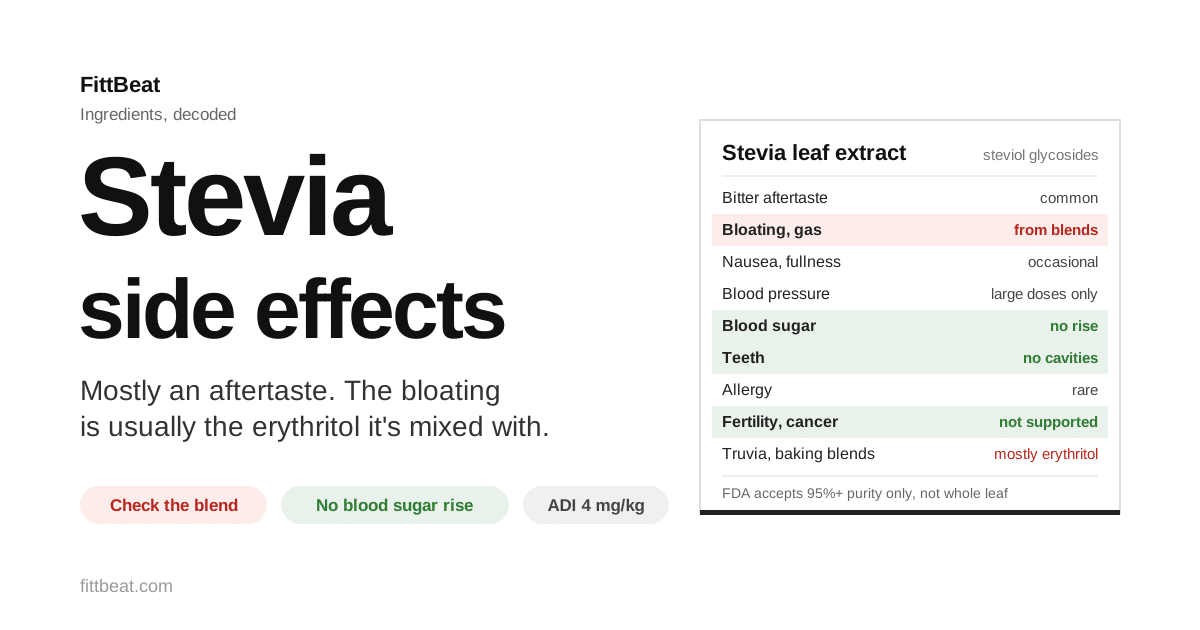
For most people, an aftertaste and not much else. High-purity stevia extract is approved as safe by the FDA and EFSA, with an acceptable daily intake of 4 mg per kilogram of body weight, counted as steviol. The documented stevia side effects are a bitter or licorice-like aftertaste and, in some people, mild nausea or fullness. Gas, bloating, and loose stools are common with stevia blends, where erythritol or another sugar alcohol does the bulking and causes the symptoms. Stevia doesn’t raise blood sugar or harm teeth. At large doses it can lower blood pressure slightly, which matters only if you take medication for blood pressure or diabetes. Allergic reactions are rare. Claims about infertility and cancer trace to old studies of crude extracts that haven’t held up for the purified form.
Jump to: What stevia is · Common side effects · Rare and theoretical · The research · Where it shows up · Stevia vs. other sweeteners · Verdict · FAQ
What stevia is
Stevia is a sweetener made from the leaves of Stevia rebaudiana, a plant native to South America. The sweet compounds are called steviol glycosides, and the main ones are rebaudioside A (Reb A), rebaudioside M (Reb M), and stevioside. They’re 200 to 400 times sweeter than sugar and have no calories.
The distinction that matters for safety is purity. The FDA accepts steviol glycosides purified to at least 95% as generally recognized as safe. Whole stevia leaves and crude extracts are not approved as sweeteners in the U.S., because they haven’t been through the same review. On a label, the approved form appears as stevia leaf extract, steviol glycosides, Reb A, or Reb M.
Because it’s so sweet, a serving contains only a few milligrams. That’s why packets and baking blends add a bulking ingredient, and the bulking ingredient is where most of the trouble starts.
Common stevia side effects
Bitter or licorice aftertaste Very common
Steviol glycosides activate bitter taste receptors as well as sweet ones, and how strongly you taste it is partly genetic. Reb M and newer blends are less bitter than the Reb A that early products used. This is a taste issue with no health consequence.
Bloating, gas, and loose stools Usually the blend
These are the stevia side effects people report most, and pure stevia is rarely the cause. Truvia’s first ingredient is erythritol. Many baking blends use erythritol or other sugar alcohols, and some packets use dextrose or maltodextrin. Sugar alcohols draw water into the gut and ferment, which produces exactly these symptoms. If a stevia product upsets your stomach, read the ingredient list for what else is in it. Our erythritol breakdown covers the amounts that cause it.
Nausea or fullness Occasional
A minority of people in trials report mild nausea or a feeling of fullness with stevia itself, usually at higher doses. It tends to pass.
Rare and theoretical side effects of stevia
Lower blood pressure At large doses
In trials that gave people with high blood pressure 750 to 1,500 mg of stevioside a day, far more than a sweetener supplies, blood pressure dropped modestly. At the amounts in a can of soda or a packet, studies don’t show a meaningful effect. If you take blood pressure medication and use a lot of stevia, mention it to your doctor.
Lower blood sugar Mostly a benefit
Stevia doesn’t raise glucose or insulin, which is why people with diabetes use it. The caution is the reverse: combined with diabetes medication, replacing a lot of sugar with any zero-calorie sweetener can contribute to low readings.
Allergic reaction Rare
Stevia belongs to the same plant family as ragweed, daisies, and chrysanthemums, so a cross-reaction is possible in theory. Reported cases are few, and purification removes most of the plant proteins that would cause one.
Medication interactions Check if you take these
Beyond blood pressure and diabetes drugs, stevia may act as a mild diuretic, which is why people on lithium are sometimes told to keep their intake steady. The evidence here is limited.
Fertility and hormones Not supported
This claim comes from a 1968 study in which rats given a crude stevia brew had fewer offspring. Later studies with purified steviol glycosides didn’t reproduce it, and regulators reviewed reproductive data before approval. A 2016 lab study found steviol affected hormone production in isolated cells, which hasn’t been shown in people.
Cancer Not supported
The FDA kept stevia out of food in the 1990s partly over early lab tests suggesting steviol could damage DNA. Later, more complete testing found no cancer risk, which is why it was accepted in 2008 and approved in the EU in 2011.
What the research says about stevia side effects
Regulatory reviews Safe within the ADI
EFSA and the international food-additive committee both set the acceptable daily intake at 4 mg per kilogram of body weight per day, expressed as steviol. For a 150-pound adult that’s about 270 mg of steviol, or roughly 800 mg of Reb A. A typical packet has around 10 to 40 mg of extract, so reaching the limit takes a lot of packets every day.
Gut bacteria and glucose Smaller signal than sucralose
The 2022 trial in Cell that tested four sweeteners in healthy adults found that all of them shifted gut bacteria to some degree. Sucralose and saccharin measurably worsened glucose tolerance. Stevia’s effect on glucose was not statistically significant. That’s one two-week study, and it’s the best human evidence so far.
Weight No proven benefit
In 2023 the WHO advised against using non-sugar sweeteners, stevia included, as a weight-control tool, because long-term studies didn’t show they help. That’s a statement about usefulness, not a safety finding.
Teeth No harm
Stevia isn’t fermented by mouth bacteria and doesn’t cause cavities. The acids in a stevia-sweetened soda still affect enamel, as our citric acid explainer covers.
Read next: Erythritol — the sugar alcohol in most stevia blends, the 2023 heart study, and how much is too much.
Where stevia shows up
| Product | Stevia | What else sweetens it |
|---|---|---|
| Coke Zero Sugar | A trace, last on the label | Aspartame, Ace-K |
| Poppi | Yes | Cane sugar (5 g), fruit juice |
| Olipop | Yes | Cassava syrup, fruit juice |
| Zevia sodas and Zevia Energy | The only sweetener | Nothing |
| Truvia packets | Yes | Erythritol (first ingredient) |
| Stevia baking blends | Yes | Usually erythritol |
Three things to notice. Stevia is rarely alone, so the label tells you what you’re actually reacting to. In sodas it’s often a supporting sweetener next to sugar or artificial sweeteners. And the stevia-only products are the ones to try first if you want to know how stevia itself sits with you.
Stevia vs. other sweeteners
| Stevia | Sucralose | Aspartame | Erythritol | |
|---|---|---|---|---|
| Source | Plant extract | Synthetic | Synthetic | Fermentation |
| Raises blood sugar | No | Not directly | No | No |
| Glucose tolerance in the 2022 trial | No significant change | Worsened | No significant change | Not tested |
| Main complaint | Aftertaste | Gut research | WHO “possibly carcinogenic” label | Bloating; heart study |
| Daily limit | 4 mg/kg as steviol | 5 mg/kg (FDA) | 50 mg/kg (FDA) | 0.5 g/kg (EFSA) |
On current evidence stevia has the shortest list of open questions of the four. It also has a shorter research history than aspartame, so “fewest concerns found” partly reflects fewer decades of looking. See our breakdowns of sucralose, aspartame, and acesulfame potassium for the others.
Stevia side effects: the verdict
FittBeat verdict
The mildest side-effect profile of the common sweeteners, with one catch on the label. Purified stevia is reviewed and approved, it doesn’t raise blood sugar, and the real stevia side effects for most people are taste and occasional nausea. If a stevia product gives you gas or bloating, the cause is almost always the erythritol or other sugar alcohol in the blend. People on blood pressure, diabetes, or lithium medication should mention heavy use to a doctor. Everyone else can treat stevia as a reasonable swap for sugar or sucralose, without expecting it to help with weight.
The concerns, ranked by evidence:
- Digestive symptoms from blends. Common and well documented. The sugar alcohol causes them.
- Aftertaste. Common and harmless.
- Additive effects with medication. Plausible at high intake for blood pressure and diabetes drugs.
- Gut bacteria changes. Seen in one trial, without the glucose effect found for sucralose.
- Allergy. Rare.
- Fertility and cancer. Not supported for purified stevia.
Stevia side effects in kids, pregnancy, and diabetes
Kids: the daily limit scales with body weight, so a small child reaches it sooner. Occasional stevia-sweetened foods are within it. Pediatric groups generally advise against making any non-sugar sweetener a daily habit for young children, because long-term data in kids is thin.
Pregnancy: purified stevia within the daily limit is considered safe. Whole-leaf stevia and crude extracts aren’t approved, so avoid those forms.
Diabetes: stevia doesn’t raise blood glucose, which makes it a common choice. Watch the other ingredients. Packets bulked with dextrose or maltodextrin add a small amount of carbohydrate.
How to avoid stevia side effects
Start with a stevia-only product, such as liquid drops or a Zevia, so you can tell stevia apart from its blend partners. If the aftertaste bothers you, look for Reb M on the label. If your stomach objects, switch away from blends that list erythritol first. And if you’d like no sweetener at all, unsweetened sparkling water, tea, and coffee skip the question.
Frequently asked questions
What are the most common stevia side effects?
A bitter or licorice-like aftertaste, and in some people mild nausea or fullness. Bloating and gas are common with stevia blends and usually come from the added erythritol or other sugar alcohol.
Is stevia bad for you?
Not at normal intake. High-purity stevia extract is approved by the FDA and EFSA, with an acceptable daily intake of 4 mg per kilogram of body weight as steviol.
Does stevia cause bloating and gas?
Pure stevia rarely does. Products like Truvia and many baking blends are mostly erythritol by weight, and sugar alcohols are the usual cause of those symptoms.
Does stevia raise blood sugar?
No. Steviol glycosides don’t raise glucose or insulin. Some packets contain dextrose or maltodextrin as a filler, which adds a small amount of carbohydrate.
Does stevia lower blood pressure?
At large supplemental doses, modestly. At the amounts used to sweeten food and drinks, studies don’t show a meaningful change. People on blood pressure medication should mention heavy use to a doctor.
Is stevia safe during pregnancy?
Purified stevia extract within the daily limit is considered safe. Whole-leaf stevia and crude extracts aren’t approved as sweeteners and should be avoided.
Is stevia better than sucralose?
On current evidence it has fewer open questions. In a 2022 trial sucralose worsened glucose tolerance in healthy adults and stevia did not, though stevia has a shorter research record overall.
Can you be allergic to stevia?
It’s possible and rare. Stevia is in the ragweed family, so people with strong ragweed allergies have a theoretical risk, though purified extracts contain little plant protein.
Sources
- Labels photographed October 2026: Coca-Cola Zero Sugar (16 oz), Poppi (12 oz). Olipop, Zevia, and Truvia ingredient lists from the manufacturers’ current published labels, checked November 2026.
- EFSA Panel on Food Additives and Nutrient Sources. Scientific opinion on the safety of steviol glycosides for the proposed uses as a food additive. EFSA Journal, 2010. doi:10.2903/j.efsa.2010.1537
- U.S. FDA. Aspartame and other sweeteners in food. fda.gov
- Suez J, et al. Personalized microbiome-driven effects of non-nutritive sweeteners on human glucose tolerance. Cell, 2022. doi:10.1016/j.cell.2022.07.016
- Hsieh MH, et al. Efficacy and tolerability of oral stevioside in patients with mild essential hypertension: a two-year, randomized, placebo-controlled study. Clinical Therapeutics, 2003. doi:10.1016/S0149-2918(03)80334-X
- World Health Organization. Use of non-sugar sweeteners: WHO guideline. 2023. who.int
- Ashwell M. Stevia, nature’s zero-calorie sustainable sweetener: a new player in the fight against obesity. Nutrition Today, 2015. doi:10.1097/NT.0000000000000094
Per-packet stevia amounts vary by brand and are approximate. Medication interactions described here are based on limited evidence; follow your prescriber’s advice.
This article is for informational purposes and is not medical advice. Talk to a doctor or registered dietitian about your individual nutrition needs, especially if you take medication for blood pressure or diabetes.
