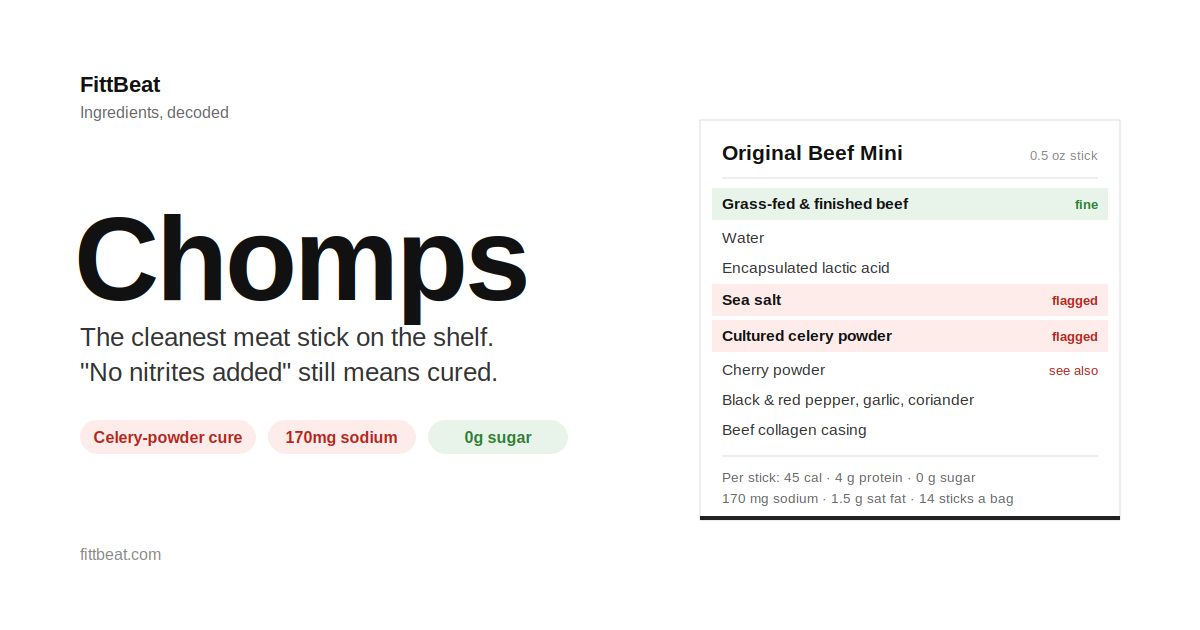

Last reviewed: October 2026. Reflects the U.S. label on Chomps Chomplings Original Beef Mini Sticks (Mild), the 14-count 7.0 oz bag photographed for this post. The full-size 1.15 oz Original stick uses essentially the same recipe at more than twice the size; its figures are compared below.
Chomps is what a meat stick looks like when someone sets out to fix the Slim Jim. Grass-fed beef is the first ingredient and the only meat. There’s no sugar, no soy filler, no corn syrup, no gluten, and none of the top nine allergens. On ingredients alone it’s the cleanest stick in the snack aisle, and it deserves the credit. But the bag also says “no nitrates or nitrites added,” with an asterisk, and the asterisk is the whole story: Chomps is cured with celery powder, which delivers the same nitrite that sodium nitrite does. It’s still a cured, salted, processed meat. Here’s every Chomps ingredients, what each one does, and what the nitrite fine print means.
Quick answer: what’s in Chomps?
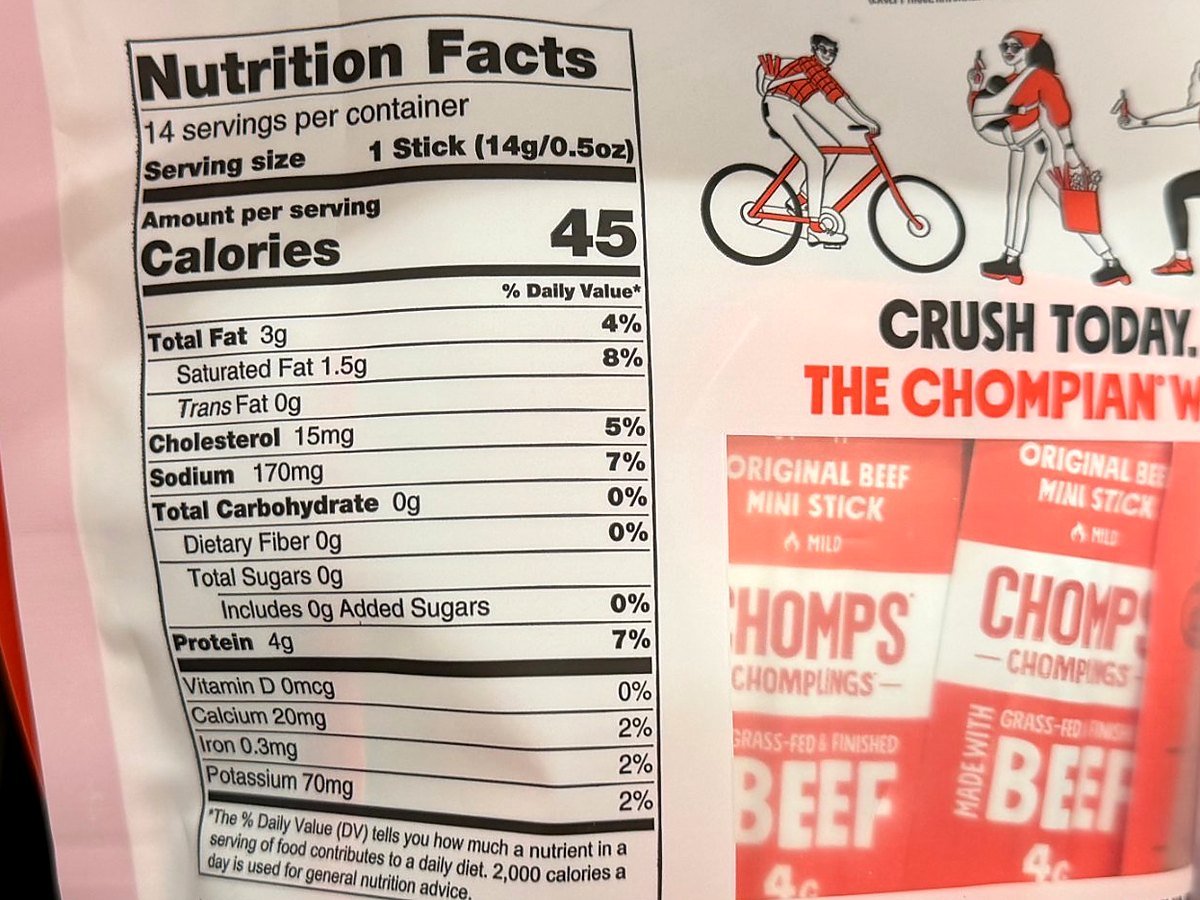
Chomps Original Beef Mini Sticks are grass-fed and grass-finished beef and water, with less than 2% of encapsulated lactic acid, sea salt, cultured celery powder (celery powder, sea salt), cherry powder, black pepper, red pepper, garlic powder, and coriander, stuffed in a beef collagen casing. A 14 g mini stick is 45 calories, 3 g of fat (1.5 g saturated), 170 mg of sodium, 0 g of carbohydrate and sugar, and 4 g of protein. A whole 14-stick bag is 630 calories and 2,380 mg of sodium — more than a day’s limit. The beef, the empty sugar line, and the short list are real advantages over Slim Jim. The celery powder and cherry powder are a natural curing system that produces nitrite in the meat, so “no nitrites added” is a legal phrase, not a chemical one. A better stick, still a processed meat, and best eaten one or two at a time.
Jump to: Full label · Each ingredient · The “no nitrites added” claim · Nutrition facts · Chomps vs. Slim Jim · Verdict · FAQ
The full Chomps ingredients list
Grass-Fed & Finished Beef, Water, Less than 2% of: Encapsulated Lactic Acid, Sea Salt, Cultured Celery Powder (Celery Powder, Sea Salt), Cherry Powder, Black Pepper, Red Pepper, Garlic Powder, Coriander, Stuffed in a Beef Collagen Casing. Made without: milk, egg, fish, crustacean shellfish, tree nuts, wheat, peanuts, soybean, and sesame. “No nitrates or nitrites added except those naturally occurring in cultured celery powder and sea salt.” Certified gluten-free (GFCO), Non-GMO Project Verified, Certified Paleo. Distributed by We Are The Chompions LLC, Naples, FL.
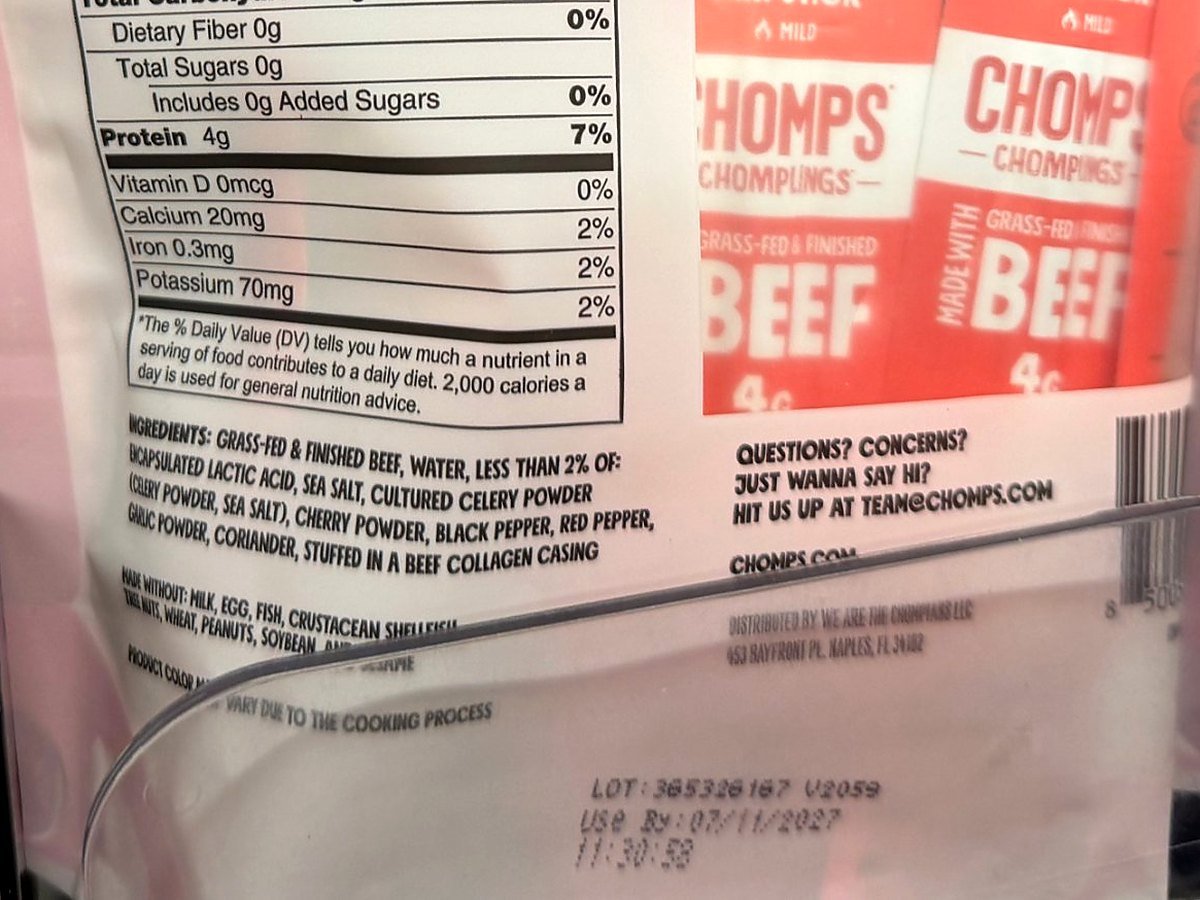
Three things to notice. Everything after beef and water is under 2% of the stick, so this really is beef, water, and seasoning — compare a Slim Jim, where water, soy flour, and corn syrup come right after the meat. The two ingredients doing the most chemical work are near the middle and sound like spices: cultured celery powder and cherry powder are, together, a cure. And the bag’s use-by date is eight months after it was made, with no refrigeration — that shelf life comes from salt, acid, drying, and nitrite, not from anything magic about grass-fed beef.
Chomps ingredients explained
Grass-fed and grass-finished beef Real meat
The first ingredient and the only meat — no pork, no mechanically separated chicken, no soy protein stretching it out. “Grass-finished” matters: plenty of “grass-fed” beef is grain-finished in the last months, and Chomps’ claim covers the whole life of the animal. Grass-finished beef has modestly more omega-3 fat and conjugated linoleic acid than grain-fed beef, and a slightly better fat profile, but the absolute amounts in a 14 g stick are tiny; the real difference is in how the cattle are raised, not in what a stick does for your heart. “Raised without antibiotics or added hormones” is a meaningful claim for beef (hormone implants are legal in conventional U.S. cattle, unlike pork and poultry). The bag’s Non-GMO Project mark refers to the cattle’s feed.
Water Fine
Added to the ground meat so the seasoning distributes and the mixture stuffs evenly; most of it cooks and dries off. It’s second on the list because everything else is under 2%, not because there’s a lot of it in the finished stick.
Encapsulated lactic acid Fine
The tang. Traditional dry sausages get their sourness, and part of their shelf stability, from fermentation: bacteria turn sugar into lactic acid over days. Slim Jim does it that way, with a starter culture and dextrose. Chomps skips the sugar and adds the acid directly, coated so it doesn’t react with the raw meat and releases during cooking. The result is the same lower pH that keeps bacteria from growing. It’s the reason Chomps can have zero sugar and still taste like a cured stick.
Sea salt Flagged: 170 mg sodium
Salt is the main preservative in any shelf-stable meat, and “sea” doesn’t change the sodium. Each half-ounce mini stick has 170 mg, 7% of the daily limit, which works out to about 340 mg per ounce — essentially the same concentration as the full-size Chomps stick, and lower than a Slim Jim’s 460 or so. It’s a reasonable amount for one stick. The issue is the format: a 14-stick bag of minis is 2,380 mg of sodium, slightly more than the 2,300 mg daily limit, and small sticks are easy to eat in multiples. Salt also appears inside the celery powder (below), and is part of why the bag’s nitrite disclaimer names “sea salt” too.
Cultured celery powder Flagged: it’s the cure
This is the most important ingredient on the label after the beef, and the least explained. Celery is naturally high in nitrate. “Cultured” means the celery powder has been fermented with bacteria that convert that nitrate into nitrite — the same molecule as the sodium nitrite in Slim Jim, Lunchables, and bacon. In the meat, it does exactly what sodium nitrite does: blocks Clostridium botulinum, fixes the red-pink color, and gives cured meat its flavor. The body can’t tell where the nitrite came from, and testing by Consumer Reports found nitrite and nitrate levels in celery-cured meats comparable to conventionally cured ones. Celery is also a common allergen in Europe (not in the U.S. top nine), which is worth knowing for anyone with that allergy. The full story of why the bag can still say “no nitrites added” is in the next section.
Cherry powder Cure accelerator
Not a flavor. Cherry powder is a natural source of vitamin C (ascorbate), and the USDA’s own guidance pairs celery powder with “a natural source of ascorbate such as cherry powder” for curing. Ascorbate speeds the conversion of nitrite into the compounds that cure the meat — the job sodium erythorbate or ascorbate does in conventional sausages — and it also helps limit the formation of nitrosamines. It’s harmless and arguably a plus, but it’s part of the curing system, not a fruit ingredient.
Black pepper, red pepper, garlic powder, coriander Fine
The “slightly smoky, slightly spicy” seasoning. Real spices, named individually instead of hidden behind “natural flavors” or “spices,” which is a small transparency credit. There’s no MSG, no hydrolyzed protein, no smoke flavor listed. “Mild” means the red pepper is light.
Beef collagen casing Fine
The edible skin, made from collagen extracted from cattle hides and formed into a tube. It’s beef protein, so the stick stays single-species and pork-free, and it’s why Chomps can be sold as beef-only. Halal and kosher status depend on certification, which this bag doesn’t carry.
What isn’t on the label Credit where due
No sugar, dextrose, or corn syrup. No soy flour or soy protein. No wheat or barley (Slim Jim contains barley malt and isn’t gluten-free). No mechanically separated meat. No MSG, no artificial colors, no preservatives beyond salt, acid, and the celery cure. That’s a genuinely short, honest list for a shelf-stable meat.
What “no nitrates or nitrites added” actually means
The front of a Chomps bag says no nitrates or nitrites added, then adds “except those naturally occurring in cultured celery powder and sea salt.” Both halves are true, and together they’re misleading — not because of anything Chomps did, but because of how the USDA’s labeling rule works.
Under current USDA rules, a meat product cured with synthetic sodium nitrite is labeled “cured.” A product cured with a natural nitrite source like celery powder isn’t considered cured under the regulation — so it’s actually required to carry “no nitrates or nitrites added,” with the qualifier naming the natural source. The result is that two sticks with comparable nitrite chemistry end up with opposite-sounding labels. In 2019, the Center for Science in the Public Interest and Consumer Reports petitioned the USDA to prohibit “no nitrate or nitrite added” and “uncured” on any product made with any nitrite source, citing tests that found similar levels in both kinds of meat. The USDA’s Food Safety and Inspection Service partly granted the petition in December 2020 and said it would propose new definitions of “cured” and “uncured.” As of the agency’s last public update in 2024, that rule was still being drafted, and the current wording remains what the regulation requires.
Does the nitrite matter in a Chomps stick? The amount is regulated and small, and it’s there for a real safety reason — it prevents botulism in a product that sits unrefrigerated for months. The longer-term concern is the one that applies to all processed meat: nitrite can form N-nitroso compounds in the gut, and in 2015 the World Health Organization’s cancer agency classified processed meat as a Group 1 carcinogen, based on colorectal cancer risk that rises about 18% for every 50 g eaten daily. Fifty grams is about three and a half Chomps minis, or a little over one and a half full-size sticks, every day. The evidence is about habitual intake, not an occasional stick, and the cherry powder’s ascorbate likely helps. But celery-cured meat is in the same category as conventionally cured meat; “natural” isn’t a way out of it.
Read next: Slim Jim ingredients — the stick Chomps was built to replace: three meats, soy flour, corn syrup, and sodium nitrite by name.
Chomps nutrition facts
| Per stick | Chomps Mini (0.5 oz) | Chomps Original (1.15 oz) | Slim Jim Giant (0.97 oz) |
|---|---|---|---|
| Calories | 45 | 100 | 130 |
| Protein | 4 g | 10 g | 6 g |
| Total fat | 3 g | 7 g | 10 g |
| Saturated fat | 1.5 g | 3 g | 3.5 g |
| Sodium | 170 mg | 380 mg | 450 mg |
| Sugar | 0 g | 0 g | 1 g |
| Sodium per ounce | ~340 mg | ~335 mg | ~465 mg |
| Protein per ounce | ~8 g | ~9 g | ~6 g |
| Cure | Celery + cherry powder | Celery powder | Sodium nitrite |
| Gluten-free | Certified | Certified | No (barley) |
The mini and the full-size stick are the same food at different sizes — sodium and protein per ounce are nearly identical. Against Slim Jim, Chomps has about a quarter less sodium and half again as much protein per ounce, with no sugar or soy. One honest note: by calories, a Chomps stick is still more fat than protein (27 of the mini’s 45 calories come from fat), so it’s a meat snack, not a lean protein source like chicken breast or Greek yogurt.
Chomps vs. Slim Jim: is Chomps actually healthier?
On ingredients, clearly yes. Chomps is one meat and spices; Slim Jim is three meats including mechanically separated chicken, plus water, textured soy flour, corn syrup, dextrose, hydrolyzed soy protein, maltodextrin, and barley malt. Chomps has more protein per ounce, less sodium per ounce, no sugar, and no gluten. On the processed-meat question, no: both are salted, cured, shelf-stable sausages, one with sodium nitrite by name and one with nitrite from celery. The WHO classification applies to both. If you eat a meat stick a few times a week, Chomps is the better one to eat. If you eat several a day, the brand is the smaller question. Our Slim Jim breakdown goes line by line on the other side.
Is Chomps healthy?
FittBeat verdict
The best-built meat stick in the aisle, wearing a label that oversells it. Chomps is grass-fed beef, salt, and spices, with no sugar, soy, filler, or gluten — a real upgrade over the gas-station stick, and a good portable protein for adults who eat meat. But “no nitrates or nitrites added” is a USDA-required phrase for a celery-powder cure that does the same thing, so Chomps is still a cured processed meat, and the sodium adds up fast in the mini-stick bag. One or two sticks as a snack: good choice. A bag a day, or a daily lunchbox habit: the same processed-meat question as any other stick.
The concerns, ranked by evidence:
- Processed meat, daily. The WHO Group 1 classification is based on regular intake, and it covers celery-cured meat as much as nitrite-cured. This is the long-term risk that matters, and it scales with how many you eat.
- Sodium in multiples. 170 mg per mini is fine; a bag is more than a day’s limit, and for young kids a few sticks is a large share of theirs.
- The label. “No nitrites added” leads people to think the stick is uncured. It isn’t. Not a health risk on its own, but it drives overconsumption by people who think they’ve avoided the issue.
- Saturated fat. 1.5 g per mini, 3 g per full stick. Modest, and typical of beef.
- Everything else. Lactic acid, cherry powder, spices, and a collagen casing have no credible evidence of harm.
Chomps for kids, keto, and allergies
Kids: the mini “Chomplings” size is clearly aimed at lunchboxes, and as kid snacks go it beats most — real protein, no sugar, no dyes. Two cautions. Sodium: the National Academies’ limit for children 4–8 is 1,500 mg a day, so one mini is about 11% of it and three is a third. And texture: firm meat sticks are a choking hazard for toddlers and preschoolers in the same way hot dogs are; cut them into thin pieces for young children. The processed-meat point applies to kids too — a daily stick is a daily processed meat.
Keto and low-carb: yes. Zero carbohydrate, zero sugar, and mostly fat and protein by calories. It’s one of the few packaged snacks that fits without caveats.
Allergies and gluten: free of all nine major U.S. allergens and certified gluten-free by GFCO, which makes it unusually safe for school and allergy households. It does contain celery, a regulated allergen in the EU and UK. It’s beef-only, with a beef casing, so it’s pork-free, but the bag carries no halal or kosher certification.
Cleaner alternatives
If you want the protein without the cure, the honest answer is unprocessed: a hard-boiled egg (6 g protein, 60 mg sodium), a cheese stick, a pouch of tuna or chicken, or leftover roast beef. If you want a shelf-stable meat snack, Chomps is already near the top of the category; jerky is the leaner option, though read the label: Jack Link’s Original, for example, has 10 g of protein and only 1.5 g of fat an ounce, but 520 mg of sodium, 6 g of added sugar, and the same celery-extract cure. And if you’re buying the mini bag, the easiest improvement is portion: two minis is a snack, the bag is a day’s sodium.

Frequently asked questions
Does Chomps have nitrates or nitrites?
Yes, from cultured celery powder. Celery is naturally high in nitrate, and fermenting it converts the nitrate to nitrite, the same compound as sodium nitrite. The bag says “no nitrates or nitrites added” because USDA rules require that wording for products cured with natural sources, followed by “except those naturally occurring in cultured celery powder and sea salt.”
Is Chomps healthy?
It’s the cleanest meat stick widely sold: grass-fed beef, no sugar, no soy, no gluten, and a short list of real spices. It’s still a cured processed meat with 170 mg of sodium per mini stick and 380 mg per full-size stick, so it’s a good occasional snack rather than a daily staple.
How much protein is in a Chomps stick?
4 g in a 0.5 oz mini stick and 10 g in the full-size 1.15 oz Original stick — about 8 to 9 g per ounce either way.
How much sodium is in Chomps?
170 mg per 0.5 oz mini stick (7% of the daily value) and 380 mg per 1.15 oz stick. A 14-stick bag of minis totals 2,380 mg, slightly more than the 2,300 mg daily limit.
Is Chomps gluten-free?
Yes. It’s certified gluten-free by GFCO and contains none of the nine major U.S. allergens: milk, egg, fish, shellfish, tree nuts, wheat, peanuts, soy, or sesame.
Is Chomps keto?
Yes. A mini stick has 0 g of carbohydrate and 0 g of sugar, with 3 g of fat and 4 g of protein.
Is Chomps better than Slim Jim?
On ingredients, yes: one meat instead of three, no soy filler or corn syrup, no sugar, gluten-free, more protein and less sodium per ounce. Both are cured processed meats, so the long-term processed-meat risk applies to both.
Are Chomps mini sticks good for kids?
Better than most packaged kid snacks — real protein, no sugar, no dyes, and allergen-free. Keep it to one or two because of sodium (one mini is about 11% of a 4–8-year-old’s daily limit), and cut sticks into thin pieces for toddlers and preschoolers because firm meat sticks are a choking hazard.
Sources
- We Are The Chompions LLC. Nutrition facts and ingredients, Chomps Chomplings Original Beef Mini Sticks (Mild), 14-count 7.0 oz bag, photographed October 2026.
- Chomps Original Beef Stick (Mild), 1.15 oz, nutrition facts as listed by retailers, October 2026. shoprite.com
- USDA Food Safety and Inspection Service. Response to Petition 19-03 (CSPI and Consumer Reports) on “No Nitrate or Nitrite Added” and “Uncured” labeling. December 2020. fsis.usda.gov
- Center for Science in the Public Interest and Consumer Reports. Petition to USDA to end misleading “uncured” labels on processed meats. August 2019. cspi.org
- USDA FSIS. Food Processing Labeling and Inspection Course 4b: Sausage operations (celery powder with a natural ascorbate source such as cherry powder; 9 CFR 317.17). fsis.usda.gov
- FoodNavigator. USDA pushes forward label updates for cultured meat, uncured claims, Nutrition Facts. June 2024. foodnavigator.com
- Bouvard V, et al., on behalf of the IARC Monograph Working Group. Carcinogenicity of consumption of red and processed meat. The Lancet Oncology, 2015. doi:10.1016/S1470-2045(15)00444-1
- National Academies of Sciences, Engineering, and Medicine. Dietary Reference Intakes for Sodium and Potassium. 2019. doi:10.17226/25353
- Daley CA, et al. A review of fatty acid profiles and antioxidant content in grass-fed and grain-fed beef. Nutrition Journal, 2010. doi:10.1186/1475-2891-9-10
Slim Jim figures are from the Giant 0.97 oz label used in our Slim Jim breakdown. Retailer listings for the full-size Chomps stick vary (some still show an older 90-calorie, 290 mg version); we use the 100-calorie, 380 mg figures most retailers list.
This article is for informational purposes and is not medical advice. Talk to a doctor or registered dietitian about your individual nutrition needs.
