
Last reviewed: November 2026. Safety limits are from the EFSA and FDA documents linked in the sources. Products named here are from manufacturers’ and retailers’ published ingredient lists, checked November 2026; we haven’t photographed them.
Erythritol is the sweetener most people have eaten without choosing it. It’s the bulk of most stevia and monk fruit blends, the reason keto ice cream and “zero sugar” candy can be sweet with no sugar on the panel, and an ingredient in several zero-sugar energy drinks. For years erythritol had the best reputation of any sugar substitute. Then a 2023 study linked high blood levels of it to heart attack and stroke, and the questions started. Here’s what erythritol is, what that research showed and what it didn’t, how much causes stomach trouble, and how to find it on a label.
Quick answer: is erythritol bad for you?
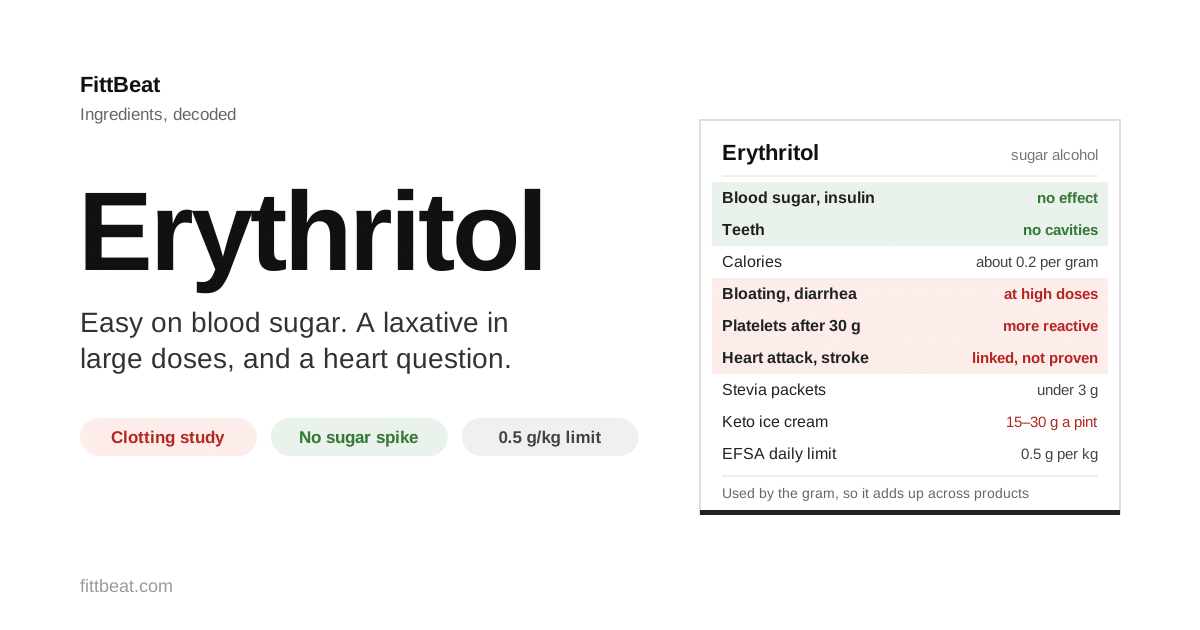
Not clearly, and the heart question is open. Erythritol is a sugar alcohol made by fermenting glucose. It has almost no calories, doesn’t raise blood sugar or insulin, and doesn’t cause cavities. Its documented side effect is digestive: large amounts cause nausea, bloating, and diarrhea, and in 2023 European regulators set a daily limit of 0.5 g per kilogram of body weight on that basis. The newer concern comes from research in 2023 and 2024 that tied high blood erythritol to cardiovascular events and showed that a 30 g dose made blood platelets more reactive in healthy volunteers. That’s a real signal that hasn’t been confirmed by a long-term trial. If you have heart disease or clotting risk, it’s reasonable to limit large servings. For everyone else, small amounts are low-risk and big keto-dessert portions are the thing to watch.
Jump to: What it is · Why it’s used · Where it’s found · The heart study · Other research · How much is too much · vs. other sweeteners · Verdict · FAQ
What erythritol is
Erythritol is a sugar alcohol, also called a polyol, in the same family as xylitol and sorbitol. Despite the name it contains no alcohol of the drinking kind. It occurs naturally in small amounts in pears, grapes, melons, and fermented foods, and your body makes a little of its own. The erythritol in food is manufactured by fermenting glucose, usually from corn, with a yeast-like fungus, then filtering and crystallizing the result.
It’s about 70% as sweet as sugar and has roughly 0.2 calories per gram, which U.S. labels round to zero. What sets erythritol apart from other sugar alcohols is how the body handles it. About 90% is absorbed in the small intestine and leaves unchanged in the urine. Because so little reaches the large intestine, it causes less gas and diarrhea than sorbitol or maltitol at the same dose.
Why erythritol is in so many products
Bulk. Stevia and monk fruit are hundreds of times sweeter than sugar, so a serving is a few milligrams. Erythritol supplies the volume that lets a packet pour and a baking blend measure cup for cup.
Taste. It has a clean sweetness and a slight cooling feel, and it covers the bitter edge of stevia.
The label. Erythritol adds sweetness with no sugar grams and no net carbs, which is what “keto” and “zero sugar” products are selling.
Where erythritol is found
| Product type | Examples | Typical erythritol |
|---|---|---|
| Stevia and monk fruit packets | Truvia, Lakanto | Most of the packet, under 3 g |
| Baking sweeteners | Swerve, granulated blends | Nearly all of it; cups in a recipe |
| Keto and light ice cream | Halo Top and similar | Often 15 to 30 g a pint |
| Zero-sugar candy and chocolate | Keto bars, sugar-free chocolate | 5 to 15 g a serving |
| Zero-sugar energy drinks | Monster Zero Ultra, Rockstar Sugar Free | A few grams a can |
| Flavored waters | Bai and similar | A few grams a bottle |
Three things to notice. Erythritol is used by the gram, not the milligram, so it adds up in a way stevia and sucralose never do. The big doses are in frozen desserts and home baking, not drinks. And it often isn’t the sweetener named on the front, which will say stevia or monk fruit.
To find it, read the ingredient list for “erythritol” and the Nutrition Facts panel for a “Sugar Alcohol” line under carbohydrates. Makers have to show that line only when the package makes a sugar claim, so the ingredient list is the more reliable check.
The erythritol heart study, explained
In 2023 a team at the Cleveland Clinic published a study in Nature Medicine with three parts.
What they found in patients. In blood samples from about 4,000 people in the U.S. and Europe, most of them being evaluated for heart disease, those with the highest erythritol levels were roughly twice as likely to have a heart attack, stroke, or death over the following three years.
What they found in the lab. Adding erythritol to blood made platelets, the cells that form clots, more reactive. In mice it sped up clot formation.
What they found in volunteers. Eight healthy people drank 30 g of erythritol. Their blood levels rose about a thousandfold and stayed above the clot-promoting range for more than two days.
A follow-up in 2024 gave 20 healthy volunteers either 30 g of erythritol or 30 g of glucose. Platelet reactivity went up after the erythritol and not after the glucose.
What the erythritol research doesn’t show Important limits
The patient data measured erythritol in blood, not in the diet. The body produces erythritol itself, and it makes more when blood sugar is high and metabolism is under strain. So high levels may mark people who were already at risk, and the people studied were mostly older and already ill. The volunteer studies were small and looked at platelet behavior for a few days, not at actual heart attacks. No trial has yet followed people who eat erythritol against people who don’t. European regulators reviewed the 2023 paper in their re-evaluation and called for more research on the association.
What it does show A plausible mechanism
A single keto-dessert-sized dose raises blood erythritol far above normal for days, and at those levels platelets respond more strongly. That’s a credible reason for caution in people whose clotting risk is already high. It’s also the one finding here that applies to healthy people.
Read next: Stevia side effects — what’s real, what’s rare, and why the bloating is usually the erythritol.
What else the research says about erythritol
Blood sugar and insulin No effect
Erythritol doesn’t raise glucose or insulin in people with or without diabetes. This is its main, well-supported advantage over sugar.
Digestive effects Dose-dependent
Nausea, stomach rumbling, bloating, and diarrhea at high intake. It’s better tolerated than other sugar alcohols, and it’s still the reason regulators set a limit. Children react at lower amounts for their size.
Teeth Protective, if anything
Mouth bacteria can’t ferment erythritol, so it doesn’t cause cavities. Some trials suggest it reduces plaque.
Weight Unproven
Replacing sugar with erythritol removes calories. Whether that leads to lasting weight loss hasn’t been shown, and the WHO’s 2023 advice against relying on non-sugar sweeteners for weight control didn’t cover sugar alcohols one way or the other.
Regulatory status Permitted
The FDA has accepted erythritol as generally recognized as safe since 2001 and hasn’t changed that position. In December 2023 the European Food Safety Authority completed a full re-evaluation and, for the first time, set a numerical daily limit.
How much erythritol is too much?
EFSA’s acceptable daily intake is 0.5 g per kilogram of body weight, chosen to protect against the laxative effect.
| Body weight | EFSA daily limit | What that looks like |
|---|---|---|
| 44 lb child (20 kg) | 10 g | Less than half a pint of keto ice cream |
| 132 lb adult (60 kg) | 30 g | About one pint, or the dose used in the heart studies |
| 176 lb adult (80 kg) | 40 g | A pint plus a sweetened drink |
A packet in coffee or a few grams in an energy drink is far below these numbers. A pint of low-sugar ice cream, a batch of keto baking, or several products in one day can reach them. EFSA estimated that heavy consumers in Europe, especially children, already exceed the limit. Note that the 30 g used in the clotting studies sits right at an average adult’s daily limit, so it wasn’t an extreme dose.
Erythritol vs. other sweeteners
| Erythritol | Xylitol | Stevia | Sucralose | |
|---|---|---|---|---|
| Type | Sugar alcohol | Sugar alcohol | Plant extract | Synthetic |
| Calories per gram | ~0.2 | 2.4 | 0 | 0 |
| Used by the | Gram | Gram | Milligram | Milligram |
| Raises blood sugar | No | Slightly | No | Not directly |
| Laxative effect | At high doses | At moderate doses | No | No |
| Open question | Platelets and clotting | Similar 2024 clotting finding | Few | Gut bacteria, glucose tolerance |
Erythritol is the gentlest sugar alcohol on the stomach and the only sweetener here that bakes like sugar. Its drawback is quantity. Because it’s eaten by the gram, blood levels climb in a way they don’t with sucralose or stevia. Xylitol, studied by the same group in 2024, showed a similar clotting signal, and it’s also dangerous to dogs. Erythritol isn’t known to be toxic to dogs.
Is erythritol safe? The verdict
FittBeat verdict
Useful in small amounts, with an unanswered question at large ones. Erythritol does what it claims: sweetness with no blood sugar rise and no cavities. The stomach effects are real and depend on dose. The heart research is a credible warning sign that hasn’t been proven or ruled out, and it concerns the gram-scale servings in keto desserts far more than a packet in coffee. If you have heart disease, a history of clots, or diabetes with cardiovascular risk, it’s sensible to keep erythritol low until better studies arrive and to raise it with your doctor. If you don’t, the practical rule is to notice how many grams you’re eating in a day, because the front of the package won’t tell you.
The concerns, ranked by evidence:
- Digestive symptoms. Well documented above about 0.5 g per kg, and lower in children.
- Platelet reactivity after large doses. Shown in two small human studies. The clinical meaning is unknown.
- Association with cardiovascular events. Seen in high-risk patients, and possibly a marker of poor metabolic health.
- Total daily intake. Easy to exceed the limit without noticing, because erythritol is in several product types.
- Everything else. No evidence of harm to teeth, blood sugar, or DNA.
Erythritol for kids, keto, diabetes, and heart disease
Kids: the limit is low for small bodies, about 10 g for a 44 lb child. One serving of a sugar-free treat can be most of it, and stomach upset is the usual result.
Keto: erythritol has zero net carbs and doesn’t affect ketosis. Keto eaters are also the heaviest users, so the daily total is worth tracking.
Diabetes: it won’t raise blood glucose. People with diabetes also carry higher cardiovascular risk, which is the group the heart research is most relevant to. That’s a conversation for your care team.
Heart disease or clotting risk: this is where caution makes the most sense. Avoiding large single servings is a low-cost precaution.
Pregnancy: there’s no specific restriction and little direct research. Moderate amounts are generally considered acceptable.
Alternatives to erythritol
For sweetness without a sugar alcohol, use liquid stevia or monk fruit drops, which contain no bulking agent. For baking, allulose behaves like sugar and is the newer option, with its own shorter research record. For drinks, the cans in our sucralose-free energy drinks list note which use erythritol. And a small amount of real sugar is a fair choice too, since the dose is what matters with either one.
Frequently asked questions
What is erythritol?
Erythritol is a sugar alcohol made by fermenting glucose. It’s about 70% as sweet as sugar, has almost no calories, and is used to bulk up stevia and monk fruit sweeteners and to sweeten keto and zero-sugar foods.
Is erythritol bad for you?
In small amounts there’s no clear evidence of harm. Large amounts cause digestive upset, and research from 2023 and 2024 raised an unconfirmed concern about blood clotting after large doses.
Does erythritol cause heart attacks?
That hasn’t been shown. A 2023 study found people with high blood erythritol had more heart attacks and strokes, but the body makes erythritol itself and the study couldn’t prove diet was the cause. Small follow-up studies showed a 30 g dose increases platelet reactivity.
What are the side effects of erythritol?
Nausea, bloating, stomach rumbling, and diarrhea at high intake. European regulators set a daily limit of 0.5 g per kilogram of body weight to prevent these.
Does erythritol raise blood sugar?
No. Erythritol doesn’t raise blood glucose or insulin, and it has zero net carbs.
How much erythritol is safe per day?
EFSA’s limit is 0.5 g per kilogram of body weight, which is about 30 to 40 g for most adults and about 10 g for a small child. A pint of keto ice cream can contain that much.
Is erythritol or stevia better?
Stevia has fewer open safety questions and is used in milligrams. Erythritol tastes more like sugar and works in baking but is eaten by the gram. Many products contain both.
Is erythritol safe for dogs?
Erythritol isn’t known to be toxic to dogs, unlike xylitol, which is dangerous to them even in small amounts. Check labels carefully, since the two are sometimes used together.
Sources
- Product ingredient lists (Truvia, Lakanto, Swerve, Halo Top, Monster Zero Ultra, Rockstar Sugar Free, Bai) from manufacturers’ and retailers’ current published labels, checked November 2026. Not photographed.
- Witkowski M, et al. The artificial sweetener erythritol and cardiovascular event risk. Nature Medicine, 2023. doi:10.1038/s41591-023-02223-9
- Witkowski M, et al. Ingestion of the non-nutritive sweetener erythritol, but not glucose, enhances platelet reactivity and thrombosis potential in healthy volunteers. Arteriosclerosis, Thrombosis, and Vascular Biology, 2024. doi:10.1161/ATVBAHA.124.321019
- EFSA Panel on Food Additives and Flavourings. Re-evaluation of erythritol (E 968) as a food additive. EFSA Journal, 2023. doi:10.2903/j.efsa.2023.8430
- Hootman KC, et al. Erythritol is a pentose-phosphate pathway metabolite and associated with adiposity gain in young adults. Proceedings of the National Academy of Sciences, 2017. doi:10.1073/pnas.1620079114
- Mazi TA, Stanhope KL. Erythritol: an in-depth discussion of its potential to be a beneficial dietary component. Nutrients, 2023. doi:10.3390/nu15010204
- U.S. FDA. Aspartame and other sweeteners in food. fda.gov
Erythritol amounts per product are estimates from published labels and typical formulations; manufacturers don’t always print grams. Check the “Sugar Alcohol” line where one is shown.
This article is for informational purposes and is not medical advice. If you have heart disease, a clotting disorder, or diabetes, talk to your doctor about sweeteners.
